




Herb Scissors Manufacturer Guide for Buyers and Sourcing Teams
A herb scissors manufacturer is a niche supplier, but the product deserves careful evaluation when buyers are building a kitchen tool range, retail program, food-service offer, or private label line. Multi-blade herb scissors look simple in a catalog photo. In use, however, their value depends on blade alignment, handle comfort, assembly stability, and realistic positioning.
This guide explains how sourcing teams can assess the category without relying on appearance alone. It focuses on practical buyer checks, sample testing, supplier questions, and common risks. It does not assume unconfirmed material grades, certifications, dishwasher claims, minimum order quantities, or production capacity. Those details should be verified directly with the supplier before an order is placed.
What Herb Scissors Are Designed to Do
Herb scissors, sometimes called multi-blade herb scissors or kitchen herb choppers, are designed to cut soft fresh herbs quickly. Typical use cases include parsley, cilantro, chives, basil, and similar leafy ingredients. Instead of moving herbs to a cutting board and using a knife, the user can make repeated scissor cuts directly over a bowl, plate, or prep container.
The main benefit is not only speed. A well-made tool can also reduce mess, support more consistent garnish preparation, and simplify small-volume prep tasks. For restaurants, caterers, meal-prep operators, and home kitchen retailers, the product is easy to understand because its function is visible: multiple parallel blades create several cuts with each squeeze.
Buyers should still avoid over-positioning the product. Herb scissors are not intended to replace all knife work. They are best presented as a convenient tool for fresh herbs and soft leafy ingredients, not as a general-purpose chopper for hard vegetables, bones, frozen foods, or dense stems.
How a Multi-Blade Herb Scissor Is Usually Built
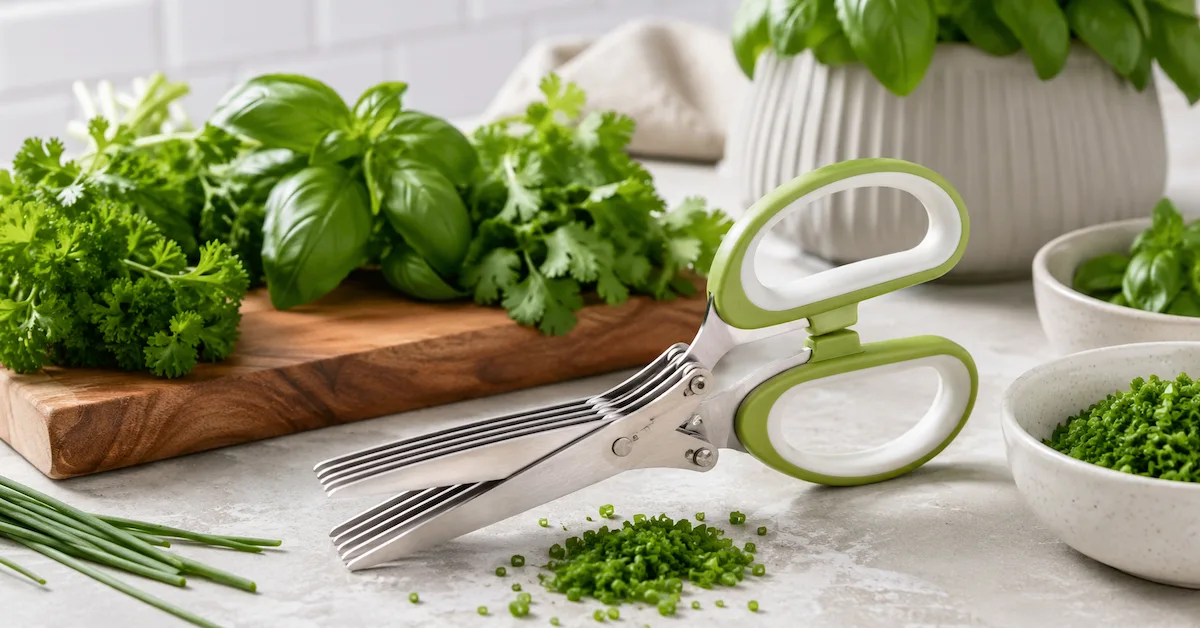
The product shown in the existing article appears to use stainless-steel blades with a brushed or satin appearance and molded handles in green and white. The exact steel grade, handle polymer, grip material, and food-contact documentation are not confirmed in the source information, so buyers should ask the supplier to identify them clearly.
From a sourcing perspective, the critical construction points are the blade stack, pivot, handle molding, and final assembly. Multi-blade tools create more opportunities for friction and misalignment than ordinary kitchen scissors. If one blade is slightly bent or the blade spacing is inconsistent, the tool may pull, crush, or trap herbs instead of cutting cleanly.
The handle matters as much as the cutting end. Finger loops should be comfortable enough for repeated use, and the surface should not feel difficult to control when hands are slightly damp. A compact angled head can help users position the blades, but the real test is practical use with actual herbs, not a visual check on a sample table.
Buyer Checklist for Comparing Suppliers
When comparing a herb scissors supplier or factory, use a structured checklist. Similar-looking products can perform very differently after several minutes of cutting, rinsing, and repeated opening and closing. The table below highlights the checks that sourcing teams should include during sample evaluation.
| Evaluation area | What to check | Questions to ask the supplier |
|---|---|---|
| Blade alignment | Parallel blades should open and close smoothly without rubbing heavily or leaving uncut herbs. | How is blade spacing controlled during assembly and inspection? |
| Cutting performance | Test on parsley, chives, cilantro, and basil to see whether the tool cuts cleanly or crushes leaves. | Can the supplier provide multiple samples from normal production? |
| Handle comfort | Check finger-loop size, grip feel, molding seams, and control with damp hands. | What handle material is used, and are color options available? |
| Assembly stability | Look for loose pivots, uneven movement, burrs, rough edges, or rattling after repeated use. | What in-process and final inspections are performed? |
| Packaging readiness | Confirm that packaging explains the product function clearly for retail or online sale. | Can packaging, barcode placement, insert cards, or branding be customized? |
| Compliance support | Do not assume certifications or food-contact approvals unless documents are supplied. | What material declarations or compliance documents are available for the target market? |
Sample Testing Before Placing an Order
A single polished sample is not enough to qualify a manufacturer. Ask for several units and compare them side by side. Consistency across samples is often more important than one perfect piece, especially for multi-blade kitchen tools where small assembly differences change the user experience.
- Open and close each unit at least 30 to 50 times to feel for friction, looseness, or uneven movement.
- Cut several types of fresh herbs and check whether leaves are sliced, bruised, or trapped between blades.
- Inspect blade edges, tips, and pivot areas for burrs or rough finishing.
- Rinse the scissors after use and check how easily herbs clear from between the blades.
- Compare handle comfort for different hand sizes if the product is intended for broad consumer use.
- Ask the supplier to confirm cleaning instructions instead of assuming dishwasher suitability.
Document sample results with photos and short notes. This gives purchasing, quality, packaging, and sales teams the same reference point when deciding whether to continue supplier discussions.
OEM, Wholesale, and Private Label Considerations
For OEM or private label projects, buyers should separate confirmed capabilities from assumptions. A supplier may be able to support color changes, logo application, packaging artwork, or retail-ready packs, but the available options, lead times, costs, and order quantities must be discussed directly. Do not rely only on a catalog image or a brief marketplace listing.
Important commercial questions include whether the supplier can maintain the same blade finish across batches, whether handle colors can be controlled consistently, how defective units are handled, and what packaging formats are available. If the product will be sold in several countries, buyers should also ask what documentation is available for food-contact materials in each target market.
For wholesale programs, packaging clarity matters. Herb scissors are visually unusual, so the packaging or product page should show the intended use clearly. A simple usage image, concise description, and cleaning guidance can reduce misunderstandings and support better customer satisfaction.
Common Sourcing Risks to Avoid
The most common mistake is choosing only by price and appearance. Low-cost herb scissors may look acceptable in photos but fail in real use if the blades are misaligned, dull, or difficult to clean. Another risk is accepting vague material descriptions. For a kitchen tool, buyers should ask for clear material information and any available compliance documents relevant to the sales region.
Also watch for overbroad claims. If the supplier cannot confirm dishwasher safety, specific steel grade, food-contact testing, or certifications, those claims should not appear on packaging or product listings. Accurate positioning protects both the brand and the end user.
Key Takeaways
- Herb scissors are best suited to fresh herbs and soft leafy ingredients.
- Blade alignment, cutting feel, and handle comfort are more important than catalog appearance.
- Buyers should test multiple samples, not just one selected unit.
- Material details, cleaning instructions, and compliance documents should be confirmed with the supplier.
- OEM and wholesale buyers should clarify branding, packaging, inspection, and batch consistency before ordering.
FAQ
What should buyers ask a herb scissors manufacturer first?
Start with material descriptions, sample availability, blade assembly details, cleaning instructions, packaging options, and any available food-contact compliance documents for the target market.
Are multi-blade herb scissors only for herbs?
They are mainly intended for fresh herbs and similar soft leafy ingredients. Buyers should avoid marketing them as a tool for hard or dense foods unless the supplier can support that claim with suitable product evidence.
How can I judge whether a sample is good?
Test several units on real herbs, compare smoothness of movement, inspect blade alignment, check for burrs, and rinse the tool after use to see whether herb residue is easy to remove.
Can herb scissors be customized for private label?
Possibly, but this must be confirmed with the supplier. Ask about logo methods, handle color options, packaging formats, artwork requirements, lead times, and minimum order quantities.
Should I claim the product is dishwasher safe?
Only if the supplier confirms it and provides appropriate support for that claim. If cleaning information is not verified, use cautious care instructions and request clarification before finalizing packaging.
A Practical Next Step for Sourcing Teams
Before selecting a herb scissors factory, request several samples and run a simple use test with fresh herbs, repeated cutting, rinsing, and comfort checks. Then ask the supplier to explain its material choices, assembly controls, inspection process, packaging options, and documentation support. The best sourcing decision is usually based on repeatable performance, not the most attractive photo or lowest initial quote.
