




How to Choose a Reliable Home Cooking Tools Supplier?
A reliable home cooking tools supplier should provide more than individual kitchen products. For retailers, importers, wholesalers, and private-label brands, the right supplier should support product selection, quality consistency, customization, packaging, and long-term supply needs.
Home cooking tools are everyday products used for food preparation, cooking, and kitchen organization. Because customers interact with these products frequently, product usability, appearance, durability, and consistency directly influence purchasing decisions.
For business buyers, choosing a supplier requires evaluating:
- Product category coverage
- Manufacturing capability
- Material selection
- Product design
- Quality control
- OEM and private-label support
- Retail packaging capability
The goal is not only to purchase kitchen tools but to build a product assortment that matches customer expectations and market positioning.
BONET provides kitchenware manufacturing solutions covering kitchen scissors, kitchen knives, utensils, chopping boards, multifunctional kitchen tools, and related products for global brands, retailers, distributors, and e-commerce businesses. BONET Products
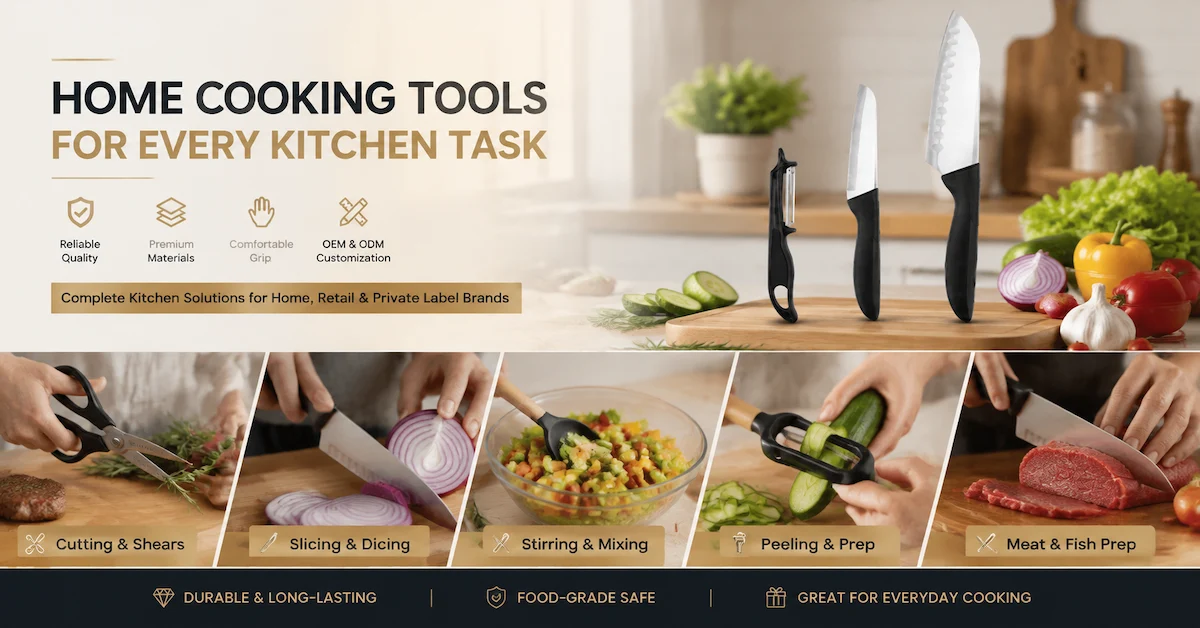
What Are Home Cooking Tools?
Home cooking tools are kitchen products designed to support daily food preparation, cooking, and household kitchen tasks.
They help users complete activities such as:
- Cutting ingredients
- Preparing food
- Cooking meals
- Serving dishes
- Organizing kitchen workflows
For retail buyers, home cooking tools represent a high-frequency product category because they serve practical daily needs.
Common Home Cooking Tool Categories
| Category | Typical Applications |
|---|---|
| Kitchen scissors | Cutting food, packaging, household preparation |
| Kitchen knives | Vegetable cutting, meat preparation, daily cooking |
| Cooking utensils | Stirring, mixing, serving, cooking |
| Chopping boards | Food preparation surfaces |
| Multifunctional tools | Space-saving kitchen solutions |
| Kitchen gadgets | Convenience and efficiency products |
A strong cooking tools supplier should understand how these products fit into different customer lifestyles and retail channels.
Why Retailers Need a Professional Cooking Tools Supplier
Kitchen products may look simple, but buyers face many sourcing challenges.
A professional supplier helps retailers manage:
- Product consistency
- Customer satisfaction
- Market differentiation
- Product availability
- Quality expectations
Key Supplier Benefits
| Supplier Capability | Buyer Value |
|---|---|
| Product variety | Build complete kitchen categories |
| Stable manufacturing | Support repeat orders |
| Quality management | Reduce customer complaints |
| Customization | Create differentiated products |
| Packaging support | Improve retail presentation |
| Product development | Launch new collections |
For homeware stores and kitchen brands, supplier selection directly affects customer experience and brand reputation.
What Kitchen Tools Should Retailers Source?
A successful kitchen product range usually combines essential items with products that provide additional value.
Essential Kitchen Tools
These products usually have stable demand:
- Kitchen scissors
- Basic kitchen knives
- Cooking utensils
- Chopping boards
Functional Kitchen Products
These products improve convenience:
- Multifunctional kitchen tools
- Specialty preparation tools
- Space-saving solutions
Premium Kitchen Collections
These products focus on:
- Better design
- Gift value
- Brand positioning
- Higher perceived value
BONET's product portfolio includes kitchen scissors, knives, utensils, chopping boards, multifunctional products, and kitchen gadgets that can support different retail assortment strategies. BONET Kitchenware Products
How to Evaluate a Home Cooking Tools Supplier?
Choosing a supplier requires reviewing both product capability and manufacturing ability.
Supplier Evaluation Checklist
| Evaluation Area | Questions Buyers Should Ask |
|---|---|
| Product range | Can the supplier support required categories? |
| Manufacturing | Does the supplier control production processes? |
| Materials | Are specifications clearly defined? |
| Design | Can products meet market expectations? |
| Quality control | Are products inspected consistently? |
| Customization | Can products support branding? |
| Packaging | Is packaging suitable for retail? |
| Communication | Are requirements confirmed clearly? |
The best supplier is not simply the one with the most products. It is the one that can consistently deliver products matching the buyer's market requirements.
Materials Used in Home Cooking Tools
Material selection affects:
- Product durability
- Appearance
- User experience
- Cost positioning
- Market acceptance
BONET supports multiple material options through its OEM/ODM capabilities, including stainless steel, silicone, plastic, wood, bamboo, aluminum alloy, and composite materials depending on project requirements. BONET OEM ODM Service
Stainless Steel Kitchen Tools
Common applications:
- Kitchen knives
- Scissors
- Metal kitchen accessories
Important considerations:
- Product specification
- Surface finish
- Intended use
- Manufacturing requirements
Silicone Cooking Tools
Common applications:
- Cooking utensils
- Kitchen accessories
- Comfortable grip components
Buyers should evaluate:
- Product design
- Color consistency
- Flexibility requirements
- User experience
Wood and Bamboo Kitchen Products
Often used for:
- Natural kitchen collections
- Premium product lines
- Gift-oriented products
Material selection should match the product positioning and customer expectations.
Ergonomic Design in Home Cooking Tools
Modern kitchen buyers increasingly value comfort and usability.
Ergonomic design focuses on improving how users interact with products.
Important Ergonomic Factors
| Design Factor | User Benefit |
|---|---|
| Handle design | Better grip comfort |
| Weight balance | Easier control |
| Product shape | More convenient operation |
| Functional layout | Improved efficiency |
For products such as kitchen scissors, knives, and utensils, ergonomic design can become an important selling point.
Retailers and brands can use ergonomic features to create stronger product differentiation.
Manufacturing Process Behind Cooking Tools
Reliable manufacturing determines whether a product concept can become a consistent commercial product.
Important manufacturing stages may include:
- Material preparation
- Forming
- Surface treatment
- Grinding
- Polishing
- Handle production
- Assembly
- Quality inspection
BONET's manufacturing information describes production processes including stamping, straight adjustment, heat treatment, grinding, polishing, injection molding, ultrasonic cleaning, assembly, quality inspection, final cleaning, protection, and packing for related cutting-tool products. BONET Manufacturing Process
Why Manufacturing Capability Matters
A capable manufacturer helps buyers achieve:
- Stable product quality
- Better sample-to-production consistency
- More customization possibilities
- Improved communication efficiency
This is especially important for retailers planning repeat purchases.
OEM and Private Label Cooking Tools
Many brands develop their own kitchen product collections through OEM and private-label programs.
A professional supplier should support different customization requirements.
Common Customization Options
Buyers may request:
- Custom logo
- Product colors
- Packaging design
- Product combinations
- Material selection
- Product improvements
BONET's OEM/ODM services include production based on drawings or samples, material and color customization, logo printing or laser engraving, packaging customization, and product development support. BONET OEM ODM Solutions
OEM vs Private Label Cooking Tools
| Model | Suitable For |
|---|---|
| OEM | Buyers with existing specifications |
| Private Label | Brands creating their own products |
| ODM | Buyers needing product development support |
Selecting the right model depends on the buyer's business goals.
Quality Control for Home Cooking Tools
Quality control is essential because kitchen tools are directly connected with daily user experience.
A professional supplier should define quality standards before mass production.
Kitchen Tool QC Checklist
| QC Area | What Buyers Should Check |
|---|---|
| Appearance | Surface quality and consistency |
| Function | Product performance |
| Assembly | Component stability |
| Materials | Specification consistency |
| Branding | Logo and packaging accuracy |
| Packaging | Retail readiness |
| Quantity | Order completeness |
BONET states that its OEM/ODM workflow includes quality inspection covering appearance, function, assembly, packaging, and overall consistency before delivery. BONET OEM ODM Process
Applications and Buyer Markets
Different business buyers have different sourcing requirements.
Retail Stores
Need:
- Complete product assortment
- Attractive packaging
- Stable replenishment
Supermarkets
Need:
- Reliable supply
- Competitive products
- Retail-ready packaging
E-Commerce Brands
Need:
- Differentiated products
- Strong product presentation
- Custom branding
Private Label Companies
Need:
- Product customization
- Brand consistency
- Long-term supplier cooperation
A supplier with flexible manufacturing capability can better support different business models.
How to Start a Cooking Tools Sourcing Project?
A structured sourcing process reduces risk.
Step 1: Define Product Requirements
Confirm:
- Product category
- Target customers
- Price positioning
- Material requirements
- Packaging needs
Step 2: Review Supplier Capability
Evaluate:
- Manufacturing experience
- Product range
- Customization ability
- Quality management
Step 3: Approve Samples
Check:
- Product design
- Function
- Material
- Packaging
Step 4: Confirm Production Standards
Define:
- Product specifications
- Inspection requirements
- Packaging details
Step 5: Build Long-Term Cooperation
Maintain communication about:
- New product development
- Repeat orders
- Quality improvements
Common Mistakes When Choosing a Cooking Tools Supplier
Choosing Only Based on Price
Low prices may create hidden costs through:
- Quality issues
- Returns
- Replacements
- Poor customer experience
Ignoring Product Function
Kitchen tools should be evaluated through actual use, not appearance alone.
Not Confirming Product Specifications
Clear specifications prevent misunderstandings regarding:
- Materials
- Size
- Color
- Packaging
- Functions
Skipping Sample Approval
Samples help verify whether products meet expectations before bulk production.
FAQ
What products does a home cooking tools supplier provide?
A home cooking tools supplier typically provides kitchen scissors, knives, utensils, chopping boards, kitchen gadgets, and multifunctional kitchen tools.
How do retailers choose a reliable cooking tools supplier?
Retailers should evaluate product range, manufacturing capability, quality control, customization options, packaging, and supply stability.
Can cooking tools be customized with a brand logo?
Yes. Suppliers may provide logo printing, laser engraving, custom colors, packaging customization, and branded product solutions.
What materials are commonly used for cooking tools?
Common materials include stainless steel, silicone, plastic, wood, bamboo, aluminum alloy, and composite materials.
Why should brands work with kitchen tools manufacturers?
Manufacturers can provide better production control, customization flexibility, quality consistency, and product development support.
What quality checks should buyers request?
Buyers should check product appearance, function, materials, assembly, packaging, quantity, and consistency with approved samples.
Can suppliers develop private-label cooking tools?
Yes. Private-label programs can include customized products, branding, packaging, and product development support.
What makes ergonomic cooking tools different?
Ergonomic cooking tools focus on user comfort, grip, control, and easier operation during daily kitchen tasks.
How can buyers request a quotation?
Buyers should provide product requirements, target market, quantity, customization needs, packaging requirements, and quality expectations.
Does BONET provide home cooking tools manufacturing solutions?
BONET provides kitchenware manufacturing, OEM/ODM customization, product development support, and packaging solutions for global business buyers. BONET Contact Us
Conclusion
Choosing the right home cooking tools supplier requires evaluating more than product availability and price. Retailers, importers, and brands need suppliers that can provide reliable manufacturing, consistent quality, suitable materials, customization support, and professional packaging solutions.
A strong supplier helps businesses create kitchen product collections that meet customer expectations and support long-term market growth.
BONET supports global buyers with kitchen scissors, knives, utensils, chopping boards, multifunctional kitchen tools, OEM/ODM services, and customized kitchenware solutions.
Companies developing home cooking tool collections can explore BONET's product range, manufacturing capabilities, OEM/ODM services, or contact the team to discuss sourcing requirements. BONET Products BONET Contact Us
