




A reliable household scissors manufacturer should be judged by much more than whether a sample can cut paper on the first try.
For B2B buyers, the real purchasing challenge is consistency. The approved sample needs to be reproduced across hundreds or thousands of units. Blade alignment should remain stable. Pivot resistance should feel similar from piece to piece. Handle molding should be clean. Color should stay close to the approved reference. Packaging should protect the scissors in transit and still fit the intended retail channel.
That is why household scissors sourcing is not simply a “find a factory and add a logo” project.
A strong supplier should understand how blade material, straightness, heat treatment, grinding, polishing, pivot assembly, handle construction, surface treatment, packaging, inspection, and reorder control work together.
If you are sourcing for a private-label brand, supermarket, distributor, home-goods retailer, office-supply channel, craft seller, or e-commerce business, the better question is not:
“Who can quote the cheapest household scissors?”
It is:
Which supplier can reproduce the same approved product specification through mass production and future repeat orders?
That is the standard buyers should use when evaluating a manufacturer.
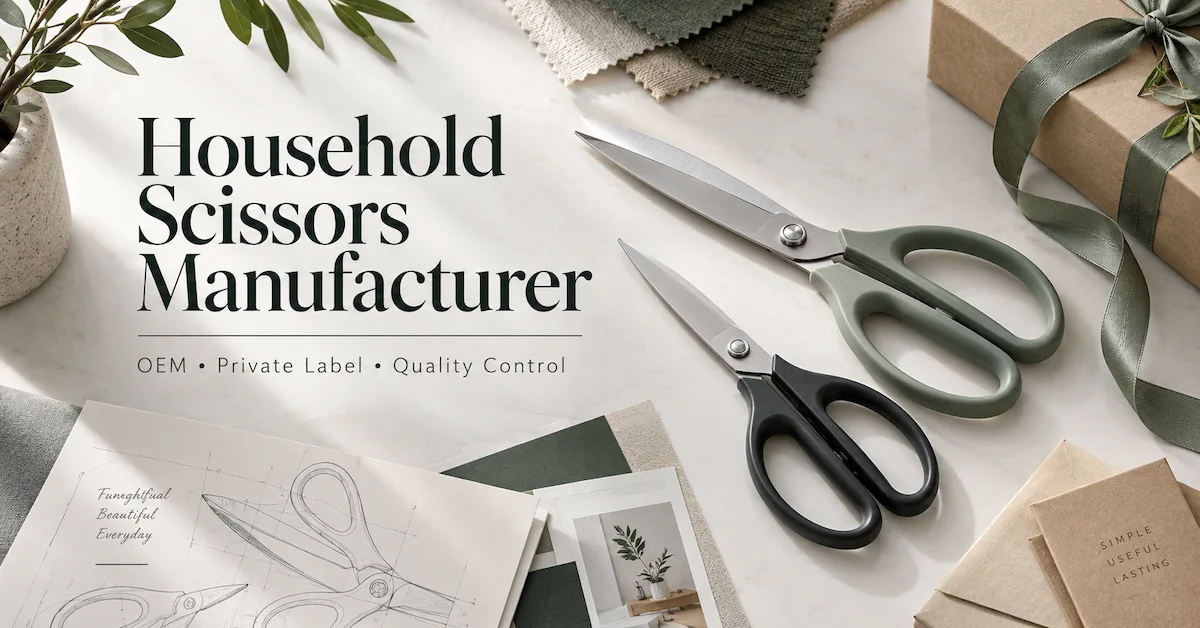
What Is a Household Scissors Manufacturer?
A household scissors manufacturer produces general-purpose scissors designed for routine cutting tasks in homes and related everyday environments.
Depending on the model, household scissors may be used for:
- paper;
- packaging;
- plastic bags;
- light cardboard;
- fabric;
- string;
- labels;
- gift wrapping;
- craft materials;
- household organization;
- office tasks;
- sewing-related light work;
- general utility cutting.
The category sits between highly specialized scissors and basic disposable cutting tools.
For example, household scissors are different from poultry shears, professional tailoring scissors, surgical scissors, barber scissors, or industrial shears. Each of those categories has more specialized geometry, materials, performance expectations, or application requirements.
A household product usually needs to balance several factors at once:
- cutting performance;
- comfort;
- safety;
- durability;
- appearance;
- affordability;
- packaging efficiency;
- broad usability.
BONET's scissors range includes different household, office, kitchen, sewing, and multi-purpose directions, which is useful for buyers who need to compare several product structures before finalizing a sourcing program.
Why Household Scissors Are More Complex Than They Look
Household scissors appear simple because consumers see only two blades, one pivot, and a handle.
But manufacturing quality depends on the interaction of many small details.
If one blade is slightly distorted, cutting may fail near the tip.
If the pivot is too loose, the blades may separate under load.
If it is too tight, users may feel fatigue.
If the inner cutting surfaces do not contact correctly, the scissors may push or fold material instead of cutting it.
If the handle has uncomfortable pressure points, the product may feel cheap even if the blades are sharp.
If a coating looks different from batch to batch, a private-label brand may receive inconsistent product photography and customer complaints.
If the package does not support the blade or handle properly, products may arrive scratched even when manufacturing was acceptable.
This is why sourcing household scissors should be treated as a complete product-engineering and supply-chain task rather than a logo-printing exercise.
Who Buys Household Scissors in B2B Markets?
Different buyers evaluate the same scissors in different ways.
Understanding those differences helps you choose a more suitable manufacturing partner.
Private-Label Home-Goods Brands
Private-label brands usually want differentiation without unnecessary technical risk.
Their priorities may include:
- custom handle colors;
- logo application;
- distinctive packaging;
- consistent product photography appearance;
- material specification;
- soft-grip options;
- protective covers;
- surface finishes;
- coordinated product families.
Their main risk is inconsistency between the approved sample and future batches.
Importers
Importers are usually more focused on process reliability.
They need clear answers about:
- materials;
- specifications;
- packaging;
- quotation structure;
- sample approval;
- inspection;
- documentation;
- shipment preparation;
- repeat orders.
They may also source multiple types of scissors at once, making supplier breadth useful.
Wholesalers and Distributors
Wholesalers often need a wider assortment rather than one highly customized model.
They may want:
- several sizes;
- entry-level and premium versions;
- soft-grip options;
- protective-cover models;
- general-purpose designs;
- office and craft variants;
- mixed assortments.
For this channel, dependable availability and repeat ordering may matter more than extensive structural customization.
Supermarkets and Chain Stores
Supermarket buyers have a different problem: the consumer must understand the product quickly.
The scissors must work, but shelf communication matters too.
Important factors include:
- clear size;
- visible handle shape;
- obvious use case;
- retail-ready packaging;
- barcode placement;
- shelf hanging method;
- carton efficiency;
- consistent visual presentation.
A product that performs well but looks confusing on the shelf may still fail commercially.
E-Commerce Sellers
Online sellers need products that photograph well and have features that can be communicated in seconds.
Useful differentiation may include:
- soft grip;
- non-slip handle;
- protective cover;
- special blade finish;
- multiple sizes;
- comfortable ergonomic shape;
- multipurpose application.
But the product also needs packaging capable of surviving individual parcel handling.
Office, Craft, and Sewing Channels
Some household scissors overlap with office, hobby, craft, and light sewing applications.
These customers often care about:
- precision;
- comfort;
- blade length;
- handle size;
- cutting control;
- safety storage;
- decorative finish;
- suitability for different materials.
That is why the term “household scissors” should never be used without defining the target application.
Start With the Application Before Choosing the Product
A common sourcing mistake is starting from the supplier catalog.
Buyers see a visually attractive scissors model, ask for a price, and only later decide where it will be sold.
A stronger process works in reverse.
First define:
- Who will buy it?
- What will they cut?
- How often will they use it?
- What price segment is targeted?
- What packaging channel is required?
- What level of customization is needed?
Then select the scissors platform.
This reduces the risk of choosing a product that looks appropriate but does not fit the commercial application.
| Target Market | Main Use | Important Product Features | Packaging Priority |
|---|---|---|---|
| General household | Paper, packages, light daily tasks | Comfortable grip, general cutting | Simple retail visibility |
| Home organization | Labels, tape, wrapping, boxes | Control and easy handling | Compact storage presentation |
| Office supply | Paper, envelopes, light board | Precision and comfortable loops | Shelf/hook display |
| Craft retail | Paper, fabric, decorative material | Fine control and blade finish | Visual differentiation |
| Sewing/hobby | Light fabric and thread | Precision and comfortable handling | Size and application clarity |
| E-commerce | Mixed consumer applications | Clear feature differentiation | Parcel protection |
| Supermarket | Broad household use | Familiar design, easy selling points | Retail-ready package |
| Distributor | Multiple channels | Broad SKU range | Carton efficiency |
This framework helps a buyer specify what matters before discussing unit cost.
Household Scissors vs Office Scissors vs Kitchen Scissors
These categories can overlap, but they should not be treated as identical.
Household Scissors
Household scissors are designed for broad daily use.
Typical tasks include:
- opening packages;
- cutting paper;
- clipping labels;
- trimming string;
- light craft work;
- household organization.
The design normally prioritizes versatility.
Office Scissors
Office scissors may have similar construction, but buyers often emphasize:
- paper cutting;
- smooth repeated operation;
- desk storage;
- standardized sizes;
- professional appearance.
Kitchen Scissors
Kitchen scissors operate in a more demanding environment.
They may encounter:
- food;
- herbs;
- meat;
- poultry;
- packaging;
- moisture;
- cleaning requirements.
For this reason, blade geometry, grip, serration, food-preparation functionality, detachability, and cleaning considerations may differ.
Buyers can compare BONET's broader all-purpose scissors collection with its other product categories before deciding which design direction fits the target market.
Sewing and Craft Scissors
These products place more emphasis on cutting control and the material being cut.
A household model may handle occasional fabric cutting, but a buyer selling into a dedicated sewing channel should define more specific performance requirements.
The commercial lesson is simple:
Do not use category names as technical specifications.
Tell the manufacturer what the scissors need to do.
Blade Material: What Should B2B Buyers Ask?
Blade material is one of the first technical questions in a scissors RFQ.
BONET product specifications across several scissors models list 420 stainless steel as a common blade material, while handle constructions can include materials such as PP and PP+TPR depending on the model.
However, material grade alone does not determine final quality.
A buyer should ask about:
- blade material;
- blade thickness;
- heat treatment;
- edge geometry;
- blade straightness;
- serration if used;
- surface finish;
- grinding process;
- pivot configuration;
- final cutting test.
This is important because two scissors made from the same general steel grade can still perform differently.
Processing matters.
The material is only one part of the system.
Why Blade Straightness Matters
Scissors work differently from knives.
A knife uses one cutting edge against a surface or material.
Scissors depend on two blades moving against one another.
That means blade interaction is essential.
If one blade bends away from the other, the product may stop cutting at certain points.
Users may notice:
- material folding instead of cutting;
- weak cutting near the tip;
- inconsistent resistance;
- poor cutting on thin material;
- uneven closing action.
BONET's published manufacturing process includes a straight-adjustment stage before later finishing steps.
For a buyer, that is significant because straightness is directly connected to functional cutting performance.
When evaluating a supplier, ask how blade geometry is checked before assembly.
Heat Treatment Is More Important Than the Steel Name Alone
Buyers often focus heavily on stainless-steel grade because it is easy to compare in a quotation.
But heat treatment can influence the actual behavior of the finished blade.
BONET's manufacturing workflow includes heat-treatment processes such as hardening, tempering, and annealing.
For sourcing purposes, the practical questions are:
- Is heat treatment controlled for the selected model?
- Does the supplier use the same process for production as for samples?
- Are there project-specific hardness requirements?
- If a hardness value is specified, how is it checked?
- Does the process support the intended balance of durability and cutting performance?
If your project requires a specific technical value, that requirement should be written into the RFQ.
Do not assume that a supplier's general product description automatically guarantees one hardness level across all models.
Grinding and Edge Formation
Grinding determines how the cutting edge is shaped.
BONET's manufacturing process includes both rough grinding and water grinding.
For buyers, the most relevant question is consistency.
A sample may feel sharp because one pair was carefully finished.
Mass production must reproduce the same result across the order.
Things to evaluate include:
- edge geometry;
- tip performance;
- cutting along the full blade length;
- smoothness during closing;
- blade contact;
- burrs;
- finish consistency.
Water grinding can help manage friction and heat during processing, but procurement decisions should still be based on final product performance rather than process terminology alone.
Polishing and Surface Finish Affect Perceived Quality
Consumers often judge scissors before they use them.
Visible details influence perceived value:
- scratches;
- uneven polish;
- stains;
- inconsistent coating;
- rough edges;
- molding marks;
- poor logo placement.
That means surface treatment has both functional and commercial importance.
For a private-label program, buyers should approve the visual standard under realistic lighting.
A polished metal blade, matte blade, coated blade, or decorative titanium-style appearance can look different depending on lighting and photography.
Digital renderings should not replace physical sample approval.
Handle Material and Ergonomics
The handle is where the consumer experiences the product.
A sharp pair of scissors with an uncomfortable handle may still receive poor feedback.
Common handle configurations may include:
- PP;
- PP+TPR;
- other plastic structures depending on the model.
PP can support durable molded handle structures.
TPR can add a softer grip area and improve comfort.
But a soft grip is only useful if the geometry works.
Buyers should evaluate:
- finger-loop size;
- thumb-loop shape;
- pressure points;
- grip texture;
- handle balance;
- edge smoothness;
- molding quality;
- flash;
- color consistency;
- soft-grip fit.
For products intended for repeated office or household use, ergonomics should be tested by actual handling rather than judged only from photos.
What Does a Good Household Scissors Sample Approval Process Look Like?
Sample approval is one of the most important steps in the sourcing process.
The sample should not be treated as a demonstration.
It should become a controlled reference.
A strong approval checklist may include:
| Inspection Point | What to Check | Why It Matters |
|---|---|---|
| Overall appearance | Scratches, finish, cleanliness | Defines visual standard |
| Blade geometry | Straightness and shape | Affects cutting |
| Full-length cutting | Base, middle, tip | Detects alignment problems |
| Opening/closing feel | Smoothness and resistance | Affects user comfort |
| Pivot | Tightness and stability | Influences blade interaction |
| Handle | Comfort and molding | Affects user experience |
| PP/TPR areas | Fit and finish | Prevents cosmetic defects |
| Logo | Position and clarity | Protects brand consistency |
| Coating | Shade and coverage | Important for retail appearance |
| Protective cover | Fit and removal | Relevant to safety |
| Packaging | Fit and presentation | Protects product |
| Carton | Quantity and protection | Affects transport |
The buyer should also save:
- approved photos;
- product specification;
- logo file;
- artwork version;
- color reference;
- packaging dieline;
- approved physical sample if possible.
This prevents one of the most common sourcing problems: two sides remembering the approved sample differently.
What Should Be Tested on Household Scissors?
Testing should match the actual intended application.
If the product is marketed for general household use, test it on materials consumers are realistically expected to cut.
Possible examples include:
- standard paper;
- thicker paper;
- envelopes;
- light cardboard;
- plastic packaging;
- tape;
- string;
- thin fabric if relevant;
- gift wrapping.
Do not approve a general-purpose product based on only one dramatic cutting demonstration.
A pair of scissors may cut thick material once but perform poorly on thin paper.
Conversely, a precise office-style product may cut paper beautifully but not be intended for heavier household tasks.
The product claim should match the tested application.

What Does Quality Control Mean for Household Scissors?
“100% quality” is not a useful procurement statement.
A serious buyer should ask what the supplier actually inspects.
Quality control can be divided into several categories.
1. Appearance Control
Inspect:
- blade finish;
- coating;
- scratches;
- stains;
- handle color;
- molding marks;
- logo;
- cleanliness.
2. Functional Control
Inspect:
- opening;
- closing;
- cutting;
- tip performance;
- full-blade cutting;
- handle comfort;
- protective cover if included.
3. Assembly Control
Inspect:
- pivot;
- screw or fastening condition;
- blade alignment;
- handle fit;
- accessory fit.
4. Packaging Control
Inspect:
- correct product;
- correct logo;
- correct artwork;
- labels;
- barcode;
- package orientation;
- accessories;
- carton marks.
5. Consistency Control
This matters most to B2B buyers.
You are not purchasing one excellent pair.
You are purchasing a repeatable batch.
The supplier must control variation across the order.
Why Repeat-Order Consistency Matters More Than the First Sample
Many sourcing programs look successful during development.
The problems appear later.
The first order is approved.
Six months later, a repeat order arrives with:
- slightly different handle color;
- different pivot feel;
- packaging from a new supplier;
- thinner carton;
- changed surface finish;
- revised logo position;
- different accessory fit.
These changes may seem small from the factory side, but they can create major problems for a brand.
Repeat-order control should therefore be part of the sourcing process from the beginning.
A useful master specification may include:
- model number;
- dimensions;
- blade material;
- handle material;
- color reference;
- logo method;
- logo location;
- surface finish;
- approved sample;
- packaging artwork version;
- barcode;
- carton quantity;
- inspection points.
Before every repeat order, ask:
Has any material, component, subcontractor, process, packaging supplier, or specification changed?
If yes, determine whether a new approval is necessary.
OEM Household Scissors: What Can Buyers Customize?
Customization can be divided into several levels.
Basic Private Label
This may involve:
- logo printing;
- laser engraving;
- custom label;
- custom packaging.
This is often the fastest route to market.
Color Customization
Buyers may request:
- handle color;
- TPR color;
- packaging color;
- accessory color.
Physical references are preferable to screen colors.
Surface Customization
Depending on product feasibility, a project may explore:
- polished finish;
- matte appearance;
- decorative coating;
- special blade appearance.
The supplier should explain what is practical for the selected model.
Functional Customization
This can include:
- protective sheath;
- blade cover;
- different handle structure;
- serration;
- size variations;
- grip texture;
- accessory combinations.
Structural Development
If a buyer needs new geometry, new tooling, different pivots, or a new product concept, the project moves toward a deeper ODM process.
BONET's OEM/ODM service covers requirement communication, design and sampling, quotation confirmation, production, inspection, packaging, and delivery.
For buyers, that structure is useful because it separates development decisions from production decisions.
OEM vs ODM for Household Scissors
These two terms are often used loosely.
A simple way to distinguish them is by asking how much product definition the buyer already has.
OEM Is Better When You Already Have:
- a physical sample;
- drawings;
- materials;
- size;
- handle design;
- logo requirements;
- packaging requirements.
The manufacturer mainly executes your specification.
ODM Is Better When You Have:
- a target customer;
- use case;
- price level;
- feature idea;
- brand direction;
but not a fully defined product.
In that case, you may need support with:
- product selection;
- structure;
- materials;
- sample development;
- feasibility;
- packaging;
- production preparation.
Neither model is automatically better.
The right choice depends on how mature the project is.
Packaging for Household Scissors Should Match the Sales Channel
Packaging should be discussed early, not after product approval.
It influences:
- unit cost;
- package size;
- retail presentation;
- shipping efficiency;
- product protection;
- barcodes;
- carton quantity.
Supermarket Packaging
A supermarket package needs to communicate quickly.
The customer should immediately understand:
- size;
- main use;
- comfort feature;
- protective cover if included;
- special finish if relevant.
E-Commerce Packaging
Online packaging must survive parcel distribution.
Consider:
- internal movement;
- blade protection;
- handle protection;
- crushing;
- package volume;
- opening experience.
Wholesale Packaging
Wholesale programs may prioritize:
- carton efficiency;
- consistent labeling;
- SKU identification;
- stacking;
- warehouse handling.
Gift or Premium Retail Packaging
Premium home-goods brands may use:
- color boxes;
- structured boxes;
- gift-style presentation.
BONET's OEM/ODM capabilities include custom retail packaging, color boxes, gift boxes, barcode labels, and export cartons.
The best package is not necessarily the most expensive one.
It is the one designed for the actual sales channel.
What Affects MOQ for Household Scissors?
There is no useful universal MOQ without a defined project.
Minimum order quantity can depend on:
- existing model availability;
- handle color;
- custom TPR color;
- blade finish;
- coating;
- logo process;
- package print quantity;
- accessory requirements;
- tooling;
- carton configuration;
- production setup.
For example, an existing household scissors model with a standard handle and custom logo may have a very different production structure from a new model with exclusive tooling, custom molded grips, coating, and printed gift packaging.
That is why buyers should ask for MOQ against the actual specification.
Not:
What is your MOQ?
But:
What is the MOQ for this model with PP+TPR handles, our custom color, laser logo, protective cover, printed retail box, and export carton?
That question produces much more meaningful procurement information.
What Affects the Cost of Household Scissors?
Unit price is the result of multiple decisions.
Blade Material
Material selection and thickness influence cost.
Blade Processing
Heat treatment, grinding, polishing, coating, and finishing add process complexity.
Handle
A simple molded PP handle and a multi-material PP+TPR structure do not have the same cost structure.
Size
Longer or heavier products use more material and may affect packaging.
Surface Finish
Special decorative finishes can increase processing steps.
Accessories
A cover, sheath, storage accessory, or extra component adds material and assembly cost.
Branding
Printing and engraving have different setup and production requirements.
Packaging
A simple card and a premium printed box can create very different total product costs.
Order Volume
Higher quantities may improve some cost efficiencies, but the effect depends on the specific project.
Quality Requirements
Additional testing, inspection, or compliance requirements can affect project cost.
A professional buyer should therefore compare total controlled specification cost, not only unit price.
How to Evaluate a Household Scissors Manufacturer
A structured supplier scorecard reduces subjective decisions.
| Evaluation Area | What to Ask | Good Sign |
|---|---|---|
| Product range | What scissors categories do you produce? | Multiple relevant structures |
| Materials | Can material by component be confirmed? | Clear specifications |
| Manufacturing | Can you explain blade processing? | Process-level knowledge |
| Sampling | How are revisions controlled? | Documented approval |
| OEM | What can be customized? | Clear feasibility boundaries |
| QC | What exactly is inspected? | Specific inspection points |
| Packaging | Can you support retail and e-commerce? | Channel-specific options |
| Repeat orders | How are specifications retained? | Controlled records |
| Communication | How are changes documented? | Clear project management |
| Risk management | What happens if a requirement changes? | Change confirmation process |
A strong manufacturer will not simply answer every request with “yes.”
It may explain:
- why one coating is unsuitable;
- why a color needs a higher quantity;
- why one handle structure needs tooling;
- why a packaging design will not protect the product;
- why a certain use claim needs additional testing.
That kind of pushback can be a sign of manufacturing experience.
Why Manufacturing Transparency Matters
Many suppliers show only finished product images.
That does not tell a buyer how the scissors are made.
BONET publishes a broader manufacturing process that includes:
- stamping;
- straight adjustment;
- heat treatment;
- rough grinding;
- water grinding;
- polishing;
- injection molding;
- ultrasonic cleaning;
- setting and assembly;
- quality checking;
- final cleaning;
- packing.
For a B2B buyer, the value of this information is not marketing.
It gives you a framework for asking better questions.
Instead of asking:
“Are your scissors good quality?”
you can ask:
- How is blade straightness controlled?
- How is pivot resistance checked?
- How do you control handle molding?
- What cutting tests are performed?
- How do you compare mass production with the approved sample?
- How are coating variations controlled?
- What is checked before packing?
Specific questions produce specific answers.
What Certifications and Factory Information Should Buyers Check?
Supplier evaluation should include company-level credibility as well as product-level quality.
BONET's About Us page lists quality and social-compliance systems including ISO9001, BSCI, and Sedex.
For buyers, factory-level information can support supplier assessment.
However, it is important to understand what a factory certificate does and does not prove.
A company-level certification does not automatically mean that every product satisfies every destination-market requirement.
You may still need to confirm:
- product-specific testing;
- material requirements;
- labeling requirements;
- destination-market compliance;
- customer-specific inspection standards.
That distinction is important for professional sourcing.
Ten Questions to Ask Before You Approve a Supplier
Before selecting a household scissors supplier, ask these questions.
1. What blade material is used?
Ask for the actual grade and component specification.
2. How is blade straightness controlled?
This affects full-length cutting performance.
3. What heat-treatment process is used?
If specific hardness is required, define it in the project.
4. How is the cutting edge ground?
Ask how final cutting consistency is checked.
5. How is pivot tension controlled?
This affects feel, alignment, and durability.
6. What handle materials are available?
Confirm whether the model uses PP, PP+TPR, or another structure.
7. What can be customized?
Separate logo, color, surface, packaging, function, and structural changes.
8. What does QC actually inspect?
Ask for specific checkpoints.
9. How is the approved sample controlled?
Ensure the production standard is documented.
10. How are repeat orders kept consistent?
Ask whether changes are disclosed before reorder production.
If a supplier cannot answer these clearly, price should not be the deciding factor.
How to Prepare a Better RFQ
A detailed RFQ saves time and produces more accurate quotations.
Include:
| RFQ Field | Information to Provide |
|---|---|
| Product type | Household, office, craft, all-purpose |
| Target market | Retail, e-commerce, wholesale, etc. |
| Application | Paper, packages, fabric, general use |
| Size | Required or reference size |
| Blade | Material preference |
| Handle | PP, PP+TPR, preferred structure |
| Color | Standard or custom |
| Finish | Polished, coated, other |
| Logo | Method, size, position |
| Cover | Required or not |
| Packaging | Card, box, gift box, online |
| Barcode | Required format |
| Quantity | Trial and repeat estimate |
| Testing | Project-specific requirements |
| Destination | Country/region |
| Timing | Sample and order schedule |
The more precise the RFQ, the less likely you are to compare unrelated quotations.
Common Household Scissors Sourcing Mistakes
Mistake 1: Choosing by Price Before Aligning Specifications
A lower price may reflect:
- simpler handle;
- different blade finish;
- cheaper packaging;
- different material;
- fewer inspection steps.
Align specifications first.
Mistake 2: Approving Only Visual Appearance
A scissors sample can look excellent and still cut poorly.
Always perform functional tests.
Mistake 3: Not Testing the Tip
Some scissors cut well near the pivot but fail near the tip.
Test the full blade length.
Mistake 4: Ignoring Handle Comfort
Consumers notice discomfort quickly.
Test grip with different hand sizes where relevant.
Mistake 5: Treating Color as a Screen Value
A digital color reference may not match molded plastic.
Use controlled physical references.
Mistake 6: Finalizing Packaging Too Late
Packaging can affect cost, dimensions, shipping, barcodes, product protection, and retail presentation.
Develop it early.
Mistake 7: Losing Track of Sample Versions
Sample A, B, and C may have different details.
Record the approved version clearly.
Mistake 8: Assuming the First Order Defines Future Orders
Repeat production should still use documented specifications.
Mistake 9: Asking Only About MOQ
MOQ without specification is not meaningful.
Mistake 10: Using “Household Scissors” as the Entire Product Brief
Describe what the product actually needs to cut and who will use it.
How Can a Brand Differentiate Household Scissors Without Creating a New Product From Scratch?
Many buyers assume that private-label differentiation requires new tooling.
It does not always.
A strong brand can create differentiation through a combination of:
- handle color;
- PP+TPR grip;
- blade finish;
- protective cover;
- logo placement;
- package design;
- bundle configuration;
- size selection;
- product naming;
- clear application positioning.
For example, one brand may position scissors around “everyday home organization.”
Another may focus on “comfortable soft-grip cutting.”
Another may build a craft-oriented set.
Another may create a coordinated family of household scissors and kitchen tools.
This type of differentiation can reduce development complexity while still creating a recognizable retail product.
Should You Build One Household Scissors SKU or a Product Family?
For many B2B buyers, a family strategy is stronger.
Possible range architecture could include:
- compact household scissors;
- standard 7-inch scissors;
- larger 8-inch scissors;
- soft-grip version;
- protective-cover version;
- office scissors;
- craft scissors;
- light sewing scissors;
- kitchen scissors.
Shared branding can include:
- color system;
- logo placement;
- packaging layout;
- typography;
- finish;
- product naming.
This can improve shelf presence and simplify future line extensions.
Buyers who want to extend beyond scissors can review BONET's broader product categories, including kitchen knives, utensils, multifunctional tools, cutting boards, and kitchen gadgets.
When Is BONET Relevant as a Household Scissors Supplier?
BONET may be relevant for buyers looking for a supplier that combines scissors production with broader kitchenware and household-tool capabilities.
Its website shows:
- household and all-purpose scissors;
- office and sewing-related scissor variants;
- kitchen scissors;
- different handle structures;
- OEM/ODM support;
- packaging customization;
- documented manufacturing processes.
This can be useful for:
- private-label brands;
- importers;
- distributors;
- supermarkets;
- e-commerce sellers;
- home-goods retailers.
The company also presents manufacturing and quality-management information on its About Us page, while its OEM/ODM service outlines development from requirement communication through sampling, production, inspection, and delivery.
That does not mean every model has the same MOQ, lead time, material, or customization range.
Those details should be confirmed for the specific project.
What Information Should You Send Before Asking for a Quotation?
A strong enquiry gives the manufacturer enough information to understand the commercial and technical requirement.
Send:
- Target market.
- Customer type.
- Intended use.
- Reference product or photo.
- Preferred blade size.
- Material preference.
- Handle structure.
- Required color.
- Logo method.
- Surface finish.
- Protective cover requirements.
- Packaging type.
- Barcode requirements.
- Order quantity.
- Estimated reorder volume.
- Inspection expectations.
- Destination country.
- Target delivery schedule.
This allows the supplier to identify missing information before quoting.
If you already have these details, you can submit them through BONET's contact page for a project-specific discussion.
FAQ
What does a household scissors manufacturer produce?
A household scissors manufacturer makes general-purpose scissors for everyday cutting tasks such as paper, packaging, labels, light cardboard, string, crafts, and other household uses.
Depending on the factory, the range may also include office, craft, sewing, kitchen, or specialty scissors.
What blade material is commonly used for household scissors?
BONET lists 420 stainless steel on several scissors specifications.
However, material grade alone does not determine finished quality. Buyers should also evaluate heat treatment, grinding, blade straightness, pivot assembly, edge geometry, and final cutting performance.
Are PP+TPR handles better than PP handles?
Not universally.
PP can provide a durable molded structure, while TPR can add a softer gripping area.
The right choice depends on target price, comfort requirements, appearance, and user expectations.
A good ergonomic shape may matter more than adding soft material to a poor handle design.
Can household scissors be customized for private label?
Yes, depending on the model and project.
Possible customization can include logo, handle color, surface finish, protective cover, packaging, barcode, labels, and sometimes structural modifications.
More extensive structural changes may require ODM development or tooling.
What should I test before approving a household scissors sample?
Test appearance, full-length cutting, tip cutting, blade alignment, opening and closing resistance, pivot condition, handle comfort, logo, finish, cover fit, packaging, and any additional features.
Use materials that reflect the intended consumer application.
What affects household scissors MOQ?
MOQ can be influenced by model selection, custom colors, handle materials, coatings, logo method, packaging print quantity, tooling, accessories, and production setup.
The most accurate MOQ is given after the product specification is defined.
What affects household scissors price?
Key factors include blade material, size, heat treatment, grinding, finish, handle construction, TPR components, coating, logo, protective covers, packaging, inspection requirements, and order volume.
Buyers should compare equivalent specifications rather than unit prices alone.
How do I evaluate a household scissors factory?
Evaluate product range, material transparency, manufacturing knowledge, sample control, customization capability, quality inspection, packaging support, communication, and repeat-order consistency.
Ask process-specific questions instead of relying on general “high quality” claims.
OEM or ODM: which is better for household scissors?
OEM is usually suitable when the buyer already has a defined product or reference specification.
ODM is more useful when the buyer still needs help with product selection, structure, materials, sample development, or packaging.
The right choice depends on the maturity of the project.
How can I keep repeat orders consistent?
Maintain a controlled specification that includes model, dimensions, blade material, handle material, colors, logo, finish, packaging version, barcode, carton configuration, and approved reference sample.
Before every reorder, confirm whether any material, component, process, or packaging change has occurred.
Conclusion
Choosing a household scissors manufacturer is ultimately a decision about product control, not just price.
A successful sourcing program begins by defining the user, application, channel, product structure, blade requirements, handle design, branding, packaging, and quality expectations before comparing quotations.
Buyers should then evaluate how the supplier controls the processes that influence real performance: blade straightness, heat treatment, grinding, polishing, pivot assembly, handle molding, functional inspection, and final packaging.
For private-label brands, importers, distributors, supermarkets, and e-commerce sellers, the biggest long-term risk is rarely whether one sample looks good. The bigger question is whether the same approved standard can be repeated across mass production and future orders.
That is why the most valuable manufacturer is not necessarily the one that offers the lowest initial price.
It is the one that can translate a clearly defined specification into a repeatable product, document changes, support practical customization, protect packaging quality, and help the buyer control supply risk over time.
BONET provides a scissors product range, broader product categories, a documented manufacturing workflow, and OEM/ODM support for B2B buyers developing household and general-purpose scissors programs.
If your project already has a target market, reference model, blade and handle requirements, branding direction, packaging concept, and expected order volume, the next useful step is to turn those details into a structured RFQ. You can send your project requirements through BONET's contact page so the product specification, sample requirements, customization scope, and production plan can be evaluated before mass production.
