




Houseware Manufacturer China: How Buyers Evaluate Kitchen Sets
When sourcing teams search for a houseware manufacturer China, they are usually not looking for a simple catalog. They need a supplier that can help them buy practical kitchen and home-use products with consistent appearance, acceptable everyday performance, and a cost structure suitable for retail, wholesale, gifting, or private label programs.
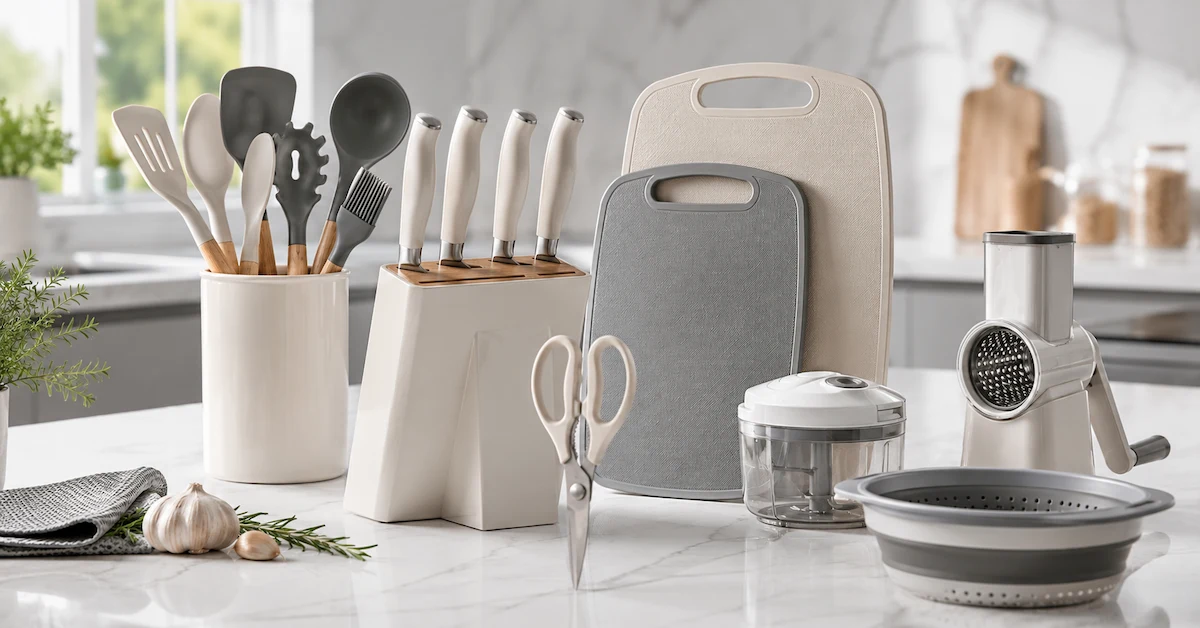
Houseware sourcing is more complex than it first appears. A single kitchen set may include utensils, cutting boards, a holder, scissors, a strainer, a grater, or a knife block. These items may involve different materials, forming methods, assembly steps, and packing requirements. The real sourcing question is not only “Who can supply this set?” but “Who can explain how each part is made, checked, packed, and kept consistent from order to order?”
Key Takeaways
- Do not judge a China houseware factory by product photos alone; ask for material, structure, and packaging details.
- Mixed-material kitchen sets need closer review because plastics, silicone, stainless steel, coatings, and wood-look parts may behave differently.
- For OEM or private label programs, clarify what can be customized without changing tooling or production risk.
- Samples should be checked as working kitchen tools, not only as display items.
Why Houseware Sets Are Harder to Source Than They Look
Kitchen and home-use assortments often look coordinated on a product page. Neutral colors, matching handles, and tidy countertop storage can make a set appear simple. Under the surface, however, a buyer may be sourcing several product types at once.
A utensil can be one-piece or assembled from separate parts. A cutting board may be rigid, flexible, textured, or layered. A colander may rely on molded structure, flexible sections, or separate rims. A knife block or tool holder may have fit and balance requirements that are not obvious in photos. If the supplier cannot describe these differences clearly, the buyer may be taking on more risk than expected.
This is especially important for retailers and importers building bundled kitchen sets. One weak component can affect the perceived quality of the full assortment. A loose handle, uneven color, unstable holder, or poor carton protection can create complaints even when most pieces are acceptable.
Comparison Checklist for China Houseware Suppliers
Before comparing quotes, buyers should compare the information each supplier can provide. The table below gives a practical framework.
| Evaluation Area | What to Ask | Why It Matters |
|---|---|---|
| Material identification | What material is used for each visible part? | Prevents confusion between silicone, plastic, stainless steel, coated parts, and wood-look finishes. |
| Product structure | Is the item one-piece, assembled, coated, molded, stamped, or joined? | Helps buyers understand durability risks and inspection points. |
| Set consistency | How are color, finish, and component matching controlled? | Important for retail sets where all pieces are displayed together. |
| Packaging | How are holders, boards, and sharp or heavy items protected in transit? | Reduces damage, marking, and poor presentation on arrival. |
| Customization | Which changes affect tooling, assembly, lead time, or cost? | Essential for OEM and private label planning. |
Material and Construction Questions Buyers Should Ask
A capable houseware supplier should be able to explain the product, not just name it. For every item in a kitchen set, request a material breakdown and construction notes. If a utensil has a light wood-look handle, ask whether it is real wood, coated, molded, or another type of finish. If the working end appears soft or coated, ask the supplier to identify the material rather than assuming it is silicone.
For stainless steel items such as scissors or small tools, ask about the forming, finishing, and assembly approach. For cutting boards, ask about stiffness, edge finishing, surface texture, and intended use. For strainers or colanders, ask how the body keeps its shape during use and how the rim or base is reinforced if applicable.
These questions do not need to be adversarial. They help both sides define the product before sampling, quoting, or approving packaging. Vague answers at this stage are a warning sign.
How to Evaluate Product Mix and Assortment Logic
A kitchen set should make sense as a working assortment. Buyers should look beyond the number of pieces and consider whether the included products support a real kitchen routine. A group of utensils, boards, holders, scissors, and strainers can be useful, but only if each item has a clear function and comparable quality level.
Assortment discipline also matters for retail presentation. If a set includes too many unrelated shapes, colors, or finishes, it can look crowded rather than coordinated. A simpler, better-matched set may perform better than a larger bundle with inconsistent components.
When reviewing a supplier’s product range, ask which items are made in-house, which are sourced through partners, and how final inspection is managed across the full set. A supplier may still be suitable if some items are externally sourced, but buyers should understand who controls quality, packing, and problem resolution.
OEM and Private Label Sourcing Guidance
OEM and private label buyers should separate cosmetic customization from structural customization. Changing packaging artwork, color, or set composition may be relatively straightforward. Changing the handle shape, holder design, cutting board construction, or tool head design may require new tooling, new samples, or revised inspection criteria.
Before confirming a project, ask the supplier these practical questions:
- Which parts of the kitchen set can be customized using existing molds or standard components?
- Which changes require new tooling or engineering review?
- How will color matching be handled across different materials?
- What sample approval steps are recommended before mass production?
- What packaging options are available for retail, e-commerce, or wholesale cartons?
- What inspection points are used for surface finish, fit, stability, and carton condition?
Do not assume that a supplier’s catalog item automatically fits your sales channel. A set for supermarket retail, online fulfillment, promotional gifting, or a private label kitchen range may need different packaging, labeling, carton strength, or assortment design. Where commercial details are not stated, buyers should ask directly about MOQ, lead time, sample cost, packaging cost, and any required documentation.
Sample Review: What Procurement Teams Should Check
Samples should be tested as everyday products, not only photographed. Pick up each utensil, check the handle joint, look for rough edges, inspect color consistency, and place the set in its holder if one is included. For boards, check flatness, edge quality, and whether the handle opening feels cleanly finished. For colanders or strainers, check stability and how the structure responds when handled.
Packaging samples are just as important as product samples. A kitchen set may contain long utensils, flat boards, sharp tools, and bulky holders in one carton. Ask how the supplier prevents rubbing, deformation, movement, and visible marking during transport. If the product is intended for retail display, review the unboxing experience and shelf presentation before approving mass packing.
Common Mistakes When Choosing a Houseware Manufacturer
One common mistake is treating all kitchenware as the same category. A molded utensil, a stainless tool, and a cutting board need different quality checks. Another mistake is over-prioritizing appearance before confirming material and use requirements. A coordinated color palette is useful, but it cannot compensate for weak construction.
Buyers also sometimes accept unclear specifications because the product looks familiar. This creates problems later when samples, production goods, or repeat orders do not match expectations. Written specifications should include material descriptions, dimensions where needed, color references, packing method, sample approval records, and agreed inspection points.
FAQ: Practical Questions for Buyers
Is one sample set enough to approve a supplier?
No. One sample can show design direction, but buyers should also review consistency, packaging, supplier communication, and the supplier’s ability to explain production details.
Should buyers choose the lowest quote?
Not without comparing specifications. A lower quote may reflect different materials, lighter packaging, fewer components, or less inspection. Ask suppliers to quote against the same product details.
Are mixed-material kitchen sets risky?
They are common, not automatically risky. The key is to confirm how each material is selected, assembled, matched, and checked before packing.
What should private label buyers confirm first?
Confirm which changes are possible with existing products and which require tooling, revised samples, or new packaging development.
What is the best next step when evaluating suppliers?
Request a structured product breakdown, exact sample photos, material notes, packaging details, and answers to your customization questions before making a purchase decision.
