




Household Scissors Supplier Guide for Retail and Bulk Sourcing
Household scissors are familiar, low-cost items, but they can create high-volume problems when sourced without clear specifications. A sample may cut paper well during a quick review, yet fail later because the pivot loosens, the blades do not stay aligned, the handles feel uncomfortable, or the packaging does not explain the intended use. For importers, supermarkets, distributors, online sellers, and private-label buyers, the goal is not simply to find scissors that cut. The goal is to build a repeatable retail product that suits the channel, ships safely, and remains consistent across orders.
Key Takeaways
- Household scissors should be evaluated by blade alignment, pivot control, handle comfort, packaging clarity, and repeat-order consistency.
- Retail buyers should define the use case before selecting a model: general home use, packaging, light craft, kitchen-adjacent tasks, or compact storage.
- OEM and private-label buyers should ask suppliers about color, logo, packaging, carton requirements, and inspection standards before confirming production.
- Bulk sourcing decisions should be based on approved samples plus agreed quality checkpoints, not only on the lowest unit price.
Why Household Scissors Fail After Bulk Delivery
The most common sourcing mistake is treating every pair of household scissors as interchangeable. In real use, consumers open parcels, cut paper, trim labels, clip string, cut light packaging, and store the scissors in drawers where the tips and handles take repeated impact. A product that looks acceptable in a catalog can still perform poorly if the blade edge, pivot tightness, or handle design is not controlled.
Common problems include blades that cut thin paper but struggle with thicker packaging, pivot screws that loosen after repeated opening and closing, rough edges or burrs, handles that are too narrow or slippery, and packaging that does not communicate whether the product is for household, office, craft, or kitchen-adjacent use. These are practical issues for retail programs because returns and negative reviews usually appear only after the product reaches end users.
Blade, Pivot, and Handle Factors to Compare
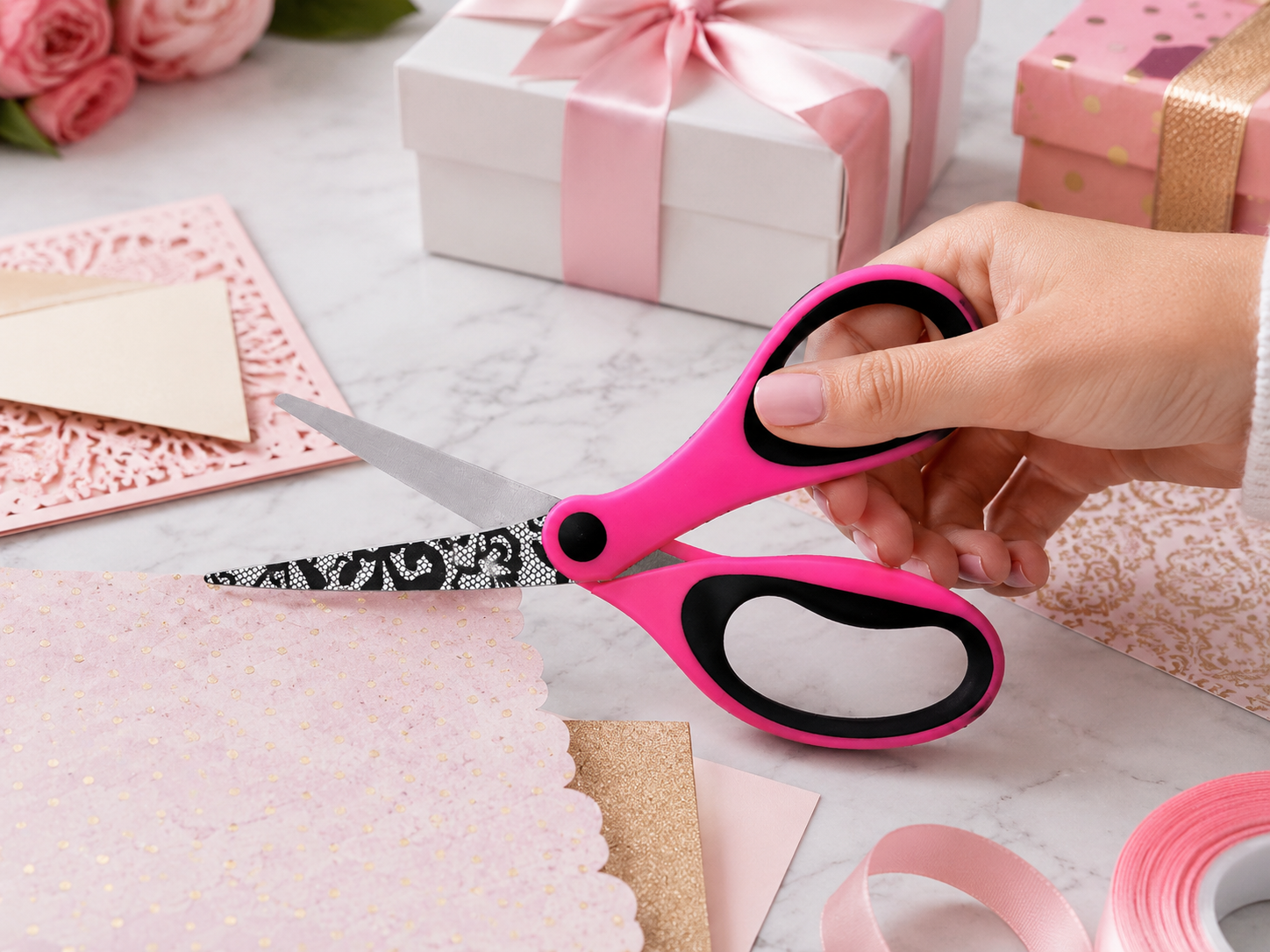
A reliable household scissors supplier should be able to discuss the structure of the product, not only the appearance. Buyers should review blade material as stated by the supplier, blade thickness, cutting edge consistency, tip shape, pivot smoothness, surface finish, and handle comfort. If the scissors are marketed for kitchen-adjacent tasks such as opening food packaging, buyers should also ask what cleaning guidance, material information, and intended-use language the supplier recommends for the destination market.
Handle design deserves close attention because discomfort can make an otherwise sharp product feel low quality. Check finger space, grip shape, edges around the handle openings, and whether the handle feels stable during repeated cutting. For online channels, close-up product images should show these areas clearly. For supermarket shelves, packaging should explain the main use case quickly.
Comparison: Low-Cost Supplier vs Retail-Ready Supplier
| Checklist Factor | Basic Low-Cost Approach | Retail-Ready Sourcing Approach |
|---|---|---|
| Use positioning | One generic model for all tasks | Clear household, utility, craft, or kitchen-adjacent role |
| Blade performance | Sample cuts paper during review | Bulk order checked for alignment and cutting consistency |
| Pivot control | Limited discussion of long-term smoothness | Opening, closing, and looseness checked during inspection |
| Handle design | Basic shape selected mainly by price | Grip comfort, finger space, and hand feel reviewed |
| Packaging | Plain bag or simple card | Retail message, protection, barcode area, and display needs planned |
| OEM questions | Color or logo discussed late | Color, logo, packaging, carton, and approval process confirmed early |
| Repeat orders | Shipment may differ from sample | Approved sample and quality checkpoints documented |
Building a Scissors Line for Different Sales Channels
A household scissors program often works better when products are separated by use case instead of forcing one SKU to serve every buyer. A basic household pair may be suitable for paper, labels, and light packaging. A multi-purpose version can be positioned for general home drawers and parcel opening. A compact model may fit small apartments, office drawers, or travel storage. A comfort-focused model may be better for online listings where ergonomic details can be shown with close-up images.
For supermarkets, the product message should be understood in a few seconds. The front card or visible packaging should show the use scenario and avoid vague claims. For e-commerce, image content should show blade size, handle shape, packaging, and typical cutting tasks. For distributors, carton packing, reorder stability, and clear item differentiation matter. For private-label buyers, questions about logo placement, handle color, packaging layout, and barcode space should be settled before artwork approval.
Bulk Sourcing Questions to Ask Before Ordering
Because commercial details vary by supplier and project, buyers should avoid assuming that every supplier can support the same options. Before confirming an order, ask direct questions and record the answers in the purchase file.
- What blade material and finish are being quoted, and how will they be shown on the specification sheet?
- What cutting tasks is the model designed for, and what tasks should not be claimed on packaging?
- How is pivot tightness checked before shipment?
- Can the supplier provide approved samples that match the intended bulk production?
- What handle color, logo, and packaging customization options are available?
- What artwork approval process is required for private-label packaging?
- What inspection points will be used for blade alignment, surface finish, handle condition, and packaging fit?
- How should cartons be marked and protected for the buyer’s warehouse or retail channel?
Quality Control for Repeat Orders
Quality control should not stop after the first sample is approved. For household scissors, the most useful inspection points are simple but important: blade alignment, cutting performance on agreed materials, pivot movement, handle condition, surface finish, tip condition, packaging accuracy, and carton protection. Buyers should define these points before bulk production so that the supplier understands what will be checked.
It is also wise to keep an approved sample for comparison during repeat orders. If a later shipment uses a different handle color, blade finish, packaging board, or pivot feel, the change should be reviewed before acceptance. This does not require overcomplicated testing for every project, but it does require discipline: the product that ships should match the product that was approved.
Practical FAQ
Q: What is the difference between household scissors and kitchen scissors?
A: Household scissors are usually for general daily tasks such as paper, labels, string, and light packaging. Kitchen scissors are more focused on food preparation or kitchen-specific use. Buyers should avoid marketing a general household model as kitchen scissors unless the supplier confirms the intended use and relevant product details.
Q: What should importers check first when comparing suppliers?
A: Start with the approved sample, blade alignment, pivot smoothness, handle comfort, packaging plan, and the supplier’s process for maintaining consistency in bulk orders.
Q: Are OEM household scissors only about adding a logo?
A: No. OEM work can include handle color, packaging design, barcode area, carton marking, product set planning, and channel-specific presentation. Buyers should ask which options are available for the specific project.
Q: How can online sellers reduce complaints?
A: Use accurate product positioning, show close-up images of the blades and handles, avoid overstating cutting power, and make sure the shipped product matches the listing images and approved sample.
Q: Is the lowest price usually the best choice for bulk scissors?
A: Not necessarily. A lower price may be useful only if the product still meets the buyer’s requirements for cutting performance, comfort, packaging, and repeat-order stability.
