




Kitchen Gadgets Supplier Guide for Multi-Tool Prep Sets
For retailers, importers, wholesale buyers, and private-label teams, choosing a kitchen gadgets supplier is not simply about finding a set that looks attractive in a product photo. Multi-tool prep sets are compact, affordable, and easy to merchandise, but they also contain several moving parts: a chopper or dicer, removable blade inserts, a clear collection container, handheld tools, and storage components. If one part feels weak or fits poorly, the whole set can disappoint the end user.
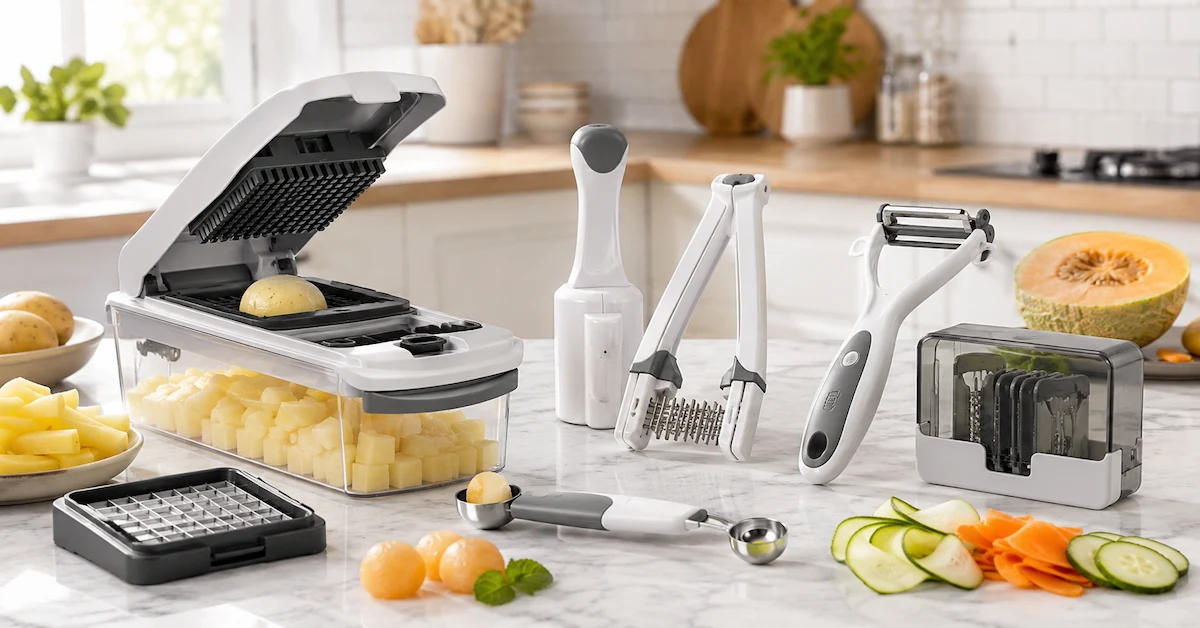
The product shown in the original article is a compact food prep system for cutting, slicing, dicing, peeling, gripping, and measuring. Its visible components include a manual chopper or dicer with a hinged lid and transparent container, a handheld peeler or stripping tool, a gripper-style utensil, a multi-blade slicer or grater module in a storage case, and a small scooping or measuring utensil. That combination makes it relevant for salads, simple meal prep, fruit and vegetable preparation, and everyday home cooking tasks.
Key Takeaways
- A multi-tool prep set should be evaluated as a complete system, not as separate low-cost utensils.
- Buyers should confirm materials, blade details, cleaning guidance, and packaging protection with the supplier instead of assuming them from the image.
- Consistent fit between removable parts is critical for reducing returns and complaints.
- Retail copy should focus on visible, verifiable benefits such as compact storage, multiple prep functions, and contained chopping.
What Buyers Are Really Sourcing
A kitchen prep gadget set like this is positioned between an impulse kitchen accessory and a daily-use tool. Consumers are not only buying blades and plastic parts; they are buying faster preparation, less mess, and a more organized way to handle common ingredients. The clear container helps keep chopped food contained. The interchangeable inserts allow users to switch between shapes and textures. The smaller handheld tools support finishing work such as peeling, gripping, or scooping.
For B2B buyers, that means the main sourcing question is not, “How many pieces are included?” A better question is, “Does the set make sense as one coordinated product?” A set with fewer but better-fitting components may be easier to sell and support than a larger set with confusing or fragile accessories.
Visible Product Features to Review
Based on the provided product image and article information, the set appears to use white and gray plastic housings, transparent plastic collection or storage parts, and metal cutting elements in the blades or rods. These are common choices for consumer kitchen prep products, but buyers should avoid making unsupported claims. The exact plastic type, stainless-steel grade, food-contact documentation, dishwasher suitability, and blade durability should all be confirmed with the supplier.
During sample review, focus on the areas that affect everyday usability:
- Open and close the chopper lid several times to check hinge movement and alignment.
- Insert and remove each blade module to see whether it locks securely without excessive force.
- Inspect the transparent container for scratches, cracks, cloudy areas, or weak corners.
- Hold the peeler and gripper tools to assess handle comfort and grip stability.
- Check whether all accessories return neatly to the storage layout after use.
Supplier Evaluation Checklist
A dependable kitchen accessories supplier should be able to explain how the set is assembled, packed, and checked before shipment. The following checklist can help buyers compare suppliers without relying only on catalog images.
| Evaluation Area | What to Check | Questions to Ask the Supplier |
|---|---|---|
| Part fit | Blade inserts, lid, container, and storage case align properly | How is fit consistency controlled between batches? |
| Material information | Plastic and metal parts are clearly identified | What material documentation can be provided? |
| Blade handling | Cutting parts are protected during packing and use | How are blades covered or separated in transit? |
| Packaging | Transparent parts are protected from abrasion and cracking | What inner packing is used to prevent movement? |
| Private label readiness | Product copy and packaging claims are supportable | Which claims are verified, and which require testing? |
Why Compact Storage Matters
Storage is a major buying factor in this category. Many consumers already own single-purpose kitchen tools that disappear into drawers. A prep set with a rectangular base, visible inserts, and a dedicated case gives buyers a clearer merchandising story: multiple functions in one organized footprint.
For retail shelves, compact organization also improves perceived value. The shopper can quickly understand what is included and where each part belongs. For e-commerce, this helps reduce confusion in product images and listing copy. If the accessories look scattered or hard to store, customers may assume the product will be inconvenient after the first use.
Common Sourcing Mistakes to Avoid
One frequent mistake is treating all included tools as equally important. In many multi-tool prep sets, the chopper or dicer is the hero item. The slicer, peeler, gripper, and small measuring tool add value, but they should not distract from the main function. Packaging and online images should show the full set while making the primary use immediately clear.
Another mistake is overpromising. Unless documentation supports it, buyers should not claim a specific material grade, dishwasher safety, special blade performance, or compliance status. Conservative, accurate copy is safer than broad claims that may lead to returns or retailer questions.
A third mistake is ignoring ergonomics. A tool may look acceptable in a catalog but feel awkward in hand. Buyers should test handle shape, pressure points, base stability, and the force needed to chop or insert blades. Small frustrations become negative reviews when a consumer uses the product repeatedly.
Merchandising Guidance for Retail and Wholesale Buyers
This type of product sells best when the function is visible within seconds. Buyers should ask for product images or samples that clearly show the chopper, container, removable inserts, handheld tools, and storage case. Labels or diagrams can help customers understand the difference between slicing, dicing, peeling, and grating functions.
For product listings, useful copy should focus on practical use cases: preparing vegetables for salads, cutting fruit, making side dishes, organizing blade inserts, and reducing countertop mess during manual prep. Avoid exaggerated lifestyle phrases and unsupported technical claims. A clear explanation of what the product does is usually more persuasive than vague promotional language.
Questions to Ask Before Placing Volume Orders
- Can the supplier provide samples from the same construction planned for bulk production?
- How are missing, loose, or damaged inserts detected before shipment?
- What packaging method protects the transparent container and cutting edges?
- Can the supplier document the materials used in food-contact parts?
- Are cleaning instructions, warning labels, and user guidance available for review?
- For OEM or private-label projects, what artwork, packaging, and claim approvals are required before production?
These questions are basic, but they help separate a general kitchen gadget wholesaler from a supplier that understands multi-component prep products. For private-label programs, repeatability and documentation are often more valuable than adding one more accessory to the set.
FAQ
Is this type of kitchen prep set mainly for home use?
Yes. Based on the visible design, it is best understood as a consumer kitchen product for home preparation of vegetables, fruit, salads, and simple meal ingredients.
Can buyers assume the set is dishwasher safe?
No. Dishwasher suitability is not confirmed by the image or provided article details. Buyers should ask the supplier for written cleaning guidance before using that claim.
What is the most important quality point?
Part fit is one of the most important points. Removable blades, lids, containers, and storage pieces must align consistently, or users may find the set frustrating.
What should private-label buyers verify first?
They should verify materials, packaging protection, product claims, user instructions, and whether the supplier can keep the same construction across repeat orders.
How should retailers present this product?
Show the complete set, highlight the chopper or dicer as the main function, and explain the storage layout. Keep claims practical and easy to verify.
Final Sourcing Advice
A good multi-tool prep set should feel coherent, not crowded. When reviewing a kitchen gadgets supplier, inspect the sample as a complete system: open it, assemble it, store it, clean it according to the available guidance, and check whether each accessory has a clear purpose. The strongest sourcing decisions come from confirming real usability, not from counting pieces or relying on optimistic product copy.
