

A kitchen knife factory in China should be evaluated by its ability to manufacture the knife you have specified, demonstrate how that knife is tested, and reproduce the approved design—not simply by offering an attractive sample and a low unit price. For international importers, kitchenware brands, supermarket chains, hospitality distributors, and e-commerce sellers, selecting the right factory means connecting the cutting application, steel specification, blade geometry, handle construction, inspection requirements, packaging, and reorder procedure in one purchasing file.
China has an extensive knife and hardware supply ecosystem, and Yangjiang, Guangdong, is closely associated with knife and scissors manufacturing. That industrial background can make sourcing more efficient, but geography alone does not prove that every supplier controls all critical processes or that every knife in its catalog is suitable for your market.
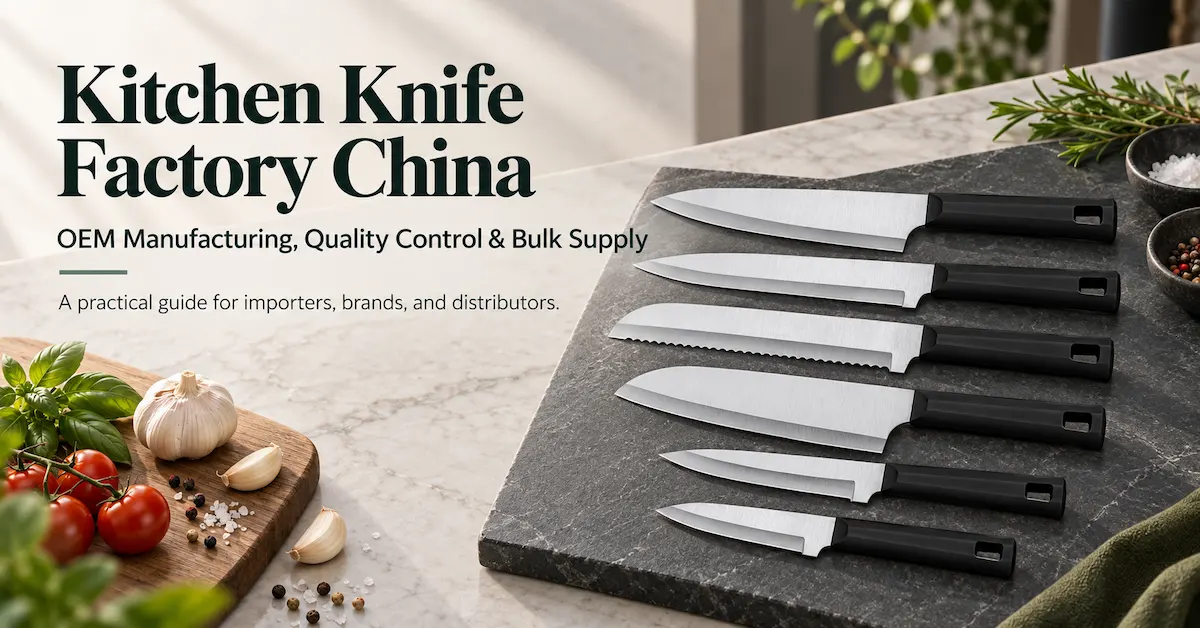
The most useful first request is a model-specific manufacturing and quotation package: product drawings or reference dimensions, blade and handle materials by component, intended cutting tasks, sample approval criteria, packaging requirements, production responsibilities, and clear commercial terms. Only then should buyers compare pricing across suppliers.
This guide focuses on factory qualification and repeatable production rather than repeating a generic chef-knife buying guide. It also uses published BONET product references and distinguishes those catalog specifications from tests, hardness values, production capacities, compliance declarations, or lead times that must still be verified for each project.
What Should a Kitchen Knife Factory in China Actually Provide?
A factory should provide a defined manufacturing solution, not an assortment of loosely described products. For a standard OEM order, the buyer may already have drawings, a reference sample, a target handle material, and packaging files. For ODM development, the buyer may need help choosing a blade profile, balancing manufacturing feasibility with target cost, developing samples, and deciding how a knife or set should be presented at retail.
The distinction matters because the manufacturing risk changes with the project. A catalog knife with an approved logo may require limited development, while a new chef-knife geometry or custom handle requires more technical decisions, tooling review, and verification.
At a minimum, a capable supplier should explain the following areas:
- Product fit: Which knife types support the buyer's actual cooking or retail use case.
- Materials: What grade is used for the cutting component, handle, rivets, and any other relevant parts.
- Manufacturing route: Which operations form, heat-treat, grind, polish, assemble, and clean the products.
- Quality control: How finished knives are checked against an approved sample and objective criteria.
- Customization: Which changes use existing tooling and which require new development.
- Packaging: How individual knives or sets are protected and prepared for the intended channel.
- Commercial execution: How MOQ, pricing, lead time, inspection, export terms, and repeat orders are managed.
BONET describes OEM manufacturing by drawing or sample and ODM work involving concept development, structural optimization, sampling, material recommendations, and packaging development on its OEM/ODM service page. These are published service categories, not blanket guarantees about every individual knife model.
Why Yangjiang Matters—and What It Does Not Prove
Yangjiang's concentration of cutting-tool businesses makes it a natural place for international buyers to research kitchen knife manufacturers. Manufacturers and supporting suppliers can exist within the same regional ecosystem, which may help with access to materials, tooling, finishing, or packaging resources.
However, a Yangjiang knife factory is not automatically more suitable than another supplier merely because of its address. Buyers should still distinguish the company receiving the purchase order from the physical production site and identify which activities the factory performs itself or coordinates with qualified partners.
A particularly useful exercise is to create a simple process map. Ask who controls blade forming, material sourcing, heat treatment, grinding, polishing, handle production, final assembly, surface finishing, packaging, and outgoing inspection. If a process is outsourced, establish who approves the subcontractor and who is accountable when results vary.
A hybrid manufacturing model can work well when responsibilities are clear. What creates risk is an unclear chain in which the supplier cannot identify the material or explain how a critical dimension or blade finish is controlled.
Ask to review the current business identity, manufacturing address, representative products, process photographs or videos, relevant equipment information, and appropriate quality documents. For a substantial new program, a factory audit or independent assessment may be justified. The review should focus on the exact knives you plan to buy, not an impressive but unrelated showroom display.
Who Buys Kitchen Knives From Chinese Factories?
The right purchasing criteria vary by buyer type. A private-label supermarket range, a restaurant-supply program, and a DTC premium brand are not buying the same customer experience.
| B2B buyer | Primary objective | Most important factory questions |
|---|---|---|
| Private-label kitchenware brand | Distinctive, repeatable branded knives | Who owns design versions, tooling, logo files, and approved colors? |
| Importer or sourcing agency | Predictable product and landed cost | Which factory makes the knife, and what is included in the quote? |
| Supermarket or chain retailer | Shelf-ready range and replenishment | How are barcodes, packaging, carton quantities, and repeat lots controlled? |
| E-commerce seller | Clear feature proposition and parcel protection | Will samples match online claims, and will packaging prevent damage? |
| Distributor or wholesaler | Assortment breadth and reliable restocking | Which models share platforms, and how will multiple SKUs be tracked? |
| Hospitality or catering buyer | Practical, consistent prep tools | How are cutting performance, handles, cleaning, and replacement orders evaluated? |
For example, a restaurant distributor may prioritize predictable grip and cutting behavior over a decorative finish. A supermarket buyer may need coordinated knife sizes, packaging, labels, and price points. An online brand may focus on recognizable product photography and protective packing, while still needing clear care instructions and safety claims.
Do not let a supplier's standard sales presentation replace your channel-specific requirements. The strongest factory discussion begins with what the end customer will do with the knife.
Which Kitchen Knife Types Should Be in Your RFQ?
A kitchen knife assortment should be designed around tasks rather than an arbitrary number of pieces. Basic terms can conceal important differences in geometry, size, edge profile, and handling.
Chef Knife
A chef knife is generally positioned for broad meal-preparation tasks such as chopping vegetables, slicing ingredients, and mincing herbs. The buyer should specify the intended blade size, profile, cutting-board interaction, and grip preferences. An attractive broad blade does not guarantee suitable balance or edge quality.
Santoku Knife
Santoku profiles are commonly chosen for chopping and slicing a range of ingredients. The design may appeal to household buyers wanting a compact all-round kitchen knife. When a catalog describes scallops or hollow-ground features, confirm that the selected model actually has them and that the product claim is supported by the physical sample.
Bread Knife
A bread knife generally uses a serrated edge to cut through crusts while minimizing crushing. Buyers should evaluate serration geometry and use representative bread during sample review. Do not treat a decorative serration as proof of effective cutting.
Utility and Paring Knives
Utility knives can bridge the gap between larger preparation knives and smaller detailed tools. Paring knives are more oriented toward controlled small-scale work. For both categories, handle comfort and tip geometry can be important to the intended use.
Cleaver or Meat-Cutting Knife
The word 'cleaver' covers different applications. A heavy chopping cleaver and a thinner slicing-style meat knife are not necessarily interchangeable. State the task, thickness expectations, and materials to be cut rather than relying on the category name alone. Do not advertise bone-cutting capability unless verified for the selected model.
Knife Sets
A set adds challenges beyond the individual blades. Buyers must approve the assortment, handle color consistency, number of components, optional scissors or peelers, storage arrangements if included, and the fit of every item within packaging. A seven-piece marketing label does not necessarily mean seven knives; identify each component explicitly.
These categories are represented in various forms in BONET's Kitchen Knife category. The unusual spelling in that URL comes from the existing published site path and should not be 'corrected' in an article link without confirming a different live URL.
BONET Product Examples: Published Specifications, Not Assumed Performance
A model-level comparison is more useful than generic references to 'premium stainless steel.' The following entries reproduce relevant public product fields and help buyers decide what questions to raise during sourcing.
| BONET model | Product reference | Published metal material | Published plastic material | Procurement implication |
|---|---|---|---|---|
| K102 | Chef knife and kitchen-tool set | 420 stainless steel | PP | Confirm every included blade and accessory, not just a general set description |
| K103 | Kitchen knife set | 430 stainless steel | PP | Confirm blade-grade suitability, material documentation, and actual cutting tests |
| K105 | Plastic-handle knife set | 430 stainless steel | PP | Review the blade component specification separately from handle claims |
| K107 | Hollow-handle knife set | 430 stainless steel | Not listed as plastic ('/') | Check construction, handle joints, blade composition, and set assortment |
Product links: K102 chef knife set, K103 kitchen knife set, K105 plastic-handle knife set, and K107 hollow-handle knife set.
A significant sourcing point emerges from the material fields: these products do not all list the same stainless-steel grade. Buyers should not silently substitute one model's published grade for another's, and should not infer hardness, edge retention, or long-term cutting performance from the website specification alone.
In particular, a published 430 stainless steel field merits specific clarification about the cutting blade. The 430 designation is commonly associated with a ferritic stainless-steel family, which behaves differently from hardenable knife-blade alloys. A purchasing team should ask the factory to confirm which component uses the stated grade, whether the published field is current, and which physical sample and test evidence support the intended knife performance. This is a verification question, not an assertion that any listed BONET product is defective.
Because some product listings describe an entire set using a single material field, verify whether all knives and accessories share that specification. When catalog copy and technical fields are inconsistent, request an approved component-by-component specification rather than selecting the more favorable marketing phrase.
Use existing BONET product details to narrow down the exact knife or set you want to customize.
420 vs 430 Stainless Steel: What Knife Buyers Need to Verify
Steel-grade comparisons can attract search traffic, but they become harmful if they encourage buyers to choose on a single number. The labels '420' and '430' refer to different stainless-steel families; the exact composition, processing, and application need confirmation.
A 420-series martensitic stainless steel may be capable of hardness changes through suitable heat treatment depending on its specific chemistry and condition. A 430-type ferritic stainless steel is not conventionally hardened in the same way. Those general material characteristics explain why a buyer should ask more questions when an entire kitchen knife set is described only as '430 stainless steel.'
Do not jump from the steel label to statements such as 'the knife is sharp for five years' or 'the knife will never rust.' Neither follows from a catalog grade alone.
| Evaluation question | 420-series listing | 430-series listing |
|---|---|---|
| Which component is covered? | Confirm actual blade/handle components | Confirm actual blade/handle components |
| How is hardness achieved? | Request grade-specific treatment and measurements if needed | Ask for clarification of blade alloy and actual edge-performance basis |
| How is corrosion performance described? | Require claims supported by conditions and tests | Require claims supported by conditions and tests |
| What proves the finished knife works? | Representative cutting and durability evaluations | Representative cutting and durability evaluations |
| What belongs in the purchase agreement? | Agreed material and acceptance criteria | Agreed material and acceptance criteria |
The goal is not to recommend a universal steel grade for every kitchen knife. It is to specify the material appropriate to the design, confirm what is actually used, and validate finished products on realistic food-preparation tasks.
Knife Manufacturing: Stamping, Heat Treatment, Grinding, and Assembly
A manufacturer's process description should explain how finished quality is achieved. BONET publishes a workflow for cutting tools covering stamping, straight adjustment, heat treatment, rough grinding, water grinding, polishing, injection molding, ultrasonic cleaning, setting/assembly, quality check, final clearing, and packing. Not every step necessarily applies in identical form to every knife type, so buyers should request the actual route for their selected product.
Forming or Stamping
Blade blanks need controlled geometry. In stamped constructions, tooling and forming operations can establish the initial shape. Ask how the factory checks dimensions relevant to the approved design and what changes would require new tooling.
Forging vs Stamping: Avoid a False Hierarchy
Some kitchen knives are forged and others are stamped or formed through different routes. Forging does not automatically guarantee better cutting performance, and stamping does not automatically indicate inferior quality. Final geometry, material, heat treatment, grinding, assembly, and inspection all matter. If the selected design requires a particular process, ask for product-specific evidence rather than accepting the claim based on appearance.
Heat Treatment
Heat treatment is critical when the selected alloy and blade design depend on controlled hardness and toughness. Buyers should request the intended process and any required hardness or metallurgical checks. Do not copy a hardness value from another manufacturer into the RFQ without engineering justification.
Rough and Water Grinding
Grinding establishes the edge and influences how a knife engages food. Water-assisted grinding can manage heat and friction during finishing, but a machine name is not a substitute for a finished-product test. Assess edge consistency, grind symmetry where relevant, and cutting performance on agreed materials.
Polishing and Surface Finishing
Inspect surface uniformity, scratches, burrs, and finish transitions. For private-label retail products, cosmetic consistency matters because consumers evaluate several knives together and compare product photos with the delivered item.
Handle Production and Assembly
Handles may involve injection molding or other construction methods. Ask how the blade is joined to the handle and which characteristics are checked for security, finish, ergonomics, and moisture-related use. A beautiful handle photograph cannot establish joint strength.
Cleaning, Final Checks, and Packing
The knife should reach the buyer with a clean, approved surface and packaging appropriate to the sales channel. Where corrosion protection or process residues are relevant, agree on suitable final-treatment and care requirements. Verify that the packed product is safe to handle and protected against transport damage.
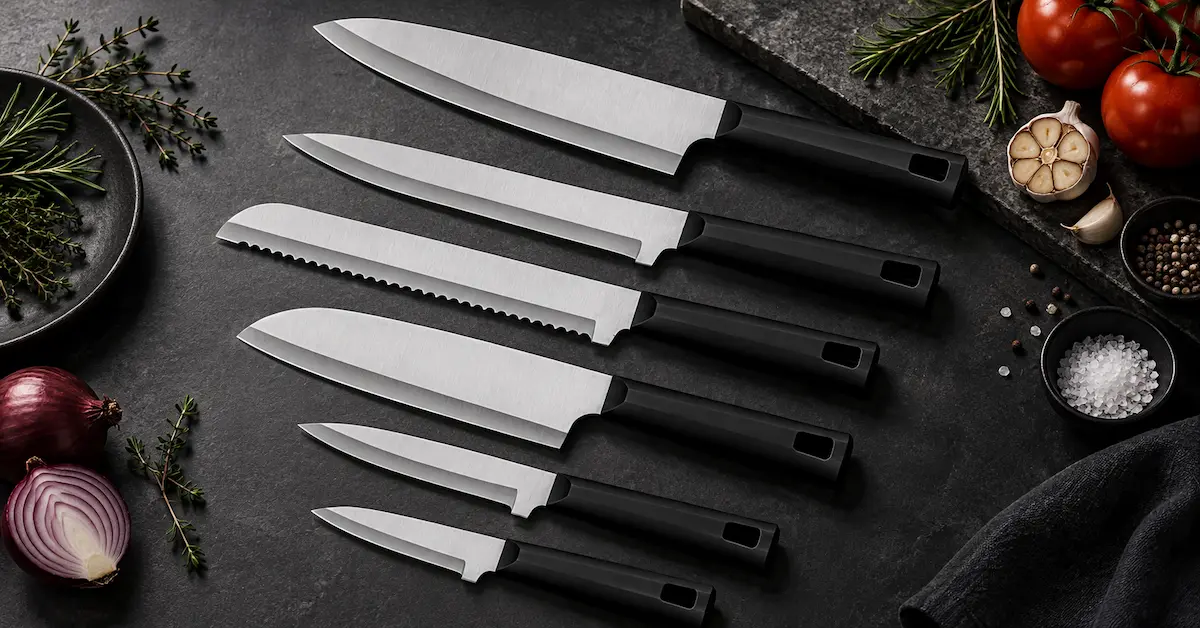
How to Evaluate Blade Geometry, Balance, and Handle Design
A kitchen knife should be assessed as a complete tool. Steel grade is important, but geometry and handling often determine the customer's experience during everyday preparation.
Blade profile: Confirm whether the shape is suited to slicing, rocking, chopping, peeling, or other intended tasks. Use the intended food-preparation applications to guide selection.
Edge geometry: An excessively thick or poorly formed edge may cut inefficiently, while a very thin edge may not suit the intended abuse level. Ask the supplier to explain its design choice and validate it through controlled samples.
Balance: The feel of a knife depends on the blade, handle, and their relationship. A perceived balance point is a sample-review criterion, not something that can be inferred reliably from a studio photograph.
Handle ergonomics: Check grip shape, finger clearance, texture, finish, and comfort during repeated preparation. Include users representative of the target channel where practical.
Joint and fitting quality: Inspect gaps, edges, rivets where present, or the joining method for hollow or molded handles. An attractive finish is not proof of reliable assembly.
Care and storage: Consider cleaning, drying, sharpening guidance, and a safe storage format. Claims such as 'dishwasher safe' or 'non-slip under all conditions' need product-specific support.
A restaurant-supply buyer may prioritize repeated preparation and replacement consistency. A retail gift-set buyer may place more emphasis on coordinated design, packaging, and typical home use. The supplier should explain the trade-offs instead of claiming one model excels at every task.
Build a Sample Test Plan Before Requesting Bulk Production
Samples are the link between marketing promises and a reproducible product specification. They should be tested on the tasks your buyers actually perform. A product that cuts one soft vegetable in a video has not necessarily been evaluated for its full intended application range.
| Test area | Example activity | What to record |
|---|---|---|
| Vegetable preparation | Slice representative firm and soft vegetables | Cut quality, control, user feel |
| Herb or fine preparation | Chop or mince representative herbs | Handling and edge behavior |
| Bread knife function | Slice crusted bread where applicable | Crumbling, tearing, pressure |
| Utility/paring tasks | Peel and trim representative produce | Tip control, precision, comfort |
| Repeated use | Conduct a defined preparation sequence | Fatigue, handle feel, loss of performance |
| Handle connection | Inspect under agreed non-destructive conditions | Looseness, gaps, visible movement |
| Appearance | Evaluate finish under controlled lighting | Scratches, polish, coating consistency |
| Packed sample | Check product orientation and protective elements | Damage prevention and unboxing safety |
These are suggested buyer evaluations, not completed BONET laboratory results. Define the materials, methodology, number of samples, acceptance thresholds, and reporting format before testing. Where a specific hardness, corrosion, or durability metric is important, use an appropriate measured method and document the actual values.
A designated approved reference sample should be connected to the final product drawing, component list, logo version, and packaging artwork. The phrase 'same as sample' is meaningful only if everyone can identify the same controlled revision.
A Kitchen Knife Factory Audit: What to Ask on the Production Floor
A factory audit should follow the product flow rather than become a tour of unrelated equipment. Start with how raw blade materials enter the operation, proceed through relevant forming and finishing stages, then look at handle assembly, inspection, packing, and finished-goods segregation.
Useful questions include:
- Which blade materials are purchased for the selected SKU, and how are they identified?
- Where are component specifications and approved drawings stored?
- Which stages are performed at this site, and which are subcontracted?
- How are tooling revisions approved and recorded?
- How are nonconforming blades separated from acceptable components?
- What happens when grinding or polishing results vary?
- How are assembled handles and finished knives checked?
- Where are reference samples and packaging masters retained?
- How does the factory prevent mixing similar SKUs or artwork versions?
- Who authorizes production changes after customer approval?
A strong response includes responsible people, records, and observable controls. A weak response relies only on words such as 'strict management' without demonstrating the process.
BONET describes 6S management and ISO9001, BSCI, and Sedex-related information on its About page. These are useful due-diligence starting points, but buyers should request current supporting documents and confirm their relevance to the particular factory and transaction. Factory-level management credentials are not substitutes for product-specific conformity evidence.
Send your project brief to discuss feasible materials, sampling, packaging, and order quantities.
OEM, ODM, and Private Label: Which Route Fits Your Knife Project?
The right development model follows the maturity of the buyer's product definition.
Existing-platform private label is suitable when a selected knife already meets the application and the buyer mainly needs logo, color, or packaging changes. Its commercial advantage may be simpler development, but it does not automatically create a unique structural design.
OEM build-to-spec is appropriate when the buyer provides a controlled sample, drawings, blade/handle specifications, and acceptance criteria. The factory then evaluates manufacturing feasibility and produces to the agreed file.
ODM is useful when the buyer has a concept, target market, desired price range, or product-family idea but needs structural or material recommendations, samples, and design iteration. Once approved, the result should still transfer into a stable production specification.
A supplier may offer all three approaches, but each project should identify what is included in the quote, who approves development decisions, and who owns tooling and custom files. BONET's OEM/ODM program provides a six-stage cooperation structure from requirement communication through sampling, quotation, mass production, inspection, and delivery.
Private-Label Customization: Logo, Handle, Finish, and Set Design
Buyers often ask whether a China kitchen knife manufacturer can put their logo on the blade. A more useful branding discussion considers the complete product family.
Logo location and method: Printing and laser engraving may produce different appearances depending on the substrate. Approve the exact result on a physical product.
Handle color and material: A coordinated handle family can create a recognizable retail range. Confirm the material by component and use physical color references where appropriate.
Surface finish: Polished, brushed, matte, or other finishes can support brand positioning when feasible. Their technical or durability implications should be established rather than assumed.
Knife composition: Decide which knives belong together. A set may include a chef knife, santoku, bread knife, utility knife, paring knife, or selected accessories; the assortment should reflect actual user needs.
Packaging and presentation: Artwork, barcodes, instructions, blade protection, gift boxes, and export cartons affect both customer experience and landed cost.
Design ownership: Clarify whether the brand owns new tooling or uses an existing catalog platform. Paying for logo application does not automatically transfer ownership of an existing mold or design.
Packaging and Safety for Retail, Supermarket, and E-Commerce
Knives create packaging challenges that are different from many ordinary kitchen accessories. Their edges need protection, customers must be able to unpack them safely, and the retail package must communicate the intended use without making unsupported claims.
For supermarket programs, check barcode format, shelf/hanging presentation, carton quantity, price-label areas, and consistent artwork across each SKU. For e-commerce, assess individual parcel handling, internal movement, blade protection, and the total shipping volume of the packed product. For gift sets, confirm that every component is retained and that the finished pack presents the assortment consistently.
A package that looks premium in a studio may still fail if knives shift during transportation or if accessories damage each other. Approve a packed sample, not just an empty box dieline. Clearly specify which party is responsible for protective inserts, warnings, instruction leaflets, and carton markings.
Retail compliance and labeling requirements vary by destination market, product presentation, and buyer channel. Verify those requirements with qualified specialists or the retailer's compliance team rather than assuming one universal label works globally.
MOQ, Tooling, and Factory Quotation: What Actually Changes Cost?
The minimum order quantity of a kitchen knife is not a single industry-standard number. It can change with the model, material, blade shape, handle color, tooling, logo method, packaging print run, accessory choices, and production setup.
A catalog knife with standard components and simple branding may have a different MOQ from a fully customized hollow-handle set with new packaging. Ask suppliers to quote the exact configuration you intend to buy.
A transparent quotation should distinguish product-unit cost, new tooling or development cost, sample expenses, decorative finishing, branded packaging, inspection/testing costs, and shipping terms. Buyers should also know whether a quotation covers packed units or loose products and whether the offer includes any after-approval changes.
| Cost driver | Typical buyer question | Risk if omitted |
|---|---|---|
| Steel and geometry | Which material and blade form are included? | Non-equivalent quotes |
| Handle | What material and construction are included? | Unexpected tool or component changes |
| Surface finish and logo | Which treatment, size, and position are included? | Later price adjustment |
| Knife set composition | Exactly which items are included? | Missing accessories or wrong assortment |
| Packaging | Which individual pack and export carton are quoted? | Freight and retail readiness problems |
| Quality requirements | What tests and inspection scope are included? | Uncontrolled acceptance disputes |
| Tooling and MOQ | Which changes trigger setup costs or minimum quantities? | Surprise development costs |
A final decision should consider the landed cost, including import-related expenses and realistic logistics—not only the supplier's headline unit price.
Incoterms, Customs, Export Cartons, and Delivery Responsibility
International kitchen knife sourcing needs clear delivery obligations. EXW, FOB, and other Incoterms allocate different responsibilities and should not be used as interchangeable shorthand. Confirm the named place and agreed Incoterms version in the contract, and ensure the quotation covers the same shipment scope across suppliers.
Customs classification and applicable duties depend on the specific knife products and destination market. Avoid copying a generic tariff code or duty percentage from an unrelated article. Check the actual shipment with a qualified customs broker or trade specialist, especially when a set contains different items.
Before shipping, reconcile the commercial invoice, packing list, product descriptions, carton quantities, country-of-origin information, and any documents the importing country or retailer requires. Packaging approvals should be linked to the same SKU version identified on the purchase order.
For ongoing retail programs, build enough time into the schedule for sample approval, packaging proofs, manufacturing, inspection, transport, customs formalities, and destination distribution. A 'quick production' promise does not protect a launch date if artwork or compliance requirements remain unresolved.
Quality Control: From Incoming Material to Approved Shipment
A usable QC plan states what is checked, how it is checked, how many units are inspected, how defects are classified, and what happens if a batch fails. 'We have strict quality control' is not an inspection specification.
Buyers can divide checks into incoming components, in-process characteristics, finished knife performance, appearance, packing, and shipping release.
Critical issues may include unacceptable handling risks, incorrect components, unapproved material substitution, or a product failing required cutting performance. Major issues may include meaningful dimensional or functional deviations. Minor issues may involve agreed cosmetic variation. The precise classification must be set for the product and market rather than copied blindly from a template.
When a deviation occurs, clarify who quarantines affected production, who determines the cause, and who approves any rework or replacement. A defined corrective-action process is more valuable than a vague promise of zero defects.
For professional buyers, inspection should include at least the accepted blade profile, intended cutting test, handle fit, surface condition, set contents, logo placement, packaging integrity, barcode, and carton count. Add product-specific metrics where their relevance can be demonstrated.
Repeat Orders: Prevent Steel, Handle, and Packaging Drift
A successful first production run does not guarantee an identical second run. Materials, component suppliers, tooling condition, coatings, artwork files, or packaging suppliers may change over time.
Create a master SKU specification that includes: product and revision number, component materials, drawings, blade profile, approved finishes, handle color references, logo size and location, accessories, packaging files, carton data, key quality checks, and approved reference samples.
Before every reorder, ask what has changed since the last production. Changes affecting performance, appearance, safety, cost, or market compliance should be reviewed and, where necessary, sampled again. A supplier that can trace revisions and explain change approvals provides a stronger basis for long-term cooperation than one that relies on informal recollection.
This is particularly important for multi-SKU retail programs. Similar-looking knives may use different steel grades, handles, or packaging components. Maintaining separate approved records prevents accidental substitution across the assortment.
A Practical Knife Factory Supplier Scorecard
A structured evaluation can make procurement decisions more defensible. The following weights are an illustrative buyer tool, not a rating of BONET or any other factory.
| Criterion | Suggested weight | Evidence to request |
|---|---|---|
| Product/application fit | 20% | Representative knives, complete set composition, sample results |
| Material and manufacturing transparency | 20% | Component specifications, process map, critical controls |
| Quality and compliance readiness | 20% | Inspection plan, relevant documents, response to deviations |
| OEM/ODM and packaging capability | 15% | Feasibility plan, samples, artwork and pack approval |
| Commercial/logistics execution | 15% | Comparable quotation, MOQ, terms, shipment plan |
| Change and repeat-order control | 10% | Master specification, version history, change approval |
| Total | 100% |
A weighted result should never excuse the absence of a mandatory safety or legal requirement. Treat those as pass/fail gates before commercial scoring. Adapt weights to your product: a hospitality knife program might prioritize handling and long-term consistency, while a retail gift-set program may put greater emphasis on packaging and assortment design.
Example: Launching an OEM Kitchen Knife Collection
Consider a hypothetical private-label kitchenware brand launching a three-tier knife collection. This is an illustrative procurement workflow, not a reported BONET customer case.
The entry tier targets household buyers who want everyday utility at an accessible price. The midrange tier emphasizes more coordinated handles and a curated set of preparation knives. The premium tier emphasizes a distinctive finish and gift-ready presentation.
Instead of requesting an assortment of unrelated knives, the brand creates one range architecture. Each tier has a defined user, target price, selected knife types, packaging brief, and quality criteria. A common brand system controls the logo, type treatment, and visual presentation, while each model retains its own blade and handle specification.
The sourcing team chooses real reference products, requests physical samples, compares the finished knives on representative food-preparation tasks, and approves the packaging and product together. It then asks manufacturers to quote each SKU under equivalent quantity and delivery assumptions.
After approval, the buyer maintains a separate master file per SKU. Reorders use those files rather than the latest supplier catalog description. This approach reduces version confusion and makes future assortment expansion more manageable.
Ten Common Mistakes When Buying Kitchen Knives From China
1. Choosing solely by a factory's region. Yangjiang can help identify candidates, but individual manufacturing evidence is still needed.
2. Accepting steel-grade claims without component detail. An entire set may be given one catalog material field; verify the actual cutting blades.
3. Treating 420 and 430 as interchangeable. Their metallurgical behavior differs. Confirm the role of the listed grade and the finished performance of each selected model.
4. Assuming forged is always better than stamped. Judge the final product against the specification, not the marketing category alone.
5. Approving a photograph instead of a representative sample. Evaluate cutting, balance, handle fit, and package protection physically.
6. Ignoring the contents of a knife set. List each knife and accessory explicitly and check the packed configuration.
7. Comparing incomparable quotes. Align materials, packaging, inspection, development work, quantity, and trade terms first.
8. Making unsupported care or safety claims. 'Rust-proof,' 'dishwasher safe,' and 'food contact approved' need applicable product evidence.
9. Leaving tooling and design rights undefined. Clarify ownership and use of custom molds, files, and exclusive designs.
10. Reordering without version control. An approved reference and documented changes protect consistency over time.
How BONET Supports Kitchen Knife OEM/ODM Projects
BONET HOUSEWARE CO., LTD. is based in Yangjiang, Guangdong, China. Its website presents kitchen knives, scissors, utensils, chopping boards, multifunctional products, and OEM/ODM services for brands, importers, retailers, distributors, and other B2B buyers.
For importers and private-label brands searching for a kitchen knife factory China, BONET offers kitchen knife product options, OEM/ODM customization, and documented manufacturing processes. Buyers can evaluate suitable knife models, blade materials, handle designs, packaging requirements, and quality control before requesting a project-specific quotation.
Its public Kitchen Knife category provides examples of knife sets and different handle constructions. Its Manufacturing page describes process stages relevant to cutting-tool production. Its OEM/ODM page lists material, color, logo, finish, and packaging customization, alongside a six-stage workflow: requirement communication, design and sampling, quotation and confirmation, mass production, quality inspection, and packaging/delivery.
These published capabilities make BONET a relevant company to evaluate for a kitchen knife project. They are not a substitute for confirming the actual production route, material by component, test method, MOQ, available capacity, current certification documents, or project timeline.
A productive enquiry begins with your buyer segment, intended use, reference models, desired materials, branding, packaging, quantity, destination, and required evidence. BONET's contact page provides the official route for requesting a project-specific quotation.
Frequently Asked Questions About Kitchen Knife Factories in China
How do I choose a reliable kitchen knife factory in China?
Start with a knife or set that matches your target users. Confirm business and manufacturing identity, component materials, process responsibilities, physical sample performance, inspection requirements, packaging, quotation inclusions, and repeat-order controls. A regional location or attractive catalog is not sufficient evidence of product suitability.
Is Yangjiang a good place to source kitchen knives?
Yangjiang is associated with knife and scissors manufacturing and can be a useful area for identifying suppliers. However, each candidate still needs product-level and factory-level qualification. Ask who controls critical processing stages and how the approved knife is reproduced on repeat orders.
What knife materials does BONET list on its website?
BONET's K102 product page lists 420 stainless steel and PP; K103 and K105 list 430 stainless steel and PP; K107 lists 430 stainless steel and no plastic component in its structured plastic-material field. Buyers should confirm which parts those material fields cover and obtain current approved specifications before ordering.
Is 430 stainless steel suitable for kitchen knife blades?
A 430-type designation commonly refers to a ferritic stainless-steel family, so buyers should not assume it responds to heat treatment like martensitic knife-blade grades. Where a kitchen knife listing identifies 430 stainless steel, request clarification of the actual blade composition, manufacturing route, and representative cutting-performance evidence. A catalog entry by itself is not a pass or fail result.
Is a forged kitchen knife always better than a stamped knife?
No. Manufacturing method alone does not determine finished quality. The intended application, steel specification, blade geometry, treatment, edge finish, handle construction, and testing all matter. Compare finished representative samples against the same requirements instead of relying only on forged-versus-stamped terminology.
Can I order OEM or private-label kitchen knives from BONET?
BONET publicly describes OEM manufacturing by drawing or sample and ODM development support, together with colors, materials, logo methods, surface finishes, packaging, and sample development. The actual availability, minimum quantity, tooling, and lead time should be confirmed for the chosen model and customization scope.
What affects MOQ for a kitchen knife set?
Minimum quantities can depend on whether the set uses existing models, special blade or handle configurations, custom colors, logo methods, accessories, packaging print quantities, tooling, and manufacturing setup. Request an MOQ for the full proposed specification rather than an undefined 'standard knife set.'
What should I test before approving a kitchen knife sample?
Test the knife on food-preparation tasks relevant to the target market. Review cutting behavior, blade geometry, handle comfort, joint quality, finish, care instructions, and packed-product protection. Set the acceptance method and criteria in advance; do not invent hardness or durability values without product-specific evidence.
What documents do I need to import kitchen knives from China?
Documents and requirements vary by destination market, product category, commercial arrangement, and retailer. Common transaction documents include the commercial invoice and packing list, but additional classification, origin, product safety, labeling, or testing documents may be needed. Consult qualified customs and compliance professionals rather than relying on a universal checklist.
How do I request a quotation from BONET?
Share your target market, sales channel, intended cutting applications, model or reference photos, blade and handle requirements, desired customizations, packaging format, initial volume, projected reorders, and destination. Review BONET's kitchen knife products and submit your request through the contact page.
Conclusion
Selecting a kitchen knife factory in China should begin with the right knife specification and end with a controllable production and reorder process. Compare actual product materials, blade geometry, manufacturing responsibilities, sample cutting results, quality criteria, packaging, and landed cost before choosing on price alone. For models listing 420 or 430 stainless steel, confirm what each published material field covers rather than inferring performance from the grade name.
BONET provides kitchen knife product references, a published manufacturing workflow, and OEM/ODM customization services. To evaluate a specific project, contact BONET for a kitchen knife quotation with your target market, selected knives, branding, packaging, and expected quantity.