




Kitchen Knife Set Supplier Guide for Buyers
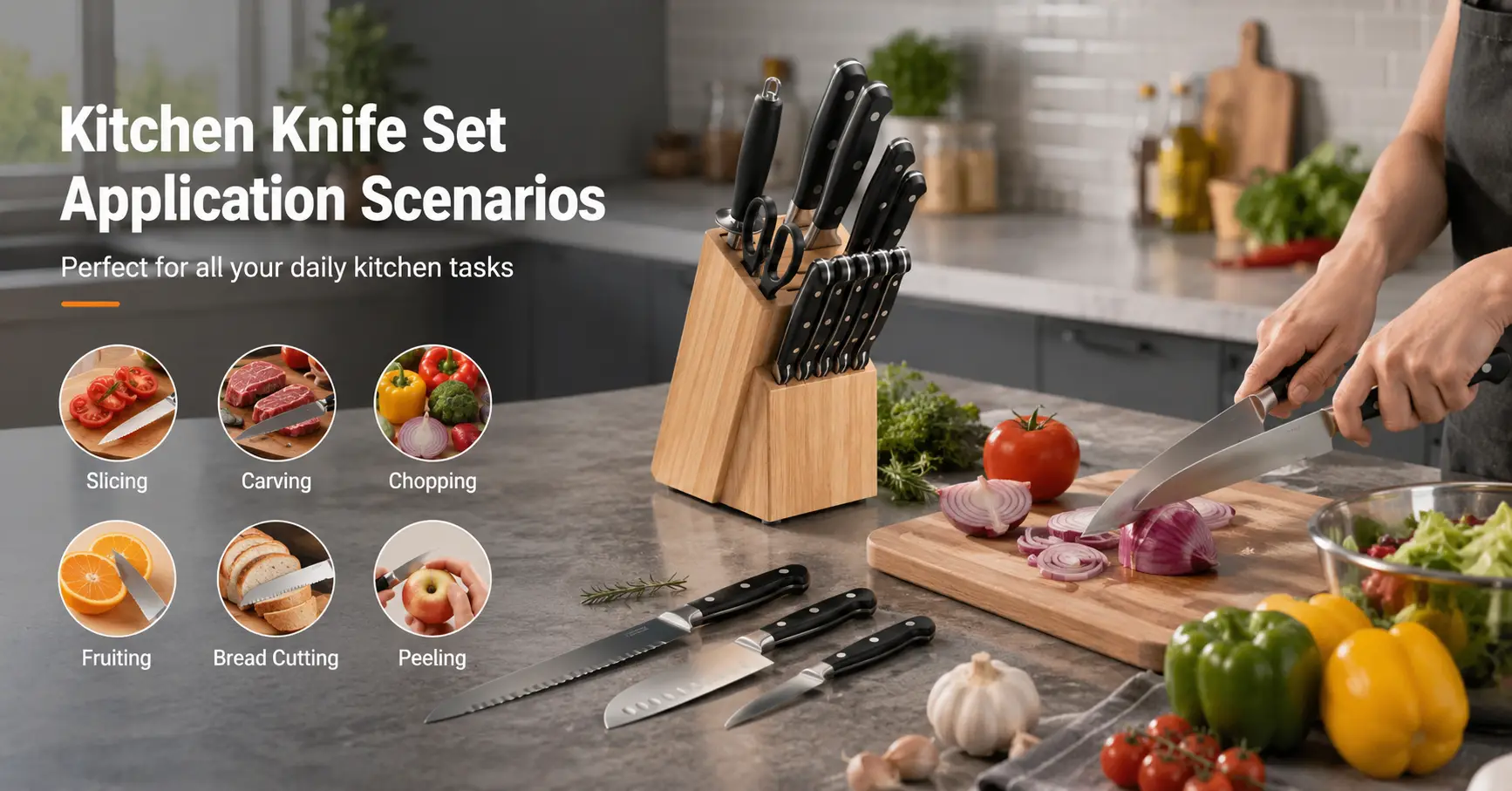
Choosing a kitchen knife set supplier is not only about finding a neat block and an attractive photo. For retail buyers, sourcing managers, and private label teams, the real issue is whether the supplier can deliver a coherent set that works in daily kitchens and remains consistent from sample to shipment. A household knife set is expected to handle simple but frequent tasks: slicing onions, chopping vegetables, cutting bread, carving cooked meat, peeling fruit, and quick countertop prep.
That makes a knife set both a product and a production package. The blades, handles, storage block, scissors if included, packaging, and fit between all parts need to be evaluated together. A good-looking catalog image may create interest, but loose handles, poorly fitted block slots, or inconsistent blade finishing can lead to complaints after the product reaches consumers.
Key Takeaways
- Evaluate the full set structure, not only the number of pieces.
- Ask suppliers to explain blade types, handle assembly, block material, and packaging.
- Use samples to check balance, slot fit, finish consistency, and practical kitchen use.
- Avoid claims about performance, materials, or compliance unless the supplier can document them.
What Buyers Really Need From a Knife Set Supplier
A reliable kitchen knife set supplier should be able to describe what is included in the set and why each part is there. A buyer should understand how many knives are included, which blade styles are used, whether a pair of kitchen scissors is part of the bundle, and what type of storage block is supplied. The set shown in the original product image appears to include multiple knives, black riveted handles, a light natural-looking wood or bamboo-style block, and kitchen scissors. Those visible details are useful starting points, but they are not a substitute for supplier confirmation.
For B2B sourcing, the question is not simply, “Does this set look complete?” A better question is, “Does this configuration match the target customer?” A first-apartment consumer, a supermarket shopper, a gift buyer, and a specialty cooking customer may all expect different levels of variety, finish, and packaging.
Understand the Knife Mix Before Comparing Prices
Piece count can be misleading. A set with many similar knives may look generous but offer limited practical value. A smaller, better-balanced set can be easier for consumers to understand and use. Buyers should compare knife mix by function instead of only by total count.
For a general household assortment, the set should normally cover larger prep work, small trimming tasks, bread or serrated cutting, and convenient storage. If scissors are included, confirm whether they are intended as kitchen scissors and how they are packed in the block. If a supplier describes a set as suitable for slicing, chopping, carving, bread cutting, and peeling, the actual blade selection should support those tasks.
Comparison Checklist for Supplier Evaluation
Use a structured checklist when reviewing samples or quotations. This helps prevent a polished product photo from hiding practical weaknesses.
| Area to Check | Why It Matters | Questions to Ask the Supplier |
|---|---|---|
| Knife assortment | Determines whether the set covers real household tasks. | Which blade types and sizes are included? Are any pieces optional? |
| Blade finish | Affects appearance, cutting feel, and consistency. | How is blade grinding and finishing controlled across production? |
| Handle assembly | Loose seams or poor alignment can trigger customer complaints. | How are handles attached and inspected? Are rivets decorative or structural? |
| Storage block | The block affects countertop stability, access, and perceived quality. | What is the block material? How are slot fit and surface finish checked? |
| Packaging | Sharp parts and block surfaces need protection in transit. | How are blades protected? Has the packaging been reviewed for the sales channel? |
| Documentation | Claims must be supported before retail use. | What product specifications, test reports, or compliance documents are available? |
Manufacturing Details Buyers Should Clarify
Knife sets involve multiple components, so buyers should ask about production control at each stage. For blades, ask how forming, grinding, polishing, and sharpening are managed. Do not assume a steel grade, hardness, or edge performance unless the supplier provides clear specifications and supporting documents. If those details are not available, treat them as open questions rather than marketing claims.
For handles, the visible black handles and metal rivets create a familiar household cutlery look. However, visual sturdiness is not the same as proven durability. Ask how handle alignment is checked, whether gaps are allowed, how edges are finished, and what quality limits apply to scratches or surface defects.
The block also deserves close attention. The image shows an angled, light-colored block that appears to be wood or bamboo-style. Buyers should confirm the actual material, finish, stability, moisture-care instructions, and slot dimensions. A block that wobbles or holds knives too tightly can make the entire set feel poorly made, even when the knives are acceptable.
How to Review Samples Properly
Samples should be tested as a complete consumer product. Remove every knife from the block, return each knife to its slot, hold the handles with dry and slightly damp hands, and inspect alignment under normal room light. Try common prep motions on onions, vegetables, bread, and fruit if safe and appropriate for the sample review. The goal is not to run a laboratory test, but to find obvious design or finishing issues before placing an order.
Also compare more than one sample if possible. A single good sample does not prove production consistency. Ask whether the sample is from regular production or made separately for presentation. For OEM or private label orders, confirm which details can be customized and which changes may affect tooling, packaging, timeline, or cost.
Common Sourcing Mistakes to Avoid
- Buying by piece count alone: More pieces do not always mean better consumer value.
- Ignoring the block: The storage block is part of the user experience, not just a display item.
- Accepting vague material claims: Ask for written specifications instead of relying on broad descriptions.
- Skipping packaging review: Knife sets can arrive with scuffed blades or damaged blocks if packing is weak.
- Using unsupported marketing language: Retail claims should match verified product information.
Wholesale, OEM, and Private Label Questions
When sourcing wholesale or private label knife sets, ask questions that connect product design to commercial execution. Can the supplier provide a clear bill of materials? Which components can be customized? What packaging formats are available? What artwork requirements apply? What inspections are performed before shipment? Are spare or replacement components available if a block or accessory issue appears?
A responsible supplier should be comfortable discussing these points without overpromising. If details such as minimum order quantity, lead time, certification, test reports, or packaging standards are important to your channel, request them directly and confirm them in writing. Do not assume Bonet-specific capacity, pricing, or compliance status unless it is provided in formal supplier documentation.
FAQ
What should a basic household knife set include?
It should include a practical mix for everyday prep, such as larger cutting tasks, small trimming or peeling work, and at least one serrated option for bread-type cutting. The exact mix should match the target shopper and price point.
Why is the knife block important?
The block organizes the set, protects access to sharp tools, and affects countertop presentation. Poor slot fit, rough finishing, or instability can make the whole set feel lower quality.
Should buyers choose a manufacturer or a trading company?
Either can work if communication and quality control are strong. A direct manufacturer may offer closer control over components, while a trading company may coordinate multiple sourcing needs. Ask who controls production, inspection, and corrective action.
How can buyers verify quality before ordering?
Request samples, written specifications, packaging details, and inspection criteria. For larger or private label orders, consider pre-shipment inspection and confirm acceptable quality limits before production.
Are all stainless-looking blades the same?
No. Appearance does not confirm steel grade, hardness, corrosion resistance, or edge retention. Ask the supplier for documented specifications if those factors are important to your product positioning.
Practical Next Step for Buyers
Before selecting a kitchen knife set supplier, build a short comparison sheet covering knife mix, blade finish, handle construction, block material, packaging, customization options, and available documentation. Then review samples against the same criteria. The best supplier for your program is not necessarily the one with the most dramatic product photo; it is the one that can explain the set clearly, repeat production consistently, and answer sourcing questions before they become retail problems.
