




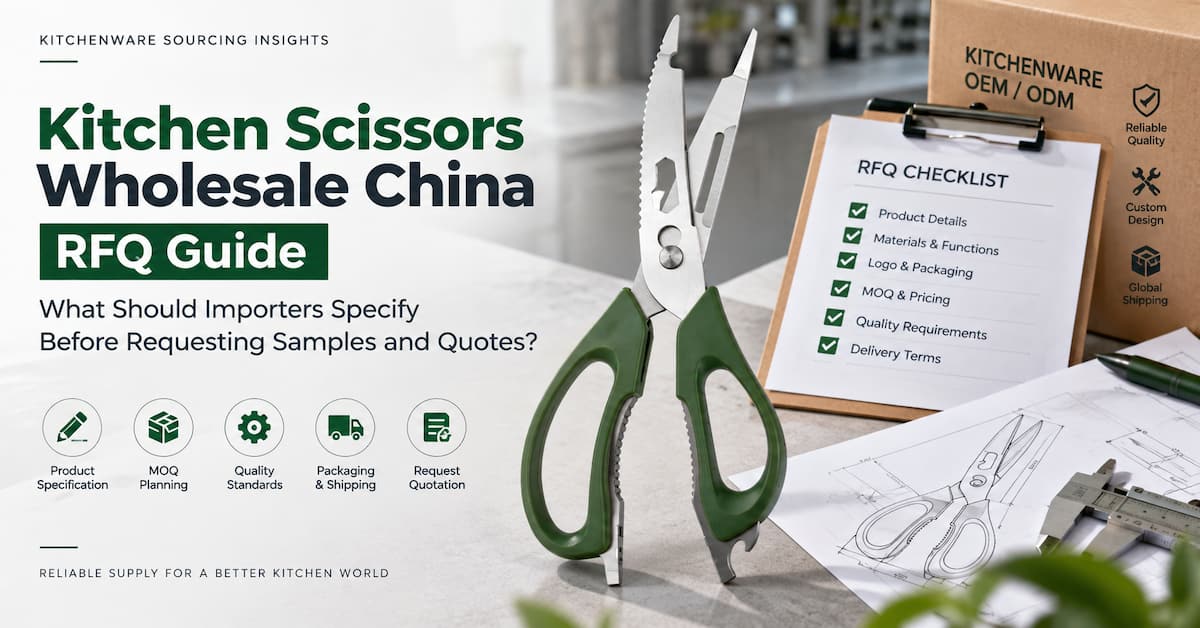
Quick Answer:
A kitchen scissors wholesale China RFQ should identify the cutting task, blade and handle requirements, functions, quantity by SKU, logo and packaging status, inspection route, destination and required date. Ask suppliers to return a model-specific sample plan, MOQ by layer, normalized price, carton data and change-control method. This lets an importer compare equivalent offers instead of comparing unrelated catalog descriptions.
Why a Precise RFQ Produces a Quote You Can Use
It is tempting to request the catalog, price list and sample in one short email. The supplier then has to guess which pair, cutting job and package the buyer has in mind. Prices returned from that request rarely describe the same thing. One may cover a multifunction pair on a retail card, the next a plain pair in a bag, and the third a handle that would require new molding work.
This RFQ guide is for a buyer who is ready to contact a Chinese factory or wholesaler and wants an answer that can move toward sampling. It treats the request as a controlled document. The aim is not to make the buyer sound technical for its own sake. The aim is to make the supplier's assumptions visible early enough to correct them before tools, artwork or printed packaging are committed.
The entity used for context is BONET HOUSEWARE. Its public OEM/ODM workflow describes requirement communication, product development, sampling, quotation, mass production, inspection, packaging and delivery. The supplied ISO certificate covers production and sale of scissors. The BSCI record gives process evidence from its audit date. The RFQ below still asks for project-specific confirmation because a public capability page is not a substitute for a signed specification.
What Is a Kitchen Scissors Wholesale RFQ?
A wholesale RFQ is a shared request for quotation that tells a supplier what must be made, packed, checked and delivered. It is more specific than “send your best price,” but it does not need to solve every design question before the supplier sees it. Good RFQs separate fixed requirements, preferred options, supplier recommendations and unknowns. They also make the order quantity and destination explicit.
| RFQ block | Buyer provides | Supplier should return |
|---|---|---|
| Product identity | Reference image, drawing, model or sample | Feasibility, proposed model and open questions |
| Cutting task | Material to cut, frequency and user environment | Blade, pivot and handle recommendation |
| Functions | Fixed and optional features | Function check and limitations |
| Branding | Logo, color, position and artwork status | Marking method, setup and sample stage |
| Wholesale order | Units by SKU, color, first order and reorder outlook | MOQ, price breaks and packaging minimum |
| Delivery and quality | Destination, date, carton and acceptance route | Schedule, carton data, inspection and test proposal |
Nine-Step RFQ Method for Kitchen Scissors Wholesale China
The nine steps below can be sent as an attachment or used as a call agenda. Each one produces a decision that belongs in the quote, sample record or purchase order.
Step 1: Tell the Supplier Who Will Sell and Use the Scissors
Begin with the buyer role and the route to the customer. An importer supplying supermarkets does not handle the product in the same way as a restaurant distributor, online seller, private-label brand or promotional buyer. Name the destination and describe the shelf, trade catalog or parcel journey. That small piece of context changes what counts as an acceptable finish, useful package and strong enough carton.
Include the target launch or replenishment date, but do not confuse a desired date with a confirmed lead time. The supplier needs to know which decisions are urgent: product selection, handle color, logo file, packaging, testing or booking. A simple milestone view often prevents a buyer from waiting for a logo approval while expecting the factory to be ready for mass production.
Step 2: Attach Product Evidence and Measurements
Attach top, side and open views. Include a ruler or drawing for overall length, blade length, handle opening, pivot position and any feature that changes the silhouette. If the product is a set, show each component and the intended arrangement. Identify which dimensions are fixed and which are open for supplier recommendation. A product title such as “premium kitchen shears” does not tell a toolmaker where the load travels or how the user will open it.
The buyer should also describe the surface. Is the handle smooth, textured, soft-touch, two-color, transparent or overmolded? Is the blade polished, satin, coated or left as a different finish? Do not turn a preference into an unverified technical claim. Ask the supplier to state the available route, sample requirement and evidence for the selected version.
Step 3: Define the Cutting Task and Safety Boundary
List the common materials and the expected frequency. Herbs and packaging film are not the same request as poultry joints or thick twine. Explain whether the scissors are used by a home cook, foodservice worker, store employee or gift recipient. Note hand size or opening-force concerns if they matter to the program. If there is a blade guard, detachable joint or locking feature, define how the customer should use it.
Safety language should be precise. Ask the supplier to show how the blade is protected in the pack, how the pair stays closed and how the user removes it without reaching across an exposed edge. Give any warning statement a named owner. The factory may suggest where it appears, while the buyer market team makes the final call on the wording.
Step 4: Mark the Must-Have Functions
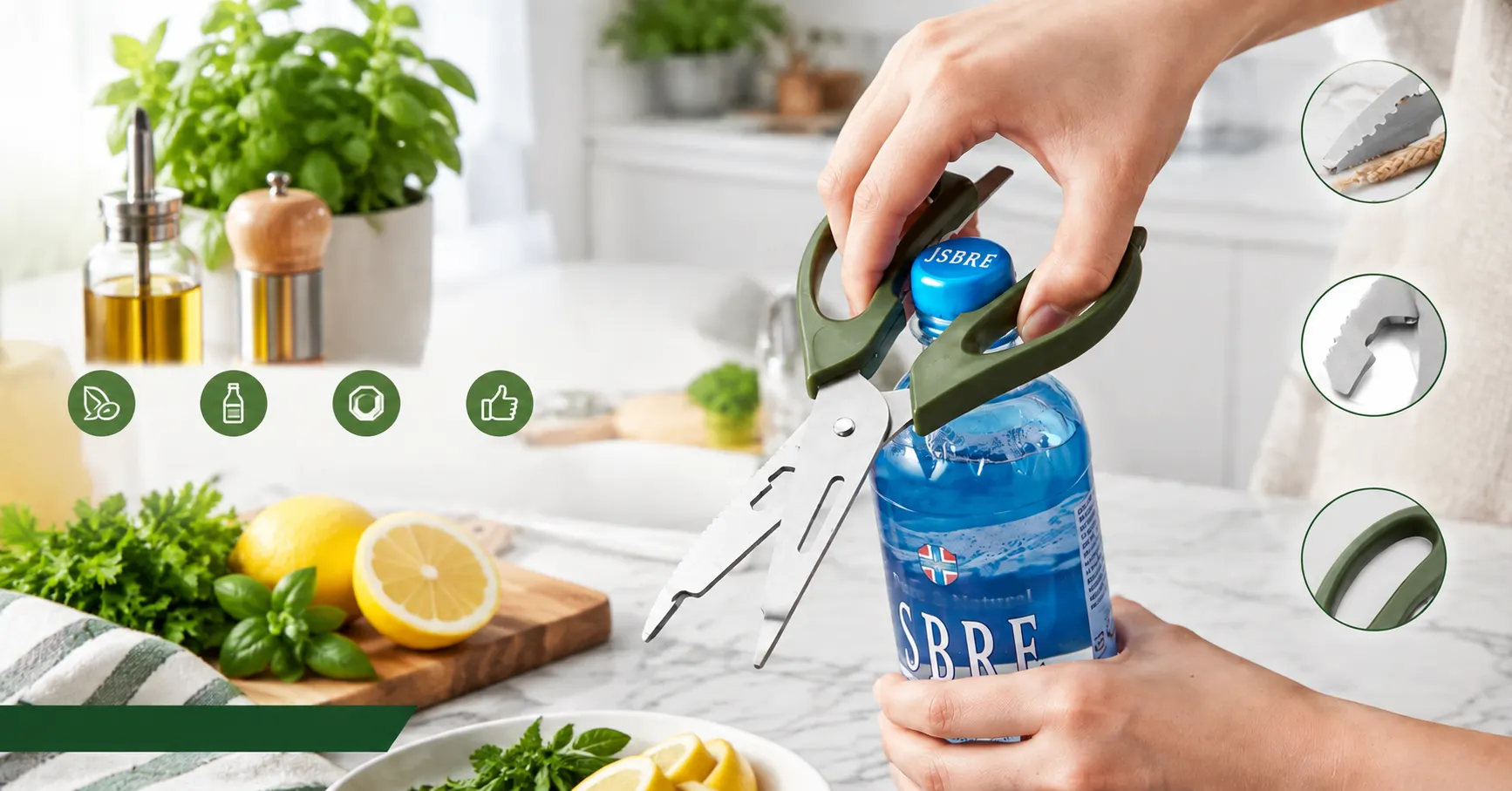
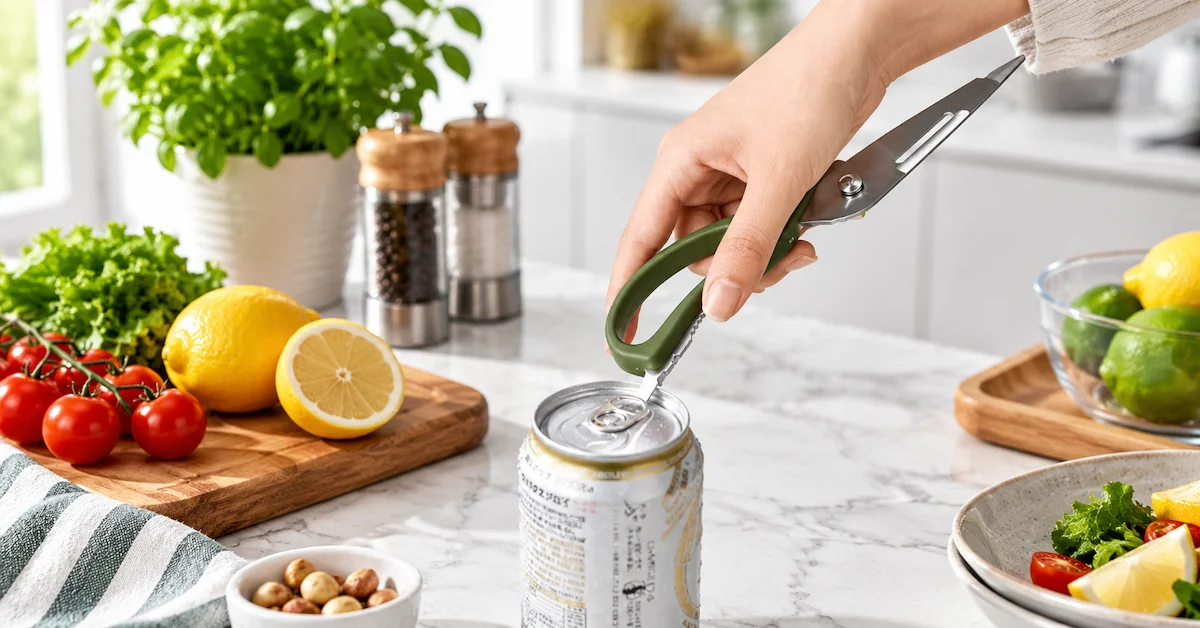
A kitchen shear can carry serration, an opener, nut-cracking jaws, an herb stripper, a bone notch, a fish-scaling edge, magnetic storage or a detachable joint. Sort those ideas into three columns: required, nice to have and open to a factory suggestion. The distinction lets the supplier explain cost or tooling consequences and stops a feature seen in one catalog photograph from slipping into the final SKU by assumption.
| Feature field | Example buyer instruction | What to verify |
|---|---|---|
| Core cutting | Cut herbs and food packaging for household retail | Blade contact, opening force and edge consistency |
| Serration | Required on one section of the blade | Profile, cleaning and actual cutting purpose |
| Bottle opener | Optional after cost review | Position, strength and user access |
| Detachable joint | Required only if cleaning benefit is proven | Release force, reassembly and accidental opening risk |
| Magnetic storage | Preferred for selected retail model | Magnet location, holding behavior and packaging impact |
| Logo area | Handle or blade mark subject to sample | Method, durability and artwork approval |
Step 5: Set the Material and Finish Request
Write “stainless steel blade” only if that is the actual requirement; otherwise ask the supplier to propose the material family and document the basis. Handle materials may include plastic, silicone or a composite direction depending on the model. The knowledge base lists these materials as company capability directions, not as a promise that every SKU uses all of them. Ask for the selected material, surface treatment, color route and relevant evidence in the reply.
Finish requests should be practical. If the buyer wants a bright polish, brushed surface, matte handle or two-color overmold, ask for a physical sample or color chip. Screen images are useful for layout but weak for judging gloss, texture and color under different light. A final approval should identify the sample revision and the part of the finish that was accepted.
Step 6: Specify Logo, Packaging and Label Inputs
Attach a vector logo when available, state the preferred mark location and show the packaging route. A logo on a handle may use a different method from a logo on a blade or card. Include barcode ownership, product name, color or variant, piece count, care copy, origin statement and importer information as applicable to the destination. If the copy is not ready, mark it open instead of placing filler text in a file that may be mistaken for final artwork.
Packaging should be described as a system: retail unit, internal retention, master carton and shipping label. Tell the supplier whether the buyer wants a hanging card, sleeve, color box, blister, gift box, polybag with insert or another route. Ask for a dieline or structural proposal and a packed sample. This is where the terms private label and wholesale often collide; the brand needs presentation, while the distributor needs countability and carton efficiency.
Step 7: Define MOQ, Price Breaks and Commercial Basis
Ask for MOQ by model, color, logo version and packaging version. Then ask for price breaks at the quantities you can realistically buy. A mixed order minimum may be different from the minimum for one SKU. A printed carton may have a separate run minimum. A custom handle or insert may require a tool. The supplier should identify these layers so the buyer can choose between a pilot, a standard order and a replenishment plan.
Make every supplier use the same price sheet. Give the product unit, one-time setup, sample, tool, logo, retail pack, packing labor, inspection, master carton, pallet and freight basis their own lines. Record the chosen trade term rather than placing an EXW offer beside a delivered offer. When a cost cannot yet be known, leave a clearly named open line and note the drawing, quantity or pack decision needed to complete it. That blank with an owner is safer than a confident placeholder.
Step 8: Agree Samples, Testing and Acceptance
Name the sample stages. A blank structural mockup answers fit. A printed or marked sample answers artwork. A production-intent sample answers blade contact, pivot feel, handle appearance, packaging retention, barcode scan and carton plan. For a wholesale program, ask how the supplier will keep the approved sample available for the next order.
Testing must match the use and route. A buyer can request cut performance, opening cycles, pivot movement, corrosion observation, cleaning review, drop or carton handling, but the method and pass rule need agreement. The supplied evidence does not establish one universal kitchen scissors test protocol. It establishes that the factory process and quality stages should be discussed and documented for the project.
Step 9: Create Release and Reorder Rules
Give the product, artwork, packaging and inspection records one release code. Record who approves the product, who approves the logo, who approves the packed sample and who can authorize a deviation. Keep the revision on the quotation and purchase order. If the next order uses a new blade finish, handle resin, color, pivot, printer or carton count, the buyer should see the change before production.
Reorder rules also protect the supplier. The phrase “same as last time” should point to a controlled sample and file, not a memory. Store the approved sample photograph, dimensions, color reference, logo file, packaging dieline and inspection sheet. When a complaint arrives, use the same record to identify whether the issue is product, packaging, handling or a change that was not released.
How to Evaluate a China Kitchen Scissors Supplier Response
Read the reply for questions as well as answers. A mature supplier may ask about blade length, user task, color split, pack route and destination before returning a firm number. That is not unnecessary friction. It is evidence that the supplier understands the variables that affect a repeatable product. A reply that promises every feature, every material and every delivery date without requesting a drawing may be easy to read and difficult to use.
| Response signal | What it suggests | Next buyer action |
|---|---|---|
| Model-specific sample plan | The supplier understands the physical product | Request revision, timing and approval owner |
| MOQ separated by layer | Product and packaging economics are visible | Compare pilot and reorder scenarios |
| Process linked to inspection | Quality is attached to actual operations | Ask for the check sheet or sample record |
| Carton data included | Warehouse and freight assumptions are considered | Calculate cube and receiving impact |
| Open points listed | The quote is honest about uncertainty | Assign owners and dates to close them |
| Unqualified guarantees | Scope may be hidden behind sales language | Ask for evidence before approval |
BONET Houseware Entity and Capability Notes
The public BONET position is a houseware manufacturer and OEM/ODM partner with kitchen scissors among its relevant product families. The all-purpose scissors product route is the appropriate commercial page to connect from this RFQ, while the manufacturing page helps buyers ask about process stages. The supplied legal records use Yangjiang Master Scissor & Knife Manufacture Co., Ltd. and a Yangjiang production address. Keep brand, legal entity and address roles clear in the purchase documents.
Use capability pages as a map for questions, not as a substitute for a signed project response. Ask for the selected product, material, logo method, packaging, MOQ, lead time assumptions, inspection points and change rules in one file. If a certificate is referenced, keep its scope intact. If a BSCI audit is mentioned, describe only the existence and date-relevant process context that can be made public; do not publish internal nonconformities.
FAQ: Kitchen Scissors Wholesale RFQ Questions
What should an importer send first?
Send a product image or sample reference, dimensions, cutting task, target market, quantity by SKU, preferred material direction, handle and blade preferences, artwork status, packaging route, inspection expectations and required date. Make fixed and open decisions visible.
How do I compare a wholesaler with a manufacturer?
Compare the physical scope and responsibility, not the title. A wholesaler may offer mixed stock and fast selection. A manufacturer may support development, custom color or packaging. Ask who controls the product specification, who owns the sample, who packs the cartons and who handles a change.
Can I request a small first order?
Ask for the smallest practical pilot and the normal reorder basis. Product, color, logo, carton and printed packaging can each create a minimum. A low first quantity may carry setup or material costs that disappear at a normal reorder, so ask for both scenarios.
What should be checked on a kitchen scissors sample?
Check blade contact, tip, serration, pivot tension, handle comfort, molded surfaces, added functions, logo position, pack retention, barcode scan and carton marks. Photograph the sample with its revision and keep it as the reference for production.
How long does a wholesale kitchen scissors project take?
Timing depends on product selection, tooling, material, artwork, sample gates, testing, packaging and order quantity. Ask for a milestone calendar and identify what the buyer must approve. Do not treat a generic lead-time number as a confirmed schedule for a custom project.
Can BONET quote kitchen scissors with private label packaging?
BONET's public OEM/ODM page covers logo work, packaging changes and kitchenware development. Through the BONET contact page, send the item or reference, sales market, realistic quantity, available logo file, preferred pack and required date. A useful reply should say what can be made, which samples come first, what drives MOQ, which charges occur once, how the price is based, what carton information is available and which timing or test points remain assumptions.
Buyer-Specific Notes to Add to the RFQ
An importer that sells to supermarkets should put barcode, carton marks, country-of-origin information and shelf orientation near the top of the brief. A distributor serving restaurants should put grip, cleaning, case count and replacement logic first. An online brand should describe the parcel path and the damage that creates a return. A promotional buyer should identify the event date and logo approval owner. The product may be the same, but the RFQ should reflect the commercial job.
For a private-label family, keep the brand rules and the tool design in different parts of the brief. Logo treatment, colors and the packaging hierarchy can remain consistent across the range. Each pair may still need its own blade length, serrated area, joint and handle shape. Show the family rules once, then give every SKU a short technical page of its own. The supplier can preserve a recognizable range without pretending that all scissors come from one mold or fit one carton.
A foodservice buyer should also explain the cleaning reality. “Commercial kitchen” can mean frequent hand washing, a dishwasher route, a busy prep line or a back-of-house storage rack. The supplier needs to know which environment matters. Do not convert the phrase into an unsupported food-contact or sanitation certification claim. Instead, describe the use and request the material, surface and test information that the quality team needs.
| Buyer type | Add these RFQ details | Common mistake |
|---|---|---|
| Supermarket importer | Barcode, shelf direction, case count and label owner | Choosing a product before checking the retail pack |
| Restaurant distributor | Cleaning routine, grip, replacement cycle and carton handling | Using household copy for a commercial use case |
| E-commerce brand | Parcel path, protective pack and return damage tolerance | Testing only the retail unit, not the shipped unit |
| Private-label brand | Shared visual rules, logo files, colors and revision owner | Treating artwork approval as product approval |
| Promotional buyer | Event date, logo deadline, quantity split and backup route | Ignoring setup time and artwork cutoffs |
How to Write a Product Specification That a Factory Can Price
Use nouns and measurable fields before adjectives. Write overall length, blade length, handle opening, serration location, pivot type, color, finish and functions. “Premium” can remain as a market position, but it should be followed by the details that make the position visible: a smooth handle, a particular finish, a gift pack or a controlled color. The supplier can recommend alternatives when the buyer makes the desired result clear.
Mark each field as fixed, preferred or open. Fixed means a deviation requires approval. Preferred means the supplier may propose a practical alternative. Open means the buyer expects a recommendation. This simple status prevents a supplier from spending time on an option that the buyer will never accept and prevents the buyer from treating a suggestion as an approved change.
Attach a reference sample when shape and feel matter. A photograph helps identify the model, but it does not show opening force, pivot tension, surface texture or the way a handle sits in the hand. If sending a physical sample is not possible, add a scale view, a short video and a list of the dimensions that cannot move. Ask the factory to repeat the dimensions in its feasibility reply so both sides are looking at the same object.
How to Ask About Materials Without Overclaiming
Instead of asking for 'the best stainless steel,' explain the use, surface expectation and cleaning exposure, then ask for the proposed material family and the evidence available for the selected model. A supplier may have more than one route. The correct choice depends on edge behavior, corrosion expectation, finish, cost and the buyer's market. If a grade or standard is required, name it and ask for confirmation before the sample is approved.
For handles, describe the result in the hand and the visual system on the shelf. The supplier may propose plastic, silicone or a composite direction. Ask about the surface, color consistency, parting line, grip and any overmold process. A color rendered on a screen is not the same as a molded color under warehouse light. Include a color chip or a physical reference in the approval process.
Packaging materials deserve their own field. A card, sleeve, color box, blister or insert can touch or rub the product. Ask how the pair is cleaned before packing, how the blades are protected and whether printed ink or adhesive can contact a surface that must stay clean. These questions are practical and evidence-based; they do not require the buyer to promise a food-contact certification that has not been confirmed.
RFQ Samples: What Each Stage Should Prove
A structural sample should answer whether the scissors fit the requested retail or shipping format. Measure the cavity, close the pack and handle it from the side and top. A graphics sample should answer whether the logo, product name, piece count and barcode are placed correctly. A material sample should answer whether the handle color, surface and blade finish match the approved direction. A production-intent packed sample should answer the remaining questions about retention, assembly, scan and carton.
Name the approval gate on the file. “Approved” can mean approved for concept only, approved for artwork, approved for packaging, or approved for mass production. The buyer should not let one word carry four meanings. Use a revision, date and owner. If the supplier makes a change after approval, request a new sample or a documented deviation depending on the effect.
For a range, do not assume one sample represents every color or function. A different handle resin can change the surface and fit. A different blade length can change the insert. A different logo method can change the artwork proof. Sample the meaningful combinations and explain why any combination is being treated as representative. This is especially important when the first order contains a family of wholesale SKUs.
Testing and Inspection Questions for a Wholesale RFQ
A test request should answer four questions: what is being tested, how it will be tested, what passes, and who keeps the evidence. For cutting performance, define the material and the number of cuts or observation route. For opening cycles, define the movement and the sample count. For corrosion observation, define the exposure or reference method. For packaging, define the route and the damage limit. The supplier can recommend a method, but the buyer should approve the final rule.
Inspection at production should mirror the important risks. A first-piece check can confirm the blade pair, pivot and handle. An in-process check can catch assembly or color drift. A final check can cover count, function, appearance, logo, packaging and carton marks. Ask where records are kept and how a nonconforming lot is contained. The goal is not to demand a large report for every order; it is to make the acceptance path visible.
For a multifunction model, write one acceptance line per feature. “All functions work” is hard to audit. Instead, check the opener, notch, stripper, magnetic feature or detachable joint separately. If a feature is optional or only decorative, say so. Clear feature language reduces the chance that a buyer approves a photograph while the factory builds a different practical behavior.
| Test or check | Buyer-defined input | Useful output |
|---|---|---|
| Cut performance | Material, cut action, observation or cycle count | Pass/fail note tied to the model and sample |
| Pivot movement | Opening force, play, smoothness and repeat action | Inspection record or comparison to retained sample |
| Surface and corrosion | Exposure route, appearance reference and tolerance | Observation, photo and disposition |
| Handle assembly | Flash, cracks, color, grip and logo position | First-piece and final-check record |
| Packed shipment | Route, carton, movement and damage limit | Packed sample, test note and carton data |
| Barcode and label | Digits, quiet zone, copy and scan requirement | Approved artwork and scan confirmation |
Commercial Fields That Make Two Quotes Comparable
Ask the supplier to quote in the same order as the RFQ. Start with the product unit for each SKU. Add logo or other marking, packaging components, assembly, inspection, testing, carton, pallet and freight basis. If a cost is provisional, label the assumption. If a cost is included, define what included means. Two quotes become comparable when a buyer can point to the same field in each file.
Use quantities that match the business plan. One total order can hide a low quantity per color. State both total units and the split. Ask for at least one pilot quantity and one normal reorder quantity. Include whether the buyer wants mixed cartons. Then ask what changes if one color is removed or if the packaging artwork changes. These answers reveal where the supplier's minimum is truly coming from.
Trade terms and logistics should be explicit. Factory price is not delivered cost. FOB can be useful for a buyer with a forwarder, while CIF or DDP may suit a different team. Ask for packed dimensions and gross weight either way. A product with an attractive unit price can lose its advantage when the case is large, the carton count is low or the packaging adds air.
Supplier Due Diligence Before Awarding the Order
Check the legal name on the quote against the entity on the certificate or audit record, while keeping the brand name clear for commercial communication. Confirm the production address and the contact who owns the RFQ. Ask whether the selected model is made on the stated line or coordinated through an approved resource. The purpose is not to reject every subcontracted step. It is to know who controls the final product and where a change must be approved.
The ISO certificate in the supplied records covers production and sale of scissors. That is relevant evidence for a kitchen scissors project, but it is not a blanket certificate for every material, food-contact statement or destination requirement. The BSCI record describes a process snapshot at its audit date. Use both as part of due diligence and still request the current sample, inspection plan and project-specific documents.
A factory photograph can support a story, but it cannot prove that the requested handle, blade or package is controlled. Ask for evidence attached to the project: a drawing, a sample photo, an inspection record, a material statement, a packaging proof or a carton test note. Evidence should answer the exact buyer question. General capability language should not be allowed to carry the whole decision.
RFQ Change Control and Reorder Library
The most common wholesale errors occur after the first approval. A buyer sends a new logo file, a color is changed in a chat message or a packaging printer suggests a different board. If the change is not linked to a revision, production may use an old file or a mixed version. Add a change table to the RFQ record with date, request, impact, approver and new sample requirement.
Build a reorder library with the product code, blade and handle specification, approved sample image, logo file, packaging dieline, barcode, carton plan and inspection points. Store superseded files separately. A new buyer or planner should be able to find the approved route without asking the original salesperson to remember a decision from months ago. This is especially valuable for importers with seasonal staff or multiple warehouses.
When a complaint appears, compare the received lot with the approved record. Was the blade different, or did the insert move? Was the product wrong, or was the carton crushed? Did the artwork change, or did the barcode fail to scan because of the fold? A disciplined release library helps the supplier respond with containment and correction instead of an argument about whose memory is right.
RFQ Submission Checklist
Before sending the RFQ, confirm that the file contains a product reference, buyer and market, quantity by SKU, cutting task, dimensions, functions, material direction, handle and blade preference, logo status, packaging route, carton assumptions, test questions, acceptance owner, required date and quote basis. Attach the most current artwork and identify files that are not final.
Ask an internal colleague to read the brief without the background conversation. If the reader cannot tell which requirement is fixed or how many units are needed, the supplier will probably have the same problem. A short internal review catches missing dimensions, conflicting color names and dates that do not account for approval time. It also gives the commercial team a cleaner explanation when comparing the replies.
| Before send | Pass question |
|---|---|
| Product file | Can the supplier identify the exact pair and its dimensions? |
| Use case | Does the brief say what the scissors must cut and who uses them? |
| Functions | Are optional features separated from required features? |
| Quantity | Are total units, SKU splits, color splits and reorder outlook stated? |
| Branding | Are logo files, positions, colors and copy owners visible? |
| Packaging | Is the retail unit, inner retention and master carton route clear? |
| Quality | Are sample stages, checks and pass rules named? |
| Commercial | Can the supplier quote setup, recurring price and logistics on separate lines? |
| Release | Is there an owner for approval and change control? |
What a Buyer Should Expect in the First Reply
The first reply does not need to answer every question with a final number. It should identify the proposed model, list the assumptions, flag any infeasible feature and state which sample is needed next. It should give a preliminary MOQ or explain what controls it. It should also identify the quotation basis and the documents required to finalize the price. That is enough to decide whether a supplier deserves the next round.
If the buyer receives a price without a model, ask for the model before comparing it. If the buyer receives a lead time without an approval calendar, ask which dates are included. If the buyer receives a material name without a sample, ask how the surface and color will be approved. These simple follow-ups turn a sales reply into a procurement record.
A supplier may suggest a different blade, handle or package. Record the proposal and its reason. The alternative may reduce cost or improve protection, but it is not automatically equivalent to the buyer's original request. A controlled comparison lets the buyer choose based on function, appearance, MOQ, price and timing rather than accepting the change by silence.
Kitchen Scissors RFQ Supplier Links
Start with a China kitchen scissors wholesaler when you need a product-led catalog discussion. For a factory comparison, review a kitchen scissors supplier China and a kitchen scissors manufacturer China. Ask a wholesale kitchen shears supplier for case quantities and a bulk kitchen scissors supplier for price breaks. For brand development, brief an OEM kitchen scissors manufacturer about private label kitchen scissors. If the use is foodservice, state the commercial kitchen scissors wholesale route so the sample, carton and inspection plan reflect it.
Conclusion: Send an RFQ a Supplier Can Actually Answer
The best kitchen scissors wholesale China RFQ is not the longest document. It is the one that makes the product, task, market, quantity, pack, test and approval route visible. Attach evidence. Separate fixed requirements from recommendations. Ask for a model-specific sample and normalized quote. Keep MOQ, price, lead time and test values project-specific until they are confirmed. Then protect the approved record so the second order is not a new negotiation.
For a quote request, send the product image or sample, target market, quantity, material direction, function list, logo or packaging files and required date through the BONET HOUSEWARE contact page.
