

Quick answer: For kitchen utensils wholesale China sourcing, compare suppliers using an identical item-by-item RFQ, not a single advertised unit price. Confirm component materials, the MOQ for every SKU and variation, approved samples, inspection requirements, packed-carton data, the named delivery term and reorder arrangements before paying for bulk production.
The lowest factory quotation is not always the lowest-cost retail program. A profitable shipment needs products customers want, predictable landed costs and a clear path to restock the successful items without accumulating slow-moving stock.
1. What Does Buying Kitchen Utensils Wholesale from China Actually Involve?
Wholesale kitchen utensil sourcing is the purchase of cooking, serving and food-preparation tools in commercial quantities for resale, distribution or incorporation into a larger kitchenware line. It may involve standard factory models, a coordinated retail assortment, branded items or newly developed products. China offers a broad manufacturing ecosystem, but a large catalog alone says little about whether a supplier can manage the exact assortment and delivery schedule required by an importer.
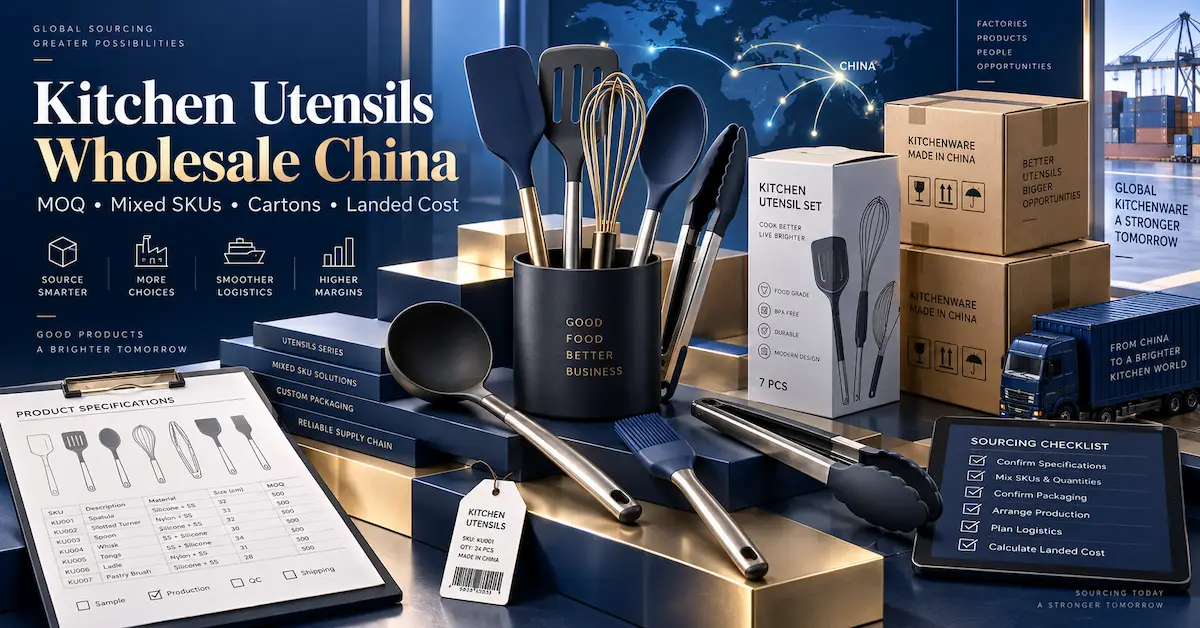
A bulk order becomes more difficult as the number of sellable units, colors, packaging formats and destinations increases. A single silicone spoon may be easy to quote. Ten different items with three colors each can create thirty stock-keeping units, different component minimums, separate cartons and multiple test requirements. The purchasing work therefore starts with controlling complexity, not with collecting the largest possible range of samples.
For supermarket buyers, the problem is often shelf productivity and replenishment. For online brands, the biggest risks may be review-driving product defects and shipping damage. For wholesalers supplying small retailers, a broad but repeatable stock range can matter more than custom decoration. These buyers can use the same factory, but they should not use the same purchase brief.
2. How Should Importers Build a Profitable Wholesale Utensil Assortment?
Begin with the customer and cooking tasks rather than a piece count. Choose products that solve recognizably different jobs: scraping, stirring, turning, serving, gripping or preparing food. Avoid adding another item merely because it looks different in a catalog. Every SKU consumes purchasing attention, inventory capital, packaging space and a place in the replenishment plan.
A useful opening assortment often combines predictable everyday tools with a few distinctive products. A basic spatula and spoon are easier for shoppers to understand than a complicated gadget that needs extensive instructions. Distinctive tools can still improve margin or differentiation, provided the promised function is demonstrated and the product is easy to explain at the point of sale.
| Buyer channel | Initial assortment logic | Common sourcing risk | Useful buying control |
|---|---|---|---|
| Supermarkets and mass retail | Recognizable core utensils, clear shelf packaging, stable replenishment | Excessive colors and poor shelf differentiation | Planograms, barcode checks, carton-level SKU labels |
| Online brands and marketplaces | Focused features, accurate listing photography, parcel-ready packaging | Returns from product variation or crushed retail packs | Golden sample, packed-unit drop or transport validation |
| Kitchenware wholesalers | Reliable everyday range and practical stock depth | Inventory fragmented across slow-moving SKUs | SKU profitability report and documented reorder minimums |
| Cookware brands | Tools designed for the cookware and cleaning routine | Compatibility or heat-use claims without evidence | Application testing and approved claim wording |
| Promotional and gift buyers | Clear gift value, attractive packaging, simple fulfillment | Packaging MOQ higher than product quantity | Artwork approval and packed-set sample |
Think in groups rather than isolated product pages. A "daily cooking" collection might pair a spoon, spatula and turner. A "food preparation" collection may center on a peeler and corer. A premium gift set may justify a more substantial presentation, but the buyer must price the box, protective insert, barcode and outer carton as part of the product.
3. Which BONET Kitchen Utensils Can Buyers Use as Starting References?
BONET HOUSEWARE CO., LTD. is based in Yangjiang, Guangdong, China. The company presents kitchen utensils, kitchen knives, food-preparation gadgets, cutting boards and scissors in its product range and describes services for global brands, retailers and wholesalers. Its published Utensil category contains product references that buyers can use to begin an item-level discussion.
For example, BONET lists model G2008 as a silicone spatula with product dimensions of 20 × 3 × 1 cm. Model G2009 is a silicone spoon listed at 27 × 6.5 × 1.5 cm. The G2007 utensil page lists 27.5 × 6.5 × 1.5 cm. Importantly, the metal-material field for those examples says carbon steel while the plastic-material field says silicone. Ask how the components are constructed rather than describing an unverified core as stainless steel.
| BONET reference | Published dimensions | Use in a buyer shortlist | What still needs approval |
|---|---|---|---|
| G2008 silicone spatula | 20 × 3 × 1 cm | Evaluate for small-scale scraping or spreading | Actual construction, edge flexibility, packing and claims |
| G2009 silicone spoon | 27 × 6.5 × 1.5 cm | Compare stirring reach and bowl shape | Functional load, cleaning instructions and colors |
| G2007 silicone cooking utensil | 27.5 × 6.5 × 1.5 cm | Compare ergonomics with other cooking tools | Component drawing, finish and final sample |
These are examples, not a claim that BONET offers one fixed wholesale price, a mixed-SKU minimum or every requested color. The factory should confirm each item's current availability, specific materials and quotation basis. For additional preparation tools, explore the complete kitchenware product catalog and shortlist only products that fit the sales channel.
Have a Target Range but No Final SKU List?
Send BONET your desired categories, destination market, expected quantities and packaging direction. Ask for feasible product references and a quotation with MOQ shown separately by item.
4. How Does MOQ Work for Kitchen Utensils Wholesale China Orders?
The abbreviation MOQ means minimum order quantity, but it is incomplete until the supplier states what it applies to. A factory may set different minimums for the product model, a color batch, a printing process or a retail box. A wholesale buyer should distinguish the total order quantity from the minimum for every combination that requires separate materials or production preparation.
Consider an illustrative six-SKU launch: 300 spatulas, 250 spoons, 200 turners, 200 tongs, 150 peelers and 100 cutting boards, totaling 1,200 individual units. These numbers are a planning example, not BONET's published MOQ. If the selected spatula requires 300 units per color, dividing those 300 units between three colors may be unacceptable even though the combined spatula quantity reaches 300.
Mixed-SKU purchasing introduces another question: can the supplier coordinate several product families within a single commercial order without making every item share the same production schedule? Do not infer that "mixed orders accepted" means all quantities, colors and packaging types are freely interchangeable. Ask for an item-by-item feasibility table and keep any approved exceptions with the purchase order.
Four MOQ layers to identify
01Model MOQ: the smallest acceptable production or purchase run for each physical item. A standard item may have different conditions from a newly developed design.
02Color and material MOQ: the minimum for a particular material, compound or finish. Matching several models to one color does not necessarily eliminate material preparation requirements.
03Decoration and packaging MOQ: custom printed sleeves, cartons, barcodes and labels may carry minimums that exceed the utensil quantity.
04Shipment economics: even when factory minimums are satisfied, a small mixed order can have a high freight and handling cost per sellable unit.
Ask for three written options if a proposed order falls below a minimum: the original specification, a standardized version using existing components, and a smaller pilot configuration if available. Compare the complete cost and limitation of each. Fewer colors or standardized packaging may help more than a premature redesign.
5. Build an Item Master Before Requesting Prices
Use an item master as the source of truth for the wholesale range. It should connect the buyer's SKU, the factory's product code, the version of the specification, the approved component materials, color, quantity, retail packaging and carton configuration. Every sample approval and inspection report should point back to the same SKU and revision.
Where the supplier proposes a substitute part, new finish or different retail box, treat that as a revision requiring confirmation. Otherwise, the reordering team may only have a photograph and a short product description, leaving the next purchase vulnerable to avoidable differences.
| Field | Example of the required decision | Why it matters |
|---|---|---|
| Buyer SKU and supplier code | Connect the retail SKU to BONET's exact catalog reference | Prevents substitutions and incorrect carton labels |
| Product revision | Drawing and approved sample version | Makes quality checks repeatable |
| Component materials | Working end, reinforcement, handle, joint and finish | Supports performance and food-contact review |
| Color and marking | Physical color reference and decoration location | Reduces batch and branding variation |
| Packing specification | Retail-pack contents, barcode, units/carton | Controls warehouse receipts and shelf readiness |
| Commercial terms | Quantity, MOQ, unit cost, tooling and delivery term | Allows transparent quotation comparison |
| Testing and inspection | Test report scope, defect categories and acceptance plan | Creates an enforceable quality decision |
6. What Material and Functional Checks Matter Most for Wholesale Cooking Utensils?
Materials should be judged at the component level, not by a single catalog adjective. Ask which parts touch food, carry mechanical loads and contact hot cookware. For a silicone tool, review its working edge, handle or core, coating, joining method and intended cleaning procedure. A description such as "food-grade silicone" does not establish the composition of an enclosed metal component.
Test representative work: scraping a curved bowl, stirring a thick mixture, lifting food with tongs, turning ingredients in the target pan, and cleaning food residue from the product. Document the task, test conditions and observations. A sample that feels pleasant at a trade-show table may behave differently under load or with wet hands.
Material checks by category
Silicone: evaluate flexibility, surface finish, color consistency, odor, bonding or assembly and the proposed temperature/cleaning claims. Obtain evidence for claims under the actual intended use conditions.
Metal components: specify the material grade where relevant and verify corrosion-control measures, edges, surface finish and mechanical security. Do not assume that every metal part is stainless steel.
Plastic and composite parts: identify resin or component materials where required, inspect molding consistency, surface defects, stress points and contact suitability. Review changes to pigments and additives through the compliance process.
Wood or bamboo handles: inspect finish, moisture-related dimensional behavior, exposed joints and care instructions. A washing claim for a silicone head may not be appropriate for the handle attached to it.
For a coordinated set, check all elements separately, including holders and accessories. If customers will use the tools with coated cookware, the relevant cookware-care instructions and representative compatibility tests should guide any retail claim. Avoid absolute "scratch-proof" language without adequate evidence.
7. How Can a Buyer Verify a Kitchen Utensils Supplier in China?
A professional supplier should be able to connect the offered product to the steps used to make, inspect and pack it. Ask which processes are performed by the quoted factory, which are outsourced or subcontracted, and how external components are controlled. A company-wide machinery list does not prove every utensil is manufactured on the same line.
BONET's OEM/ODM service page describes production from drawings or samples, color and material customization, logo marking, packaging work, sample development and quality inspection support. Its company information also discusses a Yangjiang manufacturing operation and quality-management practices. Buyers should request current documentary evidence for any certification they need and confirm exactly how the capabilities apply to the shortlisted utensils.
Ask for a process flow and representative records relevant to the selected SKU: component identification, inspection points, work instructions and the handling of rework or rejected items. Ask who authorizes material substitutions and who signs the final production sample.Those answers are more useful than a generic assurance that quality is excellent.
8. Approve Samples in Three Gates Before Mass Production
Gate 1 — product and ergonomics: evaluate size, reach, balance, flexibility, grip and the actual cooking task. Record differences from the drawing. If a prototype uses temporary tooling or materials, mark it as a concept sample rather than a production approval.
Gate 2 — safety and construction: review the agreed mechanical checks, component information, surface defects, cleaning conditions and applicable product-specific reports. A lab result for another material or an earlier version should not automatically be applied to the current order.
Gate 3 — packed retail unit: check logo location, the exact piece count, instructions, retail pack, barcode, inner protection, master-carton marks and destination labeling. Maintain an approved sample of the final pack as well as the tool itself.
Give every revision an identifier and decision owner. Keep a sample register stating the submission date, status and remaining issues. A written "approved with changes" message can cause confusion; require the supplier to resubmit or document evidence that each required change has been incorporated.
9. What Should a Wholesale Kitchen Utensil Inspection Cover?
A final inspection should assess the actual production lot against a signed specification and reference samples. Divide observations into critical safety issues, major functional or commercial defects, and minor cosmetic variations. Agree on definitions and rejection rules before manufacturing starts. A sharp exposed edge or insecure part may demand a different response from a small packaging scuff.
| Inspection area | Example check | Evidence to retain |
|---|---|---|
| Item identity | Model, version, color and components match purchase order | Approved BOM and sample photographs |
| Dimensions | Length and key functional measurements meet agreed tolerances | Signed drawing and measurement results |
| Surface and assembly | Look for burrs, cracks, loose joints, finish defects or trapped dirt | Defect photographs and inspection summary |
| Function | Apply agreed load, flexibility or operation tests to the relevant tool | Test method, sampled units and results |
| Brand and labeling | Correct mark, artwork version, language and barcode readability | Approved artwork and scan records |
| Retail and master cartons | Correct count, protective packing, labels and outer dimensions | Carton audit and packing-list reconciliation |
If using statistical sampling, specify the current applicable edition of ISO 2859-1, the inspection level, the AQL-indexed plan, lot formation and treatment of critical defects. ISO 2859-1:2026 provides lot-by-lot sampling schemes, but an AQL is not a blanket guarantee that every unit is defect-free. Product-specific safety and regulatory controls may require additional checks beyond general sampling.
Agree how failures are handled: quarantine, sorting, rework, retesting, replacement or order rejection. Name the person who can release a shipment after a defect is found. Keep the supplier's final internal QC report and any agreed independent inspection report with the purchase documentation.
10. What Compliance Documents Should Importers Request?
Food-contact requirements depend on the destination country, materials and intended use. For products imported into the United States, the FDA's food-contact guidance distinguishes substances, materials and finished articles and evaluates authorized use conditions. A broad "FDA approved" claim should not replace a substantiated assessment of the components being purchased.
For EU markets, Regulation (EC) No 1935/2004 provides a general food-contact framework; Regulation (EC) No 2023/2006 addresses good manufacturing practice. Additional EU or national requirements may apply to particular materials, substances and product types. Ask a qualified regulatory specialist to determine the actual testing and declaration obligations for the intended utensil rather than applying one generic checklist to everything.
Keep records linking the tested material and sample to the production SKU, including colorant or component changes. Check that care statements, temperature descriptions and food-contact claims in the listing agree with the validated specification. Supplier audits, social-compliance documents and quality-management certificates serve different purposes and do not independently demonstrate finished-product food-contact compliance.
Procurement safeguard: collect a bill of materials, target-market use description, product-specific test evidence where required, declared care instructions and traceability information. Confirm the latest applicable obligations before a shipment. The article does not replace destination-market regulatory advice.
11. How Do Carton Planning and Mixed-SKU Packing Affect Wholesale Cost?
Carton planning begins after the actual retail unit and packing method are agreed. Ask the supplier for gross weight, net weight, master-carton length, width and height, packed pieces per carton, carton count and any packing restrictions. These figures cannot be inferred accurately from an unpacked utensil's dimensions.
For a simple volume illustration, a carton measuring 52 × 36 × 32 cm has a geometric volume of 0.059904 cubic meters (0.52 × 0.36 × 0.32). One hundred such cartons occupy approximately 5.99 cubic meters before pallets, spacing and loading constraints. This is arithmetic for planning, not published BONET packing data or a guarantee of container utilization.
For mixed-SKU orders, decide whether cartons contain one sellable SKU or a predefined assortment. Single-SKU cartons are often easier to receive and count. Mixed cartons may fit a particular distribution plan, but require itemized internal packing records and clear identifiers so the receiving warehouse knows the contents without opening every box.
Have the packing list show item quantities and carton ranges, not only a grand total. Agree on retail pack protection and perform representative transport testing if required by the distribution route. For online sellers, the parcel-shipping environment may differ significantly from the factory's master-carton shipment.
Shipping volume also interacts with reorder cadence. A large order may reduce freight allocation per unit while increasing inventory carrying costs. A smaller order may protect cash but make freight and fixed testing charges expensive. Evaluate both using realistic sales and replenishment assumptions.
12. How Do You Calculate Landed Cost for Kitchen Utensils Wholesale China Orders?
Start by making every quote comparable. The supplier's unit price might exclude retail packaging, brand application, tooling, quality testing or local trucking. An importer also faces international transport, cargo coverage, customs services, duties, taxes and inland delivery according to the agreed trade term and local rules. Separate recoverable taxes from true product costs where relevant to your accounting treatment.
The useful denominator is the quantity you can sell, not merely the number loaded at origin. Damage and rejected items increase cost per saleable unit. Account for those risks without assuming the same defect rate across all suppliers.
Landed cost per saleable unit = (factory goods + agreed branding and packaging + allocated tooling/testing/inspection + logistics, duty and applicable nonrecoverable costs) ÷ saleable units received.
Imagine a completely hypothetical utensil with $2.80 product cost, $0.20 decoration, $0.45 retail packaging, $0.70 allocated transport and customs handling, $0.15 nonrecoverable entry expenses and $0.10 allocated quality/development cost. The illustrated delivered cost is $4.40 per saleable unit, assuming the whole lot is saleable and no additional costs arise.
If a distributor sells that item for $7.80 excluding relevant sales taxes, the illustrative gross margin is approximately 43.6% before warehouse overhead, marketing, returns, financing and operating expenses. This is a teaching example, not a BONET price or margin promise. A lower factory price can still be commercially worse if it arrives in unsuitable packaging, misses a selling season or demands excessive stockholding.
Calculate cost by SKU, not only by shipment. Allocate shared inspection, freight and setup costs using a documented and consistent method. Otherwise a bulky, low-value utensil can appear more profitable than it really is when its transport share is hidden in the total order.
13. Which Incoterms and Shipping Details Should Buyers Confirm?
Incoterms 2020, published by the International Chamber of Commerce, clarify certain delivery tasks, cost responsibilities and points of risk transfer. They do not determine product specification, transfer of ownership, payment terms or whether the goods meet local regulations. Always write the chosen term together with the named place and the applicable version into the contract.
A supplier may quote EXW, FCA, FOB or another appropriate term; the correct choice depends on transport mode and what the parties can actually perform. In containerized shipping, discuss FCA with your freight professional rather than defaulting automatically to FOB. Have a qualified forwarder compare complete routes and document who handles export, import, insurance and local delivery.
Ask for the commercial invoice, packing list and shipment documents needed for your destination and agreed terms. Verify importer-of-record responsibilities, correct product descriptions and relevant tariff classifications with a customs broker. Avoid asking a supplier to guarantee duty rates or customs clearance in a jurisdiction where it does not have the necessary information or legal role.
14. Plan the Production Calendar Around the Slowest SKU
Mixed orders frequently contain several production dependencies. One utensil may use an existing mold, while another requires a new label or a separate component. A realistic schedule must identify the critical path: the item or approval that determines when the full order can be inspected and dispatched.
Ask for milestone dates for initial sample submission, sample approval, artwork approval, material allocation, production completion, carton readiness and final inspection. Distinguish ex-factory readiness from expected vessel departure and warehouse arrival. Build time for revisions and corrective actions; a timetable that assumes every first sample passes is not a controlled plan.
For wholesale buyers facing fixed selling seasons, ask whether partial deliveries are possible and commercially sensible. A split shipment may cost more and complicate warehouse receiving. It may nevertheless be worth discussing when one accessory could otherwise delay the complete range. Do not accept a revised shipment plan without confirming which SKUs, quantities, documents and costs change.
15. How Should You Structure First Orders and Replenishment Orders?
For a new range, define an opening assortment separately from the expected replenishment program. The first purchase is partly a market test: it should be large enough to evaluate real sales and product performance but not so fragmented that every item falls below its production minimum. The supplier should understand which items are launch experiments and which are intended to become standard stock.
After launch, track sales velocity, contribution after landed costs, customer complaints and stock coverage by SKU. Put successful items on a controlled reorder calendar and reconsider slow sellers before ordering them automatically. The commercial value of a China wholesale supplier increases when repeat orders are predictable for both parties.
For repeat orders, keep an item master with the approved drawing, color standard, packaging artwork, carton configuration and test/inspection history. Re-confirm raw materials, packaging changes, quotation validity and lead time. "Same as the last order" is not precise enough if the earlier documentation has been revised or lost.
Define a claims process before shipping: what evidence the buyer must provide, the timeframe for raising shortages or quality concerns and the route for remedy. Photographs, carton labels, receiving counts and inspection records can prevent a commercial dispute from turning into unsupported recollections.
16. What Changes Between Standard Wholesale and OEM/ODM Wholesale?
Standard wholesale typically begins with existing models and limited product changes. That may support faster evaluation and make tooling requirements easier to understand, but it does not necessarily mean every model is stocked or available at a small quantity. Ask what is genuinely available for the proposed order.
OEM usually involves production against buyer-specified designs, samples or requirements. ODM may include supplier development assistance. BONET outlines both routes through its customization service, including discussion of designs, materials, colors, logos, packaging, samples and volume production. Confirm actual project scope before treating a service description as proof that a specific custom option is available.
Wholesale buyers should decide which SKUs truly need customization. Branding a high-volume hero item may justify additional approval work. Custom tooling on a low-volume experimental SKU may tie up cash without providing sufficient commercial benefit. A mixed approach—standard catalog tools for core demand, selected branded products for differentiation—can be assessed without pretending it is suitable for every business.
17. Common Mistakes When Importing Kitchen Utensils in Bulk
Comparing unlike quotations. One supplier may quote loose tools, another retail-packed units and a third a complete set. Require an identical unit of measure, contents and delivery basis before deciding which offer is competitive.
Confusing item count and set count. Five tools in one retail set do not equal five sellable units if the customer purchases a single set. Define every count and carton label using the same unit language.
Assuming MOQ is pooled. Aggregate quantities across models or colors only when the supplier expressly agrees to do so. Put accepted mixed-quantity conditions in the quotation.
Using an unapproved picture as the specification. Photographs cannot show complete material composition, cleaning limitations, dimensional tolerances or internal components. Maintain drawings, material information and physical reference samples.
Adding unsupported retail claims. Temperature, food-contact, cleaning and cookware-compatibility language should reflect applicable evidence, not a competitor listing or an unverified generic catalog statement.
Forgetting repeatability. A successful first order is incomplete if the next order cannot reproduce the same SKU. Maintain controlled revision records and a named process for reviewing changes.
18. Copy This RFQ Outline for Kitchen Utensils Wholesale China
A clear request for quotation can reduce several rounds of mismatched estimates. Use the structure below in an email or the BONET contact form; fill in only information you know and identify decisions that need supplier advice.
Subject: Wholesale kitchen utensils inquiry — [destination market] — [number of SKUs]
Buyer and channel: Company name, country, retail/distributor/e-commerce sales channel, target customer and intended product use.
SKU shortlist: Product reference or description; desired quantity per model, color and packing format; whether products are sold individually or as sets.
Technical requirements: Preferred materials; important dimensions; cleaning and heat-use expectations; applicable compliance documents and testing needs.
Branding and packaging: Logo requirements, retail-pack format, barcode, instruction language, outer-carton configuration and destination labeling.
Commercial request: MOQ per SKU/color/decoration; sample price; tooling and printing charges; unit price by quantity break; quote validity; payment and named Incoterm.
Schedule and quality: Sampling and production milestones; inspection method; desired shipment window; final approved sample and change-control process.
Please identify: Any proposed substitution, assumption, unavailable variation, supplier-specific minimum or additional cost not included in the quoted unit price.
The supplier's reply should make it possible to compare alternatives and move to sample approval. A quotation that omits the packing basis or MOQ by variation is not ready for a purchasing decision, even if the quoted price looks attractive.
Ready to Source a Wholesale Kitchen Utensil Range?
BONET works with global brands, wholesalers and retailers and offers published kitchen utensil references plus OEM/ODM development services. Send your market, shortlisted SKUs, quantities, packaging needs and requested evidence for a project-specific discussion.
Frequently Asked Questions About Kitchen Utensils Wholesale China
What is the best way to compare kitchen utensil wholesale suppliers in China?
Give suppliers the same SKU list, technical brief, packaging configuration and named delivery term. Compare sample evidence, MOQ by variation, inspection controls, cost breakdown and realistic delivery milestones—not just the lowest ex-factory price. Keep a written comparison so internal buyers evaluate the same scope.
Can I order different kitchen utensils in one wholesale order?
A supplier may be able to coordinate multiple models in one purchase order, but each item, color and package can still have separate production minimums. Ask for written mixed-SKU acceptance and a packing list that identifies each SKU. Do not assume the entire quantity can be pooled across unrelated products.
What is BONET's minimum order quantity for kitchen utensils?
No universal item-level MOQ is established by the product pages reviewed for this guide. Request a quotation for your specific models, colors, packaging and quantities through BONET's inquiry page. A standard item and a custom-developed variation may have very different conditions.
Does BONET offer OEM or private label kitchen utensils?
BONET describes OEM production, ODM development, logo marking, material and color options, packaging development and sample support on its website. Whether a particular utensil can use a requested finish, logo process or packaging format requires product-specific confirmation before approval.
How should buyers check silicone kitchen utensils before ordering?
Confirm the head, handle, metal or other internal components, construction, intended heat and cleaning conditions, and applicable food-contact evidence. Test the sample in the planned cooking application and keep a signed specification. Generic "silicone" descriptions should not replace component-level verification.
Are all BONET silicone utensils reinforced with stainless steel?
No such general conclusion should be drawn. The published G2007, G2008 and G2009 references identify carbon steel in the metal-material field and silicone in the plastic-material field. Ask for the construction drawing and current bill of materials for the exact SKU rather than assuming the metal is stainless steel.
Is FOB always the right shipping term for wholesale kitchen utensils?
No. The appropriate Incoterm depends on the transport arrangement and what each party can manage. Ask your logistics specialist to assess the named place and mode of transport, and compare complete delivered cost. For containerized shipments, FCA may be worth discussing rather than automatically choosing FOB.
Which quality inspection approach should I request?
Start with product-specific performance and safety requirements, signed reference samples and defect definitions. If applying AQL-indexed lot sampling, document the chosen plan and use the appropriate current edition of ISO 2859-1. Determine separately whether any critical defects or regulatory checks require additional controls.
How do I calculate carton volume for a mixed kitchenware shipment?
Multiply packed master-carton length, width and height in meters to obtain cubic meters per carton, then multiply by the carton count for each configuration. Add the totals while accounting separately for pallets and loading inefficiencies. Request real packed-carton measurements before booking transport.
What should I include in a wholesale kitchen utensils RFQ?
Provide your company and destination market, SKU references, expected quantities by variation, intended uses, material and packaging needs, requested claims and evidence, target timeline, delivery term and inspection expectations. Ask the supplier to show MOQ, one-time charges and assumptions separately.
How can I reduce the risk of stockouts on reorder?
Keep a version-controlled SKU master, monitor sell-through and set reorder triggers that reflect production and shipping lead times. Reconfirm component availability, packaging artwork, MOQ and cost before repeating the order. Document approved substitutions instead of relying on verbal understandings.
Does a factory certification prove that every utensil meets food-contact rules?
No. Quality-management or social-compliance evidence can support supplier evaluation, but it does not replace product-specific food-contact assessment, applicable reports or destination-market documentation. Match the evidence to the exact material, intended use and production SKU.
Conclusion
Successful kitchen utensils wholesale China purchasing requires disciplined assortment planning, clear minimum quantities, approved technical specifications and realistic delivered-cost calculations. The right first order is not necessarily the largest catalog selection or the lowest advertised price. It is the assortment that can be inspected, imported, sold and replenished with manageable commercial risk.
BONET HOUSEWARE provides kitchen utensil product references, a wider kitchenware catalog and OEM/ODM customization information to help buyers begin their evaluation. Before committing to production, request confirmed item-level specifications, MOQ, samples, packing details, inspection scope and a formal quotation. A well-prepared inquiry makes those conversations faster, more comparable and more likely to lead to a sustainable wholesale partnership.