




Quick Answer:
A supplier cannot quote the real pack from a product photo alone. Send the product size and weight, destination, selling channel, preferred structure, artwork status, barcode, order split and required date. Explain how the item will be packed and tested, and request a physical sample. The quotation should show setup, materials, assembly, inspection and logistics instead of hiding them in one number. BONET HOUSEWARE publicly lists packaging development and export-pack support; its answer for a particular project still needs to be confirmed in writing.
Introduction: Why Packaging RFQs Produce Unreliable Quotes
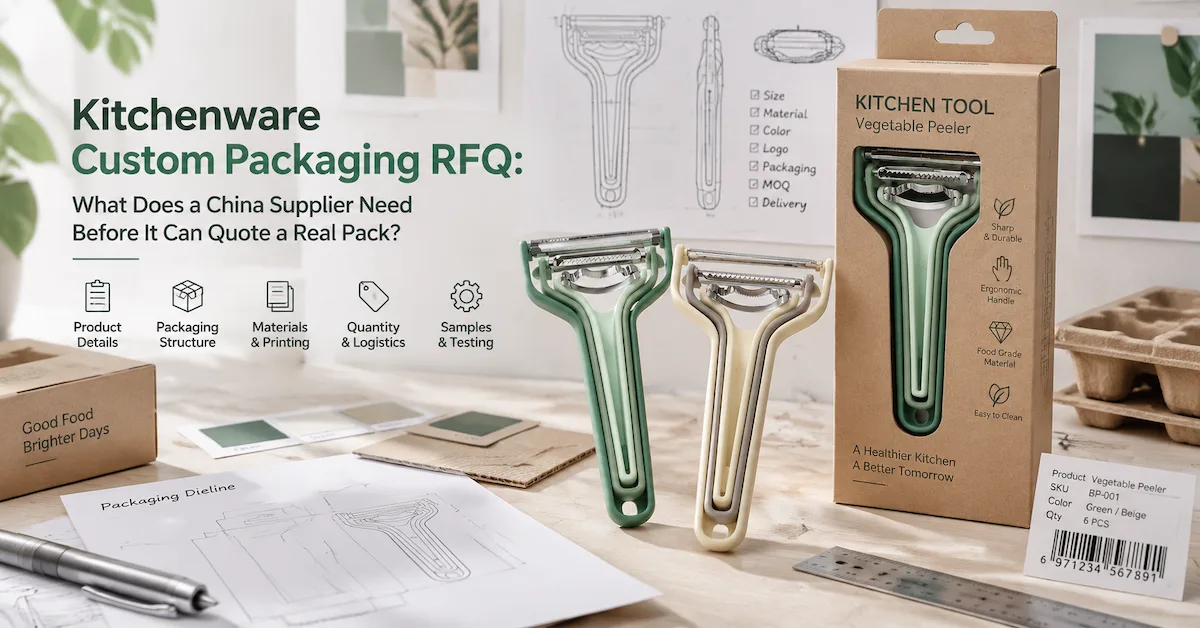
Packaging quotes become unreliable when suppliers are asked to price a picture instead of a defined system. A clear kitchenware custom packaging brief helps suppliers understand the product, packaging structure, materials, logistics requirements and approval expectations before preparing a quotation.
The result is a familiar procurement problem: a low first quotation becomes expensive after sampling. The supplier adds a die, a plate, a label, an insert, assembly labor, export cartons, testing or a higher minimum print run. The buyer has to redesign the artwork because the product does not fit, or accept a pack that looks acceptable in a digital proof but lets the product move during shipping. A disciplined RFQ prevents these surprises by turning the pack into a list of decisions.
This guide is for buyers who want a manufacturer to respond with a usable quotation and a physically testable sample. It covers the nine fields that make a packaging brief manufacturable, then adds a comparison method, evidence requirements, authority references and a practical inquiry checklist. The focus is not on one fashionable format. It is on the information needed to choose the right route for retail, wholesale, e-commerce, gift and mixed kitchenware programs.
The public BONET HOUSEWARE OEM/ODM page describes production by drawing or sample, material and color customization, logo printing and laser engraving, packaging customization, color boxes, gift boxes, retail packaging, barcode labels and export cartons. It also lists kitchen knives, kitchen utensils, chopping boards, kitchen gadgets, multifunctional products and scissors. Use those public capabilities as a conversation starting point, then request a project-specific response for the exact product and market.
What Is a Packaging RFQ for Kitchenware?
A packaging RFQ is the working brief behind a price and a sample. It describes the item, the pack, the order and the route well enough for a supplier to state what it will make. A mood board still has a useful place: it can communicate color, tone and references. It cannot tell a printer which dieline is approved or tell quality staff how much product movement is acceptable. The RFQ carries those practical decisions and labels the ones that are still open.
Start the file with a product reference and a one-sentence explanation of the pack's job. Then attach the structure idea, material direction and current artwork or barcode file. Sampling, tests, the quotation format and delivery basis can follow in their own sections. Leave space for the factory to suggest a better insert or board. The important distinction is simple: mark what the buyer has fixed, what the supplier may propose and what neither party has decided yet.
For kitchenware custom packaging projects, this brief connects the product, pack structure, artwork, materials and production requirements into one clear sourcing document.
| RFQ block | Buyer supplies | Supplier returns |
|---|---|---|
| Product identity | SKU, product link, drawing or sample, dimensions and weight | Feasibility notes and pack footprint |
| Commercial route | Channel, target user, destination and launch date | Recommended structure and schedule assumptions |
| Packaging structure | Preferred format or permission to propose alternatives | Dieline concept, insert and packed orientation |
| Materials and print | Board, finish, window, ink, label and sustainability direction | Material basis, process, limitations and evidence |
| Quantity and logistics | Units by SKU, color split, carton and delivery basis | MOQ, setup, carton data and quote basis |
| Quality and change | Sample gates, tests, inspection and approval owner | Control plan, exceptions and change process |
The Nine-Step RFQ Method
Use these nine steps as a shared worksheet. A buyer can send them in one brief, or complete them with the supplier during a development call. Each step produces an output that belongs in the quote or sample file.
Step 1: Name the Product and the Buyer's Channel
Start with the exact product. A kitchen utensil, knife, board and gadget do not create the same packaging problem. Add product dimensions, weight, material direction, finish, moving parts, sharp points, accessories and intended use. Then name the channel: retail shelf, wholesale, e-commerce fulfillment, gift, foodservice, promotional bundle or mixed.
Channel information changes the pack recommendation. A shelf pack may prioritize front-panel communication and hanging behavior. A wholesale pack may prioritize carton density and receiving. An e-commerce pack may need to survive parcel handling and avoid excess empty space. If the supplier does not know the route, it cannot reasonably decide which packaging performance matters most.
Step 2: Attach Product Evidence and Mark Unknowns
Attach a clear product photograph, drawing or physical sample. Mark the dimensions that are controlled and the dimensions that may change. Show the top, side and end views if the item has a handle, blade, hinge, hook, hole or asymmetric shape. Identify where the logo, care information or barcode cannot go.
A useful RFQ does not pretend that unknowns are fixed. Write “supplier to recommend” beside the insert, board thickness or window if that is genuinely open. Write “must not change” beside the product dimensions, piece count, brand color or barcode. This gives the supplier room to engineer while protecting the buyer from a silent change to the commercial promise.
Step 3: State the Pack Format and Opening Experience
Choose a preferred pack format or ask the supplier to quote alternatives. Possible routes include a folding carton, paper sleeve, tray and sleeve, color box, rigid gift box, blister, window carton, molded pulp pack, polybag with insert, or corrugated shipper. State how the customer should see and remove the product. A sharp knife should not require the buyer to pull against an exposed edge. A utensil should not fall out when the peg pack is lifted.
Describe whether the pack is opened by a shopper, warehouse worker, fulfillment operator or recipient. Opening experience affects glue, locks, tear strips, seals and retention. It also affects whether the pack can be resealed, displayed or recycled. The supplier's quote should name the proposed opening path and show it in the sample.
Step 4: Define the Material and Sustainability Boundary
Replace broad sustainability adjectives with a component sheet. A buyer may prefer paperboard, allow a small window, prohibit foam and leave the insert open for the supplier to solve. Write those choices down. If the artwork is expected to mention recycled content, FSC certification or recyclability, name the person who will approve the claim and the evidence required. FSC guidance ties label use and claims to authorized, certified organizations and the relevant documentation; a logo pasted into a draft is not enough.
For Europe, the regulatory review also needs a date. The European Commission says the Packaging and Packaging Waste Regulation starts to apply from mid-2026 and deals with matters such as recyclability, recycled content, reuse, waste prevention and consumer information. Put the destination reviewer and the requested composition data in the RFQ. Asking a factory to write “green” on a quote does not settle any of those questions.
Step 5: Lock the Graphic, Barcode and Copy Inputs
List the available artwork files and their status. Include the logo master, color references, product name, variant, piece count, dimensions, care instructions, warnings, origin statement, importer information and barcode. Note who approves each item. If a translation is required, identify the language owner and the point at which the copy becomes frozen.
GS1's barcode guidance says the packaging process should be considered when assigning symbol placement and warns against folds, flaps, edges or other layers that obscure the code. Put the barcode zone on the dieline, reserve the quiet zone, specify orientation and scan the final packed sample. A barcode pasted on after the box is finished is a common source of avoidable rework.
Step 6: Define Prototype Stages and Sample Deliverables
Ask for named sample stages. A blank structural mockup answers fit and opening questions. A printed proof answers layout and copy. A material or color proof answers paper, finish and contrast. A packed sample answers retention, product protection, barcode, carton quantity and opening. A production-intent sample answers whether the approved route can be repeated.
For each stage, write what is approved and what remains open. A buyer may approve the structure while holding the finish. A supplier may need to quote the tooling before making a full color sample. A decision log prevents “approved” from being interpreted as permission to start mass production when the barcode or insert is still unsettled.
Step 7: Specify Testing, Inspection and Acceptance
Describe the route the packed product will take and the damage that matters. ISTA's published procedures explain that package testing challenges the integrity of the product-and-package combination against supply-chain hazards. The buyer should specify the method or ask the supplier to propose one, then define sample count, conditioning, pass/fail criteria and report owner.
Inspection has to reach beyond print color. Open the case and count the pieces. Check their facing direction, movement and any exposed edge; then close the pack and scan the barcode. Carton marks, packed size, gross weight and visible damage belong on the record too. Use a retained sample or a scale photograph when appearance matters. If a later packaging change alters the way the product is held or shipped, reopen the test plan instead of assuming the previous result still covers it.
Step 8: Normalize the Commercial Quote
Send every bidder the same quote sheet. It should expose the retail pack, insert, labels and assembly, while keeping setup, tooling and proofs visible as separate charges. Add lines for the outer carton, pallet, tests, inspection and the agreed logistics basis. The trade term matters. An EXW figure and a delivered figure can both be correct, but placing them in the same price column creates a comparison that is not.
Ask how MOQ applies. It may apply to the kitchenware SKU, a packaging print run, a color, a box size, a carton or a material. Ask what happens when the buyer splits a first order across three colors or two markets. The answer belongs in the quote because it changes cash exposure and the feasibility of a pilot launch.
Step 9: Set Release, Change and Reorder Rules
Close the RFQ with names, not just departments. One person releases artwork, another may sign the packed sample, and someone must be able to accept or reject a deviation. Collect the product and pack codes, artwork revision, dieline, material, insert, barcode, carton plan and inspection sheet under a single release reference. If the factory later needs a different board, printer, adhesive or carton count, that reference makes the proposed change and its consequence visible before production.
A reorder rule is simple: “same as last time” is valid only when last time has a controlled file and sample. Store the approved packed sample or a scale-accurate record. Keep superseded artwork out of the release folder. Record the first production date and any approved deviation so a new planner can call up the correct pack without relying on personal memory.
How to Compare Two Packaging Quotes
Normalize before judging price. Put each proposal into the same table and mark assumptions in a separate column. Check whether the primary pack is the same, whether the insert is included, whether assembly is manual, whether the carton quantity matches, whether testing is included and whether the freight basis is comparable. A supplier with a higher unit price may be offering a stronger insert or a more complete service.
| Comparison item | Quote A | Quote B | Buyer decision |
|---|---|---|---|
| Primary pack | Format, material, dimensions and print | Format, material, dimensions and print | Are the physical packs actually equivalent? |
| Insert and assembly | Included or separate; manual or automated | Included or separate; manual or automated | Does the unit price hide labor? |
| Setup and tooling | Plates, die, proof and sample charges | Plates, die, proof and sample charges | Which charges repeat on a reorder? |
| Testing and inspection | Method, sample and report | Method, sample and report | Can both suppliers demonstrate the same pass rule? |
| Carton and logistics | Quantity, dimensions, weight and term | Quantity, dimensions, weight and term | Which landed-cost assumptions differ? |
| Change control | Notice and approval route | Notice and approval route | Who owns future consistency? |
Evidence a Kitchenware Packaging Supplier Should Provide
Request evidence that relates to the exact project. A general factory photograph does not prove that a knife pack will retain the blade. A generic box sample does not prove that the selected board will hold the required weight. Useful evidence includes a structural mockup, material swatch, printed proof, packed sample, barcode scan, carton test record, inspection checklist, sample photo with dimensions and a clear explanation of what remains to be confirmed.
BONET's public OEM/ODM workflow lists requirement communication, design and sampling, quotation and confirmation, mass production, quality inspection, and packaging and delivery. Its public page also lists logo printing, packaging customization, barcode labels and export cartons. These are relevant capabilities to ask about in an RFQ. The buyer should ask for the specific file, sample, schedule and acceptance record for the selected product rather than treating a service list as a completed project result.
Packaging Materials and Claims Buyers Should Handle Carefully
A claim on the artwork turns into a purchasing obligation. Words such as “recyclable,” “compostable,” “plastic-free,” “FSC,” “food safe” and “made with recycled content” do not share one proof route. Tell the supplier where the pack will be sold and who signs off the wording. Ask for documents that match the material and the exact sentence under review. When that proof is missing, describe only what can be substantiated or remove the claim before printing.
The European Commission's PPWR information emphasizes recyclability, clear labeling and reduced unnecessary packaging. FSC's packaging guidance explains that an FSC label is tied to certified material and an authorized certification process. These sources do not prescribe a universal kitchenware box. They do give procurement teams a defensible reason to make materials, labels and substantiation part of the RFQ.
RFQ Templates for Common Kitchenware Products
Utensil or silicone tool
Specify handle length, head shape, hanging hole, flexibility, color, surface texture, care route, product weight and whether the utensil must be visible. Ask for a sleeve, tray or carton option with a retention feature that does not deform the silicone. Request a packed sample, rub review for print or label, barcode scan and carton quantity.
Kitchen knife or knife set
Specify blade length, tip, edge, handle, guard requirement, set count, orientation, warning copy and opening route. Ask how the blade is prevented from contacting the pack and how the customer removes it safely. Request a production-intent guard and packed sample before approving a retail box.
Cutting board
A cutting board gives the pack a broad, heavy surface. Send a dimensioned drawing and show the handle, hanging hole and finished edges. Note its weight, thickness and whether another tool is bundled with it. In the sample review, pay attention to corners, moisture exposure and whether the sleeve or carton stays flat. The shopper should be able to find the board dimensions and care instructions without turning the pack into a page of small type.
Kitchen gadget or multifunctional tool
List every function, moving part, accessory, lock position and user demonstration needed. The pack should show the product without making unsupported performance claims. Request a tray or insert that prevents parts from striking each other, plus a packed sample that can be opened and repacked without losing the accessories.
FAQ: Packaging RFQ Questions from Importers
What should I send first to a kitchenware packaging supplier?
Send the product link or sample, dimensions, weight, channel, destination, quantity by SKU, preferred format, material direction, artwork status, barcode status, carton plan, testing expectation and target date. Say which decisions are fixed and which are open to a supplier recommendation.
How many packaging samples should I request?
The number depends on the questions. Request at least one structural sample for fit and opening, one printed or material sample for visual approval and one production-intent packed sample when protection, barcode or assembly is important. For a range, sample each meaningful product, surface, format or color combination rather than assuming one sample approves all SKUs.
How do I compare a packaging supplier in China with a local converter?
Compare the complete scope: product integration, communication, tooling, material evidence, sampling, testing, carton, export experience, inspection, change control and delivered cost. A local converter may be excellent at print but not at product retention; a kitchenware manufacturer may understand the product and coordinate packaging but still need a specialized printer. The right comparison follows the work, not the supplier label.
What does OEM kitchenware packaging mean?
In this context, OEM means that the pack follows the buyer's product and brand requirements. The manufacturing arrangement can vary. Sometimes the kitchenware factory manages the printed components; sometimes the buyer nominates a converter and the factory only packs the goods. Write that boundary into the RFQ. It should be obvious who owns the dieline, buys the materials, releases artwork and reports a change.
What does private label kitchenware packaging include?
It can include the brand lockup, range system, SKU name, color, product information, barcode, care copy, warning, origin or importer information, retail box or sleeve, insert and export carton. The buyer should list each item in the RFQ and identify the file or owner for approval.
How can I avoid packaging delays?
Freeze the product dimensions early, start the dieline while the product is being sampled, assign copy and barcode owners, request a physical proof, keep approvals in a decision log and build testing into the schedule. Separate waiting time for artwork or buyer approval from factory working time. A two-day comment can still miss a print or material slot.
How early can packaging pricing start while the product is changing?
Budget work can start with an approximate envelope and a likely material. Call the result an estimate, because the cavity and board use are still moving. Once size, weight, finish and loose accessories are frozen, return the pack to the supplier for a firm revision. This keeps an early number useful for planning without pretending the physical job is already known.
How do I request a packaging quote from BONET?
Send the product or sample, target market, quantity by SKU, preferred format, material direction, artwork and barcode status, packaging requirements, desired delivery date and quality expectations through the BONET HOUSEWARE contact page. Ask the team to return feasibility, sample stages, MOQ, setup charges, unit price basis, carton data, testing proposal and lead-time assumptions.
Conclusion: A Better Quote Begins With a Better Question
The best packaging RFQ is not the longest document. It is the clearest shared decision record. Name the product and channel. Attach usable evidence. Set the pack format and opening experience. Define material and claim boundaries. Lock the graphic and barcode inputs. Name sample stages. State the test and acceptance route. Normalize the commercial quote. Protect the release and reorder.
That sequence turns a packaging request into a procurement conversation a supplier can answer. It also makes the answer easier to compare, because the buyer can see where two quotes differ in structure, material, labor, testing, carton or logistics. For importers and brands sourcing kitchenware from China, this clarity is a practical way to protect cash, schedule, product presentation and repeat-order consistency.
Share your product details and packaging brief with BONET HOUSEWARE through Contact Us. Include product images, target market, quantity, materials, pack format and required date.
A Field-Level Packaging RFQ Template
The easiest way to improve a quote is to make the request easy to fill in. Give the supplier a numbered template. Field 01 is the product name and SKU. Field 02 is the product link, drawing or sample. Field 03 is the packed product dimensions or the date they will be available. Field 04 is weight. Field 05 is channel. Field 06 is destination. Field 07 is quantity by SKU and color. Field 08 is preferred packaging format. Field 09 is material direction. Field 10 is artwork and barcode status. Field 11 is carton and pallet expectation. Field 12 is testing. Field 13 is target date. Field 14 is quotation basis. Field 15 is approval owner.
This template prevents a common failure: the supplier answers the easy fields and leaves the expensive assumptions invisible. It also makes it easier for a buyer to send the same request to several suppliers without changing the question. Keep a response column for the supplier, an evidence column for the sample or document, and a decision column for the buyer. When a field is unknown, use “open” rather than leaving a blank cell that could be interpreted as permission to decide silently.
| Field | Example buyer entry | Supplier response to request |
|---|---|---|
| Product identity | Black kitchen knife set, five pieces, reference sample attached | Confirm packed orientation and required blade protection |
| Destination | EU retail and parcel fulfillment | Flag composition, labeling and test assumptions |
| Quantity | Three SKUs; two colors; first order and reorder outlook | State MOQ by product and packaging print run |
| Artwork | Logo vector ready; copy in review; EAN assigned | Confirm proof sequence and barcode zone |
| Pack route | Retail carton inside export carton | Return carton quantity, dimensions and gross weight |
| Schedule | Target availability date and approval owner | Return sample and production milestones |
How to Write a Product Description That Helps Packaging
A product description should describe the physical situation, not only the marketing name. “Premium kitchen knife” is not enough. State blade length, tip, handle material, guard, set count, loose accessories, surface finish, weight and how the customer should see the product. “Silicone spatula” should state overall length, head width, flexibility, hanging hole, color, surface texture and whether it is shipped as a single tool or in a set. The packaging engineer needs contact points and risk, not just a category word.
Attach photos from more than one angle. Place a ruler next to the product and include a close view of the edge, joint, handle end, hook or attachment. If the product is still changing, mark the current revision on the photo. This small habit prevents a supplier from building a cavity around a sample that was later replaced by a longer handle or thicker board.
For product families, send an assortment map. Show the shared features and the differences. A packaging supplier can then propose a common sleeve, a modular insert or a family of cartons with shared panel rules. Without the map, the supplier may treat every SKU as a new project or force all products into a structure that was designed for only one of them.
RFQ Decision: Existing Pack, Modified Pack or New Development
Many projects sit between a catalog pack and a fully new package. An existing pack with a new logo may need only artwork and label approval. An existing product with a new insert can require a die, fit sample and transit check. A new product and new box may need structural development, prototype cycles and a longer release plan. Write the route explicitly so the supplier can assign the right resources.
A supplier should explain what it can reuse and what it must create. Reusing a known carton size may reduce time, but it can also leave too much empty space or force an awkward product orientation. A new dieline may cost more at the start but improve pack density and shelf fit. The RFQ should invite the supplier to show the trade-off rather than forcing a false choice between “standard” and “custom.”
Artwork Approval Rules for Custom Printed Kitchenware Boxes
Make the artwork route visible on one page. Begin with panel order and information hierarchy. Review folds, glue, barcode and safe zones on the dieline, then check color and finish on the intended stock. The last approval is a folded sample with the real product inside. Record the revision and owner at every stop. A flat PDF can prove that words are present; it cannot prove that a window stays clear, a glue joint holds or an insert releases the product cleanly.
Before release, read the printed pack as if it has never been seen before. Check the product name, set count, measurements, care and warnings. Verify origin and importer details against the destination file. Compare the barcode digits with the master, inspect its quiet zone and scan the made-up sample. Color references, fonts, images, required symbols and recycling instructions deserve the same pass. A printer may catch a broken font or low-resolution image, but the buyer still owns the meaning of approved copy.
Multiple markets need a small language matrix and a sensible variant code. Avoid the filename “final”; it stops being useful as soon as a second language is approved. A compact code can identify product, market, language, revision and status. This bit of housekeeping prevents a perfectly correct design from being printed for the wrong SKU or destination, which is a surprisingly expensive way to discover a filename problem.
How the Test Changes From Shelf to Parcel
On a retail shelf, the pack needs to keep its shape, present the product and scan after repeated handling. A wholesale case is judged differently: it should stack, remain countable and keep receiving labels readable. Parcel fulfillment adds another journey, with individual orders and more handoffs. A design can perform well in one route and disappoint in another. Write the route in the RFQ; the phrase “drop test” says very little until the drop and the expected damage limit are defined.
Define damage tolerance before testing. Is a small scuff on an export carton acceptable? Is a dented retail box a failure if the product is intact? Is a shifted insert acceptable if the blade remains protected? ISTA's published overview emphasizes that the shipper, manufacturer and retailer should determine what constitutes damage and what tolerance is allowed before the test. Put those decisions in the test plan.
Use production-intent pieces for the final check. A hand-cut paper mockup can confirm geometry, but it cannot prove print rub, adhesive, board strength or carton compression. If the first test uses a substitute insert or a different board, label the result as directional and list the retest trigger.
MOQ, Lead Time and Cash Exposure
Ask for MOQ at every layer. The kitchenware supplier may have a product MOQ. The packaging printer may have a paperboard or print-run minimum. A color box may require a minimum per artwork version. A special insert may require a tool or batch. A buyer can have an acceptable product quantity and still face an uneconomic packaging run. Ask for the smallest practical pilot and the cost of moving from pilot to normal reorder.
Lead time also has layers. Artwork approval, dieline, tooling, material purchasing, print slot, prototype, testing, product production, packing and export booking each consume time or waiting. Request a milestone calendar with the owner of each approval. If the buyer must meet a seasonal date, identify the last date for copy, barcode, material and sample decisions. Do not treat a single “lead time” number as a complete schedule.
Cash exposure is easier to discuss when the quote separates one-time charges, deposits, packaging material commitments and balance points. Ask what happens to unused printed packaging if the SKU changes. Ask whether the supplier can hold approved packaging components for a reorder and under what storage conditions. These questions are commercial, not merely technical.
Supplier Questions That Reveal Process Maturity
Ask how the supplier prevents an old artwork file from reaching a production line. Ask how it identifies a packed sample. Ask whether first-piece approval is recorded. Ask how a barcode is scanned. Ask which person owns a deviation. Ask what happens when a material is unavailable. Ask how an approved change is linked to the next purchase order. The answers reveal more than a polished capability list.
A mature response may include a simple flow: brief, feasibility, structural proposal, quote, prototype, artwork proof, packed sample, test, release, production check and reorder library. It may also point out that a requested finish or format changes MOQ or timing. That kind of caution is useful. A supplier that says every option is easy without asking about the product, market or route is giving the buyer very little evidence.
Three RFQ Scenarios and the Right Next Step
Scenario one: a brand has a finished silicone utensil, a vector logo and a target retail channel. The right next step is a product-specific pack recommendation, a sleeve or carton concept, a sample with the actual silicone, barcode zone, care copy and a normalized quote. The buyer should not begin with a large print run.
Scenario two: an importer has a mixed range of knives and gadgets and wants one visual system. The right next step is an assortment map, common panel rules, product-specific retention and a carton strategy. The supplier should identify where shared packaging is realistic and where a different insert or box is safer.
Scenario three begins with crushed corners after a trial parcel shipment. Do not solve it by adding filler immediately. Photograph the retail unit and outer carton before unpacking, note where the product moved and look for compression marks. Review both packaging layers with the supplier. The next sample should respond to the observed failure, and its test route should resemble the fulfillment path that produced the damage.
The Five-Minute Internal Handoff Before Sending an RFQ
Gather the internal owners around the same version before it leaves the company. Product checks measurements and piece count. Design checks the logo and copy. Quality reads the acceptance and test questions, while logistics verifies the carton and delivery assumptions. Commercial closes quantity, timing and the price basis. Five focused minutes here can prevent five separate corrections after the supplier has already started a sample.
After the supplier replies, hold a short comparison meeting. Mark each answer as accepted, open, supplier recommendation or evidence required. Do not award a project because a quote is lowest before the sample, pack scope and schedule are comparable. A clear “open” list is progress; it tells the next conversation exactly what must be closed.
Keep one final RFQ principle in view: every open packaging decision has a downstream owner. If the brand has not approved the barcode, someone must own the approval date. If the supplier has proposed two inserts, someone must select the route. If a test has no acceptance limit, someone must define what counts as damage. Put the owner and date beside the question. This makes the brief useful to design, quality, logistics, finance and the factory at the same time, and it gives the buyer a defensible record when the quotation is converted into a purchase order.
