




Multi Functional Kitchen Tools: What Buyers Should Look For
Multi functional kitchen tools remain popular because they answer a simple kitchen problem: people want faster preparation without filling drawers with single-use gadgets. For retailers, distributors, and private-label teams, the category can be attractive because the product benefit is easy to understand. A compact set that dices, slices, grates, peels, or portions ingredients can photograph well, explain quickly, and support everyday cooking routines.
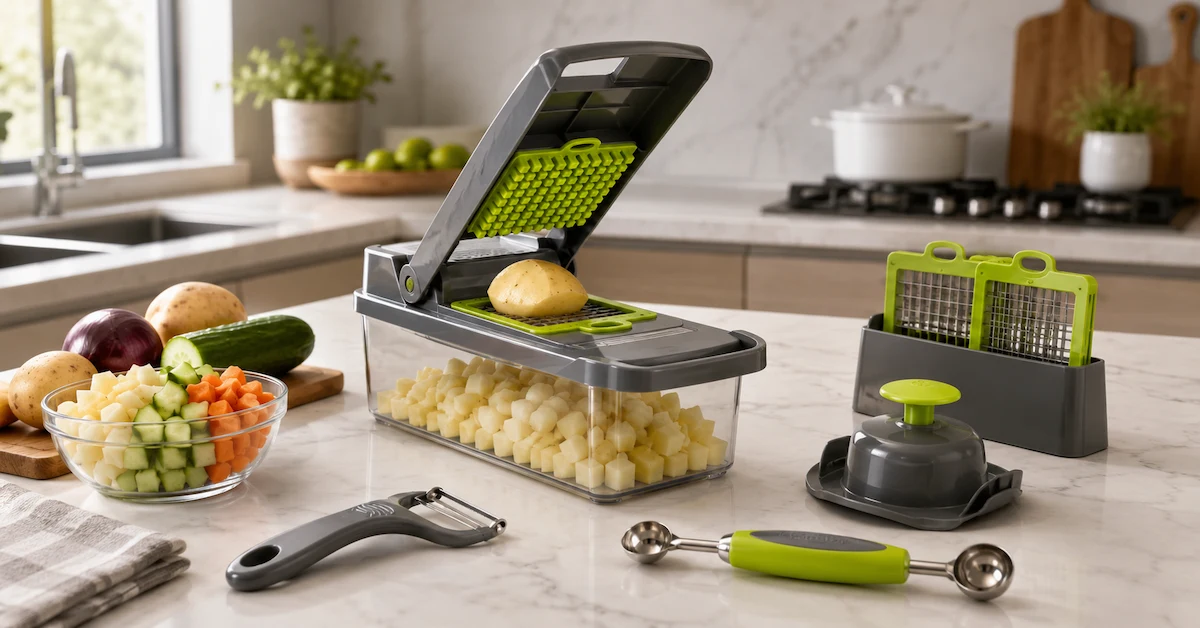
The product shown in the original article is a manual vegetable prep set with interchangeable inserts, a clear collection container, a hinged lid, and a small storage caddy for blade modules. That format is familiar in the market, but sourcing teams should not judge it by accessory count alone. The real question is whether the tool reduces effort, controls mess, stores safely, and holds up under repeated household use.
Key Takeaways
- Focus on practical functions, not the largest number of accessories.
- Check blade alignment, hinge strength, container fit, and cleaning access before placing an order.
- Ask suppliers to clarify materials, replacement parts, packaging options, and quality-control procedures.
- Position the item as an everyday vegetable prep aid, not as a professional chef tool.
What This Type of Kitchen Tool Is Designed to Do
This category sits between a hand chopper and a small prep station. The clear base collects chopped ingredients, while the upper frame holds cutting inserts. Based on the visible layout, the set appears intended for common produce such as potatoes, onions, cucumbers, carrots, and similar firm vegetables. It is better understood as a daily meal-prep aid than as a precision slicing device.
The accessory bundle also matters. A peeler, scoop or measuring spoon, and multiple grid-style inserts suggest a small preparation system rather than a single-function chopper. That can increase perceived value in retail or e-commerce channels, but only when the parts support real use cases. Extra pieces that are hard to identify, clean, or store may create returns instead of loyalty.
How the Design Works in Daily Use
A manual vegetable chopper generally works in three stages. First, the user places produce on the cutting area. Second, the hinged lid presses the ingredient through the selected insert. Third, the pieces fall into the transparent container, where the user can see the quantity and cut consistency.
The visible design uses color contrast between the container, lid frame, and inserts. From a merchandising perspective, that helps users understand which parts move and which parts cut. From a sourcing perspective, it also creates checkpoints: the insert should lock into position, the lid should close evenly, and the container should attach without wobble.
Buyers should sample the tool with realistic ingredients rather than only inspecting it in the box. A product may look useful in photography but feel awkward if the frame flexes, the lid requires too much force, or food gets trapped around blade mounts.
Buyer Checklist Before Sourcing
For wholesale, OEM, and private-label programs, product selection should start with use conditions. Ask how the customer will handle the tool, how often it will be cleaned, and what level of simplicity the channel expects. Then evaluate the sample against concrete criteria.
| Evaluation point | What to check | Question to ask the supplier |
|---|---|---|
| Blade insert fit | Insert seats securely and stays aligned during pressing | How are inserts fixed, inspected, and replaced? |
| Hinge and lid action | Lid closes smoothly without excessive flex | What quality checks are used for hinge movement? |
| Container usability | Clear base is easy to attach, remove, and empty | What material is used for the container and lid? |
| Cleaning access | Parts separate enough for practical washing | Are cleaning instructions included or customizable? |
| Accessory storage | Blade modules are organized and protected | How are sharp inserts secured in packaging and storage? |
| Retail presentation | Functions are clear in box, listing, or display | What packaging, labeling, or private-label options are available? |
Why Accessory Count Is Not the Same as Value
One common sourcing mistake is treating the number of functions as the main selling point. More inserts can make a listing look stronger, but they also add cost, part management, cleaning complexity, and potential customer confusion. A smaller set of frequently used inserts may be more successful than a larger bundle with rarely used parts.
When reviewing a sample, separate the functions into three groups:
- Core functions: likely to be used often, such as dicing or slicing firm vegetables.
- Support functions: useful in some kitchens, such as peeling or portioning.
- Low-use functions: parts that look good in a product photo but may not solve a daily problem.
This approach helps sourcing teams decide whether to keep the assortment simple, request a different accessory mix, or build multiple versions for different price points.
Cleaning, Safety, and User Experience Considerations
Cleaning is often where multi purpose kitchen utensils succeed or fail. Narrow corners, tight blade mounts, and small food traps can turn a convenient tool into a frustrating one. Buyers should not assume that every removable-looking part is easy to clean. Ask for user instructions, inspect the part separation, and test sticky or strongly scented ingredients such as onion if they are relevant to the target market.
Blade handling also deserves attention. Interchangeable inserts must be useful, but they should be stored logically. A storage caddy can reduce the risk of loose sharp parts in a drawer, but only if the modules fit securely and are easy to identify. If the set is intended for retail, packaging should also make clear how the inserts are stored and handled.
Do not make unsupported claims about dishwasher safety, material grade, food-contact compliance, or testing unless the supplier provides documentation. These are important commercial details, but they should be verified through supplier records and buyer-side due diligence.
Retail, Wholesale, and OEM Positioning
For retailers, the strongest positioning is usually practical: faster vegetable preparation, reduced countertop mess, organized blade storage, and compact use compared with several separate tools. The item should be presented as a convenient home cooking aid, not as a replacement for skilled knife work.
For distributors, the product can fit kitchen starter assortments, seasonal cooking promotions, home organization ranges, or value-focused prep collections. For OEM and private-label buyers, differentiation often comes through packaging design, color selection, accessory configuration, instruction quality, and after-sales part planning. The base product architecture may be familiar, so the details of usability and presentation become more important.
Before confirming an order, sourcing teams should ask the supplier about available customization options, production lead-time assumptions, packaging formats, spare-part support, and quality-control checkpoints. If certifications or compliance documents are required for the destination market, request current documentation rather than relying on general statements.
Common Sourcing Mistakes to Avoid
- Choosing by photo only: Sample the product with real ingredients and repeat the motion several times.
- Ignoring cleaning time: A tool that saves cutting time but adds washing time may disappoint users.
- Overloading the set: Too many accessories can increase cost without improving sell-through.
- Skipping packaging review: Inserts, blades, and small parts need clear organization in transit and on shelf.
- Assuming specifications: Confirm materials, dimensions, care guidance, and compliance documents with the supplier.
FAQ
Are multi functional kitchen tools suitable for all produce?
No. This type of manual chopper is usually most practical for firmer vegetables and similar prep tasks. Softer produce may crush, smear, or produce uneven results depending on the insert and blade condition.
Should buyers choose the set with the most inserts?
Not always. A focused set with reliable, frequently used inserts can be easier to sell and use than a larger bundle with confusing or low-value parts.
What should an OEM buyer confirm before ordering?
Ask about the exact material list, blade configuration, packaging options, replacement insert policy, cleaning instructions, labeling requirements, and any documents needed for the target market.
Why does the transparent container matter?
It lets users see the amount and consistency of prepared ingredients without opening the unit. It also helps communicate the product function clearly in retail images.
How should brands position this product?
Position it as an everyday vegetable prep solution for home kitchens. Emphasize practical benefits such as uniform cutting, organized storage, and reduced mess, while avoiding exaggerated performance claims.
A Practical Next Step for Sourcing Teams
If you are building an assortment around multi functional kitchen tools, start with the target use case. Decide whether your customer values speed, compact storage, simple cleaning, or a fuller prep bundle. Then evaluate samples against that priority instead of relying on accessory count.
For a retail or OEM program, request clear specifications, sample the tool with common vegetables, inspect the storage caddy, and confirm what support the supplier can provide for packaging and documentation. The best sourcing decision is not the set that looks the busiest; it is the one that users can understand, clean, store, and reach for again.
