




Multi Purpose Kitchen Tools Manufacturer Guide for Prep Kits
A multi purpose kitchen tools manufacturer is not only supplying a collection of blades, containers, and molded accessories. For sourcing teams, the real question is whether the product helps users prepare vegetables faster without creating extra cleaning, storage, or safety concerns. Manual prep kits remain relevant because many home cooks and light-duty users want the efficiency of repeatable cuts without the size and setup time of a food processor.
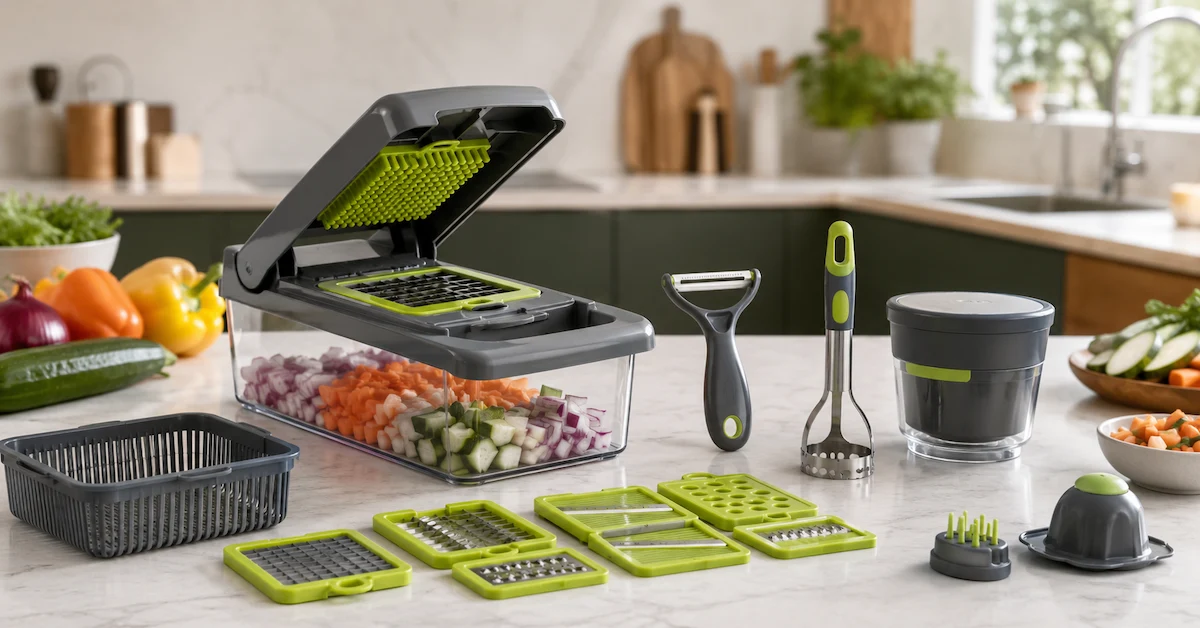
These kits usually sit between ordinary hand cutting and powered appliances. They are often built around a catch container, a lid or press surface, and interchangeable cutting plates for common prep tasks such as slicing, dicing, grating, julienning, or chopping. The visible product image shows a compact set with a clear container, a dark frame, green insert components, and several accessories arranged as a prep system rather than a single tool.
Key Takeaways
- Multi-piece prep kits should be judged as complete workflows, not as a count of accessories.
- Blade insert fit, container size, lid strength, and cleaning access are critical sourcing checks.
- More attachments do not always mean better value if users cannot identify, store, or wash them easily.
- Buyers should ask suppliers to confirm materials, included parts, recommended cleaning methods, and intended use cases.
What This Product Type Is Designed to Replace
A multi-functional kitchen tool set is designed to reduce repetitive knife work. It does not fully replace a food processor, mandoline, peeler, grater, or chef’s knife in every situation. Instead, it combines several common prep functions into one compact system for moderate-volume tasks.
This positioning matters for wholesale buyers and OEM product teams. If the target customer prepares onions, cucumbers, peppers, carrots, zucchini, potatoes, or salad vegetables in batches, the product can offer practical value. If the target customer only needs one cut type, a simpler slicer or grater may be easier to explain and support.
How a Typical Prep Kit Is Built
Most products in this category combine molded polymer components with metal cutting elements. The container, frame, lid, blade carriers, and accessories are typically molded parts, while the cutting edges are usually metal inserts. Buyers should not assume a specific material grade, finish, or compliance status unless a supplier confirms it with documentation.
The main manufacturing challenge is alignment. A sharp blade is not enough if the insert does not seat properly, the lid flexes, or food jams between the press and cutting plate. The product must guide ingredients through the cutting path with reasonable force while keeping the user’s hands away from the blade area.
Comparison Checklist for Sourcing Teams
| Evaluation Area | What to Check | Why It Matters |
|---|---|---|
| Blade inserts | Number of plates, identification, seating method, and storage | Confusing or loose inserts increase misuse and returns |
| Container | Capacity, visibility, stability, and ease of emptying | The container must support real prep volume without becoming bulky |
| Lid or press | Rigidity, hinge behavior, grip area, and force transfer | Flexing or unstable pressure makes cutting inconsistent |
| Cleaning access | Food traps, corners, clips, and disassembly route | Difficult cleaning is a common reason users stop using the kit |
| Accessory logic | Whether each tool supports a common prep task | Extra pieces add cost and confusion if they do not serve the workflow |
Selection Criteria for OEM, Wholesale, and Private Label Buyers
When comparing options from a kitchen tools manufacturer, begin with usability before discussing packaging or color. A product that photographs well may still be frustrating if the user cannot change inserts quickly or clean the parts properly.
- Confirm the included set. Ask which accessories are standard and which are optional. Product photos sometimes show a fuller configuration than the shipped set.
- Review the insert system. Check whether blade plates are easy to recognize and whether they lock or sit securely during use.
- Test common vegetables. Use the foods that match the intended market, such as onions, cucumbers, carrots, peppers, or potatoes.
- Inspect molded components. Look for hinge weakness, sharp plastic edges, unstable bases, or areas where food may become trapped.
- Ask about packing and instructions. A multi-piece kit needs clear user guidance, especially for blade handling and safe cleaning.
Common Buyer Mistakes to Avoid
The first mistake is treating part count as the main selling point. A crowded kit can look attractive online or on shelf, but users may ignore half the pieces if they are hard to identify or too similar in function. A smaller, better-organized kit can be more valuable than a larger set with unclear attachments.
The second mistake is focusing only on sharpness. Cutting performance also depends on the container, blade frame, press surface, and ingredient path. If these elements do not work together, the blade may bind, the vegetable may slip, or the user may need awkward force.
The third mistake is ignoring cleaning. Multi-purpose kitchen tools often fail in daily use because food gets trapped around blade grids, clips, or corners. Buyers should request cleaning guidance from the supplier and review whether the product can be safely washed without excessive effort.
Where This Category Fits in the Market
Manual prep kits appeal to several retail and distribution channels. For home cooks, they reduce repetitive knife handling. For meal-prep users, they can improve cut consistency. For retailers, the visible assortment of inserts and accessories creates a clear product story. For importers and private-label teams, the platform can often be configured with different accessory combinations.
However, the category is competitive. Differentiation often comes from practical details rather than dramatic claims: a sturdier frame, clearer labeling, a better storage layout, a more stable base, or a container that is easy to empty. These details influence repeat use and customer satisfaction.
Questions to Ask a Multi Purpose Kitchen Tools Manufacturer
Before placing an order, buyers should request clear answers instead of relying only on catalog descriptions. Useful supplier questions include:
- Which exact parts are included in the quoted configuration?
- What materials are used for the container, lid, frames, and cutting inserts?
- How are blade inserts retained during use and stored after use?
- What cleaning method does the supplier recommend for each component?
- Is the product intended for household use only or for light commercial prep as well?
- What packaging, instruction sheet, and safety warning options are available?
- Can the supplier provide samples for usability, cleaning, and packaging review before bulk production?
These questions help sourcing teams separate a practical prep system from a visually busy gadget. A capable supplier should be able to explain the user workflow, not just list the number of pieces.
Practical FAQ
Is a multi-purpose prep kit better than a single slicer?
It depends on the use case. A prep kit is useful when customers need several cut types in one compact system. A single slicer may be better for a narrow task where simplicity matters most.
What is the biggest quality risk in this category?
The main risk is poor fit between molded parts and cutting inserts. If inserts move, flex, or jam, the entire product feels unreliable even if the blades are sharp.
Should buyers choose the kit with the most accessories?
Not automatically. Each accessory should support a common prep task, store neatly, and be easy to clean. Unused parts can increase cost and customer confusion.
What should be tested on a sample?
Test insert changes, cutting consistency, container stability, lid rigidity, cleaning access, and whether the final packed set matches the supplier’s quotation and images.
Final Buyer Guidance
A good multi purpose kitchen tools manufacturer should provide more than an appealing accessory layout. The product should function as a coherent prep workflow: ingredients go in, the correct insert is easy to select, food cuts cleanly, the container collects the result, and the parts can be washed and stored without frustration.
For OEM, wholesale, and private-label sourcing, evaluate samples under realistic kitchen conditions. Ask practical questions about materials, assembly, cleaning, configuration, and intended use. The best choice is not always the largest kit; it is the one that balances useful functions, stable construction, clear handling, and manageable maintenance.
