




A reliable multipurpose scissors manufacturer should be evaluated by how well the product performs across its intended tasks—not by how many functions can be listed on a package.
That distinction matters for B2B buyers.
A pair of scissors may include a bottle opener, nutcracker, serrated blade, herb stripper, fish-scaling edge, protective cover, or other auxiliary functions. Those additions can create strong retail differentiation, but they also introduce more variables that must work consistently in mass production.
For brands, importers, distributors, supermarkets, home-goods retailers, and e-commerce sellers, the real sourcing question is therefore not:
“How many functions can this pair of scissors have?”
It is:
Which functions create real value for the target customer, and can the manufacturer reproduce them consistently from approved sample to repeat order?
That is the standard buyers should use when evaluating a supplier.
A professional manufacturer should be able to discuss blade material, edge geometry, straightness, heat treatment, grinding, serration, pivot assembly, handle construction, auxiliary functions, surface treatment, logo application, packaging, functional testing, and repeat-order control as one connected product system.
BONET's scissors range and all-purpose scissors collection provide several reference directions for buyers comparing general-purpose and multifunction designs.
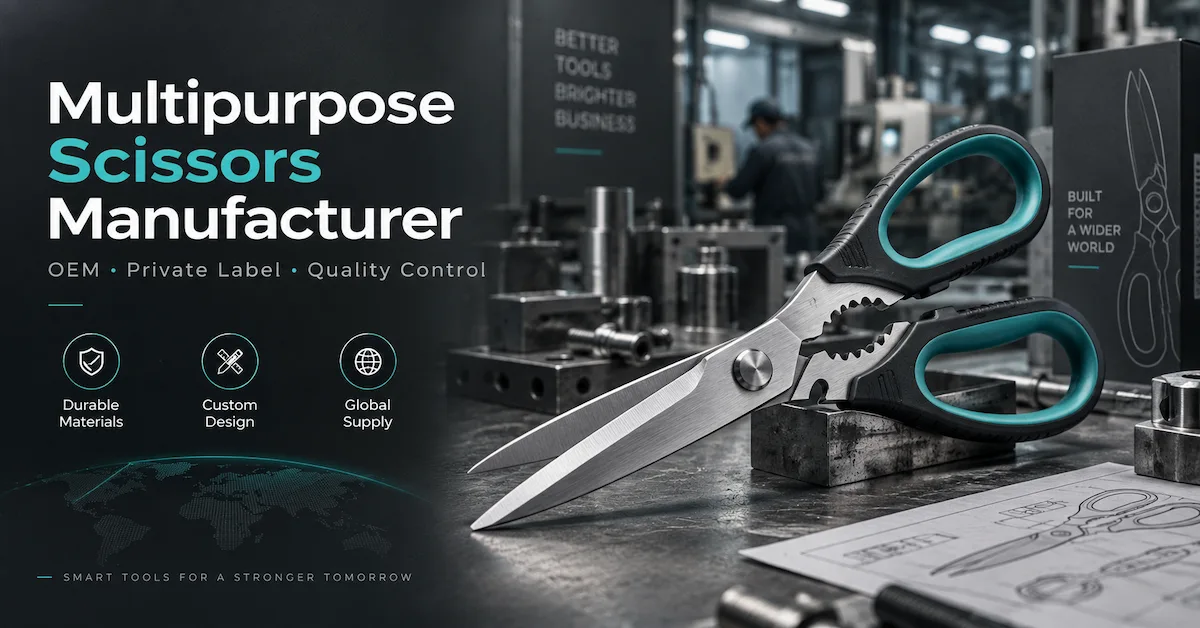
What Is a Multipurpose Scissors Manufacturer?
A multipurpose scissors manufacturer produces scissors designed to perform more than one cutting or utility task.
The term can describe several product families.
Some models are essentially general household scissors with one or two added functions.
Others are kitchen-focused tools that combine cutting with food-preparation features.
Still others are outdoor, office, household, or utility scissors designed around compact multifunctionality.
Typical added functions may include:
- straight cutting;
- serrated cutting;
- bottle opening;
- nut cracking;
- herb stripping;
- fish scaling;
- food gripping;
- packaging opening;
- detachable blades;
- magnetic storage;
- protective covers;
- auxiliary edge functions.
The exact combination depends on the target market.
That is why the word “multipurpose” is not a complete technical specification.
A buyer should define:
- what the scissors must cut;
- which auxiliary functions are required;
- how frequently each function will be used;
- who the end user is;
- where the product will be sold;
- what level of comfort and durability is expected;
- how the product will be packaged.
Without those details, two suppliers may quote very different products under the same description.
Why Multipurpose Scissors Are Attractive to B2B Buyers
Multipurpose scissors are commercially attractive because they can create visible differentiation without requiring an entirely new product category.
A standard pair of scissors competes mainly on:
- size;
- appearance;
- comfort;
- blade quality;
- price.
A multifunction model can compete on additional consumer benefits.
For example:
- “cut + crack + open”;
- “kitchen scissors with bottle opener”;
- “detachable scissors for easier cleaning”;
- “magnetic kitchen scissors for convenient storage”;
- “one tool for meat, herbs, packaging, and more.”
That gives buyers more content for:
- packaging;
- product photography;
- marketplace listings;
- retail shelf communication;
- video demonstrations.
But there is a trade-off.
Every additional function creates another point that needs to be designed, sampled, tested, produced, and inspected.
A decorative feature that does not work well is worse than not having the feature at all.
For private-label programs, functional credibility matters.
Who Buys Multipurpose Scissors?
Different B2B channels have different reasons for choosing multifunction designs.
Private-Label Kitchenware Brands
A brand may use multipurpose scissors to create a differentiated SKU within a broader kitchenware line.
Typical priorities include:
- branded handle colors;
- coordinated packaging;
- logo application;
- feature differentiation;
- attractive photography;
- premium presentation;
- consistent repeat orders.
The brand is not buying only a cutting tool.
It is buying a recognizable retail product.
Importers
Importers usually focus more heavily on specification control.
They need clear answers about:
- blade material;
- handle material;
- functions;
- packaging;
- MOQ;
- customization;
- sample approval;
- quality inspection;
- repeatability.
They may also need multiple models at different price levels.
Wholesalers and Distributors
Distributors can use multifunction scissors to broaden an assortment.
They may want:
- standard models;
- magnetic models;
- detachable models;
- kitchen-focused designs;
- general utility versions;
- heavy-duty options.
For these buyers, product-family consistency can matter more than highly customized tooling.
Supermarkets and Chain Stores
A supermarket needs features that can be understood quickly.
A package with eight obscure functions may be harder to sell than a model with three clear functions.
Retail buyers therefore need to think about:
- feature hierarchy;
- visual communication;
- price positioning;
- shelf space;
- packaging size;
- barcode requirements;
- replenishment.
E-Commerce Sellers
Online marketplaces reward products that can demonstrate value visually.
Multipurpose scissors are well suited to:
- comparison images;
- function diagrams;
- short product videos;
- before/after demonstrations;
- bundled value messaging.
However, online customers can also leave detailed reviews when one advertised feature performs poorly.
That makes function validation especially important.
Outdoor and Camping Brands
Outdoor buyers may value:
- compact design;
- portability;
- multiple functions;
- protective covers;
- storage convenience;
- durability.
The ideal model for camping may differ substantially from one designed for home kitchens.
Start With Use Case, Not Feature Count
One of the most common product-development mistakes is starting with the question:
“How many functions can we add?”
A better question is:
“Which functions solve real problems for our target customer?”
Consider two examples.
A supermarket kitchenware line may benefit from:
- food cutting;
- serrated grip;
- bottle opener.
A compact camping product may benefit from:
- packaging cutting;
- bottle opening;
- nut cracking;
- protective storage.
Adding a fish scaler to a product that is never marketed for seafood preparation adds complexity without creating clear value.
Function should follow application.
| Target Channel | Primary Use | Useful Feature Direction | Main Risk |
|---|---|---|---|
| Home kitchen | Daily food prep | Cutting, serration, bottle opener | Feature overload |
| Supermarket | General retail | 2–4 easy-to-explain functions | Confusing package |
| E-commerce | Visual differentiation | Detachable, magnetic, multifunction | Review risk if functions fail |
| Distributor | Broad assortment | Several product tiers | SKU complexity |
| Outdoor | Compact utility | Cutting + storage + auxiliary tools | Weight and safety |
| Food service | Repeated cutting | Cutting performance first | Too many unnecessary features |
This table highlights an important sourcing principle:
More functions do not automatically mean a better product.
Multipurpose Scissors vs All-Purpose Scissors
These terms are sometimes used interchangeably, but buyers can use them differently.
All-Purpose Scissors
All-purpose scissors are usually designed to handle several types of cutting tasks.
The versatility comes mainly from the blade and handle design.
Typical uses may include:
- paper;
- packaging;
- household tasks;
- general food-preparation tasks;
- craft applications.
Multipurpose Scissors
Multipurpose scissors often add functions beyond conventional cutting.
These may include:
- opening;
- cracking;
- stripping;
- scaling;
- magnetic storage;
- detachable cleaning;
- gripping.
The distinction is not universal across the industry, so buyers should never rely on the category name alone.
Instead, put every required function into the specification.
Multipurpose Kitchen Scissors vs Household Multipurpose Scissors
The application environment changes the design priorities.
Kitchen-Oriented Multipurpose Scissors
These may need to handle:
- herbs;
- vegetables;
- meat;
- poultry;
- food packaging;
- seafood-related tasks.
The buyer may care about:
- serration;
- grip;
- cleaning;
- detachable structure;
- corrosion resistance;
- storage.
Household Multipurpose Scissors
These may be used for:
- boxes;
- labels;
- tape;
- paper;
- string;
- packaging;
- crafts;
- light fabric.
Comfort and general cutting may matter more than food-related features.
BONET's broader product portfolio can help buyers compare kitchen tools, scissors, knives, and other categories before deciding how a multifunction model fits into a full assortment.
Why Blade Material Is Only the Starting Point
A buyer may begin an RFQ by asking:
“Is the blade stainless steel?”
That is useful, but incomplete.
BONET product specifications show 420 stainless steel across several scissors models.
Depending on the model, handle structures can include PP and PP+TPR.
But final performance depends on more than material grade.
Buyers should evaluate:
- steel grade;
- blade thickness;
- blade geometry;
- heat treatment;
- straightness;
- serration;
- edge formation;
- pivot construction;
- polishing;
- surface treatment.
A poor manufacturing process cannot be solved by simply specifying a better-sounding material name.
Blade Straightness Is Critical in Scissor Performance
Scissors cut because two blades interact along a moving line.
That means straightness matters.
If blade geometry is inconsistent, the scissors may:
- cut well near the pivot;
- fail in the middle;
- push material near the tip;
- feel uneven during closing.
This can be particularly problematic in multifunction products because the blades may already carry extra geometry, serration, or integrated functions.
BONET's published manufacturing workflow includes a straight-adjustment stage before later processes.
For buyers, this is a useful point to investigate.
Ask:
- How is straightness checked?
- Is adjustment performed before or after heat treatment?
- How is the production batch compared with the approved sample?
- Is tip cutting checked separately?
Specific questions are more valuable than general quality claims.
Heat Treatment and Edge Performance
Heat treatment influences the finished blade.
BONET's manufacturing process describes hardening, tempering, and annealing within its heat-treatment stage.
For buyers, the goal is not to memorize technical terminology.
The goal is to make sure the process supports the required performance.
If your project requires a defined hardness value or specific testing method, put that requirement into the specification.
Do not assume every scissors model uses one identical technical target.
A multipurpose scissors project may balance:
- cutting performance;
- toughness;
- durability;
- blade interaction;
- application.
The correct target depends on the design.
Rough Grinding and Water Grinding
Grinding forms the cutting edge.
BONET's manufacturing page includes both rough grinding and water grinding.
From a B2B perspective, buyers should ask how the process affects:
- edge consistency;
- blade contact;
- tip performance;
- surface quality;
- heat control;
- batch repeatability.
The most important question is not whether a supplier owns a particular machine.
It is whether production can reproduce the approved cutting result.
Serrated Blades: Useful, but Only for the Right Application
Serration can improve gripping action on some materials.
It can be useful for:
- meat;
- slippery food;
- packaging;
- certain general-purpose tasks.
But serration changes how the product cuts and feels.
Buyers should define:
- which blade is serrated;
- serration geometry;
- intended material;
- acceptable cutting feel;
- cleaning requirements.
A serration that looks impressive in a catalog but tears rather than cuts can damage the product's reputation.
Pivot Assembly Can Make or Break the Product
Two well-made blades can still produce poor scissors if the pivot is wrong.
If the pivot is too loose:
- blades may separate;
- thin material can fold;
- cutting feels unstable.
If it is too tight:
- opening becomes tiring;
- closing feels rough;
- users may complain about stiffness.
For multifunction products, pivot consistency can become even more important because some auxiliary functions place additional loads on the structure.
Sample approval should therefore include opening and closing resistance.
Not just appearance.
Handle Design and Ergonomics
Consumers interact with the handle every time they use the product.
A good handle should support:
- secure grip;
- comfortable pressure distribution;
- controlled cutting;
- easy finger entry;
- stability.
Possible materials include:
- PP;
- PP+TPR;
- other molded plastics depending on the product.
TPR can add soft-grip comfort, but soft material alone does not guarantee ergonomics.
Handle geometry matters.
Buyers should evaluate:
- loop size;
- thumb position;
- edge radius;
- pressure points;
- grip texture;
- weight balance;
- molding marks;
- color consistency.
If a product is marketed as “heavy-duty,” test whether the handle remains comfortable under higher cutting force.
How Should a Buyer Evaluate Each Additional Function?
Every function should answer three questions.
1. Does It Solve a Real User Problem?
If not, it may only increase cost.
2. Does It Work Reliably?
A weak auxiliary function creates negative reviews.
3. Can It Be Explained Clearly?
If consumers cannot understand the feature from packaging or online images, commercial value may be limited.
Below is a practical evaluation framework.
| Function | Buyer Should Check | Potential Risk |
|---|---|---|
| Bottle opener | Grip, leverage, usability | Decorative but ineffective |
| Nutcracker | Opening size, grip, handle load | Slippage or handle stress |
| Herb stripper | Hole sizing, edge finish | Too narrow or too wide |
| Fish scaler | Edge geometry, user safety | Poor scaling or discomfort |
| Magnetic storage | Holding strength, sheath fit | Falling or weak attachment |
| Detachable blades | Separation and reassembly | Accidental separation |
| Serration | Grip and cutting quality | Tearing material |
| Protective cover | Fit and retention | Loose cover |
A good supplier should be comfortable discussing these trade-offs.
The Sample Should Become a Production Standard
A sample should not be treated as a showroom piece.
It should become the reference against which mass production is evaluated.
A sample approval checklist can include:
Product Appearance
Check:
- scratches;
- finish;
- polishing;
- coating;
- blade symmetry;
- handle molding.
Cutting
Test:
- base;
- middle;
- tip;
- intended materials.
Pivot
Check:
- opening force;
- closing force;
- stability.
Additional Functions
Test every advertised function.
Handle
Check:
- comfort;
- molding;
- grip;
- TPR fit;
- color.
Logo
Confirm:
- method;
- position;
- size;
- contrast.
Accessories
Confirm:
- sheath;
- magnetic holder;
- cover;
- inserts.
Packaging
Check:
- fit;
- protection;
- artwork;
- product orientation.
This should be documented.
The phrase “same as approved sample” only has value if everyone is referring to the same version.
A Practical Sample Approval Table
| Area | Approval Question | Why It Matters |
|---|---|---|
| Blade material | Is the specified material confirmed? | Technical consistency |
| Straightness | Do the blades contact correctly? | Cutting performance |
| Edge | Does the full length cut cleanly? | User experience |
| Serration | Does it grip without tearing? | Function quality |
| Pivot | Is action smooth and controlled? | Comfort and stability |
| Handle | Is grip comfortable? | Perceived quality |
| Auxiliary tools | Do all functions work? | Product credibility |
| Finish | Is appearance consistent? | Retail value |
| Logo | Is branding correct? | Brand control |
| Packaging | Does it protect and present well? | Channel readiness |
OEM Customization for Multipurpose Scissors
OEM programs can be customized at different depths.
Branding Level
Typical options may include:
- logo printing;
- laser engraving;
- brand labels;
- packaging artwork.
This is usually the simplest level.
Color Level
Possible changes include:
- PP handle color;
- TPR color;
- accessory color;
- sheath color;
- packaging color.
Physical color references are preferable to screen samples.
Surface Level
Depending on the model, buyers may consider:
- polished finish;
- brushed appearance;
- decorative coating;
- matte treatment.
Functional Level
Customization may involve:
- adding or removing auxiliary features;
- changing serration;
- changing sheath structure;
- selecting detachable or fixed designs;
- modifying grip texture.
Structural Level
More extensive changes may require:
- new tooling;
- different geometry;
- new components;
- new handle structure.
At this point the project becomes closer to ODM.
BONET's OEM/ODM service covers concept discussion, sample development, material recommendations, structural optimization, surface treatment, packaging development, production, and inspection.
OEM or ODM: Which Is Better?
The answer depends on how much of the product is already defined.
Choose OEM When:
You already have:
- a sample;
- a drawing;
- defined dimensions;
- material requirements;
- function list;
- logo;
- packaging.
The manufacturer mainly needs to reproduce and customize the design.
Choose ODM When:
You have:
- a market idea;
- target consumer;
- intended functions;
- price level;
- visual direction;
but not a finished technical design.
The supplier may then help with:
- product selection;
- structural changes;
- material choice;
- feasibility;
- sample iterations;
- packaging.
The important thing is to communicate your starting point clearly.
Quality Control Must Cover Every Advertised Function
A multipurpose product needs a wider QC plan than a simple scissor.
Why?
Because more functions create more acceptance points.
A reasonable QC framework can include five categories.
Appearance
Check:
- finish;
- scratches;
- color;
- molding;
- logo;
- coating.
Cutting
Check:
- blade contact;
- full-length cutting;
- tip cutting;
- serration.
Auxiliary Functions
Check:
- opener;
- nutcracker;
- stripper;
- scaler;
- sheath;
- magnet.
Assembly
Check:
- pivot;
- blade alignment;
- handle fit;
- accessory fit.
Packaging
Check:
- correct SKU;
- correct artwork;
- labels;
- barcode;
- package integrity;
- carton configuration.
This is more useful than asking whether the supplier has “strict QC.”
Why Repeat-Order Consistency Matters
A private-label program can perform well on the first order and fail later.
Possible causes include:
- component supplier changes;
- material variation;
- color drift;
- revised packaging;
- tool wear;
- process changes;
- different assembly conditions;
- undocumented substitutions.
That is why the approved specification should survive beyond the first purchase order.
A master specification may contain:
- product code;
- dimensions;
- blade material;
- blade finish;
- handle material;
- handle color;
- auxiliary functions;
- logo method;
- logo position;
- accessory list;
- packaging artwork;
- barcode;
- carton quantity;
- approval sample;
- inspection criteria.
Before a reorder, ask:
Has anything changed since the last approved production?
That one question can prevent many avoidable problems.
Packaging Is Part of the Product
A multifunction product often depends heavily on packaging because consumers need help understanding what it does.
Supermarket Packaging
The package should prioritize:
- primary function;
- main additional functions;
- material or comfort benefit;
- storage benefit if relevant.
Trying to display ten equal features can make the packaging difficult to scan.
E-Commerce Packaging
Online packaging needs:
- product protection;
- compact dimensions;
- secure accessories;
- parcel resistance.
A magnetic sheath or detachable component should not move freely inside the package.
Gift Packaging
A premium multifunction product may use:
- structured boxes;
- gift boxes;
- coordinated inserts.
But premium packaging should reflect the target price segment.
Wholesale Packaging
Distributors may prioritize:
- carton efficiency;
- SKU labels;
- warehouse handling;
- reliable restocking.
BONET states that its OEM and private-label services can support retail packaging, color boxes, gift boxes, barcode labels, and export cartons.
What Affects MOQ?
MOQ depends on the specific combination of product and customization.
Factors may include:
- whether an existing model is used;
- custom handle color;
- TPR color;
- coating;
- auxiliary components;
- custom sheath;
- logo method;
- packaging print quantity;
- new tooling;
- production setup.
A buyer should therefore avoid asking only:
“What is your MOQ for multipurpose scissors?”
Instead ask:
“What is the MOQ for this model with 420 stainless steel blades, PP+TPR handle, our custom color, magnetic sheath, laser logo, printed retail box, and export carton?”
That creates a commercially meaningful answer.
What Affects Multipurpose Scissors Cost?
Price is influenced by more than blade size.
Blade Structure
A simple straight blade may cost less to manufacture than a model with serration or specialized geometry.
Material
Material grade and thickness affect cost.
Heat Treatment and Grinding
More demanding processing can affect manufacturing cost.
Handle
PP and PP+TPR structures may have different material and molding requirements.
Added Functions
Every integrated feature adds:
- tooling;
- material;
- assembly;
- inspection.
Accessories
A magnetic sheath or protective cover creates additional product and packaging cost.
Logo
Printing and engraving have different processes.
Packaging
Retail boxes, gift boxes, sleeves, cards, or e-commerce packaging create different costs.
Quantity
Order volume can influence material buying and production setup efficiency.
The right commercial question is:
What is the total controlled cost of the product specification we actually need?
Not:
What is the lowest possible unit price?
How to Compare Multipurpose Scissors Manufacturers
A supplier scorecard helps remove emotion from sourcing.
| Area | Buyer Question | Red Flag |
|---|---|---|
| Product range | Do you produce several multifunction structures? | Only one generic model |
| Materials | Can you confirm materials by component? | Vague material descriptions |
| Manufacturing | Can you explain blade processing? | Only marketing language |
| Functional design | Can every feature be demonstrated? | Features added only for appearance |
| Sampling | How are sample revisions recorded? | Informal approvals |
| QC | What functions are checked? | “Strict QC” with no detail |
| Packaging | Can you support channel-specific packaging? | One package for every market |
| OEM | What can be changed without new tooling? | No feasibility explanation |
| ODM | Can you support structural development? | Cannot explain development stages |
| Reorders | How do you maintain specifications? | Depends on memory |
| Communication | How are changes confirmed? | Decisions stay undocumented |
One important observation:
A supplier that challenges an unrealistic function request may be more useful than one that says “yes” to everything.
Manufacturing expertise often appears in the questions a supplier asks.
What Should Be in an RFQ?
A good RFQ gives the manufacturer enough information to understand both technical and commercial requirements.
Include:
- Product type.
- Intended application.
- Target market.
- Target customer.
- Reference product.
- Blade material.
- Handle material.
- Dimensions.
- Required functions.
- Serration requirements.
- Color.
- Logo.
- Finish.
- Sheath or cover.
- Packaging.
- Barcode.
- Order quantity.
- Expected reorder volume.
- Destination market.
- Compliance requirements.
- Sample deadline.
- Shipment target.
A structured RFQ reduces quotation ambiguity.
Example RFQ Framework
| Requirement | Example |
|---|---|
| Product | Multipurpose kitchen scissors |
| Market | US retail |
| Main use | Food prep and packaging |
| Blade | Stainless steel |
| Handle | PP+TPR |
| Functions | Cutting, opener, nutcracker |
| Feature | Magnetic sheath |
| Color | Custom dark green |
| Logo | Laser marking |
| Packaging | Printed retail box |
| Quantity | Initial trial + reorder forecast |
| QC | Functional and appearance checks |
| Destination | Buyer-defined market |
This information gives the supplier a useful starting point.
Common Multipurpose Scissors Sourcing Mistakes
Mistake 1: Adding Too Many Functions
More functions create more cost and more possible failure points.
Use features that support a clear consumer proposition.
Mistake 2: Approving Only Appearance
Every function must be tested.
Mistake 3: Ignoring Core Cutting Performance
A multifunction product is still a pair of scissors.
Cutting quality comes first.
Mistake 4: Treating 420 Stainless Steel as the Entire Specification
Material is one input.
Processing and assembly matter too.
Mistake 5: Not Testing the Pivot
Poor pivot tension can ruin otherwise good blades.
Mistake 6: Treating Packaging as Decoration
Packaging affects protection, shelf communication, e-commerce logistics, and carton efficiency.
Mistake 7: Comparing Prices Before Features Are Aligned
A three-function product should not be compared directly with an eight-function product.
Mistake 8: Losing Sample Version Control
Document each revision.
Mistake 9: Ignoring Reorders
Private-label sourcing should be designed for repeat production.
Mistake 10: Making Marketing Claims Before Testing
Product claims should reflect real performance.
How to Create Differentiation Without Overengineering
A buyer does not always need a new mold.
Commercial differentiation can come from combining:
- a proven base model;
- selected useful functions;
- distinctive handle colors;
- comfortable TPR grip;
- magnetic storage;
- branded packaging;
- clear feature communication;
- coordinated product photography.
For example, an e-commerce seller might select a proven multipurpose scissors model with three high-value functions instead of developing a complicated seven-function design.
That may produce:
- simpler manufacturing;
- clearer marketing;
- easier QC;
- fewer complaints.
Product simplicity can be a competitive advantage.
Building a Multipurpose Scissors Product Family
A brand can extend a successful design into a product family.
Possible range:
- standard all-purpose scissors;
- multipurpose household scissors;
- magnetic kitchen scissors;
- detachable kitchen scissors;
- heavy-duty poultry shears;
- compact utility scissors.
A consistent family may share:
- handle colors;
- logo placement;
- surface finish;
- packaging style;
- typography;
- product naming.
That creates stronger brand recognition across channels.
Why Factory Process Visibility Matters
A buyer learns more from manufacturing transparency than from generic promises.
BONET's manufacturing page describes a sequence including:
- stamping;
- straight adjustment;
- heat treatment;
- rough grinding;
- water grinding;
- polishing;
- injection molding;
- ultrasonic cleaning;
- assembly;
- quality check;
- final clearing;
- packing.
Each process creates useful sourcing questions.
For example:
Stamping
Is blade geometry consistent?
Straight adjustment
How is straightness checked?
Heat treatment
How is process consistency controlled?
Grinding
How is full-length cutting performance achieved?
Injection molding
How are color and handle fit controlled?
Assembly
How is pivot tension managed?
Quality check
Which functions are tested?
That is far more useful than asking:
“Do you have good quality?”
Company-Level Capability Should Support Product-Level Quality
Factory credibility is part of B2B supplier evaluation.
BONET's company information presents quality and social-compliance systems including ISO9001, BSCI, and Sedex.
These company-level signals can support supplier assessment.
But buyers should still distinguish between:
- factory management systems;
- project-specific product requirements.
A company certification does not automatically answer:
- product-specific material requirements;
- destination-market compliance;
- labeling requirements;
- buyer-specific testing.
Those should be confirmed separately.
When Is BONET Relevant as a Multipurpose Scissors Manufacturer?
BONET may be relevant for buyers looking for a supplier that combines scissors production with wider kitchenware manufacturing and OEM/ODM support.
Its website presents:
- all-purpose scissors;
- kitchen scissors;
- household scissors;
- office and sewing-related scissors;
- multifunction models;
- kitchen knives;
- utensils;
- kitchen gadgets.
That wider product base can be useful for buyers building a coordinated assortment rather than sourcing one isolated SKU.
The company also publishes its OEM/ODM development process, from requirement communication and sampling through quotation, production, quality inspection, packaging, and delivery.
A buyer should still confirm every model's actual:
- material;
- dimensions;
- customization feasibility;
- MOQ;
- sample requirement;
- packaging options;
- delivery schedule.
Project-specific details should never be assumed.
Questions to Ask Before Selecting a Supplier
A serious B2B evaluation should include questions such as:
- Which multipurpose scissors structures do you currently manufacture?
- What blade materials are available?
- How is blade straightness controlled?
- What heat-treatment process applies to the selected model?
- How is the edge ground?
- Can serration be customized?
- How is pivot resistance controlled?
- Which handle materials are available?
- Can PP+TPR colors be customized?
- Which auxiliary functions are already proven?
- Which function changes require tooling?
- Can the scissors use a magnetic sheath?
- How are detachable structures tested?
- What logo methods are available?
- What retail packaging formats can be supplied?
- How are functional checks performed?
- How is the approved sample retained?
- What happens if a component changes before reorder?
- What information determines MOQ?
- What project information is required for a final quotation?
A supplier's answers reveal far more than a product catalog.
FAQ
What is a multipurpose scissors manufacturer?
A multipurpose scissors manufacturer produces scissors designed for several cutting or utility functions.
Depending on the model, those functions may include standard cutting, serrated gripping, bottle opening, nut cracking, herb stripping, scaling, detachable cleaning, magnetic storage, or other applications.
The manufacturer should also control materials, blade processing, assembly, functional testing, packaging, and repeat production.
Are multipurpose scissors the same as all-purpose scissors?
Not always.
All-purpose scissors usually emphasize versatility across several cutting tasks.
Multipurpose scissors often integrate additional non-cutting or storage functions.
Because terminology varies, buyers should define the exact required functions instead of relying only on the product category name.
What materials are commonly used for multipurpose scissors?
BONET lists 420 stainless steel across multiple scissors specifications, while handle structures may include PP or PP+TPR depending on the model.
However, final performance also depends on heat treatment, grinding, straightness, pivot assembly, and design.
How many functions should multipurpose scissors have?
There is no ideal number.
The right number depends on the target customer and sales channel.
Three useful, reliable functions can create more value than eight poorly executed functions.
Choose functions that solve real user problems and can be explained clearly.
Can multipurpose scissors be customized for private label?
Yes, depending on the model.
Possible options may include:
- logo;
- color;
- handle material;
- surface finish;
- sheath;
- packaging;
- selected functions.
More extensive structural changes may require ODM development or new tooling.
What should I test before approving a sample?
Test:
- full-length cutting;
- tip cutting;
- blade alignment;
- pivot resistance;
- handle comfort;
- serration;
- every advertised auxiliary function;
- logo;
- finish;
- sheath;
- packaging.
The test materials should reflect the actual intended use.
What affects MOQ?
MOQ may depend on:
- existing model;
- custom color;
- PP+TPR requirements;
- surface finish;
- accessories;
- logo method;
- packaging quantity;
- tooling;
- production setup.
The supplier can give a more meaningful MOQ after the specification is defined.
What affects the price of multipurpose scissors?
Cost can be influenced by:
- material;
- blade geometry;
- heat treatment;
- grinding;
- handle structure;
- TPR;
- coatings;
- auxiliary functions;
- accessories;
- branding;
- packaging;
- quantity;
- inspection requirements.
Compare equivalent specifications rather than basic unit prices.
How do I control quality on repeat orders?
Maintain a master specification containing:
- model;
- material;
- dimensions;
- colors;
- functions;
- logo;
- finish;
- accessories;
- packaging;
- approved sample;
- inspection requirements.
Before each reorder, ask whether any material, component, process, tooling, or packaging has changed.
How should I contact a manufacturer for a multipurpose scissors project?
Prepare a structured enquiry containing target market, reference product, intended application, functions, material, handle, color, logo, packaging, quantity, destination, quality requirements, and schedule.
If you already have those details, you can submit them through BONET's contact page for project-specific evaluation.
Conclusion
Choosing a multipurpose scissors manufacturer is not a competition to find the product with the longest feature list.
The strongest sourcing program begins with a clear user problem.
Define what the scissors must cut, which additional functions customers will genuinely use, how the product will be sold, what level of customization is necessary, and what production standard must be maintained.
Then evaluate the manufacturing details that determine real performance:
- blade material;
- straightness;
- heat treatment;
- grinding;
- serration;
- pivot assembly;
- handle ergonomics;
- auxiliary functions;
- surface finish;
- packaging;
- quality inspection.
For brands, importers, supermarkets, distributors, and e-commerce sellers, a successful multifunction product needs to achieve two things at the same time.
It must be easy to sell and reliable to reproduce.
A supplier that can produce one attractive sample is only solving the first part of the problem. A manufacturing partner must also translate the approved product into consistent mass production, protect specifications across repeat orders, document changes, and explain the trade-offs between feature complexity, cost, quality, and production feasibility.
BONET provides a scissors portfolio, an all-purpose scissors category, a documented manufacturing process, and OEM/ODM support for B2B buyers developing private-label or customized scissors programs.
If your project already has a target market, reference model, required functions, handle and blade direction, branding concept, packaging format, and expected quantity, the next step should be to turn those details into a structured RFQ rather than asking only for a price.
That approach gives both buyer and manufacturer a clearer basis for sampling, quotation, quality approval, mass production, and future reorders—and ultimately creates a product that has a stronger chance of performing well in the market.
