

An OEM kitchen knife manufacturer should help a brand convert a market requirement into a knife that can be sampled, approved, manufactured, packaged, and reordered consistently. Adding a logo to a catalog blade is one possible starting point, but it is not the complete job. The real work lies in defining how the knife should cut, feel, look, and arrive in the customer's kitchen—and making those expectations measurable before volume production.
For an importer or private-label brand, the critical decisions are linked. Blade profile affects cutting behavior. Steel selection matters alongside heat treatment and grinding. Handle construction influences balance and cleaning. Retail positioning determines packaging and assortment. The approved sample must then remain recognizable in the first shipment and every subsequent reorder.
The most useful manufacturer is not the one offering the longest feature list. It is the one that can explain which product decisions are already proven, which changes require engineering, and how the final approved version will be reproduced.
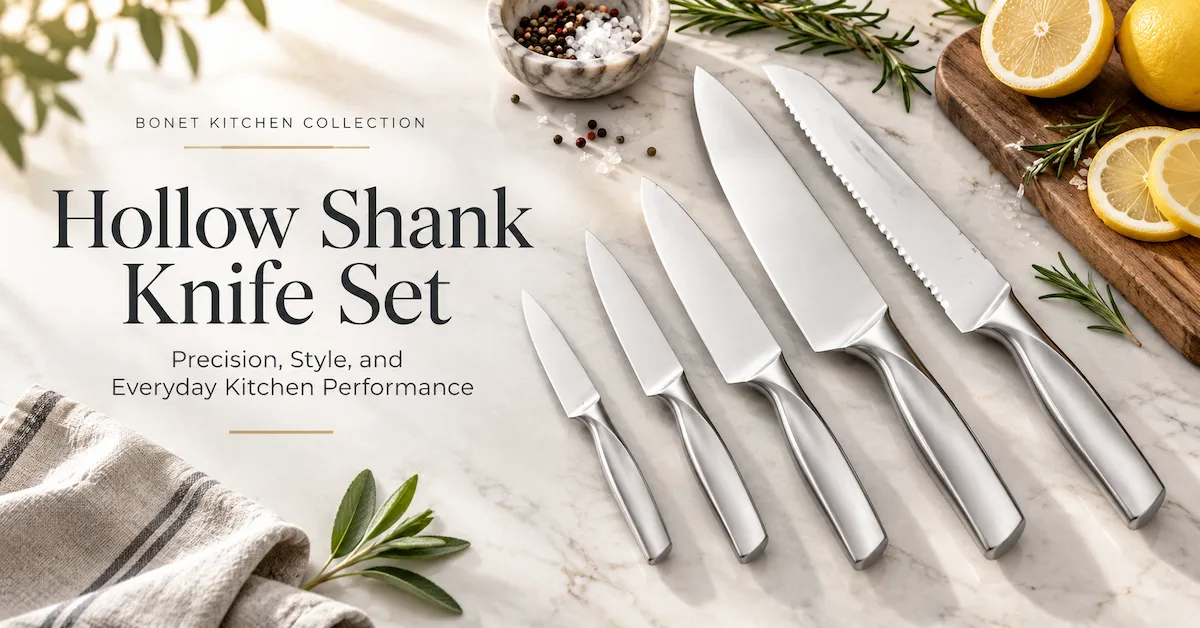
This guide focuses on that brand-to-production workflow. It is deliberately different from a general China kitchen knife factory sourcing article or a consumer chef-knife selection guide. The goal is to help buyers prepare a stronger OEM project, reduce quotation ambiguity, and arrive at a request for samples or pricing that a real manufacturer can act on.
Turn Your Knife Concept Into a Market-Ready Product
Share the target market, reference models, specifications and packaging requirements for a project-specific discussion.
Quick Answer: What Should an OEM Kitchen Knife Manufacturer Deliver?
A suitable partner should provide a clear route from product brief to controlled repeat production. That may involve executing a buyer's existing drawing, adapting an established knife platform, or assisting with concept development under an ODM arrangement. The buyer should receive enough evidence to approve the product, not merely a photograph and a unit price.
Before placing a production order, ask for a confirmed product specification, a physical reference sample, a packaging proof, a quotation with its assumptions, agreed quality checks, and a method for documenting revisions. For a multi-SKU range, make sure those records distinguish each knife and each set configuration.
| Buyer decision | Useful manufacturer contribution | Evidence before production |
|---|---|---|
| Knife purpose and target customer | Recommend appropriate existing or custom profiles | Confirmed use cases and product list |
| Blade and handle design | Assess manufacturability and materials | Component specification and drawings |
| Branding and presentation | Advise on logo methods and retail packs | Approved marking and packaging samples |
| Cutting performance | Produce representative prototypes | Agreed application-specific sample tests |
| Commercial feasibility | Quote quantity, tooling, pack and development scope | Written assumptions and project schedule |
| Production consistency | Manufacture against the approved revision | Golden sample, QC criteria and change process |
A manufacturer that cannot clarify an important requirement should identify the uncertainty instead of agreeing to everything. Clear feasibility feedback is often more useful to a professional buyer than an immediate but poorly defined quotation.
Start With the Brand's Customer, Not the Knife Catalog
A kitchen knife that works well for a home-cooking gift set is not automatically the right choice for a food-service distributor. Two buyers can request an 8-inch chef knife and still need different products. One may prioritize a light, approachable handle and compact packaging; another may prioritize grip during repetitive preparation and simple replacement ordering.
Private-label kitchenware brands often need a recognizable family appearance, controlled colors, logo placement, and consistent packaging. Supermarket chains need clear shelf benefits, barcode accuracy, dependable replenishment, and product sizes that fit the store's planogram. E-commerce sellers may be especially sensitive to parcel damage, online demonstrations, return causes, and unboxing experience. Hospitality and catering buyers typically focus on practical handling, cleaning, repeated use, and supply continuity.
Before speaking with an OEM team, answer eight short questions: Who will use the knife? What will they cut? How frequently? What retail price position is targeted? Is this a single knife or a set? What must distinguish the brand? Which market rules apply? How will the product be sold and delivered? Those answers drive the specification more effectively than a generic request for a 'premium knife.'
Build a SKU Role Before Building a SKU Count
A coherent product range may contain an entry product, a core-volume product, a trade-up product, and a complementary set. Each role should be justified. Adding more blades only because a competitor sells a larger set may increase cost without improving usefulness.
| Range role | Intended customer need | Reasonable product direction | Purchasing priority |
|---|---|---|---|
| Entry | Accessible everyday preparation | Simple utility or paring knife | Clear function and cost control |
| Core | Versatile home meal preparation | Chef or Santoku-style knife | Consistent cutting and comfort |
| Trade-up | Stronger visual or tactile differentiation | Coordinated finish and handle design | Approved appearance and performance |
| Set | Multiple tasks in one purchase | Curated chef, bread, utility and paring mix | Exact contents, protection and pack efficiency |
This approach helps prevent one of the most expensive early mistakes in private-label knife sourcing: committing to attractive models before determining which products the target buyer will actually purchase.
OEM, ODM, or Existing-Model Private Label: Choose the Development Route
The words OEM, ODM, and private label are used inconsistently across the market. Buyers should define the work rather than rely on a label alone. In an existing-model private-label project, the knife structure may already be established and the requested changes may be limited to logo, colors, finish, and packaging. In an OEM build-to-spec project, the buyer supplies an approved sample or controlled drawing and expects manufacturing against the defined requirements. In ODM, the manufacturer contributes more to concept development, structural choices, sampling, and feasibility.
The route changes the questions you must ask. An existing-model project needs confirmation that the base product performs well and that the branding is practical. A custom design needs clarity over development stages, tooling, revisions, testing, ownership, and who approves changes. The same brand may use all three routes across a collection; there is no need to force every SKU into one approach.
BONET describes production by drawing/sample, color and material customization, laser engraving or logo printing, packaging, concept development, structural optimization, and sample development within its OEM/ODM services. Availability and cost of a particular modification should still be confirmed for the selected knife.
Select Knife Types Around Real Cooking Tasks
The buyer's product brief should describe tasks first and knife names second. A chef knife is generally intended for broad ingredient preparation, but its weight and profile should still match the market. Santoku-style knives may suit compact, versatile household preparation. Bread knives depend on usable serration. Utility and paring knives need control in smaller tasks. A meat-cleaver listing needs a carefully defined application; not every broad kitchen blade is intended for bone chopping.
When assembling a set, write the contents separately. 'Six-piece' may include a peeler, scissors, stand, or other accessory rather than six knives. Confirm component names and materials individually. If consumers are expected to store the tools in a block or tray, test how the knives fit and how they can be safely removed and returned.
Use sample tasks in the brief: chopping firm vegetables, slicing tomatoes, cutting crusted bread, trimming smaller produce, or other application-specific operations. Avoid the claim that one edge excels at every task. An OEM manufacturer should help identify reasonable product trade-offs rather than promise incompatible advantages.
Compare Published BONET Knife Platforms Before Custom Development
BONET's public Kitchen Knife category includes knife sets with different materials and handle structures. These are useful starting points for an OEM discussion, but the product pages provide catalog information—not independently verified results for blade hardness, edge-retention cycles, or destination-market compliance.
| Published BONET model | Product direction | Metal material field | Plastic material field | Important OEM clarification |
|---|---|---|---|---|
| K102 chef knife set | Mixed kitchen knife and tool assortment | 420 stainless steel | PP | Confirm each included knife and accessory |
| K103 kitchen knife set | Stainless/plastic-handle set | 430 stainless steel | PP | Confirm which actual components use 430 |
| K105 plastic-handle set | Coordinated plastic-handle knives | 430 stainless steel | PP | Validate blade grade, handle fit and cutting tasks |
| K107 hollow-handle set | Alternative handle construction | 430 stainless steel | / | Request blade/handle component-level material list |
This table should not be read as a performance ranking. The pages do not establish that one model has better edge retention or corrosion resistance than another. The structured materials deserve further confirmation, particularly where a product listing identifies 430 stainless steel without separating blade and other metal components. For a blade-performance claim, request the relevant material certification, approved sample, processing details, and test requirements for the actual item under quotation.
For B2B buyers, a concrete model number is valuable because it makes the RFQ, sample revision, artwork, and repeat order traceable. The next step is to turn that catalog reference into a complete brand-specific specification.
Choose a Product Platform Before Customizing
Share the target market, reference models, specifications and packaging requirements for a project-specific discussion.
Specify Blade Steel Without Overpromising Performance
Steel selection matters, but the alloy name does not finish the engineering work. A kitchen knife's behavior depends on the blade material, geometry, heat treatment where applicable, grinding, edge finish, handle, and intended use. Two knives that appear similar in photographs may feel very different at the cutting board.
BONET publishes 420 stainless steel for K102 and 430 stainless steel for K103, K105, and K107. These should be represented accurately, without converting the material fields into claims about hardness or lifetime. The 420 designation commonly refers to a martensitic stainless-steel family capable of heat-treatment-dependent properties; 430 generally identifies a ferritic stainless-steel family with different hardening behavior. If a knife set is listed with 430, verify which component uses it and whether a separate cutting-blade specification exists. It would be misleading to assume all knives in a set have identical blade material solely from a single catalog field.
For any steel grade, ask the manufacturer to identify the relevant component, confirm the approved material condition, and agree on how finished performance is evaluated. If hardness is important, define an appropriate measurement method and acceptance range through the product's technical requirements. If corrosion performance is a marketing claim, specify exposure conditions and evidence. Do not create universal numbers where the manufacturer has not published them.
A useful contract statement describes the material and functional acceptance separately: the blade component must match the approved material specification, and the finished knife must pass the agreed cutting tests. This prevents material terminology from substituting for product validation.
Engineer the User Experience: Blade Geometry, Balance and Handles
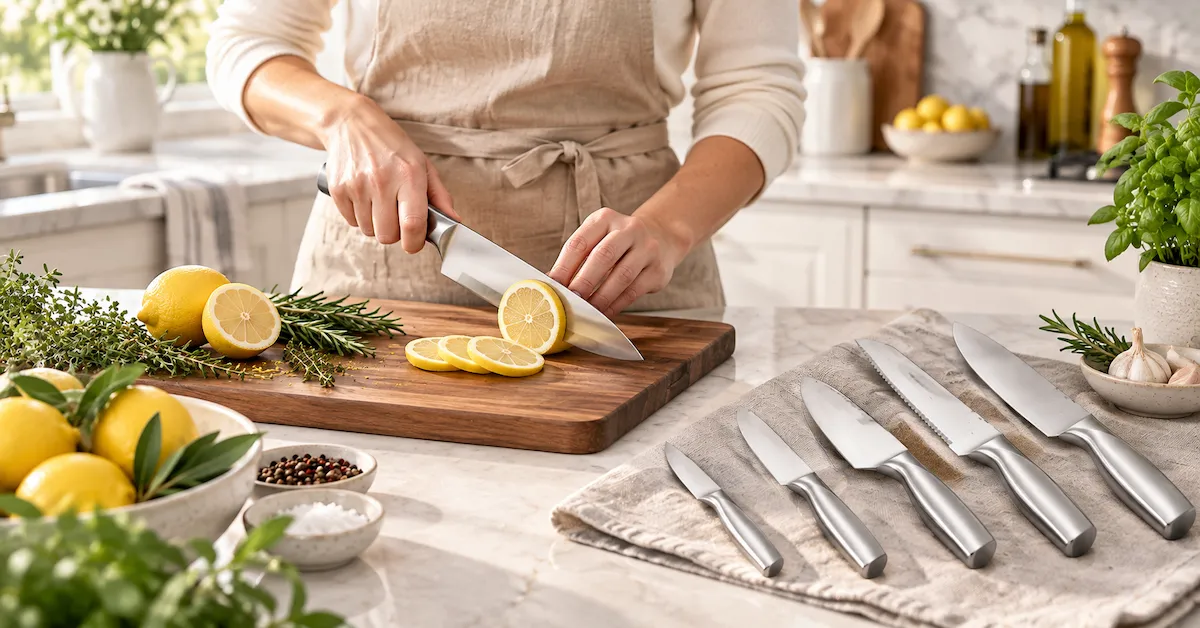
Blade shape affects how a knife works with food. Curvature and height influence chopping and slicing behavior; thickness behind the edge affects how materials separate; tip geometry influences detail work. The design should follow the consumer's typical use rather than a premium-looking silhouette chosen only for marketing.
Balance is not a number that can be judged from a product listing alone. Ask reviewers to handle the assembled knife and complete representative tasks. A product may feel comfortable for a short demonstration but tiring over repeated use. Grip security depends on geometry, texture, surface finish, handle material, and how the blade meets the handle.Claims such as universally non-slip or suitable for every hand size should be avoided without appropriate evaluation.
Inspect joints and transitions carefully. A plastic handle may use a different construction from a hollow metal handle, and each has different fit and finish questions. Check sharp corners near the grip, unacceptable gaps, visible movement, cleanliness, and care instructions. A knife with a convincing polished blade can still underperform commercially if the handle feels unstable or difficult to maintain.
For a branded collection, coordinate the design language without forcing identical dimensions across every SKU. Shared colors, logo placement, and surface character can create a family resemblance while allowing each knife to suit its actual task.
Design for Manufacturing Before Paying for New Tooling
Once the preferred concept is selected, ask for a manufacturability review. This is especially valuable for new handle profiles, custom blade shapes, hollow-handle constructions, decorative finishes, and set accessories. A prototype can be visually persuasive while relying on details that are difficult to reproduce consistently in a production environment.
The review should identify the parts that already use existing tooling, the parts that would change, and the risks created by those changes. For example, a requested handle color may be practical without changing the mold; a different finger-guard geometry may require more substantial tooling work. A new box size can alter carton packing even when the knife itself stays unchanged.
Use a simple design-for-manufacturing (DFM) decision log with four fields: proposed feature, effect on use, production change required, and approval evidence. Confirm who owns the decision and whether the change affects price or timing. This prevents the product from gradually becoming more complicated without corresponding commercial benefit.
Do not ask a manufacturer to preserve both the exact original unit price and an expanded set of unapproved custom features. Instead, compare the added value of the feature with the cost and repeatability implications. Buyers often discover that a carefully chosen existing platform with coordinated handles and packaging is a stronger first launch than an expensive fully new design.
Understand the Production Stages That Influence Knife Quality
BONET's manufacturing overview lists stamping, straight adjustment, heat treatment, rough grinding, water grinding, polishing, injection molding, ultrasonic cleaning, setting or assembly, quality checks, final cleaning, and packing. The precise route for a knife model should be confirmed rather than assuming every product goes through every operation identically.
Forming and blade geometry: The metal shape must correspond to the approved design. If stamping is used, its tooling and dimensional repeatability affect later finishing. If another forming route is proposed, ask what the actual product follows.
Heat treatment: When the chosen alloy and performance target require it, controlled treatment can influence material properties. Buyers should confirm the process and any required testing for that alloy rather than borrow hardness values from unrelated products.
Grinding and polishing: Grinding determines much of the working edge and should be evaluated through actual cutting results and finish consistency. Water-assisted grinding helps manage heat during finishing, but the factory must still produce the approved blade geometry.
Handle production and assembly: Injection molding can create ergonomic handle components; fit and attachment quality must be checked on the complete knife. For a different handle construction, define its own assembly inspection.
Cleaning, checking, and packaging: These final stages matter because even a correctly formed blade can reach customers scratched, contaminated with process residues, or inadequately protected. The actual end condition should be compared with the approved packed sample.
Manufacturing-process evidence supports an article's technical credibility, but it does not prove that every product meets an unspecified global standard. Request a process and inspection map for the chosen SKU, not a general promise that the factory uses advanced equipment.
Build a Sample Approval Plan That Reflects the Brand Promise
Sample approval is the point where attractive ideas must become observable performance. The test set should reflect what appears on the package and product listing. For an everyday chef knife, that might include slicing representative vegetables, mincing herbs, and inspecting comfort during repeated preparation. A bread knife needs an appropriate bread-cutting task. A paring knife should be evaluated for controlled detailed preparation.
Create a written sample matrix before approving tooling or bulk production. Define the reference materials, test conditions, number of samples, observations, and what counts as unacceptable performance. The table below is a suggested buyer method, not a claim that BONET has performed these exact tests.
| Sample checkpoint | Example verification | Reason for approval |
|---|---|---|
| Blade shape and dimensions | Compare with approved drawings or reference | Product identity and fit |
| Cutting performance | Complete intended food-prep tasks | Evidence for selling claims |
| Edge finish | Inspect uniformity and unacceptable burrs | Cutting behavior and appearance |
| Handle fit | Inspect joint, gaps and movement | User comfort and structural confidence |
| Repeated handling | Test representative preparation sequence | Grip and balance feedback |
| Surface treatment | Compare color, polish and visible defects | Retail consistency |
| Brand marking | Confirm size, position and appearance | Brand control |
| Packed sample | Check retention and protective elements | Shipping and unboxing safety |
Every sample should have a revision ID. If the handle, edge, logo, or packaging changes, record what was changed and why. A golden sample is useful only when both parties identify the same approved version and the specification used for production agrees with it.
Think of Knife Sets as Systems, Not Piece Counts
Selling a knife set introduces decisions beyond the individual knives. Each piece needs a role in the customer's kitchen, and the set must feel coherent. A basic collection may include a chef knife, bread knife, utility knife, and paring knife. Some products add scissors or a peeler, as illustrated in BONET's K102 product presentation. The set name should describe actual contents rather than implying every component is a knife.
Ask whether consumers will use the accessories and whether the full assortment meets the price position. For a supermarket range, too many redundant pieces may complicate packaging and shelf explanation. For a gift set, coherent finish, handle color, and opening experience may create stronger differentiation. For e-commerce, excessive weight and oversized packaging can raise delivery cost and breakage risk.
Record the component list on the bill of materials (BOM). Identify any accessories, storage holders, blade guards, and inserts separately. Packaging must retain each component without loose metal-to-metal contact. A knife set should be approved in its final packed configuration, not simply as unpacked samples on a desk.
Plan Logo, Color, Surface Finish and Packaging Together
The brand identity should connect the physical knife and its packaging. A logo can be printed or laser-marked where suitable, but marking style should be selected with the actual blade or handle finish. Do not assume the result on a polished stainless surface will match a digital mockup. Approve a physical reference with the correct placement and orientation.
Handle colors can unify a line, but physical samples are important because resin, surface texture, lighting, and processing can influence the perceived shade. Finish choices should reflect the target price and brand positioning rather than an assumption that the most elaborate treatment is always preferable.
Retail packaging must communicate what each knife does. E-commerce packaging needs to withstand individual parcel handling. Gift packaging may need stronger presentation, while wholesale cartons prioritize identification, protection, and logistics efficiency. A package that looks attractive in a render may still be unsuitable if blades or handles shift during transit.
BONET identifies logo printing, laser engraving, colors, surface treatments, color boxes, gift boxes, barcode labels, and export cartons among its customization services. Packaging and marking feasibility for a specific project should be confirmed with the selected product platform.
Make Branding and Packaging Work Together
Share the target market, reference models, specifications and packaging requirements for a project-specific discussion.
Compare MOQ and Price Against the Actual Specification
There is no reliable universal minimum order quantity for an OEM kitchen knife project. Quantity may be affected by an existing versus new model, steel and handle materials, custom colors, tooling, marking method, packaging print runs, accessories, and production setup. A factory quotation only becomes meaningful when its assumptions are explicit.
Ask for the product-unit cost and separate lines for development, new tooling, samples, special finishing, packaging, testing, and shipping where applicable. Clarify whether the quotation includes the packed knife or an unpacked component and which revisions would trigger new pricing. For a range of SKUs, identify whether packaging or handle color costs apply to each SKU or can be coordinated commercially.
| Quote component | Why it changes | Buyer question |
|---|---|---|
| Product platform | Existing or newly developed geometry | What tooling already exists? |
| Metal and processing | Actual materials and production steps | Which component specifications are included? |
| Handle | Molding, assembly and color | Does the quoted handle match the sample? |
| Marking and finish | Process and setup | Is the exact approved logo included? |
| Packaging | Print, inserts, cartons and labeling | Is this price for a retail-ready unit? |
| Inspection and testing | Method, sample size and scope | Which checks are included or separately charged? |
| Logistics | Packed size, delivery term and destination | What remains outside the factory price? |
The correct commercial target is an acceptable landed cost for the promised product quality. A low price can lose its advantage if packaging damage, inconsistent materials, or rejected retailer deliveries create downstream cost.
Define Quality Gates Before Mass Production Starts
Quality control should be built around critical product and brand characteristics. For kitchen knives, those may include actual blade material, geometry, cutting performance, handle assembly, surface condition, accurate set contents, labeling, and protective packaging. The agreed testing plan should distinguish objectively verifiable requirements from subjective preferences.
Useful approval gates include: incoming materials or components, in-process critical characteristics, preproduction sample acceptance, finished-product testing, packing approval, and shipment release. Depending on order size and customer policy, a buyer may also request a third-party inspection. Specify the defect categories, sampling approach, reporting method, and procedure for handling a nonconforming shipment.
Claims such as 'food-safe,' 'dishwasher-safe,' 'never rusts,' or 'professional grade' should not be included automatically in marketing. Destination-market rules, product composition, use conditions, and test evidence should support any technical or regulatory claim. Factory-wide management credentials and product-specific conformity documents serve different purposes.
BONET's About page identifies ISO9001, BSCI, Sedex, and 6S-related management information. Buyers should request current evidence when relevant and avoid treating those references as automatic proof that every knife model satisfies all importing-country requirements.
Transfer One Approved Design Into Production—and Keep It There
Many OEM problems emerge after sample approval. A product manager approves one handle color, packaging approves another artwork revision, and purchasing places an order referring only to the model name. By the time production starts, the factory may have received conflicting instructions.
Avoid this with a production transfer file for each SKU. It should identify the current drawing, component list, materials, logo files, packaging artwork, sample revision, approved exceptions, inspection requirements, packing quantity, and purchase-order reference. If a change occurs, record its reason, approval owner, effective production date, and whether the customer needs a new sample.
For repeat orders, begin with the approved master file. Ask what has changed since the last shipment: material suppliers, tooling, finish, assembly method, package supplier, or carton arrangement. Revisit significant changes before production rather than accepting silent substitution.
This is how OEM development becomes a reliable supply program. The buyer is not purchasing the memory of a salesperson or the appearance of one sample; the buyer is purchasing a reproducible version with clear acceptance rules.
Ownership, Exclusivity and Tooling: Resolve Them Before Development
An OEM kitchen knife manufacturer may supply products based on existing catalog tooling or work on buyer-funded tooling. These arrangements have different ownership implications. Printing a brand name on an established knife does not automatically create exclusive rights to that underlying design.
When original drawings, molds, artwork, product photography, or distinctive structures are commercially important, define their ownership and permitted use in an appropriate agreement. If a buyer pays for new tooling, address identification, custody, maintenance, access, use by third parties, and the procedure if the relationship ends. Clarify how confidentiality and revision controls apply to shared files.
These are business and contractual decisions, not assumptions that should be filled into a marketing article. Buyers can consult qualified advisers for jurisdiction-specific contractual issues. From a sourcing perspective, the important discipline is to make the responsibilities visible before tooling or large production commitments begin.
Create an RFQ That Leads to a Useful Manufacturer Response
A strong request for quotation is concise, complete, and easy to answer. It should distinguish what the buyer already knows from what requires the manufacturer's recommendation. A brand without a finalized blade grade can state the intended cutting tasks and ask for technically justified material options rather than inventing a specification.
| RFQ field | Information to provide |
|---|---|
| Market and channel | Country, brand type, supermarket/e-commerce/wholesale/hospitality |
| Reference | Existing item number, product photo, drawing or physical sample |
| Knife role | Chef, Santoku, bread, utility, paring, cleaver or set |
| User and task | Typical ingredients, use frequency and positioning |
| Blade | Preferred component material, dimensions and finish if known |
| Handle | Construction, material, colors and ergonomics |
| Branding | Logo file, method, location and intended appearance |
| Packaging | Retail or e-commerce format, box dimensions, barcodes, protection |
| Quantity | Planned pilot order and estimated reorder pattern |
| Approval | Sample tests, product requirements and quality expectations |
| Market requirements | Applicable product documentation, labels and claims |
| Commercial scope | Target quotation basis, delivery destination and schedule |
A buyer might write: 'We are developing a four-piece branded kitchen knife collection for mid-market home retailers. We have reference photographs but need confirmation of suitable blade materials and handle construction. Please identify existing product platforms, feasible logo/color customization, required samples, packaging options, MOQ, development/tooling assumptions, and the proposed quality-inspection approach.'
That request gives the manufacturer something useful to evaluate. It also makes later supplier comparison fairer because each candidate responds to the same questions.
Ready to Evaluate Your Knife Project?
Share the target market, reference models, specifications and packaging requirements for a project-specific discussion.
Why BONET Is Relevant to an OEM Kitchen Knife Project
BONET HOUSEWARE CO., LTD. is based in Yangjiang, Guangdong, and publicly presents kitchen knives, scissors, kitchen tools, cutting boards, and related kitchenware. Its website describes OEM/ODM services for international brands, importers, distributors, supermarkets, and e-commerce sellers.That makes the company a relevant OEM kitchen knife manufacturer to evaluate when a buyer needs existing knife platforms combined with branding, development, and packaging discussions.
Its knife product range provides several published reference models. Its manufacturing page describes forming, heat treatment, grinding, polishing, handle production, assembly, quality checking, and packing operations for relevant cutting tools. Its OEM/ODM page organizes collaboration into requirement communication, design and sampling, quotation and confirmation, mass production, quality inspection, and packaging/delivery.
These published facts are useful starting points, but they are not substitutes for a model-specific quotation or current supporting documents. BONET does not publicly establish one MOQ, one production lead time, or one hardness value for every knife. Buyers should confirm the material assigned to each actual component, the available customization route, current project capacity, sample requirements, and applicable market documentation.
To begin a useful conversation, provide a reference model or drawing, intended users, target market, quantity, logo, packaging, and expected timing via the official BONET contact page. The stronger the brief, the easier it becomes to evaluate feasibility instead of exchanging generic price lists.
Frequently Asked Questions About OEM Kitchen Knife Manufacturing
What does an OEM kitchen knife manufacturer do?
An OEM kitchen knife manufacturer produces knives according to an approved product design, drawing, sample, or specification and may offer material, branding, finish, packaging, and manufacturing support. The exact scope varies by project. Buyers should distinguish simple existing-model private labeling from substantial structural development and document responsibilities before ordering.
Can I launch a private-label knife collection without designing every knife from scratch?
Often, yes. A brand can begin with appropriate existing product platforms and develop coordinated colors, logo placement, packaging, and an assortment suited to its audience. This can reduce unnecessary design complexity, but buyers must still approve each knife's actual function, materials, appearance, and packing. Exclusive rights to a catalog design should not be assumed.
What is the difference between OEM and ODM kitchen knives?
OEM generally begins with a buyer-controlled product specification or reference. ODM includes more assistance with concepts, structure, material recommendations, and samples. A project can begin in ODM development and end with an OEM-style approved production file. The important distinction is what work remains open and who approves it.
Which steel is best for OEM kitchen knives?
There is no single best steel for every knife, price level, or use. Buyers should specify the cutting application, geometry, manufacturing route, finishing requirements, and functional tests. BONET's K102 lists 420 stainless steel, while K103, K105, and K107 list 430 in the structured metal field; confirm what those fields cover before inferring blade performance.
Why should I check 430 stainless steel listings carefully?
A 430-type designation typically relates to a ferritic stainless-steel family and does not behave like heat-treatable martensitic blade grades. When a knife set's general metal field says 430, buyers should confirm which component uses it, request the actual blade material information, and approve cutting performance on the intended product. This is a clarification process, not proof that the model fails.
How should I test an OEM kitchen knife sample?
Use representative food-preparation tasks for the intended knife type, plus visual, dimensional, grip, handle-fit, finish, logo, and packed-product checks. Identify a clear sample version and agree on acceptance criteria before approval. Where hardness or corrosion metrics are material to the product claim, use an appropriate documented method instead of an assumed universal number.
What affects MOQ and price for custom kitchen knives?
The base knife platform, custom blade geometry, handle construction, material requirements, colors, logo method, tooling, finishing, packaging print runs, accessories, and inspection scope can affect MOQ and cost. Buyers should request a quotation for the exact packed product and identify separate development expenses rather than compare undefined unit prices.
Can BONET customize knife handles, logos and retail packaging?
BONET's OEM/ODM page describes material and color customization, logo printing, laser engraving, surface-treatment advice, retail packaging, color boxes, gift boxes, barcode labels, and export cartons. The practical options depend on the selected knife and project. Request physical samples and a specification-based quotation to confirm feasibility.
How can I prevent quality differences between repeat knife orders?
Maintain a master production file with the product revision, component materials, drawings, approved sample, color standards, logo and artwork files, packaging, quality checks, and purchase-order reference. Before each reorder, ask whether any component, process, finish, tooling, or packaging arrangement changed. Significant changes should be reviewed and approved before production.
What should I send BONET to request an OEM kitchen knife quote?
Send the intended market, sales channel, knife types or references, cutting tasks, preferred blade and handle requirements, logo and packaging direction, pilot quantity, expected repeat demand, compliance requirements, and desired schedule. Use the BONET contact page to request project-specific guidance on models, samples, customization, MOQ, and quotation assumptions.
Conclusion
Choosing an OEM kitchen knife manufacturer requires a clear target customer, suitable blade and handle specifications, approved samples, practical packaging, and controlled repeat production. Brands should compare manufacturers on manufacturability, application-specific testing, realistic customization, and documented change management—not unit price alone.
BONET offers kitchen knife product references, published manufacturing processes, and OEM/ODM development support. To discuss a branded knife range, send BONET your project requirements for model selection, sample planning, packaging, and a specification-based quotation.
Build a Repeatable Private-Label Knife Range
Share the target market, reference models, specifications and packaging requirements for a project-specific discussion.