




OEM Kitchen Scissors Manufacturer Guide for Private-Label Buyers
Choosing an OEM kitchen scissors manufacturer is not just about finding a factory that can make a familiar kitchen tool. For private-label buyers, the real task is to turn a common product into a reliable, brand-appropriate item that performs consistently across production lots. Kitchen scissors may be used for herbs, food bags, packaging, light trimming, and quick prep tasks where a knife is less convenient. If the pivot loosens, the handles pinch, or the blades arrive with rough edges, a simple item can become a returns problem.
This guide explains how sourcing teams can evaluate culinary shears for private-label programs without relying on appearance alone. It focuses on supplier questions, sample review, customization scope, and practical quality checks that are useful before a trial order.
Key Takeaways
- Do not judge kitchen scissors only by product photos; pivot action, edge finish, and handle comfort matter more.
- Confirm blade material, handle material, surface finish, and packaging details with the supplier rather than assuming them from appearance.
- Define whether the project needs light branding, packaging customization, or deeper OEM changes such as handle shape or blade geometry.
- Use samples to test consistency, cleaning practicality, cutting feel, and retail presentation before committing to volume production.
What the Product Design Shows
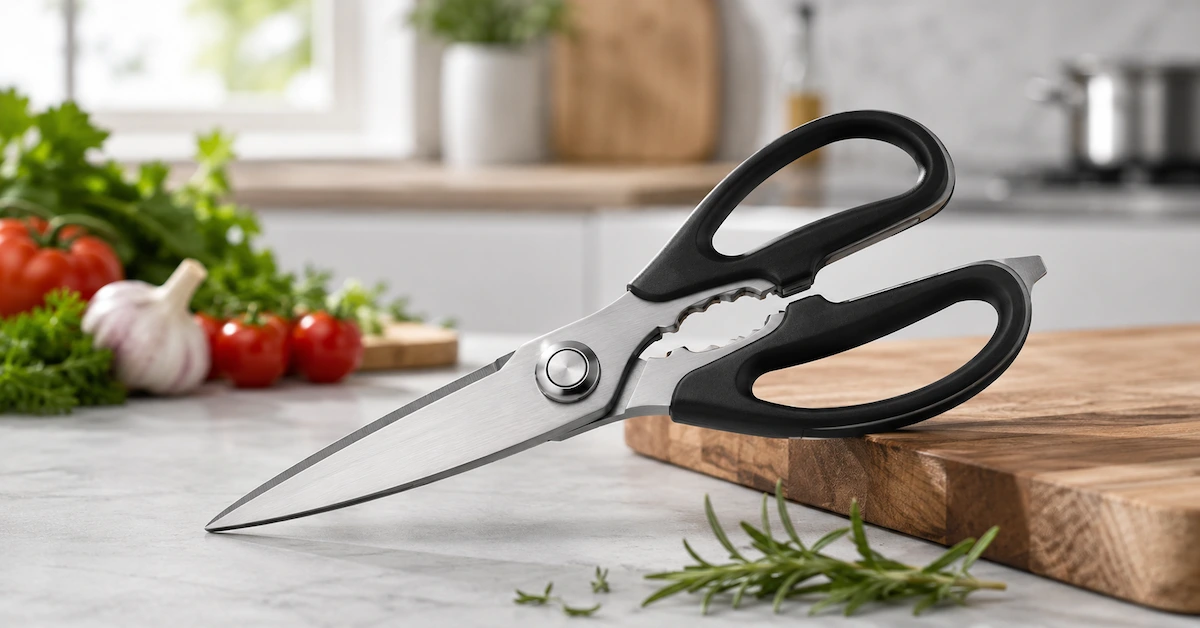
The product shown is a conventional two-blade kitchen scissor, also called culinary shears in many buying conversations. It has long straight blades, pointed tips, a central pivot, and large loop handles. The blade surface appears to have a brushed or satin metal finish, which gives a clean kitchen-tool appearance, but the exact material grade should be confirmed through supplier documentation.
The handle area appears black and may be plastic or a rubberized grip material, though the exact compound is not confirmed by the image alone. There is also a notched or toothed section near the pivot. On kitchen scissors, this kind of detail is sometimes used as a secondary gripping or opening feature, but buyers should ask the manufacturer to define its intended function before using it as a sales claim on packaging.
Supplier Comparison Checklist
When comparing an OEM kitchen scissors factory, a trading company, or a general kitchenware supplier, use a structured checklist. A low quotation is not helpful if the supplier cannot explain how the product is assembled, packed, and kept consistent.
| Check Area | What to Ask | Why It Matters |
|---|---|---|
| Customization | Can you adjust logo, packaging, handle shape, blade length, or finish? | Clarifies whether the supplier supports true OEM work or only stock branding. |
| Materials | What blade and handle materials are specified for the quoted sample? | Prevents assumptions based on appearance and supports accurate purchasing files. |
| Pivot assembly | How is opening tension controlled during production? | A poor pivot can make scissors feel loose, stiff, or uneven. |
| Edge quality | How are blades sharpened, deburred, and protected in packing? | Rough edges and inconsistent grinding are common user complaints. |
| Packaging | Can packaging hold the tool securely and protect the tips? | Good products can still arrive damaged if packaging allows movement. |
How Kitchen Scissors Are Commonly Manufactured
Although each factory may use its own process, kitchen scissors generally begin with blade blanks that are cut or stamped from sheet metal, then shaped, ground, finished, and sharpened. Some designs may use different forming methods depending on strength requirements and cost targets. Handles are often molded separately or assembled around the metal component, and the two halves are joined at the pivot.
For buyers, the important point is not to memorize the process, but to understand where defects appear. Blade alignment affects cutting feel. Pivot tolerance affects opening and closing. Handle molding quality affects comfort and perceived value. Surface finishing affects shelf appearance and cleaning perception. Each stage should be reflected in the sample review and in the supplier’s quality control discussion.
Material and Finish Questions to Confirm
Kitchen scissors are used around moisture, food residue, detergent, and frequent handling, so material selection is central to product performance. Stainless steel is common in this category, but buyers should not claim a specific grade unless the supplier provides the specification. Ask for a written material declaration, and confirm whether the quoted sample and production order will use the same specification.
Handle material also deserves attention. A hard plastic handle may be durable and cost-effective, while a soft-touch or rubberized surface may feel more comfortable. The tradeoff is that softer materials can show wear if the formulation is not suitable. Buyers should test grip feel with wet hands, check for sharp molding lines, and confirm whether the handle shape works for the intended user group.
OEM Customization Scope for Private Label
Not every supplier means the same thing by OEM. Some suppliers may offer only logo printing and retail card design. Others may be able to modify handle tooling, blade shape, color, surface finish, or packaging structure. Before asking for pricing, define the level of customization needed for the program.
- Start with the target channel: supermarket, cookware line, promotional set, foodservice, or online retail.
- Decide which features must be customized and which can remain standard.
- Ask whether changes require new tooling, revised samples, or longer development time.
- Confirm what documentation the supplier can provide for materials, packaging, and production approval.
This approach helps prevent a common sourcing problem: requesting a premium custom product while budgeting for a stock item. Clear scope also helps the manufacturer recommend a realistic path.
Sample Review Before a Trial Order
A sample should be treated as a small manufacturing audit. Open and close the scissors repeatedly to feel whether the pivot is smooth and stable. Cut common kitchen items such as herbs, food packaging, and thin cardboard if those uses match the product brief. Check whether the tips meet evenly and whether the blades rub too tightly.
Also inspect the handle area. Look for flashing, rough seams, weak grip, or uncomfortable pressure points. Review the finish under bright light to see whether scratches, burrs, or staining are visible. If the product has a notched section near the pivot, ask the supplier to demonstrate its intended use and limitations. For private-label packaging, confirm that the scissors cannot move freely enough to damage the card, blister, sleeve, or nearby products during shipping.
Common Sourcing Mistakes to Avoid
- Overvaluing appearance: A clean product photo may hide poor blade alignment or uncomfortable handles.
- Making unsupported claims: Do not print material grades, food-contact statements, or special functions unless the supplier provides support.
- Adding too many features: Extra contours, logos, and secondary functions can increase tooling complexity and quality risk.
- Ignoring cleaning use: Kitchen tools are exposed to residue and moisture, so gaps and rough surfaces matter.
- Skipping packing review: Blade tips and edges need protection during transport and retail handling.
Practical FAQ
Are kitchen scissors and culinary shears the same product?
In many sourcing discussions, the terms overlap. Some buyers use culinary shears for heavier or more food-prep-focused designs, but the category is often similar.
Can this type of design work for private label?
Yes. A two-blade kitchen scissor with large handles is a common private-label format. Actual customization depends on the supplier’s tooling, assembly process, and packaging capabilities.
What should buyers confirm before ordering samples?
Confirm blade material, handle material, pivot structure, finish, intended functions, logo method, packaging format, and whether the sample reflects future production.
What is the best way to compare two OEM suppliers?
Compare samples side by side using the same cutting tasks, comfort checks, packaging review, and documentation request. Price should be evaluated after usability and consistency are understood.
Next Step for Sourcing Teams
Before selecting an OEM kitchen scissors manufacturer, prepare a short product brief with target market, expected use, customization needs, packaging style, and required supplier documents. Then request samples that match that brief as closely as possible. A dependable supplier should be able to answer practical questions about materials, pivot assembly, finishing, and packing without relying only on generic catalog language.
For private-label kitchenware programs, the best choice is usually the supplier that provides clear answers, stable samples, and realistic customization guidance. Kitchen scissors are a small product, but the details are visible every time the user opens, cuts, washes, and stores them.
