




What Does an OEM Scissors Manufacturer Actually Do?
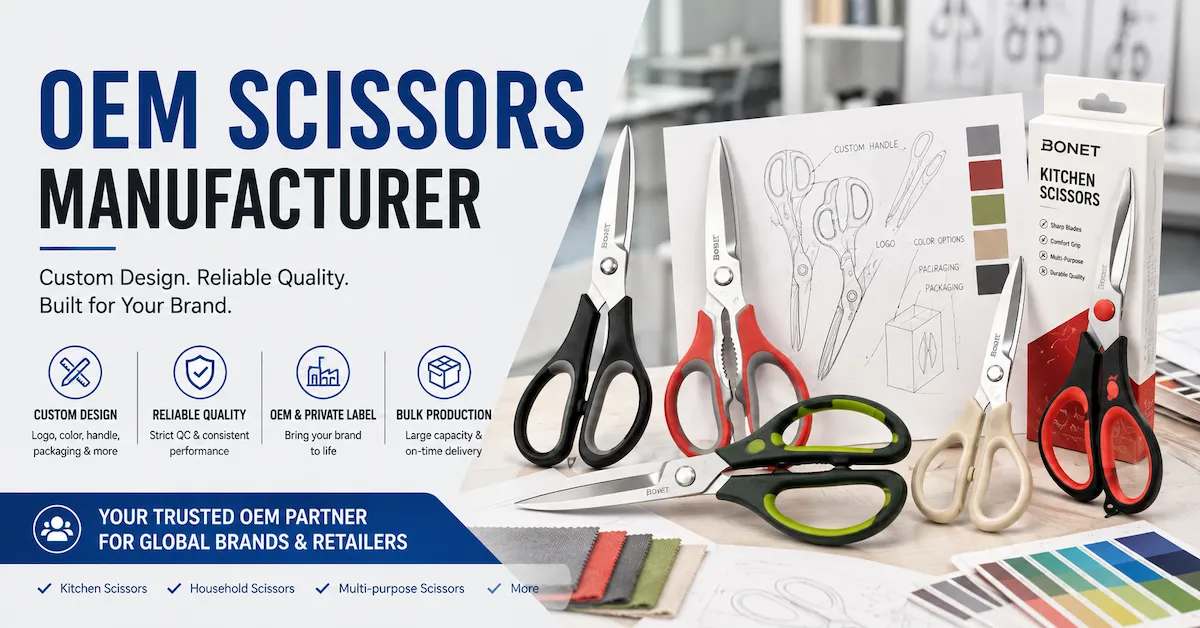
An OEM scissors manufacturer produces scissors according to a buyer's defined product specifications, branding requirements, packaging needs, and target-market positioning.
For a global retailer or private-label brand, OEM manufacturing should involve much more than placing a logo on an existing product.Depending on the project, the manufacturer may need to support:
- Product model selection
- Blade specification
- Handle design
- Color customization
- Functional changes
- Logo application
- Retail packaging
- Sample development
- Quality standards
- Bulk production
- Repeat-order specification control
The most important question for a buyer is therefore not simply:
“Can you make scissors with our logo?”
A better question is:
“Can you consistently manufacture the exact scissors configuration our brand requires,from approved sample through repeat orders?”
BONET offers multiple scissors categories, including kitchen, household, stationery, school, tailor, and other scissors, providing a broader base for OEM product development. Explore BONET Scissors Products
Who Typically Needs an OEM Scissors Manufacturer?
OEM scissors programs are most relevant to companies that want more product control than standard wholesale purchasing provides.
Private Label Brands
Private-label companies often need:
- Custom brand colors
- Logo application
- Retail packaging
- Coordinated product families
- Repeat-order consistency
The goal is not simply to resell a factory model but to create a recognizable branded collection.
Supermarket and Retail Chains
Retailers may need several scissors SKUs for different shelf positions, such as:
- Entry-level household scissors
- Kitchen scissors
- Multi-purpose scissors
- Premium ergonomic models
- Promotional or bundled products
An OEM program can help create consistent packaging and visual branding across these SKUs.
E-Commerce Sellers
Online brands often prioritize:
- Distinctive visual design
- Feature differentiation
- Branded packaging
- Compact shipping configuration
- Clear product positioning
Importers and Distributors
Importers may require:
- Multiple models
- Bulk production
- Market-specific packaging
- Stable replenishment
- Distributor-exclusive product lines
OEM vs ODM vs Standard Wholesale Scissors
Buyers should distinguish these sourcing models before requesting quotations.
| Sourcing Model | Buyer Provides | Manufacturer Role | Best For |
|---|---|---|---|
| Standard Wholesale | Quantity and model choice | Supplies existing model | Fast market entry |
| OEM | Product requirements and branding | Manufactures to buyer specification | Private labels and retailers |
| ODM | Product direction or market need | Supports deeper design/development | Brands needing product development |
| Full Custom | Detailed concept,drawings or sample | Develops new structure/components | Differentiated product programs |
Standard Wholesale
Suitable when buyers need:
- Existing products
- Minimal changes
- Faster sourcing
OEM
Suitable when buyers already know:
- Desired product category
- Brand positioning
- Color
- Packaging
- Logo
- Required specifications
ODM
More suitable when the buyer needs support turning a general market concept into a product configuration.
What Types of Scissors Can Be Developed Through OEM Manufacturing?
BONET's scissors range covers several categories, which allows buyers to develop different programs around specific applications.
Household Scissors
Suitable for:
- General household cutting
- Packaging
- Paper
- Home-office tasks
OEM opportunities include:
- Handle color
- Size
- Logo
- Retail packaging
- Product sets
Kitchen Scissors
Kitchen scissors may be designed for:
- Food preparation
- Herbs
- Packaging
- General kitchen cutting
Certain models can also integrate additional functions.
Multi-Purpose Scissors
Multi-purpose scissors may combine:
- Standard cutting
- Serrated gripping
- Bottle-opening functions
- Crushing or gripping functions
- Specialized blade profiles
These models can provide stronger differentiation for private-label programs.
Detachable Kitchen Scissors
Detachable products can provide:
- Easier cleaning
- Different functionality
- A stronger premium product story
School and Stationery Scissors
These products require different considerations around:
- Size
- User comfort
- Safety
- Color
- Packaging
The right OEM program starts by defining the use case rather than choosing a product only because it looks attractive.
What Should Buyers Specify Before Requesting an OEM Quote?
One of the biggest causes of slow quotation and poor supplier comparison is an incomplete RFQ.
Instead of sending:
“Please quote your OEM scissors.”
Provide a structured specification.
| RFQ Item | Information to Provide |
|---|---|
| Product type | Household, kitchen, multi-purpose, school |
| Reference | Product photo, drawing, or sample |
| Size | Overall length / preferred model |
| Blade | Material and application |
| Handle | Material, color,grip requirement |
| Functions | Basic or multifunctional |
| Branding | Logo method and location |
| Packaging | Card, blister, box, set |
| Quantity | Per SKU |
| Target market | Country or region |
| Quality requirements | Test or inspection needs |
| Delivery | Required schedule |
The more complete the RFQ, the more meaningful the quotation becomes.
Blade Materials: What Should an OEM Buyer Evaluate?
Blade material affects:
- Cutting performance
- Durability
- Corrosion resistance
- Product appearance
- Cost
Stainless Steel
Stainless steel is widely used for household and kitchen scissors because it can provide a practical balance of:
- Corrosion resistance
- Durability
- Appearance
- Routine maintenance
However, “stainless steel” alone is not a complete product specification.
The buyer should also consider:
- Blade thickness
- Edge geometry
- Surface treatment
- Intended cutting material
- Hardness requirements where applicable
- Manufacturing process
Two products made from apparently similar steel can perform differently depending on processing and assembly.
Handle Design Matters More Than Many Buyers Expect
The handle is one of the main interfaces between the product and customer.
OEM buyers should evaluate:
Finger Opening
The openings should match intended users and product dimensions.
Grip Geometry
Handle geometry affects:
- Leverage
- Comfort
- Cutting control
Material
Possible handle structures depend on model and positioning.
Buyers may prioritize:
- Rigidity
- Comfortable grip
- Surface feel
- Color stability
Brand Color
Custom handle colors can help create a coordinated range across:
- Kitchen scissors
- Household scissors
- Other kitchen tools
This can strengthen retail shelf recognition.
Why Blade Alignment and Pivot Control Are Critical
Scissors depend on two blades working together.
Poor blade alignment can cause:
- Material slipping
- Incomplete cutting
- Excessive cutting force
- Uneven wear
The pivot also affects:
- Opening resistance
- Cutting feel
- Blade contact
- Long-term usability
For OEM projects, these characteristics should be checked during sample approval instead of assuming that visual appearance guarantees performance.
What Manufacturing Capability Should an OEM Scissors Manufacturer Have?
A capable OEM scissors manufacturer should be able to explain the processes that influence finished-product quality.
Depending on model, manufacturing may involve:
- Material preparation
- Blade forming or stamping
- Heat treatment where applicable
- Grinding
- Edge processing
- Polishing or surface finishing
- Handle/component production
- Assembly
- Functional testing
- Final inspection
- Packaging
BONET presents manufacturing capabilities related to cutting tools and kitchenware production. View BONET Manufacturing
The buyer should evaluate not only whether equipment exists, but how manufacturing parameters are controlled between batches.
OEM Scissors Quality Control Checklist
Quality requirements should be defined before mass production.
| QC Item | What Should Be Checked |
|---|---|
| Material | Matches approved specification |
| Blade profile | Correct shape and dimensions |
| Blade alignment | Smooth and consistent contact |
| Sharpness | Meets intended cutting use |
| Pivot | Stable and smooth |
| Handle | Secure assembly and comfort |
| Additional functions | Work correctly |
| Surface | Consistent finish |
| Color | Matches approved reference |
| Logo | Correct size and placement |
| Packaging | Matches approved artwork |
| Barcode/SKU | Correct where required |
Use the Approved Sample as a Reference
The final approved pre-production sample should become a reference for:
- Production
- Inspection
- Packaging
- Repeat orders
This makes quality discussions more objective.
What Can Be Customized in an OEM Scissors Project?
Customization should be separated into different levels.
Level 1: Branding
Suitable for lower-complexity projects.
May include:
- Logo
- Label
- Packaging
Level 2: Appearance
May include:
- Handle colors
- Surface finishes
- Packaging style
Level 3: Product Configuration
May include changes to:
- Blade type
- Handle structure
- Size
- Functional combinations
Level 4: Structural Development
More advanced projects may involve:
- New product geometry
- Custom components
- Tooling
- New function development
As customization increases, buyers should expect more discussion around:
- Sampling
- Tooling
- MOQ
- Development time
- Testing
BONET's OEM/ODM offering supports product customization based on project requirements. Explore BONET OEM/ODM Services
How Does an OEM Scissors Project Usually Progress?
A structured workflow reduces revisions and sourcing risks.
Step 1: Define the Target Market
Before discussing product details,clarify:
- Where will the scissors be sold?
- Who is the target customer?
- What sales channel will be used?
- What price tier is expected?
Step 2: Select or Define the Product
The manufacturer can evaluate:
- Existing models
- Reference products
- Drawings
- Desired functions
Step 3: Confirm Customization
Lock the initial requirements for:
- Blade
- Handle
- Color
- Logo
- Packaging
Step 4: Sample Development
The buyer evaluates:
- Cutting feel
- Grip comfort
- Appearance
- Functions
- Packaging
Step 5: Sample Revision
If necessary, revise specifications before mass production.
Step 6: Lock the Golden Sample
Once approved, this becomes the manufacturing reference.
Step 7: Mass Production
Production begins according to the approved specifications.
Step 8: Inspection and Shipment Preparation
The final product and packaging should be checked before shipment.
What Affects OEM Scissors MOQ?
There is no meaningful single MOQ that applies to every custom project.
MOQ can change because of:
- Existing vs newly developed model
- Handle color
- Material
- Logo method
- Packaging
- Number of SKUs
- Tooling
- Production process
For example, a standard existing model with custom packaging may have a different commercial requirement from a completely new handle design.
Instead of asking:
“What is your OEM MOQ?”
Ask:
“What is the MOQ for this specific scissors model with our custom handle color, logo, packaging, and order split?”
That question gives the manufacturer enough information to respond commercially.
What Affects OEM Scissors Lead Time?
Lead time can depend on:
- Product complexity
- Sample development
- Tooling
- Material availability
- Packaging artwork
- Quantity
- Number of SKUs
- Factory scheduling
Buyers planning retail launches should build time into the process for:
- Samples
- Corrections
- Packaging approval
- Final production
Rushing the sample stage can create far more expensive problems during mass production.
OEM Scissors Manufacturer vs Trading Company
Both can play useful roles, but they offer different sourcing structures.
| Requirement | OEM Manufacturer | Trading Company |
|---|---|---|
| Production communication | Direct | Often indirect |
| Product modification | Easier to coordinate | Depends on factory |
| Process visibility | Higher potential | Depends on supplier network |
| Multi-category sourcing | More focused | Often broader |
| Custom tooling | Direct coordination | Through partner factory |
| Repeat production control | More direct | Depends on supply chain |
For a highly customized scissors project, direct manufacturing communication can reduce misunderstandings.
For buyers sourcing many unrelated categories, a trading company may offer convenience.
How Should Buyers Compare OEM Scissors Quotations?
Do not compare quotations unless specifications are equivalent.
Check whether each quotation includes the same:
- Blade material
- Dimensions
- Handle structure
- Color
- Functions
- Logo
- Packaging
- Inspection
- Quantity
A lower price may simply reflect a different specification.
Compare Total Project Value
Consider:
- Product consistency
- Sampling support
- Communication
- Packaging capability
- QC
- Repeat-order reliability
The cheapest initial order is not always the lowest long-term sourcing cost.
Which Risks Should OEM Buyers Control?
Changing Specifications Too Late
Late changes may affect:
- Price
- Lead time
- Packaging
- Tooling
Approving Appearance but Not Function
A visually attractive scissors sample still needs functional testing.
Not Defining Inspection Standards
“Good quality” is too subjective.
Define measurable checks.
Ignoring Repeat Orders
A scalable OEM project needs documented specifications.
Selecting Too Many SKUs at Launch
Too many variants can increase:
- Inventory complexity
- Packaging cost
- MOQ pressure
Starting with a focused product range is often more manageable.
How to Increase Inquiry Quality When Contacting BONET
For buyers already considering an OEM project, the fastest path to a useful discussion is to send actionable project information.
Prepare:
- Reference photo or drawing
- Scissors category
- Required size
- Functions
- Handle colors
- Logo
- Packaging
- Quantity per SKU
- Target market
- Expected delivery window
Instead of sending:
“Send catalog and price.”
A stronger inquiry is:
“We are developing a private-label 8-inch household scissors program for retail. We need two handle colors, our logo, custom card packaging, and an initial volume of X units per color. Please recommend suitable existing models and advise customization feasibility.”
That allows a manufacturer to respond to a real sourcing project.
Send Your OEM Scissors Requirements to BONET
FAQ
What is an OEM scissors manufacturer?
An OEM scissors manufacturer produces scissors according to a buyer's specifications, branding, color, packaging, and other agreed requirements.
What types of scissors can be OEM customized?
Common options include household scissors, kitchen scissors, multi-purpose scissors, school scissors, stationery scissors, and other specialized models depending on manufacturing capability.
Can I put my own logo on scissors?
Yes. Logo customization may be possible depending on blade material, handle design, surface, and branding method.
Can an OEM scissors manufacturer customize handle colors?
Yes, color customization is commonly used for private-label projects, subject to model, material, MOQ, and production requirements.
Can I develop scissors from my own drawing or sample?
OEM/ODM manufacturers may evaluate development from drawings, specifications, or physical samples depending on project feasibility.
What should I send to get an accurate OEM quotation?
Provide product type, reference images, size, materials, colors, functions, logo, packaging, quantity, target market, and delivery requirements.
What is the MOQ for OEM scissors?
MOQ varies according to model, customization level, packaging, tooling, colors, and production conditions. It should be confirmed for the specific project.
How long does OEM scissors production take?
Lead time depends on sample development, product complexity, customization, tooling, packaging, order volume, and production scheduling.
How should I check OEM scissors quality before mass production?
Approve a functional sample and confirm blade alignment, sharpness, pivot movement, handle assembly, surface finish, branding, functions, and packaging.
Does BONET provide OEM scissors manufacturing?
BONET provides scissors products and OEM/ODM customization support for global buyers seeking branded or customized product solutions. Contact BONET
Conclusion
Selecting the right OEM scissors manufacturer is not simply about finding a factory that can apply your logo.
A strong OEM partner should help control:
- Product specifications
- Blade performance
- Handle ergonomics
- Materials
- Functional design
- Sampling
- Quality inspection
- Packaging
- Bulk production
- Repeat-order consistency
For private-label brands, supermarkets, e-commerce sellers, importers, and distributors, these capabilities determine whether an OEM scissors program becomes a one-time purchase or a scalable product line.
BONET offers a broad scissors product range covering household, kitchen, stationery, school, and other scissors categories, together with OEM/ODM support for custom projects.
If you already have a reference model, drawing, target quantity, color requirement, packaging concept, or launch market, send those details when requesting a quotation.
