




Poultry Shears Manufacturer Guide: What Buyers Should Check
Choosing a poultry shears manufacturer is a small-looking sourcing decision with a real effect on kitchen performance. Poultry shears must cut skin, cartilage, joints, and cooked portions without forcing the user into awkward hand pressure. If the blade slips, the pivot loosens, or the handle becomes uncomfortable during repeated prep, the product can create complaints even if it looks acceptable in a catalog.
For importers, distributors, private-label buyers, and kitchenware brands, the goal is not simply to find a scissor-shaped tool. The goal is to identify a supplier that can provide consistent cutting action, practical cleanability, and a design suited to the target user. This guide explains what to inspect before moving from sample approval to an order.
Key Takeaways
- Evaluate poultry shears by cutting behavior, not only appearance.
- Blade geometry, pivot stability, and handle comfort should be checked together.
- Cleanability matters because poultry tools contact raw protein.
- Ask suppliers to explain materials, assembly, maintenance, and production consistency without guessing missing specifications.
- Test production-intent samples in realistic kitchen tasks before confirming a sourcing decision.
What Poultry Shears Need to Do
Poultry shears are commonly used to cut raw or cooked poultry, trim skin, separate joints, and break down chicken into portions. In many kitchens they are also used for light food-prep tasks, but poultry remains the demanding application. A general kitchen shear may look similar, yet it may not provide the leverage or grip needed for repeated poultry work.
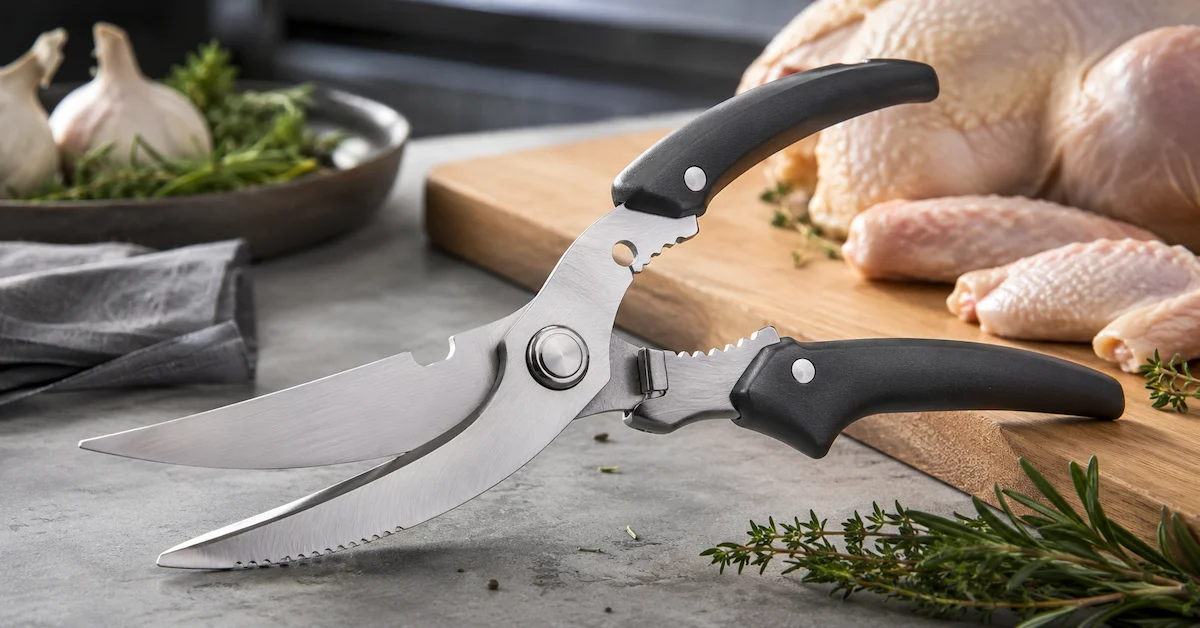
The product style shown in the original article includes curved blades, a center pivot, black molded handles, and an ergonomic finger-loop style grip. Those visible features suggest a tool designed for controlled hand use rather than occasional paper or herb cutting. Buyers should still verify how the design performs under load. A curved blade can help guide material into the cutting path, while a serrated or notched section near the pivot may help hold slippery skin or cartilage. However, more texture is not always better if it becomes difficult to clean.
Blade and Edge Details to Inspect
Blade quality is often where buyers begin, but it should be assessed in practical terms. The original product description refers to brushed or satin stainless-steel blades. That visible finish can be easier to wipe than heavily textured surfaces, but it does not identify the exact steel grade, heat treatment, or edge process. Those details should be requested from the supplier rather than assumed.
During sample review, examine whether the blades meet evenly through the cut. Look for slipping at the start of the cut, twisting near the pivot, and crushing instead of slicing. Poultry shears should bite into skin and connective tissue with control. If the user must repeatedly reposition the tool, the blade geometry may not fit the application.
Also inspect the edge near the pivot. This area often does the hardest work because it provides leverage for cartilage and thicker sections. If a supplier promotes serration or notches, ask why they are placed there and how the design affects cleaning. A thoughtful poultry scissors manufacturer should be able to connect design choices to user tasks.
Pivot, Handle, and Comfort Factors
The pivot is easy to overlook until repeated cutting reveals problems. A loose pivot can make the shears feel unstable and reduce cutting accuracy. A pivot that is too tight can fatigue the hand and prevent smooth opening. Ask whether pivot tension is checked during assembly and how consistency is controlled across production batches.
Handle comfort is just as important. The product style described in the source has black molded handles and a finger-loop grip. That can support control, but one handle shape will not suit every user. If the shears are intended for restaurant prep, butcher counters, catering teams, or broad retail use, samples should be tested by people with different hand sizes.
Some poultry shears may include a spring or latch feature near the handle area, but buyers should confirm the exact final configuration. A spring can reduce effort during repetitive cuts, while a latch can keep the tool closed during storage. Both features introduce additional parts that must be checked for durability and cleanability.
Cleanability and Maintenance Questions
Because poultry shears touch raw protein, cleanability is a core product issue. Smooth blade surfaces help, but residue often collects around the pivot, handle interface, latch, spring, or serrated areas. During sample testing, wash and dry the tool after actual poultry cutting, then inspect whether food particles remain trapped.
Do not assume dishwasher suitability, corrosion resistance level, or sanitation compliance unless the supplier provides clear documentation. Instead, ask practical questions: What cleaning method is recommended? Should the tool be dried immediately after washing? Are abrasive pads discouraged? Can the pivot area be cleaned without special tools? These answers affect customer instructions, returns, and product life.
Supplier Comparison Checklist
Use the following table when comparing a poultry shears manufacturer, OEM supplier, or wholesale kitchen tools source. It is not a substitute for a formal specification, but it helps sourcing teams focus on performance-critical points.
| Check Point | What to Look For | Question to Ask the Supplier |
|---|---|---|
| Blade construction | Clean cutting, suitable curvature, stable edge contact | What blade material and edge finishing process are used? |
| Pivot quality | Smooth opening, no looseness, no twisting under load | How is pivot tension checked during assembly? |
| Handle design | Comfort during repeated cuts and secure grip control | Has the handle been tested with different hand sizes? |
| Serration or notches | Grip on slippery poultry without excessive residue traps | What task is this feature designed to improve? |
| Cleaning access | Easy rinsing and drying around pivot and handle areas | What maintenance instructions will be provided? |
| Batch consistency | Samples match intended production quality | How do you confirm consistency before shipment? |
How to Test Samples Before Ordering
A visual sample is not enough. Ask for production-intent samples rather than hand-finished prototypes, and confirm whether the blade finish, handle material, pivot style, and any latch or spring are the same as the proposed order. If multiple versions are available, test them side by side using the same tasks.
- Cut raw chicken skin and check whether the blade slips.
- Separate a joint and note the hand force required.
- Cut cooked poultry to see whether the tool tears or tracks cleanly.
- Open and close the shears repeatedly to assess fatigue and pivot smoothness.
- Wash the shears and inspect residue around the pivot and handle.
- Record comments from actual users, not only procurement staff.
Simple, repeatable kitchen testing often reveals more than a polished product presentation. If one sample feels sharp for the first few cuts but becomes tiring after a short prep run, that should be documented before commercial discussions continue.
Common Sourcing Mistakes to Avoid
One common mistake is choosing based on finish and handle color. Satin metal and black handles can look professional, but they do not prove performance. Another mistake is focusing only on blade length while ignoring leverage, pivot feel, and cleanability. Longer blades are not automatically better if the user cannot control the cut.
Buyers also sometimes assume that every kitchen poultry shears supplier can support food-service expectations. A supplier may be suitable for light consumer use but not for repeated prep in a restaurant environment. Clarify the intended channel and ask whether the design is recommended for that use case.
Finally, avoid approving a sample without asking how production will be controlled. The first sample may feel good, but the order is only successful if later units maintain similar pivot tension, edge alignment, handle fit, and finish quality.
FAQ for Buyers
Is a poultry shear different from a general kitchen shear?
Yes. A poultry shear is intended to handle poultry tasks such as skin, joints, and cartilage. A general kitchen shear may work for lighter prep but may not offer the same leverage or grip.
Should buyers require serrated blades?
Not always. Serration or notches can improve grip on slippery material, but they may also make cleaning more demanding. Evaluate the feature against the intended user and maintenance expectations.
What commercial details should be confirmed before ordering?
Ask about available materials, sample policy, packaging options, lead time, quality checks, MOQ, pricing, and any documentation relevant to your market. Do not assume these details without supplier confirmation.
How should sourcing teams judge a sample?
Judge it through repeated real-use cutting, pivot feel, handle comfort, washing, and drying. A sample that only looks good on a desk has not been properly evaluated.
Final Sourcing Takeaway
The right poultry shears manufacturer should help buyers connect design details with actual kitchen work. Blade shape, pivot stability, handle comfort, and cleanability all matter. Before placing an order, ask clear supplier questions, compare production-intent samples, and test the shears on realistic poultry tasks. A good sourcing decision is based on how the tool performs after repeated use, not how convincing it looks in a product photo.
