




Private Label Kitchen Scissors: What Buyers Should Evaluate
Private label kitchen scissors look like a simple kitchen tool, but sourcing teams should not treat them as a commodity. A pair of scissors may cut in a sample photo, yet fail in daily use because the blades drag, the handle pinches, the finish is inconsistent, or the packaging overpromises the function.
For retailers, distributors, hospitality buyers, and kitchenware brands, the goal is not only to add a logo to an existing item. The goal is to choose a product that matches the intended user, price tier, and channel. Private label kitchen scissors may be used for trimming herbs, cutting green onions, opening food packaging, and handling small prep tasks where a knife is less convenient.
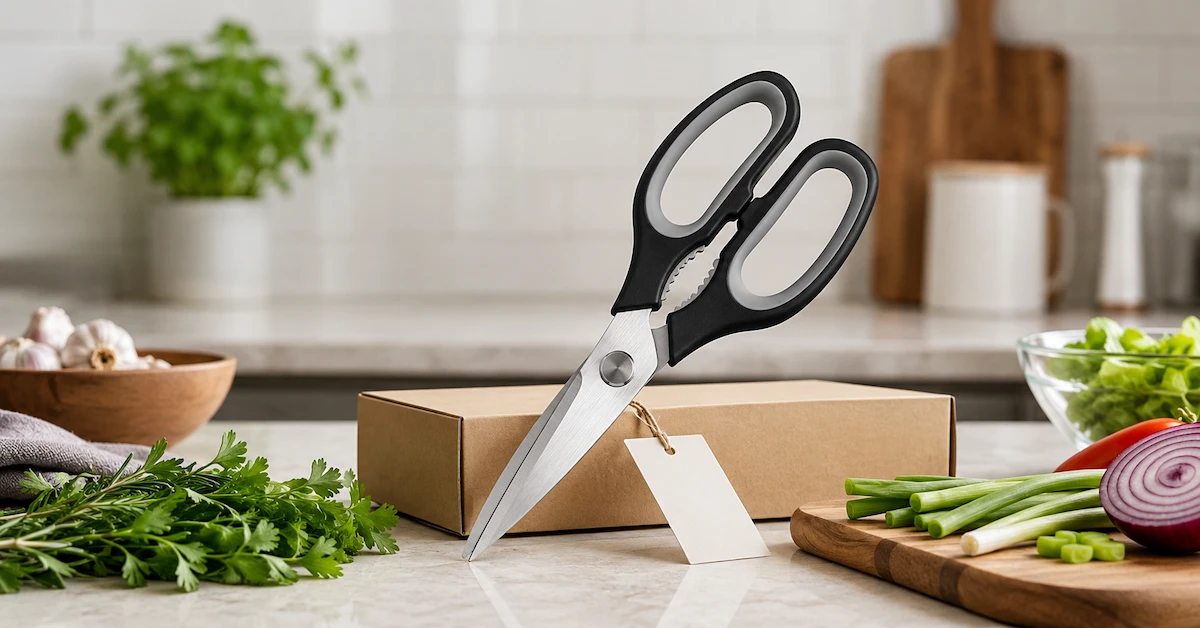
The product shown in the source material has a two-blade scissor form, metal cutting blades, a brushed or satin silver appearance, and black and gray molded handle inserts. It also shows large oval handle loops and a textured or serrated section near the pivot. Buyers should verify the exact function and material details with the supplier rather than assuming performance from appearance alone.
Key Takeaways
- Evaluate private label kitchen scissors by real use, not by catalog photos alone.
- Blade alignment, pivot tension, and handle comfort are critical quality signals.
- Ask which features can be customized without changing tooling or assembly.
- Confirm any secondary feature, such as a textured area near the pivot, before making packaging claims.
- Use samples to compare cutting feel, finish consistency, and retail presentation.
What Private Label Kitchen Scissors Are Usually Used For
Kitchen scissors occupy a useful middle ground between a general household scissor and a knife. In home kitchens, they are often used for quick cutting tasks such as herbs, food bags, parchment, or vegetable trimming. In restaurant, catering, or prep environments, they may become a frequently used utility tool that must feel comfortable during repeated use.
This distinction matters for private label sourcing. A lightweight retail kitchen scissor may be suitable for occasional home use but may not satisfy food-service buyers who care about grip stability and repeated cutting comfort. On the other hand, a heavier tool may feel unnecessary for a value-focused retail assortment. The sourcing brief should define the channel before discussing logo placement or packaging style.
Comparison Checklist Before Placing an Order
Before choosing an OEM kitchen scissors manufacturer or custom kitchen scissors supplier, compare samples using the same criteria. A simple checklist helps buyers avoid decisions based only on price or appearance.
| Evaluation point | What to check | Questions to ask the supplier |
|---|---|---|
| Blade performance | Cutting feel, alignment, edge consistency, drag during use | What blade material options are available, and what performance information can be provided? |
| Pivot construction | Smooth opening and closing, no looseness, no excessive stiffness | How is pivot tension controlled during production and inspection? |
| Handle comfort | Loop size, grip stability, pressure points, fit for larger hands or gloves | Can handle colors or inserts be customized without new tooling? |
| Finish consistency | Uniform brushed or satin appearance, clean edges, no visible defects | What visual standards are used for finished goods inspection? |
| Packaging | Retail readability, protection in transit, accurate feature claims | Which packaging formats are available for private label programs? |
| Customization | Logo, handle color, packaging, set configuration, possible design limits | Which changes are standard, and which require tooling or engineering review? |
How to Judge Blade, Pivot, and Handle Quality
The most important quality points are not always visible online. A brushed silver blade finish may look clean, but it does not confirm the steel specification, hardness, edge quality, or corrosion behavior. Buyers should request material information from the supplier and ask what documentation is available for the intended market.
The pivot is often where differences become obvious. If the joint is loose, the blades may separate slightly and cut poorly. If it is too tight, the tool can feel tiring or rough. A consistent pivot should open and close smoothly, keep the blades aligned, and avoid wobble.
Handle comfort is equally important. The described product has large oval handle loops and molded black and gray inserts. That type of design can support a secure grip, but buyers should still test it with different hand sizes. Check whether the handle edges create pressure, whether the grip feels stable when wet, and whether the loops are comfortable during repeated cutting.
Private Label and OEM Customization Options
Private label kitchen scissors can often be adapted through branding and packaging rather than full product redesign. Common discussion points include logo placement, handle color, retail card or box format, instruction text, barcode placement, carton labeling, and whether the item will be sold alone or as part of a kitchen tool set.
More structural changes require caution. Blade shape, serration pattern, pivot design, and handle mold changes may affect tooling, production flow, cost, and approval time. Buyers should ask the supplier to separate standard options from engineering changes. This helps prevent a project from becoming more complex than the target price or launch schedule can support.
The textured or serrated area near the pivot in the source image should also be clarified. It may be intended for gripping or another utility purpose, but buyers should not describe it as a nut-cracker, bottle opener, bone cutter, or other function unless the supplier confirms the design intent and supports the claim.
Common Sourcing Mistakes to Avoid
- Choosing by price only. Small cost differences can reflect meaningful differences in blade alignment, finish control, or handle comfort.
- Skipping sample testing. Photos cannot show pivot feel, hand fatigue, or actual cutting performance.
- Making broad multi-purpose claims. If packaging says the scissors cut many materials, confirm each claim with the supplier.
- Ignoring packaging durability. A good product can still arrive with bent cards, unclear instructions, or weak shelf presentation.
- Assuming customization is simple. Handle color may be easier than changing blade geometry or pivot construction.
How to Brief a Kitchen Scissors Supplier
A useful supplier brief should be specific but not overloaded. Start with the target market: home retail, wholesale kitchenware, hospitality procurement, promotional kits, or food-service use. Then describe the expected tasks, preferred appearance, target packaging format, and any branding requirements.
Ask direct questions rather than relying on assumptions. Useful questions include: What material options are available? What parts of the design are standard? Can the handle color be changed? Where can a logo be placed? What packaging choices are already supported? How are blade alignment and pivot tension checked? Can pre-production samples be reviewed before bulk production?
If regulatory or compliance requirements apply in your market, ask the supplier what documents they can provide and have them reviewed by the appropriate internal or third-party specialist. Do not assume certifications, test results, or food-contact suitability unless they are clearly documented for the product and destination market.
FAQ for Sourcing Teams
Are private label kitchen scissors suitable for restaurant use?
They can be, but only if the construction, handle comfort, and cutting feel match repeated prep use. Restaurant buyers should test samples under realistic conditions rather than relying on retail appearance.
What should I check first in a sample?
Start with blade alignment, pivot smoothness, handle comfort, and finish consistency. Then test common kitchen tasks such as trimming herbs and opening food packaging.
Can the same kitchen scissors work for home and food-service channels?
Sometimes, but the expectations are different. Home users may prioritize convenience and appearance, while food-service users may care more about comfort, durability, and easy replacement.
What can usually be customized for private label programs?
Branding, packaging, handle color, and labeling are common starting points. Structural changes such as blade form or pivot design should be discussed early because they may require tooling or engineering review.
Should packaging mention every possible use?
No. Packaging should make clear, supportable claims. If a feature or use has not been confirmed by the supplier, it is safer to describe the product more generally.
Next Step for Buyers
For private label kitchen scissors, the best sourcing process begins with the use case, then moves to samples, customization, packaging, and commercial terms. Ask the supplier for clear product information, compare physical samples, and verify which claims are appropriate for your market. A well-chosen kitchen scissor does not need exaggerated promises; it needs consistent cutting feel, comfortable handling, accurate packaging, and a supplier who can explain what is standard and what must be specially developed.
