

Private label kitchen utensils are cooking and serving tools manufactured by a supplier and sold under your brand. A dependable program starts with a defined customer, a practical assortment, documented component materials and approved production samples. Logos and packaging matter, but they should follow decisions about how the products will perform, be cleaned and be replenished.
For kitchenware brands, importers and retailers, the real sourcing question is not simply, “Can you put our name on this spatula?” It is, “Can we sell this product with accurate claims, receive the same specification on repeat orders and manage the total cost of bringing it to market?” This guide turns that question into a working purchasing plan.
What Should You Decide Before Requesting a Quotation?
Begin with the product promise. A cookware brand may need utensils that complement its pans. A homeware retailer may want coordinated tools that can be sold individually. An online seller may prefer a compact cooking set with protective packaging. These are different projects, even when each includes a spoon and a spatula.
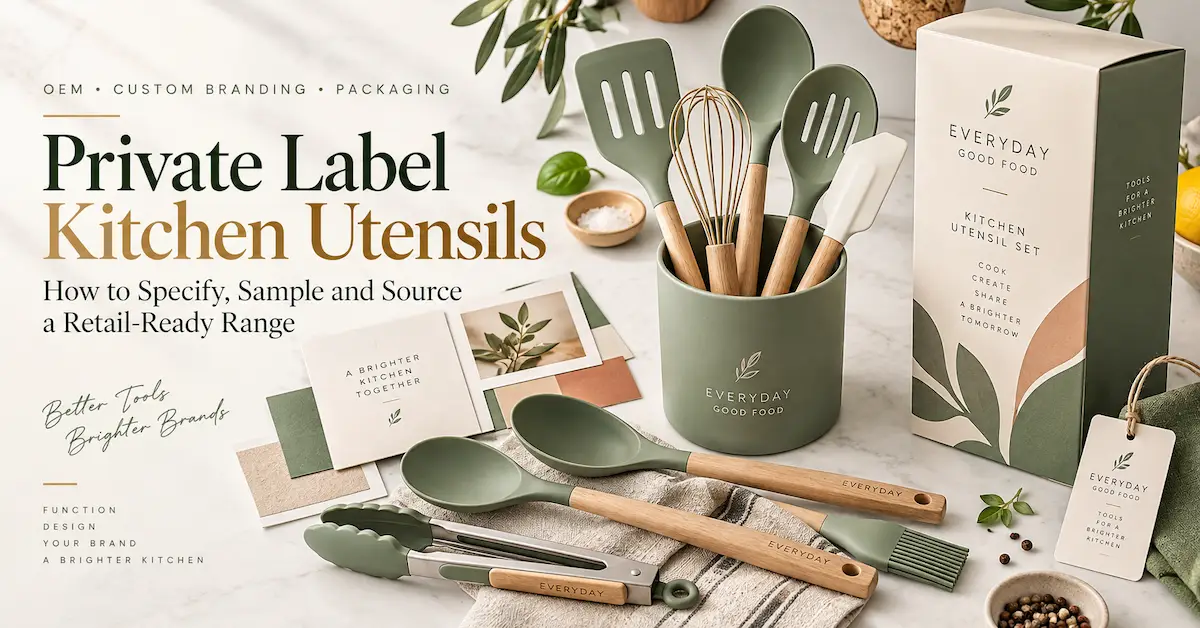
Write a one-page brief covering the customer, destination market, intended cooking tasks, cleaning routine, retail positioning, launch assortment and opening-order quantity. Separate essential features from optional decoration. This gives suppliers a basis for recommending an existing design, a modified product or new development rather than quoting unrelated catalog items.
The table below is a purchasing framework, not a promise that every customization route is available for every utensil. Ask the supplier to identify the actual work, approvals and ownership terms involved.
| Development route | What the project involves | What to confirm first |
|---|---|---|
| Existing product with branding | Use a current shape and discuss logo placement, approved colors and packaging. | Available stock or production options, branding durability and packaging minimums. |
| Modified existing design | Change selected materials, finishes, handles or components where technically feasible. | Tooling changes, sample revisions and whether earlier tests still apply. |
| New OEM or ODM development | Manufacture to an agreed buyer specification or develop a supplier-supported concept. | Engineering scope, tooling ownership, validation costs and development schedule. |
Terms such as OEM, ODM and private label can overlap in quotations. Define the deliverables rather than relying on the label. BONET's OEM/ODM services page describes production from drawings or samples alongside concept development, structural optimization and sampling support. Project-specific feasibility still needs written confirmation.
Match the Utensil Range to the Customer and Kitchen Environment
For homeware retailers, think about both the shelf and the kitchen drawer. A hanging-card utensil needs a clear product name and a workable display format. A boxed set needs an honest component count and enough protection to arrive looking coordinated. Consider whether customers can buy replacements separately instead of replacing an entire set.
For e-commerce brands, evaluate the packed product as carefully as the utensils. Long handles, bulky holders and unsecured metal parts introduce different packing challenges. Ask whether the configuration shown in the listing is exactly the configuration being sampled, inspected and shipped. A photograph of a twelve-piece arrangement should not become a substitute for a signed packing list.
For cookware and baking brands, start with the tasks your existing customers perform. Test a scraper against the bowls you sell, a turner with representative pans and a serving spoon with typical pot depths. A coordinated appearance is useful only when reach, flexibility and grip also suit the intended application.
For hospitality distributors, define the washing process, frequency of use and replacement requirements separately. Do not treat a decorative household bundle as a commercial product without validation. Likewise, open-flame barbecue use or specialist food-processing work deserves its own specification rather than an assumption that an everyday utensil can cover it.
Build the Assortment Around Useful Products, Not Piece Count
For an initial collection, assign every tool a job: scraping, stirring, turning, lifting or serving. Remove duplicates that add little practical value. Then decide whether the range should launch as individual products, a small task-focused bundle or a larger coordinated set. This is an assortment decision, not simply a packaging decision.
BONET's published utensil catalog provides concrete starting points for a discussion. The following dimensions and material descriptions come from the linked product pages; they are catalog references, not substitutes for approved engineering drawings.
| Published product reference | Listed dimensions | Published material fields | Useful sampling question |
|---|---|---|---|
| G2008 Silicone Spatula | 20 × 3 × 1 cm | Carbon steel; silicone | Does its working edge and compact size suit the intended scraping or spreading task? |
| G2009 Silicone Spoon | 27 × 6.5 × 1.5 cm | Carbon steel; silicone | Is the head sufficiently supported for the intended stirring and serving load? |
| G2007 Silicone Cooking Utensil | 27.5 × 6.5 × 1.5 cm | Carbon steel; silicone | How do its shape, grip and reach compare with the other shortlisted tools? |
Material detail worth checking: these pages list carbon steel, not stainless steel, in the metal-material field. Request a component drawing to confirm where the metal is located and how it is protected. Do not advertise an unspecified internal component as stainless steel or assume the entire product is solid silicone.
Review these products together, but do not assume they automatically form a finished retail set. Confirm matching colors, available branding, packaging compatibility and order quantities for each selected reference. When adding tongs, whisks or a holder, request separate specifications for those components.
Choose Materials by Function and Verified Construction
Material selection should start at the working end. Consider what touches the food, what touches the cookware, what carries the load and what the user holds. A description such as “silicone kitchen utensil” does not answer all four questions. Ask for the material identity of the head, core, handle, coating and any joining components.
Silicone working ends
For private label silicone utensils, compare samples under the intended scraping, folding or stirring motion. A flexible edge that follows a bowl can be useful for batter, while a serving tool may need more support. Do not select flexibility from a photograph. Record the acceptable feel against a retained sample and agree on a measurable test where consistency is critical.
Ask for the product-specific heat-use instructions and their supporting evidence. Separate brief contact with hot food from prolonged contact with a heated pan. A temperature claim needs an exposure time, test method and defined product configuration; it should not be copied across an entire mixed-material range.
Metal components and handles
For metal utensils or reinforced designs, specify the actual material rather than an unspecified “premium metal.” Review exposed edges, joints, finish and grip transitions. When a metal component is covered, ask how its position and coverage are controlled and what happens if the outer material is damaged. Appearance alone cannot establish internal construction.
Wood, bamboo and molded handles
When considering wood, bamboo or molded-plastic handles, make the cleaning routine part of the selection. Request care instructions for the assembled product, not just the utensil head. Compare wet handling, finish consistency and joint stability after the agreed cleaning cycles. A handle that supports the desired appearance but conflicts with the promised care routine is the wrong specification.
For a cookware bundle, obtain the cookware manufacturer's utensil-use guidance and test the proposed tool accordingly. Avoid unconditional “scratch-proof” language. State the intended compatibility only when it is supported by the materials, design and relevant evaluation.
Create a Specification Sheet That Can Be Inspected
A specification should allow someone who never attended the design meetings to judge the shipment. Replace “good quality,” “comfortable” and “strong” with drawings, physical references, test conditions and acceptance criteria. Include a revision number so purchasing, production and inspection are working from the same document.
| Specification field | What to record | Approval evidence |
|---|---|---|
| Dimensions and geometry | Overall length, head dimensions, relevant thicknesses and agreed tolerances. | Signed drawing and dimensional inspection record. |
| Component materials | Head, core, handle, coatings and joining materials where present. | Bill of materials linked to the selected product revision. |
| Appearance | Color reference, finish, logo position and acceptable visual variation. | Physical reference sample and agreed viewing conditions. |
| Function and assembly | Intended loading, flexibility, joint security and operating requirements. | Agreed test method, conditions and acceptance criteria. |
| Heat and cleaning claims | Intended temperature exposure, duration and cleaning instructions. | Relevant product-specific validation and approved wording. |
| Packaging and traceability | Exact contents, artwork version, barcode, carton pack and batch identification. | Packed reference sample and approved packaging specification. |
Do not invent tolerances or test loads merely to fill the table. Ask the manufacturer which characteristics it measures, how it measures them and what limits are realistic for the design. Where an attribute is subjective, such as grip comfort, document the comparison sample and the review procedure.
This document also makes quotations more comparable. Without it, a lower price may represent a different core, a lighter component, less protective packaging or a different inspection scope. Those changes are commercial choices, but they should be visible choices.
Verify Food-Contact Evidence Before Writing Retail Claims
A private label kitchen utensils program needs a compliance review tied to the destination market and the finished product. Start with the complete material breakdown and intended use. Then ask a qualified laboratory or compliance specialist to identify the applicable requirements, test scope and documentation. A supplier's general brochure is not a product-specific compliance file.
The FDA's Understanding How the FDA Regulates Substances that Come into Contact with Food explains that food-contact authorizations have specifications and limitations; food contact notifications are also specific to the notifier and intended use. The purchasing implication is to ask which regulatory basis covers the relevant substances and uses. Do not turn a supplier's mention of “FDA” into a blanket finished-product approval claim.
The European Commission identifies Regulation (EC) No 1935/2004 as the general framework for food-contact materials and Regulation (EC) No 2023/2006 as the good manufacturing practice framework. Its legislation guidance also distinguishes material-specific measures, including rules for plastics. Have the actual composition and destination requirements reviewed rather than assuming one test package covers silicone, plastic, metal and wood components alike.
Request reports that identify the tested article, material or formulation, sample description, test conditions and results. Ask the laboratory to explain whether different colors, revised coatings or changed components are covered. Keep approved product claims connected to this evidence and review the implications before substituting a material.
Performance claims need their own support. “Dishwasher safe,” a heat limit and a food-contact statement address different questions. A visually attractive sample does not prove any of them. Equally, a factory-management certificate should not be used as a substitute for evidence about the utensil being ordered.
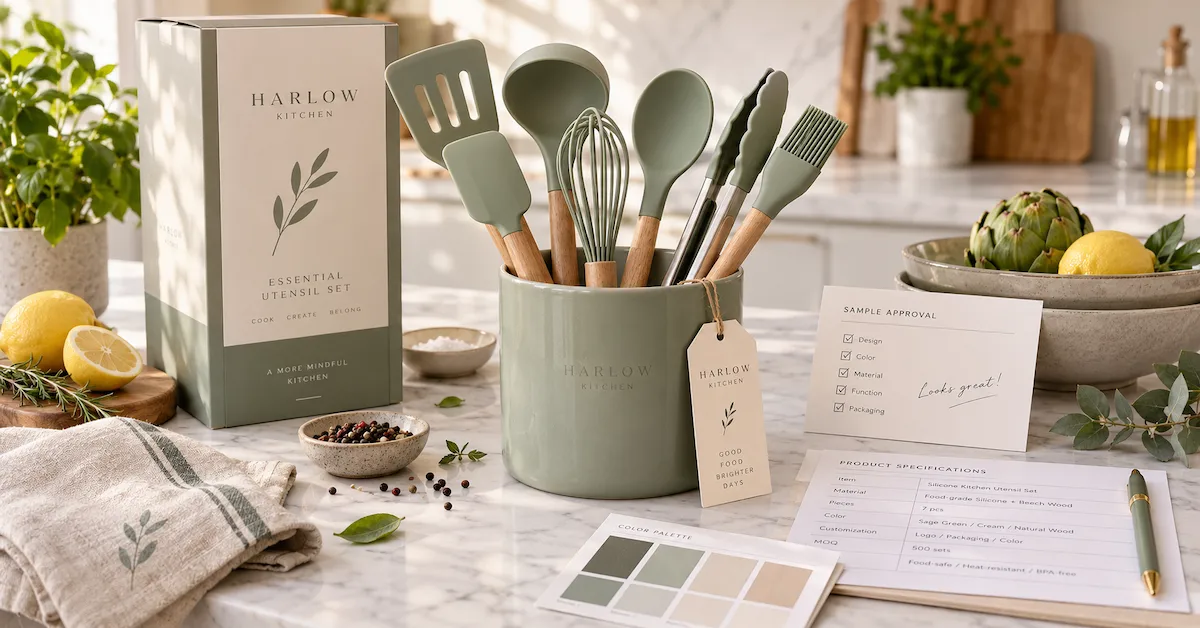
Approve Samples Through Separate Decision Gates
A sample should have a defined purpose. An early prototype may help evaluate shape without representing final material, finish or production tooling. Ask the supplier to identify those differences before anyone signs it off. Otherwise, the team may approve a visual concept while assuming it has approved a production-ready utensil.
Gate one: function. Use the tool in the intended task. Scrape a representative mixing bowl, stir a realistic food load, reach into the intended pot and check the grip with damp hands. Record the cookware, task and observations so later samples can be compared under the same conditions.
Gate two: construction and claims. Check dimensional conformity, edge finish, joint security and the relevant heat or cleaning evaluations. For a set, examine every component rather than allowing one good spoon to stand in for the whisk, tongs and holder. Agree which tests need laboratory work rather than informal kitchen trials.
Gate three: the packed retail product. Review the final colors, logo, contents, instructions, barcode and protective packaging together. After approval, retain matching reference samples with the buyer and supplier. Keep photographs and records, but do not rely on photos alone to describe flexibility, surface feel or color.
For new or substantially changed designs, discuss a pilot run made using the intended production process. Any difference from the approved specification should trigger a documented review. A pilot order is a validation opportunity, not permission to relax the agreed product requirements.
Turn Your Shortlist into a Sampling Brief
Share the utensil references, intended cooking tasks, target market and proposed branding with BONET. Ask which samples represent existing production and which details require development.
Discuss Samples and Specifications →Customize the Brand Experience Without Creating Avoidable Complexity
Start with branding that remains useful after the box is opened. Decide where the logo belongs, how it will look in the chosen material and whether its placement affects cleaning or grip. Review a physical sample of the proposed marking method before approving artwork for the whole range.
BONET lists logo printing, laser engraving, color customization and retail packaging among its kitchenware customization options. Availability depends on the selected material and product. A marking method appropriate for a metal handle should not be assumed suitable for a silicone working surface.
For color coordination, approve a physical reference on the actual material wherever possible. Evaluate the assembled tools together under agreed lighting. A screen image or color name is not enough to settle a disagreement about whether the spoon and spatula match.
Separate branding from design exclusivity. Adding a logo to an existing utensil does not, by itself, establish exclusive rights to its shape. For custom development, have the parties document ownership, tooling access, design-use permissions and any exclusivity arrangement before paying for new work.
Understand MOQ and Compare the Cost of the Complete Order
There is no single meaningful MOQ for all private label kitchen utensils. Ask for the minimum order quantity by product, color, decoration and packaging configuration. A total order of several thousand utensils does not automatically satisfy a minimum that applies separately to each variation.
Consider a purely illustrative launch of 1,200 sets in four colors. That is 300 sets per color. If each set contains six different tools, the production plan needs 300 of each tool in each color. A quoted total-set quantity hides those component-level requirements unless the supplier explicitly accepts that mix.
To simplify an opening order, discuss fewer colors, a narrower assortment or existing tooling before compromising a functional requirement. Ask whether the retail carton, printed sleeve or gift box has its own minimum. Also clarify how any excess packaging is paid for, stored and matched to later artwork revisions.
Compare the complete landed purchase rather than the utensil-only price. Request separate lines for products, decoration, packaging, tooling, samples, agreed testing and inspection. Obtain current transport, duty and destination-charge estimates from the appropriate logistics and customs specialists. Keep one-time development costs separate from recurring production costs.
Comparison formula: delivered order cost per saleable unit = product costs + packaging + allocated development and testing + inspection + transport and destination charges, divided by the number of saleable units received. Apply a consistent scope when comparing suppliers.
For illustration only, not a BONET quotation, assume Supplier A's delivered order costs $10,000 and yields 950 saleable sets. The result is about $10.53 per saleable set. Supplier B's order costs $10,200 and yields 995 saleable sets, or about $10.25 each. The higher invoice is cheaper per usable set under those assumptions. Forecasts still need evidence, and expected retail returns should be assessed separately.
Plan Lead Time Around Approvals and Production Dependencies
Ask what the supplier's lead-time estimate actually measures. Does the clock start after deposit, after sample approval, after artwork approval or after all materials are available? Is the promised milestone ex-factory completion, shipment departure or arrival at your warehouse? These are different dates.
Build the schedule backward from the required arrival date. Include technical clarification, sample revisions, testing where necessary, packaging approval, production, inspection, correction time and transport. Give each approval an owner. Leaving artwork without an approver can hold up a project even when the utensils themselves are ready.
For a mixed set, confirm the schedule of every component. Ask which part is most likely to determine completion and whether packaging or bought-in accessories have separate lead times. Request a project-specific capacity discussion rather than relying on an unrelated factory-wide output figure.
Protect repeat orders with change control. State that material, color, finish, assembly and packaging changes require review before shipment. Keep the latest approved bill of materials, drawing, artwork and sample references together. Repeatability is easier to manage when a reorder specifies a revision instead of saying “same as last time.”
Design Packaging for the Sales Channel and the Journey
Packaging has three jobs in this program: identify the product accurately, protect it through the intended distribution route and make it practical to merchandise. Decide whether the utensil will hang individually, sit in a boxed set or ship directly to a customer before locking the final pack dimensions.
For individual retail tools, review hanging strength, visibility of the working end, product naming and barcode placement. For sets, state exactly what the piece count includes. A holder or storage accessory should not leave customers guessing how many actual cooking tools they receive.
For online orders, review the product in its parcel configuration, not only in a master carton. Check whether utensils can move, finishes can rub and accessories can press against one another. Have the packaging supplier or test provider propose a transport-validation method appropriate to the distribution route.
Make instructions part of the approval. The care wording on the box should match the product specification and online listing. Confirm the required language, traceability markings and destination-market information with the relevant specialists. Recheck the final printed pack after artwork changes, even when the product inside is unchanged.
Evaluate the Supplier with Evidence You Can Use
Supplier evaluation should produce answers to operational questions. Who controls the materials? Which processes are performed in-house? Who approves substitutions? Who holds the reference samples? How are nonconforming goods identified and corrected? The useful supplier is the one that can explain the proposed workflow for your actual range.
BONET HOUSEWARE CO., LTD identifies its business in Yangjiang, Guangdong, China, and presents kitchen tools, utensils and other houseware categories on its company profile. Its manufacturing page describes processes including stamping, injection, assembly, inspection and packing, with several other stages focused on knives and scissors. Confirm which operations apply to your utensil project rather than transferring every listed process to every product.
During evaluation, request a representative inspection record, an explanation of product identification and a proposal for handling defects. Agree on the acceptance plan before production. Safety-related requirements should be addressed directly, not averaged away by an attractive cosmetic finish or a strong overall supplier score.
A sound commercial discussion also covers sample charges, responsibility for testing, payment milestones and the procedure for resolving a specification dispute. Record the answers in the quotation and order documents so the purchasing decision survives beyond the sales conversation.
What to Send BONET for a Private Label Kitchen Utensils Proposal
The most useful inquiry gives the supplier enough information to recommend a route and identify unresolved questions. You do not need to finish every technical decision before making contact. You do need to distinguish requirements from preferences and provide a realistic description of the intended order.
Project: Private label kitchen utensils for our brand, with a proposed launch range of the following tools or BONET product references.
Market and channel: Destination country, retail or online channel, target customer, intended cooking tasks and expected cleaning routine.
Product direction: Preferred materials, colors, approximate sizes, visual references and any features that must not change.
Branding and packaging: Logo files, proposed marking position, individual or set format, exact contents, barcode needs and packaging language.
Order plan: Opening quantity by product and color, target arrival window and estimated replenishment needs, clearly separated from a firm purchase commitment.
Evidence requested: Component specifications, available samples, relevant test documents and a proposed inspection and approval process.
Quotation breakdown: Product, branding, packaging, tooling, sample and agreed testing costs; MOQ by variation; production milestones; quotation validity and delivery basis.
Ask BONET to highlight any assumptions or deviations instead of quietly replacing a requirement. An alternative material, shared color or simpler packaging format may be worth considering, but it should be offered as an explicit option with its cost and validation implications.
Frequently Asked Questions About Private Label Kitchen Utensils
Can I start with existing utensil designs?
Yes, an existing design can be a starting point for a branding discussion. Confirm which colors, marking methods and packaging formats are available for that specific reference. An existing shape does not eliminate the need to review material information, finished samples and applicable product claims.
What is the MOQ for a custom kitchen utensil order?
Request the MOQ by item, color, logo process and packaging configuration. Do not assume one minimum covers a mixed order. Ask BONET for a project-specific breakdown; a usable answer needs to reflect the products and customization route actually being proposed.
Should I choose silicone or stainless steel utensils?
Choose around the intended task, cookware, construction and care routine, then compare samples. Specify the working end and any internal components separately. Neither a material name nor a polished appearance establishes that a particular utensil will satisfy your complete product brief.
Are the listed BONET silicone utensils entirely silicone?
The linked G2007, G2008 and G2009 product pages list both silicone and carbon steel in their material fields. Request the component drawing and approved specification to establish the location and protection of the metal. Do not describe the complete construction from the product name alone.
Can the same heat-resistance claim cover every tool?
Do not assume so. Ask for the evidence and conditions supporting the claim for each relevant construction. Exposure duration, contact conditions, handle design and other components need consideration. The approved wording should match the product that will actually be manufactured and sold.
Can we market the entire set as dishwasher safe?
Only use that claim when it is supported for every component covered by the statement. Review handles, markings, joints and accessories as well as the working heads. Where care requirements differ, make the instructions clear instead of extending one component's claim to the whole set.
Do custom logos make a utensil design exclusive?
No exclusivity should be assumed from adding branding. Discuss the actual rights and permissions in writing. For new tooling or design development, clarify ownership, use restrictions, access and any agreed territorial or channel limitations with appropriate contractual advice.
What should a production sample include?
It should represent the agreed materials, construction, color, finish, branding and packaging as closely as the approval stage requires. Identify any exceptions in writing. Retain the approved reference with its specification revision so it can be used for inspection and later orders.
How can we reduce risk on the first order?
Start with a focused assortment, resolve material questions, approve representative samples and agree on inspection before production. Where development risk is significant, discuss a pilot run. Keep the packaging and product claims in the approval process rather than treating them as last-minute additions.
What information helps BONET prepare a useful quotation?
Send the destination market, sales channel, product references, quantities by variation, branding requirements and packaging format. Add the required arrival window and evidence needs. Ask for assumptions, minimums, development charges and delivery milestones to be stated separately.
Conclusion
Successful private label kitchen utensils sourcing connects the customer promise to a specification the supplier can manufacture and the buyer can verify. Start with useful tools, confirm each component material, approve representative samples and evaluate the complete delivered order. Attractive branding supports that foundation; it cannot replace it.
BONET's kitchen utensil collection offers product references for starting the conversation, while its OEM/ODM services outline the available development and customization directions. Bring your shortlist, intended market and opening-order plan to the discussion. The next step is a project-specific proposal that connects the design, evidence, packaging and commercial terms before production begins.