




How to Choose a Private Label Scissors Supplier for Long-Term Business
Choosing a private label scissors supplier is a product-development decision, not simply a price comparison. For brands, importers, wholesalers, retailers, supermarket chains, and e-commerce sellers, the right supplier needs to provide a suitable product range, reliable manufacturing, consistent quality, branding support, retail-ready packaging, and clear communication throughout the order.
A practical sourcing process should therefore answer one central question: Can this supplier turn your product requirements into a repeatable, commercially viable scissors program?
For BONET HOUSEWARE, this means evaluating the entire process from product selection and sample approval to manufacturing, inspection, customization, packaging, and delivery. BONET is based in Yangjiang, China's well-known knife and scissors manufacturing center, and its current website positions the company around kitchenware and precision cutting tools. The company states that it was established in 2011 and operates a 5,000 m² manufacturing facility.
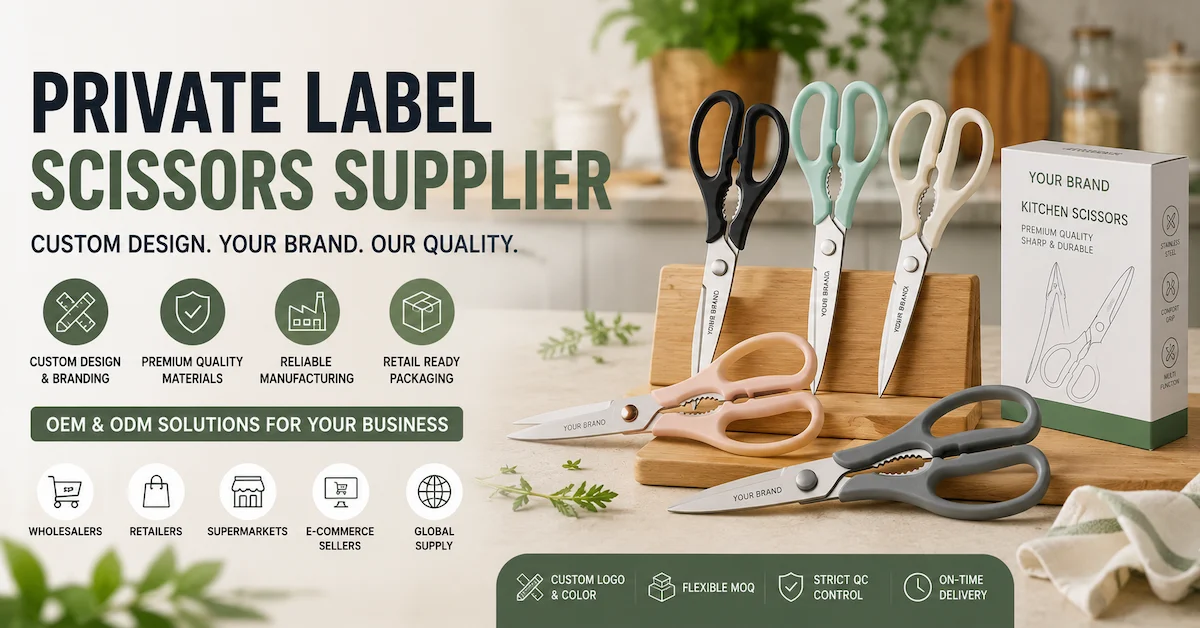
What Should a Private Label Scissors Supplier Provide?
A strong supplier should support more than logo application.
For a private-label scissors project, buyers should evaluate these eight areas:
| Evaluation Area | What Buyers Should Check | Why It Matters |
|---|---|---|
| Product Range | Kitchen, household, tailor, stationery, school and other scissors | Supports different market segments |
| Materials | Blade and handle materials | Influences performance and product positioning |
| Design | Handle shape, blade profile,finish and functions | Determines user experience and differentiation |
| Customization | Logo, color, finish and packaging | Builds brand identity |
| Manufacturing | Production processes and equipment | Influences consistency and scalability |
| Quality Control | Sample approval and inspection procedures | Reduces batch-quality risk |
| Packaging | Retail, barcode and export packaging | Supports different sales channels |
| Communication | Specification,quotation and production follow-up | Reduces misunderstandings |
This is especially important because a private-label product becomes part of your own brand. If the first batch performs differently from the approved sample, the problem affects not only the supplier but also your product listings, customer reviews, retailer relationships, and reputation.
Start With the Scissors Category and Target Customer
Not every scissors product should be sourced in the same way.
BONET's current scissors portfolio includes tailor scissors, kitchen scissors, household scissors, stationery scissors, school scissors, and other scissors.
Your first step should therefore be to define the intended market.
Kitchen Scissors
Kitchen scissors are suitable for:
- Food preparation
- Herbs and vegetables
- Food packaging
- Poultry preparation
- General kitchen tasks
- Multifunctional kitchen applications
Some BONET kitchen scissors feature stainless-steel blades, ergonomic handles, serrated sections, bottle openers, nutcrackers, detachable construction, or protective storage options depending on the model.
For a kitchenware brand, these features can create opportunities for different price points and product tiers.
Household Scissors
Household scissors can target general home use, crafts, packaging, office tasks, and DIY applications.
The key sourcing considerations are usually:
comfort + cutting performance + size + handle design + packaging + retail positioning.
BONET's existing OEM content also recommends checking blade material, handle design, tip shape, packaging, and inspection standards before placing a bulk order.
Tailor and Sewing Scissors
Tailor scissors address a more specialized customer base:
- Sewing brands
- Fabric retailers
- Tailoring shops
- Craft stores
- Garment-related businesses
- DIY and hobby markets
BONET's tailor scissors portfolio includes different designs and finishes, while the company highlights ergonomic handles, stainless-steel blades, and professional cutting applications across relevant product content.
For this category, sample testing on the actual fabrics used by your target customers is more meaningful than evaluating appearance alone.
Stationery and School Scissors
Stationery and school scissors require a different commercial approach.
The buyer should consider:
- Intended user age
- Product size
- Handle comfort
- Tip design
- Packaging
- Labeling
- Market-specific requirements
- Retail positioning
Do not assume that a general household scissors design automatically meets requirements for children's products. Compliance and safety requirements should be confirmed for the destination market before production.
Why Manufacturing Capability Matters for Private Label Scissors
A private-label supplier needs to reproduce the approved product consistently.
A sample may look excellent, but the more important question is:
Can the supplier maintain the same functional and visual characteristics across repeated production batches?
BONET's manufacturing process covers multiple stages, including stamping, straight adjustment, heat treatment, rough grinding, water grinding, polishing, plastic injection, ultrasonic cleaning, assembly, quality checking, final cleaning/anti-rust treatment, and packing.
This process matters because scissors performance is affected by several interconnected variables.
Blade Forming and Grinding
Blade geometry and grinding influence the cutting action.
Buyers should discuss:
- Blade profile
- Edge treatment
- Grinding process
- Surface finish
- Blade alignment
- Cutting performance
Rather than simply asking whether a supplier's scissors are “sharp,” request samples and evaluate the actual cutting application.
Heat Treatment
Heat treatment is an important manufacturing stage for metal cutting tools because it affects the properties of the blade material.
However, buyers should avoid relying on generic hardness claims. If hardness or steel grade is important to your product specification, request the exact material and technical documentation for the model being quoted.
Handle Manufacturing
For scissors designed for extended use, the handle is part of the product experience.
A private-label project may involve:
- Handle shape
- Grip texture
- Color
- Material
- Finger-loop dimensions
- Surface finish
- Brand markings
BONET's OEM/ODM service supports customized materials, colors, logo applications, surface treatments, and packaging for kitchenware and scissors projects.
Private Label Customization: What Can Be Customized?
A common mistake is treating private labeling as “put my logo on the product.”
A stronger private-label program considers the complete product presentation.
Product Customization
Depending on the selected model, buyers can discuss:
- Handle color
- Handle material
- Surface finish
- Blade finish
- Product configuration
- Functional features
- Product dimensions
- Logo position
Not every customization is available for every model, so requirements should be confirmed during sampling.
Logo and Branding
Possible branding methods may include:
- Printing
- Laser engraving
- Product labels
- Branded packaging
The appropriate method depends on the product material, surface, quantity, artwork, and required appearance.
Packaging Customization
Packaging is particularly important for retail-oriented private-label scissors.
Options can be developed around:
- Color boxes
- Gift boxes
- Blister-style presentation
- Hang tags
- Barcode labels
- Instruction inserts
- Retail cartons
- Export cartons
For supermarket and retail buyers, packaging should be considered together with shelf display, product protection, barcode requirements, and logistics.
How to Evaluate Samples Before a Bulk Order
Sample approval should be a formal stage of your sourcing process.
Do not evaluate only whether the scissors “look good.”
Use a checklist.
| Sample Check | Questions to Ask |
|---|---|
| Cutting | Does it perform the intended cutting task smoothly? |
| Alignment | Do the blades meet correctly? |
| Pivot | Is movement controlled and consistent? |
| Handle | Is the grip comfortable for the intended user? |
| Finish | Are surfaces clean and consistent? |
| Function | Do additional features work as intended? |
| Packaging | Does the packaging protect the product? |
| Branding | Does the logo match the approved artwork? |
| Dimensions | Does the physical sample match the specification? |
| Batch Consistency | Can the same standard be maintained in mass production? |
For example, if you are developing private-label kitchen scissors, test the sample using the actual tasks your target market expects—rather than judging sharpness through a generic paper-cutting demonstration.
BONET's own sourcing guidance recommends requesting samples before bulk production and comparing cutting performance, comfort, finishing, and packaging requirements.
Private Label Scissors Supplier vs. Generic Wholesale Supplier
The cheapest supplier is not necessarily the best supplier for a private-label brand.
| Factor | Generic Wholesale Supplier | Private Label Supplier |
|---|---|---|
| Product | Mostly existing designs | Existing + customized programs |
| Branding | Limited | Logo and brand development |
| Packaging | Standard | Customized |
| Color | Fixed options | Potential customization |
| Product Development | Limited | OEM/ODM support |
| Sample Approval | Basic | Structured |
| Brand Differentiation | Lower | Higher |
| Long-Term Program | Less flexible | Better suited to repeat programs |
The difference is important for brands planning multiple purchase cycles.
A wholesale transaction asks:
“What products can you supply?”
A private-label relationship asks:
“Can you consistently manufacture the product specification my brand has approved?”
That is a much more demanding requirement.
Quality Control Should Be Discussed Before Production
Quality control should not begin when the cartons are already packed.
It should begin when the specification is created.
A useful quality plan can define:
- Product specification
- Approved sample
- Material requirements
- Appearance requirements
- Functional requirements
- Assembly requirements
- Packaging requirements
- Labeling requirements
- Inspection points
- Final acceptance criteria
BONET states that its quality system includes ISO9001, BSCI, and Sedex certifications/credentials, while its manufacturing operation uses a 6S management system.
ISO describes ISO 9001 as a quality-management-system standard focused on consistent processes, customer requirements, performance evaluation, and continual improvement.
Sedex, meanwhile, provides tools and data for supply-chain transparency, ethical sourcing, risk assessment, and supplier engagement.
These credentials should be treated as part of supplier evaluation—not as a replacement for product-specific inspection.
How to Reduce Private Label Scissors Sourcing Risks
A reliable sourcing project should control risk at several stages.
1. Avoid Vague Specifications
Instead of:
“High-quality black scissors.”
Use a specification sheet covering:
- Product type
- Intended application
- Dimensions
- Material requirements
- Handle design
- Color
- Finish
- Logo
- Packaging
- Labeling
- Inspection requirements
2. Approve a Physical Sample
The approved sample should become the reference point for mass production.
Keep records of:
- Product photos
- Drawings
- Dimensions
- Packaging artwork
- Logo placement
- Material description
- Functional requirements
3. Separate Confirmed Data From Assumptions
For example, don't assume that all scissors from the same supplier use the same steel grade.
The exact material should be confirmed for the selected model.
The same principle applies to:
- Hardness
- Dishwasher suitability
- Food-contact compliance
- Certifications
- MOQ
- Lead time
- Production capacity
4. Evaluate Total Cost
Unit price is only one part of the sourcing cost.
Consider:
Product + Branding + Packaging + Inspection + Shipping + Defect Risk + Rework + After-Sales Cost
A slightly higher unit price can sometimes produce a better commercial result if it reduces quality and packaging problems.
Why BONET Can Be Considered for a Private Label Scissors Program
BONET combines scissors manufacturing with a broader kitchenware product portfolio.
Its current OEM/ODM service covers kitchen knives, kitchen tools, cutting boards, kitchen gadgets, multifunctional kitchenware, and scissors, serving global brands, wholesalers, retailers, supermarket chains, and e-commerce sellers.
This creates a useful opportunity for buyers that want to build a broader kitchenware assortment instead of sourcing every product category from a separate supplier.
The company's location is also relevant. BONET is based in Yangjiang, a city widely associated with knife and scissors manufacturing, and the company describes its manufacturing approach as combining traditional craftsmanship with modern production technology.
For a buyer, the practical advantage is not simply the geographic label. The more important question is whether the supplier can connect:
Product Selection → Customization → Sampling → Manufacturing → QC → Packaging → Delivery
into one repeatable process.
A Practical Private Label Scissors Sourcing Workflow
For a new project, the following workflow is a practical starting point.
Step 1: Define Your Market
Identify:
- Target country
- Customer type
- Sales channel
- Retail price position
- Main application
- Expected order volume
Step 2: Select the Scissors Category
Choose between:
- Kitchen scissors
- Household scissors
- Tailor scissors
- Sewing scissors
- Stationery scissors
- School scissors
- Other specialty scissors
Step 3: Create a Product Brief
Include the required:
design + material + dimensions + color + logo + packaging + labeling + quality requirements.
Step 4: Request Samples
Test the physical product under realistic conditions.
Step 5: Finalize Branding
Approve:
- Logo
- Color
- Surface treatment
- Packaging
- Barcode
- Labels
- Instructions
Step 6: Confirm Commercial Terms
Request written confirmation of:
- MOQ
- Unit price
- Sample cost
- Production lead time
- Packaging cost
- Payment terms
- Shipping terms
Step 7: Approve Mass Production
Mass production should follow the approved specification and sample.
Step 8: Conduct Final Inspection
Verify product function, appearance, quantity, packaging, labeling, and other agreed requirements before shipment.
What Should You Ask a Private Label Scissors Supplier?
Before requesting a quotation, send a concise but complete list of questions.
Product
- Which scissors categories do you manufacture?
- Which models are suitable for my target application?
- What materials are available?
- Can the design be modified?
Customization
- Can you add our logo?
- Which logo methods are available?
- Can handle colors be customized?
- Can the surface finish be customized?
- Can packaging be developed for our brand?
Quality
- What inspection points are used?
- Can we approve a production sample?
- How is batch consistency controlled?
- Can inspection criteria be documented?
Commercial
- What is the MOQ?
- What is the sample lead time?
- What is the mass-production lead time?
- What are the packaging costs?
- What shipping terms are available?
Compliance
- Which documents are available for the selected product?
- Are market-specific testing requirements supported?
- Can material and product specifications be provided in writing?
This question set makes supplier comparison much more objective.
FAQ
What is a private label scissors supplier?
A private label scissors supplier manufactures scissors that are sold under the buyer's own brand. Depending on the supplier and project, the program can include product selection, customization, logo application, packaging, sampling, manufacturing, inspection, and delivery.
Can a private label scissors supplier customize the handle color?
Handle color can often be discussed as part of an OEM/private-label project, but availability depends on the selected model, material, order requirements, and production process. Confirm the exact color options during sampling.
Can scissors be customized with our own logo?
Yes, logo customization can be part of an OEM program. BONET's OEM/ODM service supports branding and customization options for kitchenware and scissors projects.
What types of scissors can be private labeled?
Potential categories include kitchen scissors, household scissors, tailor scissors, sewing scissors, stationery scissors, and school scissors. BONET's current scissors portfolio includes these categories.
How should I compare two private label scissors suppliers?
Compare more than price. Evaluate product quality, sample consistency, customization capability, manufacturing processes, QC, packaging, communication, MOQ, lead time, documentation, and long-term supply capability.
Should I request samples before placing a bulk order?
Yes. Physical samples allow buyers to evaluate cutting performance, ergonomics, finish, dimensions, branding, and packaging before committing to mass production. BONET's own sourcing guidance recommends sample evaluation before bulk orders.
What packaging can private label scissors use?
Packaging depends on the product and sales channel. Options may include retail boxes, blister-style packaging, gift packaging, labels, barcodes, instruction inserts, and export cartons. The exact options should be confirmed for the selected product.
What certifications should I ask a scissors supplier for?
Ask for documentation relevant to your product and destination market rather than assuming a certification applies to every product. For the supplier itself, BONET currently identifies ISO9001, BSCI, and Sedex among its quality/social-compliance credentials.
How can I protect my private label design?
Use clear written specifications, approved drawings and samples, controlled artwork, and appropriate contractual/IP provisions. If your project involves a proprietary design, discuss ownership, confidentiality, tooling, artwork, and permitted use before production.
Is the lowest-price scissors supplier the best option?
Not necessarily. For private-label products, total sourcing value includes product consistency, quality control, customization, packaging, communication, delivery reliability, and the potential cost of defects or rework. Comparing only unit prices can hide important downstream costs.
Conclusion
The right private label scissors supplier should be evaluated as a manufacturing partner rather than simply a product seller.
For brands and B2B buyers, the strongest sourcing approach starts with a clearly defined target market and product specification. From there, buyers should compare samples, manufacturing capability, materials, customization, quality control, packaging, commercial terms, and documentation.
BONET's combination of scissors manufacturing, kitchenware production, OEM/ODM customization, and Yangjiang manufacturing experience provides a relevant starting point for buyers building private-label scissors programs. Its current manufacturing and OEM/ODM information also gives buyers a basis for discussing product development, branding, packaging, and production requirements.
If your goal is not simply to purchase scissors but to build a repeatable branded product line, the most important question is no longer “Who has the lowest price?”
It is:
Who can consistently manufacture the product your customers expect under your brand?
For a private-label project, BONET can start the conversation from product selection and sample development through customization, quality control, and production planning.
Explore BONET Scissors
Explore BONET OEM & ODM Services
Contact BONET for a Private Label Project
