

A purchasing guide for importers, retail chains, cookware brands and private-label product teams that need dependable silicone spatulas, cooking spoons and coordinated utensil collections.
A professional silicone kitchen utensil manufacturer should be able to explain the finished product—not merely show an attractive silicone color. Before placing an OEM order, buyers need evidence of the component formulation, permitted food-contact use, heat and cleaning limits, molding or assembly controls, product-specific tests, and repeat-order consistency. These checks are especially important when a silicone working end is combined with a metal reinforcement or another handle material.
Quick answer: How do you select a silicone kitchen utensil manufacturer? Shortlist a supplier that can identify every food-contact component, document material and color specifications, define realistic heat-use conditions, approve physical samples, explain who performs each molding and assembly operation, and provide an inspection plan for production and packaging. Compare quotations only after the same product, tests, customization and delivery responsibilities are defined. Ask BONET to confirm the process and supporting evidence for the exact model you intend to buy.
1. What Do B2B Buyers Actually Need From a Silicone Kitchen Utensil Manufacturer?
Silicone cooking tools look simple on a retail shelf. A spatula has a working edge and a handle; a spoon has a bowl-shaped head; a ladle transfers liquids. Yet each product can combine different ingredients, manufacturing operations and performance requirements. A retail buyer may care about color harmony and parcel damage. A cookware brand may care primarily about nonstick-pan compatibility. A distributor supplying busy kitchens may need a defined cleaning routine and repeat purchasing. One blanket description such as “premium silicone utensil set” does not address these differences.
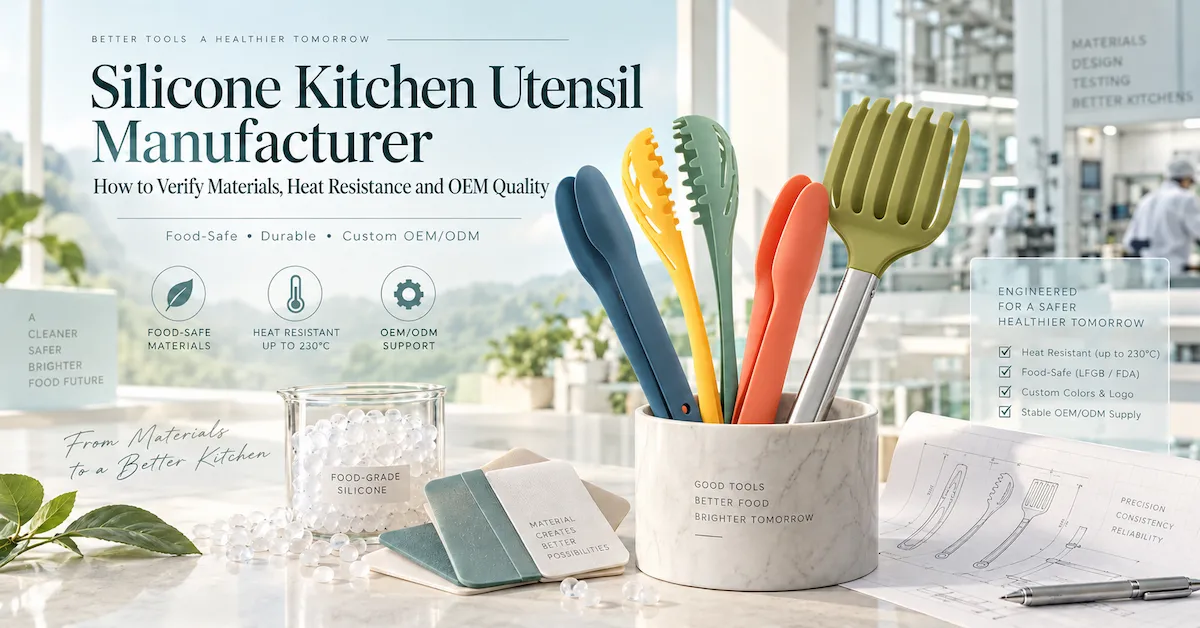
The first purchasing decision is therefore the product's intended use envelope: what food it contacts, whether exposure is brief or prolonged, what temperature conditions are expected, which cooking vessels it will touch, how forcefully it is used, and how it will be cleaned. The intended user also matters. A compact scraper intended for a small mixing bowl should not automatically be approved as a deep-pan turner merely because it has a similar material name.
Importers and brand owners must additionally consider what they will claim on packaging. “Food-contact suitable,” “dishwasher safe,” “heat resistant” and “gentle on cookware” are separate promises requiring separate technical support. A manufacturer may assist in collecting documents, but the buyer should make sure those documents match the actual product and selling market. Create a requirement sheet before discussing price so a lower quotation cannot silently change the product you are buying.
2. Which BONET Silicone Kitchen Utensils Are Useful Starting Points?
BONET HOUSEWARE CO., LTD., based in Yangjiang, Guangdong, China, publishes a kitchen utensil product collection with silicone cooking tools and related products. For an initial sampling discussion, the exact catalog reference is more helpful than an unspecific photograph. The three models below illustrate why buyers must inspect individual designs and material descriptions rather than generalize across the category.
| Published reference | Listed dimensions | Listed material fields | Best procurement question |
|---|---|---|---|
| G2008 silicone spatula | 20 × 3 × 1 cm | Silicone and carbon steel | Where is the metal component, and what scraper-edge flexibility is approved? |
| G2009 silicone spoon | 27 × 6.5 × 1.5 cm | Silicone and carbon steel | What load and temperature conditions apply to the finished spoon and its internal structure? |
| G2007 silicone cooking utensil | 27.5 × 6.5 × 1.5 cm | Silicone and carbon steel | How is the assembled utensil constructed, cleaned and evaluated for its intended tasks? |
Dimensions and material labels are published catalog fields, not new measurements performed for this article. Models, variants and technical availability should be confirmed with BONET before quotation or publication of SKU-specific claims.
These pages explicitly include carbon steel in the metal-material field. That makes a component drawing particularly important: the public listing alone does not show whether the metal is fully enclosed, how it is treated, or whether a proposed custom version uses the same construction. Do not describe these products as all-silicone or assign a stainless-steel core to them without written confirmation. Likewise, a product description mentioning a heat temperature or easy cleaning does not replace a test report for the exact variant.
For an OEM program, select the reference most closely aligned with your use case and ask which dimensions, finishes and brand elements are fixed by existing tooling. A product that needs only a different logo may take a different approval path from one needing a new head shape or composite construction.
3. What Does “Food-Grade Silicone” Actually Tell a Purchasing Team?
Silicone is a family of materials rather than one universal formula. A food-contact elastomer is normally developed from a defined polymer system plus the ingredients and processing steps needed to deliver its characteristics. Filler, pigment, processing aids and curing chemistry can affect the final article. For the buyer, the essential question is not whether a supplier calls a material “food grade,” but whether the specific finished composition is appropriate for the proposed contact conditions and supported by traceable documentation.
Ask for a component-level bill of materials that differentiates the silicone in the working head from the core, reinforcement, handle or accessory. A one-piece molded item and an overmolded item may have different risks, even if their visible surfaces look identical. Material information may involve confidential formulations; a supplier can still provide appropriate specifications, declarations and verification through qualified parties without revealing protected intellectual property.
Silicone rubber, liquid silicone rubber and process terminology
In silicone product manufacturing, buyers may encounter high-consistency rubber, liquid silicone rubber (LSR) and multiple molding or curing routes. These terms describe different material and processing systems; they do not establish a quality ranking on their own. Ask which system is used for your product, why it suits the geometry and production volume, and whether the molding activity is in-house or managed through an approved production partner.
Similarly, platinum-cured and peroxide-cured describe possible cure chemistries; neither label automatically guarantees food-contact compliance, a lack of odor, or superior durability in every application. Appropriate material selection and process controls depend on the formulation, the finished geometry and the intended use. Post-curing may be relevant for particular materials and processes, but should never be claimed as a universally mandatory step or a confirmed BONET production method unless that route is documented.
Colorants, hardness and a consistent feel
For retail ranges, a standard color chip is not necessarily equivalent to the color of a molded silicone part. Thickness, lighting and formulation can change its perceived shade. Define an approved physical color sample and the observation conditions. Check multiple molded parts when color consistency is important rather than accepting the first attractive sample.
Flexibility can be discussed with Shore A hardness, but a hardness value alone does not describe how a spatula behaves. Wall thickness, reinforcement position, head geometry and handle stiffness also matter. A spoon with a rigid internal structure might resist bending more than an unreinforced scraper using a similar elastomer. Ask for an agreed performance test alongside any material hardness target.
Odor, tackiness and surface condition are useful screening observations, but they are not substitutes for compositional or migration assessment. Establish an inspection method, how samples are conditioned and who is responsible for deciding if an odor or appearance difference is acceptable. Request investigation when unusual properties appear; do not infer a specific chemical problem from smell alone.
4. How Should a Manufacturer Prove Heat Resistance and Cleaning Claims?
“Heat resistant” is one of the most commercially important—and frequently oversimplified—claims for silicone kitchen utensils. Consumers may expose a spoon to hot soup, a spatula to a warm frying pan, or a turner to the side of cookware. Those are not the same conditions. A nominal temperature mentioned in a product description does not fully define performance because exposure duration, food medium, contact pressure and the entire utensil construction can affect the result.
Build a heat-use specification with the expected temperature range, duration, duty cycle, food or surface involved, and acceptable changes after exposure. For example, a brand can define a brief-contact test against a representative vessel and a separate extended-use simulation, where both are relevant. The supplier should then propose an appropriate validated method. Avoid promising direct flame contact or indefinite residence in an empty hot pan unless those extreme uses have specifically been considered.
| Claim or concern | Test planning question | Evidence the buyer should retain |
|---|---|---|
| Heat use | What is the temperature, medium, exposure time and accepted deformation? | Test protocol, sample identity, outcome and approved care statement. |
| Cleaning / dishwasher | What cycle, detergent, number of cycles and post-cleaning evaluation apply? | Representative cycle result including any marking or joint changes. |
| Odor and taste transfer | What conditioning and assessment approach suits the intended food-contact use? | Appropriate assessment or analytical results with clear limitations. |
| Color durability | Does the approved color change during intended heating, washing or normal use? | Retained sample comparison and agreed criteria. |
| Joint security | Can the handle and working end remain secure under realistic operating loads? | Defined functional test, results and defect response. |
Do not apply one sample's test result automatically to every color or to an entire utensil set. Different components may have different constructions and exposures. Have the laboratory or responsible compliance specialist explain whether a family approach is technically defensible and when a new formulation, pigment, reinforcement or design requires further verification.
Cleaning claims deserve the same discipline. The working head may tolerate a washing process while a wood handle, attachment or decorative print may not. Review the assembled article and design the care label around the weakest relevant component. If the evidence does not support a dishwasher-safe claim, provide accurate washing instructions instead of copying competitors' packaging language.
5. What Food-Contact Requirements Matter for US and EU Buyers?
Food-contact suitability is not a certificate that can be transferred unquestioningly from one catalog page to every other product. It is a determination related to ingredients, processing, the finished article, the expected food-contact conditions and the destination market. The actual documentation should identify the product or material tested, test conditions, results and limitations. A sales phrase such as “FDA approved silicone” is not a precise substitute for regulatory review.
United States: determine the status of each relevant substance
The U.S. Food and Drug Administration's guidance, Determining the Regulatory Status of Components of a Food Contact Material, explains that the regulatory status of a food-contact material depends on its constituent substances and their applicable authorization routes and restrictions. Those routes may include relevant Title 21 CFR provisions, qualifying exemptions or effective food-contact notifications. Where a notification is relied upon, the manufacturer and permitted use can matter. The buyer should ask the supplier or qualified adviser to identify the actual basis covering the intended product.
For silicone elastomer articles, a compliance professional may assess requirements relevant to rubber articles intended for repeated food use, where applicable, alongside other substance-specific requirements. That does not mean every silicone product automatically meets the same section, that a general material statement proves the final part, or that a finished utensil has received a blanket FDA product approval. Document what has actually been assessed.
European Union: general framework, GMP and relevant national measures
The European Commission identifies Regulation (EC) No 1935/2004 as the general food-contact-material framework and Regulation (EC) No 2023/2006 as the good manufacturing practice framework. EU requirements can also include material-specific legislation and national measures.For silicone, an importer should have the applicable national and product-specific provisions identified by a competent specialist rather than assuming a single EU-wide silicone-specific test resolves every case.
Before approving market claims, determine what evidence must accompany the actual article and which party will maintain it. Request supporting records for pigments, additives and material changes where relevant. If the brand intends to sell into several countries, do not assume the regulatory paperwork for one destination is automatically sufficient everywhere. Record any required label languages and consumer-use restrictions as part of the product approval.
Important distinction: an ISO 9001 quality-management claim, BSCI-related social compliance information or Sedex participation, even when supported by valid documentation, does not itself demonstrate that a silicone utensil is suitable for food contact. Verify the scope and validity of any factory or social-audit credentials separately from the finished-product compliance evidence.
6. What Manufacturing Steps Should Buyers Audit for Silicone Utensils?
The manufacturing route must be established for the particular product. BONET's public manufacturing information describes several activities across its kitchenware and cutting-tool operations, including component production, injection molding, assembly, quality checking and packing. It would be inaccurate to assert that every silicone tool passes through every process shown for knives or scissors. For a silicone utensil, request a product-level route map.
Incoming material and component identification
Ask how the supplier identifies each incoming silicone formulation, pigment batch and reinforcement or handle component. The purpose is traceability, not paperwork for its own sake. If a production issue appears, the team should be able to identify which material batches and product lots may be affected. Incomplete identification turns a limited deviation into a broad investigation.
Material preparation, molding and cure control
Where molding is involved, discuss how the approved mixture and tooling conditions are controlled. Technical parameters may include mixing, dosing, mold filling, curing or other operations appropriate to the selected route. Buyers do not need the supplier's confidential process recipe, but should ask which settings are critical to the finished part and how process drift is detected. For outsourced molding, ask which facility performs it and how the prime supplier controls quality.
Common visual issues to review can include excessive flash, incomplete filling, air-related defects, uneven texture, unexpected color changes and dimension variation. These are possible failure modes, not defects established on BONET models. The inspection plan should set the allowable condition for the approved design and define when a process adjustment or part rejection is required.
Assembly, finishing and protective packaging
When a tool includes a core, a joint or a separate handle, verify the component location, fit and security after assembly. Identify any cleaning, post-processing, trimming or surface-finishing steps required for the specific construction. Then inspect the finished article in its actual pack: a soft silicone surface can still be marked, bent or contaminated if packing protection is poorly designed.
Keep the production process map linked to the approved sample and SKU revision. If the supplier changes a mold, component source or assembly method, the buyer should know which specifications or validation tests must be revisited. A professional supplier relationship makes those change decisions visible before goods are released.

7. How Do You Evaluate Spatulas, Spoons, Ladles and Turner Designs?
Different shapes should not share one undifferentiated acceptance checklist. A scraper's useful feature is controlled edge contact. A serving spoon needs an appropriately shaped bowl and adequate resistance to deflection for the target food load. A turner must slide under food without excessive force and should be evaluated with the cookware the consumer will actually use. A ladle needs the right capacity, reach and pouring behavior. Shape can matter as much as the material formulation.
For a silicone spatula, assess the leading edge against representative bowls. Use a repeatable task, record the container, and compare how the head responds when tilted or pressed. Define the acceptable amount of flex instead of approving “good flexibility.” For a silicone cooking spoon, test scooping and stirring under the intended load and identify the point where excess flex interferes with normal use.
Review handle diameter, usable grip length and the distance between the user's hand and a hot vessel. These dimensions interact with the head geometry. A product may look balanced on the table but feel awkward in a deep pot. Where necessary, recruit users who represent the intended audience for sample feedback, but turn repeated observations into an agreed design requirement rather than subjective marketing copy.
When building sets, avoid selecting items only because they match in color. Select a complementary assortment around real tasks. Inspect the matching finish, visible construction and hanging or storage features once the functional choice is settled. A smaller functional set can be stronger commercially than a larger box padded with overlapping tools.
8. Which Quality Control Checks Matter Most for Silicone Kitchenware?
Quality control should convert purchasing requirements into observable and reproducible checks. Ask four questions for every important feature: what will be inspected, how, against which acceptance criterion, and what happens if the result fails? The correct mix of visual inspection, physical tests, document review and laboratory analysis depends on the product's risk and the destination market. A generic “100% inspection” promise does not answer those questions.
| Control point | Evidence or measurement | Typical failure to manage | Decision record |
|---|---|---|---|
| Material identity | Approved component specification, batch identification and relevant compliance documents. | Unapproved formulation or pigment substitution. | Incoming release and traceability log. |
| Dimensions | Length, head width, thickness and agreed tolerances. | Out-of-tolerance size or inconsistent edge geometry. | Measured part results. |
| Surface and color | Approved reference under agreed viewing conditions. | Flash, incomplete molding, marks, inconsistent shade. | Visual comparison and defect disposition. |
| Joint or core | Approved drawing, position check and suitable functional retention test. | Loose fit, unexpected exposure or separation. | Assembly or load-test record. |
| Cooking performance | Task-specific flex, reach, scooping or scraping method. | Excess deflection or unsuitable usability. | Functional sample sign-off. |
| Heat and cleaning | Validated conditions appropriate to the intended use. | Unacceptable deformation, finish change or joint damage. | Test and claims approval. |
| Retail packaging | Artwork revision, pack contents, barcode and transport protection. | Wrong SKU, mismatch, rubbing damage or incorrect label. | Final packed-goods release. |
Agree a defect-classification system for critical safety concerns, material or performance issues and cosmetic variation. Where statistical sampling is proposed, set the sampling plan, defect definitions and acceptance rules before production. Do not assume a conventional AQL calculation is an acceptable substitute for specific safety and compliance controls. Some critical requirements may call for a different release approach.
Ask for a first-piece check after a production setup and evidence of in-process monitoring when suitable. Final inspection is useful but cannot restore a curing process that was already uncontrolled or detect every internal issue by appearance. A robust control plan catches deviations where they arise and records corrective action for reorders.
9. How Should Importers Approve OEM Silicone Utensil Samples?
Sample approval should occur in stages. An early visual sample confirms appearance but may not be molded using final tooling or the approved formulation. A functional sample tests whether the geometry works in the intended task. A validated pre-production sample demonstrates the confirmed construction and relevant test evidence. A packed reference confirms labels and protection. Combining all stages into one informal “sample approved” message creates preventable confusion.
- Concept and drawing review: agree intended use, construction, preliminary dimensions, revision owner and unresolved decisions.
- Material confirmation: identify the actual silicone and other components, pigment proposal and food-contact evidence required for the destination.
- Functional prototype review: evaluate flex, ergonomics, grip, task performance, color and appearance using a documented method.
- Pre-production validation: confirm representative production materials, manufacturing route, relevant tests and the approved bill of materials.
- Pack and shipment approval: inspect the saleable pack, instructions, carton configuration, barcode and protective arrangement before production release.
Keep samples with a version identifier and date. Photograph appearance and pack arrangement, but retain a physical sample where color, texture or flexibility cannot be judged reliably on screen. Make each approval conditional on the described scope: a design sign-off is not necessarily food-contact sign-off, and a laboratory report does not automatically approve packaging text.
Have a silicone utensil sample to develop or compare?
Send BONET your model references, intended food-contact use, material concerns and required test documents. Ask the team to propose a sample-review route before committing to production tooling.
Discuss Your Sample Requirements →10. What Can Be Customized Through OEM and ODM Services?
Most brands do not need every tool reinvented from the beginning. Customization can range from selected colors or logos on existing platforms to new geometry, composite materials, tooling and private-label packaging. The appropriate route depends on whether the buyer already has a defined drawing or needs design development support. Clear ownership and approval rules are important in either case.
BONET's OEM/ODM kitchenware program describes work from customer drawings or samples, material and color options, logo application, packaging solutions, structural optimization, feasibility review, sampling and production support. The website presents these as service capabilities across multiple kitchenware categories; exact color, tooling, marking and minimum quantities must still be confirmed for your silicone SKU.
For silicone products, pay particular attention to the impact of design changes. A new shade could require different pigment qualification. A thicker head may change flexibility and cure behavior. A new hanging hole or longer handle may affect tool balance or mold design. A new marking technique may need care-durability evaluation. Treat every significant change as a controlled revision, not a decoration added after technical approval.
Ask which costs relate to new tooling, shared molds, color setup, printed retail packaging and testing. Clarify ownership, storage, maintenance and use rights of custom tooling in writing where relevant. Adding a logo to an existing design does not by itself make that design exclusive. Any exclusivity arrangement should be documented separately from the tooling and product quotation.
11. How Do You Select a Silicone Utensil Set Without Overbuying Pieces?
A coordinated utensil set should solve a coherent group of cooking tasks. Begin with the purchase reason: starter kitchen, cookware bundle, family home, baking assortment or hospitality replacement. List the useful tools first, then choose a common color and storage approach. The visual design should support the assortment rather than determine which pieces are included.
When comparing a six-piece and ten-piece set, assess the incremental functions instead of relying on the headline count. A second nearly identical spoon may be less useful than an appropriately designed scraper or turner. Confirm whether the advertised piece count includes a holder or separate accessory. Review the assembled set's actual materials one part at a time: a whisk, tongs and soft spoon may require different components and tests.
Review retail packaging and the real distribution path. An elegant gift box may be useful for department stores, while simple sleeves or individual hanging packs may work better in discount channels. For online selling, product movement inside an outer parcel becomes part of the damage risk. Ask the supplier to approve the saleable pack and shipping carton as separate but connected specifications.
A set also changes the reorder problem. Customers may need replacements for individual pieces, while the original bundle has only one barcode. Decide at the beginning whether matching single tools can be ordered later and whether the supplier can maintain colors and designs across batches. Document the range version to protect assortment continuity.
12. How Do MOQ, Color Variants and Molding Costs Affect OEM Pricing?
A meaningful silicone utensil quotation must specify the material and construction being priced, product dimensions, approval and testing scope, colors, logo or packaging work, quantity per SKU and the delivery basis. Otherwise, two factories can quote the same phrase—“silicone spatula”—while describing different products. Ask for separate prices and minimums for each variation instead of assuming one order minimum covers a whole range.
MOQ can be influenced by silicone material preparation, color batches, production setup, custom tooling, inserts, printing and packaging. There is no universally valid minimum that can be published for BONET without a real project quotation. Ask which operation drives the minimum and which existing product options might permit a simpler opening order. A standard design with fewer colors can sometimes be easier to manage than a full custom family launched immediately.
Illustrative planning example, not a supplier quote: a buyer proposes three tools in four colors, with 300 finished pieces of each SKU-color combination. That represents 12 SKU-color lines and 3,600 individual utensils. Even if the total sounds large, some material or packaging minimums may apply to each of the twelve variations. Calculate the quantity at that level and ask the supplier to state whether it accepts the planned mix.
Separate one-time charges from recurring unit costs. Tooling, engineering, sampling, artwork preparation and validation may not recur on every order; packing materials, material consumption, production, inspection and freight normally do. A cheaper unit price with higher setup costs can be more expensive for a short initial run. Conversely, new tooling may be justified by repeat volume or a clearly differentiated design. Evaluate the expected lifecycle rather than only the first invoice.
Comparable landed-cost method: estimated landed cost per saleable unit = (goods + accepted setup allocation + packaging + testing and inspection + transport + import charges + other applicable costs) ÷ expected saleable units received. Use verified project data and a consistent Incoterms scope; do not treat example figures as BONET prices or freight quotes.
13. What Does a Strong Supplier Comparison Actually Measure?
The best supplier is not simply the one with the most attractive catalog or the lowest initial price. Compare how each candidate answers the same questions about material identity, process responsibility, sample validation and repeat-order management. A supplier that honestly identifies a required third-party test is often easier to manage than one promising that every standard applies without seeing the destination market or the actual product.
| Area | Evidence to request | Warning sign |
|---|---|---|
| Product knowledge | Component drawing, application discussion and model-specific answers. | Every utensil receives identical generic claims. |
| Material control | Formulation or component specification and traceability method. | “Food grade” with no supporting scope. |
| Compliance | Market-specific documentation plan and representative sample identity. | Unqualified claims of universal FDA or EU approval. |
| Production route | Who molds, assembles, inspects and manages subcontractors. | Unclear production location or ownership of quality problems. |
| OEM/ODM | Revision control, tooling, sample path and branding feasibility. | All changes described as simple with no validation impact. |
| Commercial clarity | Written assumptions for MOQ, price, test scope, cartons and milestones. | Quote has only a unit price and a vague lead time. |
Site visits, video reviews, inspection records, sample testing and third-party checks can all be useful, depending on risk and order size. The question is whether the evidence addresses the specific utensil in the purchase order. A general capability page is an appropriate starting point, not a substitute for proof that a named part follows a controlled process.
14. What Should Be Included in a Silicone Kitchen Utensil RFQ?
Make it easy for manufacturers to quote the same product. A precise request for quotation reduces revisions and exposes missing decisions early. The following brief can be copied into a purchasing email or uploaded with drawings; replace the examples with your actual project information and separate mandatory requirements from negotiable preferences.
Project: OEM / ODM silicone kitchen utensils for a private-label retail or wholesale program.
Buyer and market: Company, intended sales channel, destination country and typical customer use.
Shortlisted products: BONET G2007, G2008, G2009 or other approved product references, with exact requested quantities.
Construction: Component-level material specification, proposed silicone type, any internal core or joint, finished dimensions and design revision.
Use conditions: Food-contact category, expected heat exposure and duration, cookware interaction, cleaning requirements and supported claims.
Appearance and branding: Color reference, logo artwork, placement, surface finish and samples required.
Regulatory and testing: Destination-market requirements and documents requested from material supplier, factory or laboratory.
Order: Quantity by SKU and color, sample quantity, repeat-order forecast, packaging type, barcode and cartons.
Commercial response: MOQ by variation, tooling or setup fees, unit cost, sampling and testing charges, lead-time start point, inspection plan and delivery basis.
Approval process: Drawing and sample revisions, owners of decisions, production-release conditions and required pre-shipment records.
Ask the supplier to reply line by line and mark assumptions instead of substituting a different product without explanation. A proposed alternative can be valuable, but the buyer must understand what changes in materials, intended use, cost and testing. Include a contact person who can approve technical deviations; otherwise a project can stall while commercial and product teams disagree about what was ordered.
15. Why Packaging, Logistics and Reorders Belong in the Quality Plan
Even a correctly molded utensil can reach a customer in poor condition. Long handles may shift within packaging, soft surfaces may pick up marks, and assorted sets can contain the wrong combination of pieces. Review the proposed retail unit, inner pack and master carton as a system. Confirm count, barcode, carton dimensions, gross weight, pallet constraints if applicable and the actual distribution route.
For e-commerce projects, ask about parcel-level protection rather than relying solely on a full shipping carton. For supermarket distribution, consider hanging format, shelf display and clear, accurate instructions. Products used for food preparation deserve readable care guidance consistent with actual validation. Where destination rules call for traceability or language-specific warnings, incorporate those details before artwork approval.
Repeat orders should reference the approved bill of materials, color standard, tooling version, logo artwork, pack specification and any accepted deviations. Do not release a reorder simply by forwarding an old invoice. Request confirmation of changes in component sources, formulations, pigments and subcontractors since the prior production. Preserve receiving and return data from the previous shipment to improve the next control plan.
Shipment timing should distinguish sample approval, start of manufacturing, completion of production, dispatch and arrival. Agree who pays for additional tests, rework or expedited logistics when changes are needed. These terms are more reliable than marketing promises of universally fast delivery because they apply to the actual project.
16. Where Does BONET Fit in a Silicone Kitchenware Sourcing Program?
BONET HOUSEWARE CO., LTD. presents a Yangjiang-based kitchenware business with an online product catalog, manufacturing information and an OEM/ODM service process covering requirement communication, design and sampling, quotation confirmation, production, inspection and packaging. For buyers evaluating silicone utensils, these pages are useful initial evidence of the available service conversation and specific catalog product references.
The practical next step is product-specific confirmation. Ask which entity performs the silicone-forming work for the selected model, what material documents and manufacturing records are available, whether the current sample represents production tooling, and which changes are possible without a new validation plan. If a molded component is supplied by a specialist partner, identify the oversight and inspection arrangement. Transparent supply-chain mapping is more valuable than assuming every step happens under one roof.
For an initial request, start with the silicone kitchen utensil category, choose the relevant models and describe your target use, materials, quantities and branding. Then use the BONET contact page to request a quote and a proposed sample-control plan. This sequence gives the supplier enough context to respond meaningfully while protecting the buyer from approving unverified claims.
Build a repeatable silicone utensil range with a clear specification
Request BONET's product options and a project-specific OEM proposal. Include your target market, sample needs, food-contact evidence requirements, colors, packaging and planned order quantities.
Contact BONET for a Technical RFQ →Frequently Asked Questions About Silicone Kitchen Utensil Manufacturers
1. What should I ask a silicone kitchen utensil manufacturer before ordering?
Ask for a complete description of the finished product, including material identity, other components, intended food-contact and heat-use conditions, manufacturing responsibilities, representative samples and available verification documents. Also ask for MOQ by variation, packaging requirements and the process used to approve and control repeat production. A short catalog description is a starting point, not a complete purchasing specification.
2. Does “food-grade silicone” mean a utensil is approved for every market?
No. It is not a universal approval statement. Compliance depends on the constituent substances, finished article, relevant authorization or standards, conditions of use and destination rules. Buyers should ask for market-specific evidence and have the proposed claims reviewed by qualified personnel. Do not substitute a generic material name for an actual compliance assessment.
3. Is platinum-cured silicone always better for cooking utensils?
No cure label automatically establishes suitability for every cooking tool. The outcome depends on the complete formulation, process control and actual product use. Discuss the chosen system with the manufacturer and relevant technical adviser, and request verification appropriate to the finished part. Do not infer a compliant or odor-free finished product from the curing description alone.
4. How much heat can a silicone spatula withstand?
There is no single temperature that should be assigned to every silicone spatula. Heat performance depends on its construction and exposure conditions. Ask for the temperature, time, test method and supported care statement for the exact model. Contact with a hot food mixture and prolonged direct contact with a heated cooking surface may require different evaluation.
5. Are BONET G2007, G2008 and G2009 made from solid silicone?
The linked BONET product pages list both silicone and carbon steel among their material fields. Buyers should request a component drawing to establish where those materials are used, whether any metal is enclosed, and what the approved construction includes. Do not infer that the entire article is solid silicone or that the metal is stainless steel.
6. Can a manufacturer produce custom silicone utensil colors and logos?
BONET describes material, color, logo and packaging customization within its broader OEM/ODM program. Confirm which options are available for the selected utensil and what new samples, test work or tooling may be required. A change in color or marking can affect both commercial minimums and the product-approval file.
7. What is the MOQ for OEM silicone kitchen utensils?
The minimum depends on the actual product, material batch, tooling, color run, printing and pack configuration. Request a written MOQ by SKU and variation. BONET's public service description does not establish one fixed minimum for every silicone product, so obtain a current project-specific quote before making launch assumptions.
8. What testing should I request for a silicone kitchen utensil?
Identify the relevant food-contact compliance basis for the destination and intended use, then set appropriate finished-product performance checks. These may address heat exposure, cleaning, surface and odor issues, functional loading, assembly and packaging. A qualified laboratory or technical specialist should define the test methods and sample scope; one universal test package is not appropriate for every product.
9. Can a silicone utensil be used on nonstick cookware?
Many silicone-working-end tools are selected for cookware-friendly tasks, but compatibility should be confirmed for the intended cookware surface, tool geometry and normal use. Avoid an absolute “scratch-proof” claim unless supported. Evaluate edges, embedded components and handling with representative cookware rather than relying only on the material name.
10. What causes silicone utensil quality to vary between orders?
Possible contributors include changes in material or pigment, molding conditions, tooling, assembly, inspection decisions and packaging. The supplier should identify the approved production revision, trace relevant batches and manage any proposed substitutions. Documenting sample and process controls helps buyers separate normal variation from a true specification deviation.
11. Is an OEM silicone utensil order the same as private labeling?
Not necessarily. Private labeling may involve branding an existing utensil platform. OEM commonly means controlled production to an agreed buyer specification, while ODM may add design and product development support. The exact deliverables, ownership, approvals and production rights matter more than the marketing label used for the service.
12. How do I request a silicone kitchen utensil quote from BONET?
Send your product references, destination market, intended cooking and cleaning conditions, preliminary dimensions, color and branding preferences, opening quantity and packaging format. Specify which material declarations or tests you expect and whether you need an existing design or new development. Use BONET Contact Us and request a line-item response for MOQ, sample work, testing, tooling, timing and delivery assumptions.