




Silicone Kitchen Utensils Supplier Guide for Better Sourcing
Choosing a silicone kitchen utensils supplier is not only about finding a coordinated product photo or a competitive quotation. For retail, wholesale, e-commerce, hospitality, and private-label buyers, the supplier decision affects product feel, set consistency, packaging reliability, and customer satisfaction after delivery. A utensil set may look simple, but it usually combines several components: silicone working ends, handles, metal whisk wires, tongs, and a countertop holder.
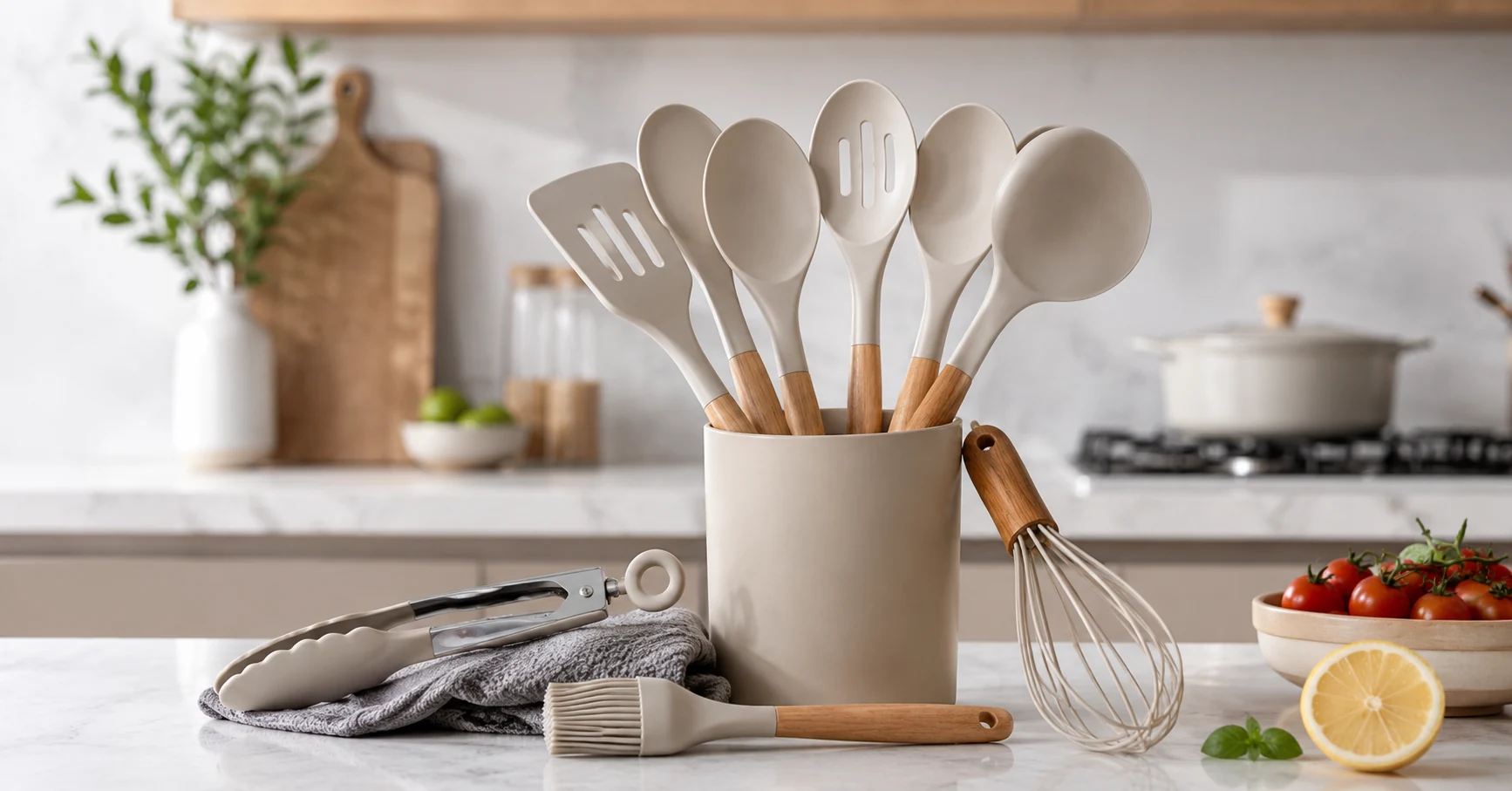
The set shown here appears to include multiple silicone utensils, a balloon whisk, metal tongs with silicone contact areas, wood-look handles, and a matching cylindrical holder. That makes it a consumer-oriented kitchen starter set rather than a single specialty tool. Buyers should treat it as a mixed-material bundle and evaluate the whole program, not just one spatula.
Key Takeaways
- Confirm the material breakdown for each part of the set before approving specifications or packaging copy.
- Review the utensils, whisk, tongs, and holder together because one weak item can reduce the perceived value of the full set.
- Ask suppliers practical questions about assembly, color consistency, care instructions, and retail packaging.
- Use real cooking and storage tests during sample review, not only visual inspection.
What This Utensil Set Is Designed to Solve
This product type serves everyday home cooking tasks: stirring, scooping, flipping, mixing, serving, and general preparation. The visible assortment suggests a bundle intended for customers who want a complete, coordinated counter-top set. The neutral color and holder also make it suitable for retail display and gifting, provided the construction supports regular kitchen use.
For sourcing teams, the core question is whether the supplier can deliver both appearance and function. A matched color palette may attract shoppers, but it does not replace stable handles, clean edges, comfortable balance, and consistent finishing. A reliable silicone kitchen tools supplier should be able to explain how each part of the set is made, packed, and controlled across repeat orders.
Product Details Buyers Should Verify
Photos can help narrow a shortlist, but they cannot confirm material grade, heat resistance, holder composition, or internal structure. The visible working ends appear to be silicone, while the handles have a wood or wood-look finish. The holder may be ceramic, stoneware, coated metal, or another material; this should not be assumed without supplier confirmation.
Before placing an order, ask the supplier to clarify:
- the material of the utensil heads, handles, internal cores, whisk, tongs, and holder;
- whether the silicone utensils are one-piece items or assembled with separate handles;
- recommended care instructions for the silicone parts, handle finish, and holder;
- available packaging formats for retail shelves, online shipping, or gift presentation;
- how color, handle finish, and set composition are controlled between production batches.
These questions are not technical formalities. They help prevent inaccurate product listings, avoid packaging claims that cannot be supported, and reduce the risk of inconsistent repeat shipments.
Supplier Comparison Checklist
Many catalog descriptions sound similar, so buyers need a structured way to compare offers. The following checklist can be used during quotation review and sample evaluation.
| Evaluation Area | What to Check | Questions to Ask the Supplier |
|---|---|---|
| Material clarity | Working ends, handles, metal parts, and holder | Can you provide a component-by-component material breakdown? |
| Assembly quality | Handle connection, seams, edges, and tool balance | How are the silicone heads and handles joined or reinforced? |
| Set consistency | Color, finish, utensil shapes, and holder appearance | How do you manage approved samples and batch-to-batch variation? |
| Use performance | Flex, grip, reach, and comfort during cooking tasks | What sample testing do you recommend before order confirmation? |
| Packaging | Protection for holder, tongs, whisk, and long handles | How is the set packed to reduce scratching, bending, or breakage? |
How to Review Samples in a Practical Way
A sample review should go beyond checking color and counting pieces. Test the utensils with real cookware and common cooking movements. Stir a thick mixture, flip a soft food item, scoop from a deep pot, and check whether the handles feel stable. For the slotted and solid spatulas, examine the edge finish and flexibility. For the whisk, check whether the wires feel secure. For the tongs, open and close them repeatedly and look at the silicone contact points.
The holder also deserves attention. A countertop holder can improve presentation, but it creates additional shipping and use considerations. Check whether utensils sit inside neatly, whether the holder remains stable, and whether the packaging protects it from chips, scratches, or dents. If the set will be sold online, ask how it performs in parcel-style shipping rather than only palletized wholesale delivery.
Common Sourcing Mistakes to Avoid
The most common mistake is approving a set based only on its visual style. Neutral silicone and wood-look handles may fit current homeware trends, but buyers still need evidence of functional quality. Another mistake is treating the set as a single silicone product. In reality, the whisk, tongs, holder, handles, and utensil heads may involve different production processes and quality risks.
Buyers should also avoid writing unsupported claims into listings. Do not state a specific material grade, temperature range, dishwasher suitability, or compliance status unless the supplier provides appropriate documentation and the claim is relevant to your market. Where information is missing, turn it into a supplier question rather than an assumption.
Best Fit for Retail, Wholesale, and Private Label
This type of set is best suited to consumer kitchenware assortments, home-goods retailers, online sellers, gift programs, and private-label lines that need a coordinated starter set. The holder makes the bundle more display-friendly than loose utensils, while the variety of tools gives shoppers a practical reason to buy a complete set.
For foodservice or heavy commercial use, sourcing standards should be stricter. Buyers would need to ask more detailed questions about repeated washing, high-frequency handling, replacement parts, and durability under demanding routines. Based on the visible design, this set should be evaluated first as a home kitchen product unless a supplier can support a different use case with clear information.
FAQ for Sourcing Teams
Is every silicone kitchen utensils supplier suitable for full sets?
No. Some suppliers may specialize in single molded tools, while others are stronger in assembled sets, mixed materials, holders, and retail packaging. Match the supplier to the product structure you need.
Can buyers assume the holder material from the image?
No. The holder material should be confirmed directly. It may look like ceramic, stoneware, coated metal, or another material, but product specifications should not be based on appearance alone.
What should be included in a sample approval process?
Review material information, handle attachment, utensil balance, edge finish, whisk and tong function, holder stability, packaging protection, and color consistency against an approved reference sample.
Should price be the main supplier selection factor?
Price matters, but it should be compared alongside construction clarity, sample quality, communication, packaging reliability, and the supplier’s ability to maintain consistent repeat orders.
A Practical Next Step
When shortlisting a silicone kitchen utensils supplier, start with a complete sample set and a written question list. Ask for component materials, assembly details, care guidance, packaging options, and color-control procedures. Then test the set in ordinary cooking and storage situations that match your target customer.
This process helps separate a visually attractive catalog item from a product that can support a stable retail or private-label program. A good sourcing decision should make the set easier to describe accurately, package safely, and reorder with confidence.
