








Choosing a Silicone Spatula Supplier for Kitchenware Lines
If you are sourcing baking tools, the choice of a silicone spatula supplier is rarely just about color or price. For engineers, sourcing managers, and product teams, the real question is whether the product will hold up in daily kitchen use, present well on retail shelves, and fit the realities of production without surprises. A spatula looks simple until you start asking about head flexibility, handle assembly, finish quality, set consistency, and how the item will perform when customers use it for stirring, folding, scraping bowls, and transferring batter.
That is why this kind of purchase deserves more than a quick catalog scan. The right supplier can help you build a kitchen utensil line that feels coherent, sells cleanly in sets, and avoids the small defects that often become large problems later: loose handle fit, uneven color, rough edges, or a head shape that does not scrape properly. Those are not glamorous issues, but they are the ones buyers remember.
What the product itself tells a buyer
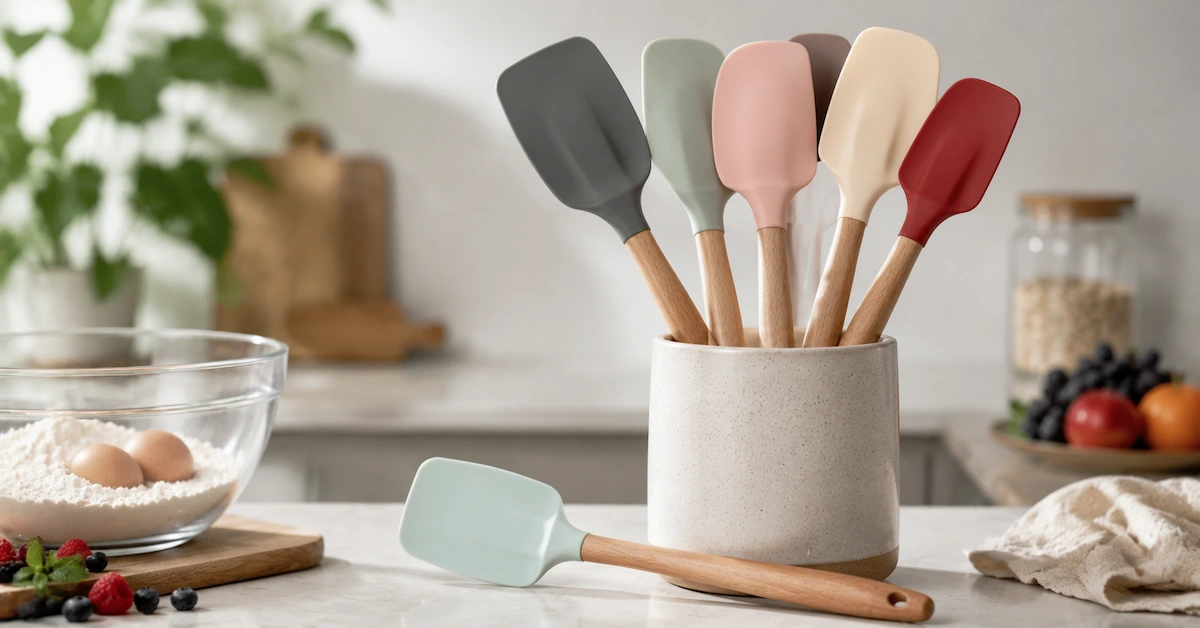
The spatulas in the preparation data are the familiar kind used in home baking and food prep: flexible silicone heads paired with wooden handles. The broad paddle shape, rounded corners, and tapered neck suggest a tool designed for bowl scraping and batter work rather than heavy-duty industrial mixing. That distinction matters. A spatula meant for cake batter needs enough flex to sweep a mixing bowl clean, but not so much softness that it folds over in use.
The visible finish also matters from a merchandising standpoint. A matte, smooth head usually reads as more modern than a glossy one, and natural wood grain on the handle gives the product a warmer, more giftable look. The color assortment shown — dark gray, sage green, pink, cream, and red — suggests a set built for retail presentation or bundled consumer sales rather than a single utilitarian utensil. For many buyers, that is the first clue that the product is meant to do more than sit in a back-of-house drawer.
Why supplier selection is harder than it looks
Kitchen utensils are often treated as commodity items, but silicone tools sit in an awkward middle ground. They are not complex appliances, yet buyers still need predictable quality. A silicone spatula manufacturer has to get a few things right at the same time: the material feel, the geometry of the head, the finish on the handle, and the consistency across colors or set pieces. Miss one, and the product can look cheap even if it functions adequately.
There is also the practical matter of assembly. The product data suggests a one-piece head-and-handle assembly of some kind, but it is not clear whether the silicone is molded directly around the handle or fitted as a separate component. That uncertainty is worth flagging because it affects durability, line setup, and quality control. Buyers should not assume every “silicone and wood” utensil uses the same build method.
Quick buyer takeaways
For sourcing teams comparing suppliers, a few points are worth keeping front and center:
The head shape should be broad enough for scraping but not awkward at the bowl edge.
Color assortment can improve shelf appeal, but only if the colors stay consistent across production lots.
Wood handles bring a premium look, yet they also raise questions about finish uniformity and assembly precision.
Set packaging can be useful for retail, but buyers should confirm what counts as a set and how each piece is packed for shipment.
None of these points is dramatic on its own. Together, they decide whether the item feels like a coherent product line or a loose collection of utensils.
How silicone spatula manufacturing usually breaks down
At a high level, this kind of kitchenware manufacturing typically involves two separate disciplines. The silicone head is formed through molding, while the wooden handle is shaped through turning or cutting before assembly. That split process gives suppliers a few different ways to control cost and finish, but it also introduces risk if tolerances or joining methods are not managed carefully.
Silicone head formation
The visible head shape in the provided product data is flat, broad, and slightly tapered. That design helps with folding ingredients and scraping bowls, especially in baking applications where the user wants to gather every bit of batter from the sides of the bowl. From a buyer’s perspective, the key question is whether the head maintains enough stiffness at the spine and enough flex at the edge. Too rigid, and it misses corners. Too soft, and it becomes frustrating in use.
Wood handle preparation
The handles appear to be natural wood with visible grain. That is attractive, but it also means buyers should pay attention to finishing quality. Rough sanding, inconsistent stain or seal application, and visible seam marks can all detract from the product. Wood is also less forgiving than synthetic handle materials when it comes to moisture exposure, so buyers should ask how the handle finish is protected during normal kitchen use. If the answer is vague, that is a small warning sign.
Assembly and final presentation
The final product has to look intentional. On a consumer shelf, an assortment of colors can help, but only if the proportions and finish stay aligned across the set. A red spatula with a slightly different head thickness than the cream one may not sound serious, yet it can be enough to make the set feel inconsistent. Retail buyers notice that immediately.
What to ask a silicone spatula supplier
A serious sourcing conversation should go beyond “Can you make this?” and move into how the product is controlled. Even when exact certifications or test data are not yet available, buyers can still ask practical questions that reveal a supplier’s maturity.
Ask how the silicone head and wood handle are joined, and whether that method has been used on similar kitchen utensils.
Ask what color matching process is used for multi-piece sets.
Ask how the supplier checks for surface defects, rough edges, or visible glue lines.
Ask whether the manufacturer can keep paddle shape and flexibility consistent across a full order.
Ask how individual pieces are packed if the product is sold as a set for retail or gifting.
These may sound like ordinary questions, but they separate a real silicone spatula supplier from a factory that is simply willing to quote a drawing.
Where buyers tend to get tripped up
One common mistake is focusing only on the number of pieces in the set. A five-piece assortment with attractive colors can still fail if the heads are too similar to each other or if the handle finish looks unfinished. Another mistake is assuming that wood always means premium. It can, but only if the machining and assembly are tidy. Otherwise, wood just becomes another point of variation.
There is also a quiet merchandising issue that product teams sometimes overlook: kitchen utensil sets are often judged by how they photograph. The shape, color balance, and grain pattern can either support the brand story or work against it. That is especially true for online retail, where the buyer sees the product before they ever touch it.
Silicone spatula wholesale considerations
For silicone spatula wholesale programs, consistency is often more valuable than an extra design flourish. Wholesale buyers usually care about repeatability, packing efficiency, and whether the supplier can keep a style stable over multiple orders. If a product line is meant for retailers, gift bundles, or seasonal promotions, the set composition should be clear from the start. Ambiguity around count, packaging, or color mix tends to create avoidable friction later.
Wholesale buyers should also consider SKU strategy. A single color assortment may be easier to merchandise, but a mixed palette can broaden appeal if the brand positions the product as cheerful, giftable, or home-baking friendly. The best choice depends on channel, not just preference.
Practical selection criteria for product teams
If your team is comparing suppliers, use a simple framework.
First, judge the functional geometry. Does the spatula shape match the intended use for baking, mixing, and scraping?
Second, assess visible quality. Are the edges clean, the finishes smooth, and the wood grain visually acceptable for the target price band?
Third, check production repeatability. Can the supplier hold the same look across colors and across a full order?
Fourth, think about customer perception. Will the product feel like a thoughtful utensil set or a random assortment?
That sequence is often more useful than chasing long feature lists. A solid everyday spatula does not need gimmicks; it needs to work, look coherent, and arrive consistently.
FAQ for sourcing teams
Is this type of spatula mainly for baking?
Yes, the design shown is well suited to baking tasks such as folding ingredients, scraping bowls, and transferring batter. It can also be used for general kitchen prep.
Does the wood handle automatically make it better?
Not automatically. Wood can improve appearance and perceived value, but it also requires careful finishing and assembly.
Should buyers request samples?
Absolutely. With spatulas, the feel of the head and the quality of the handle finish are hard to judge from photos alone.
What matters most in a set?
Consistency. If one piece in a set looks or feels off, the whole assortment can lose credibility.
What to do next
If you are narrowing down a silicone spatula supplier, start with a sample review that focuses on shape, finish, and assembly quality rather than just color and unit cost. Compare how the spatulas feel in the hand, how neatly the heads meet the handles, and whether the set looks consistent as a group. Those are the details that determine whether the product belongs in a kitchen drawer for years or becomes a return problem after a few uses.
For sourcing managers and product teams, that is usually the real decision: not whether a spatula exists, but whether it can be built and sold with enough consistency to support the rest of the line.
