




Camping Scissors Supplier Guide for Outdoor Utility Buyers
Choosing a camping scissors supplier is not only a price comparison. For outdoor, hiking, emergency kit, and utility assortments, the product has to cut more than paper. Buyers may expect it to handle cord, tape, thin packaging, light fabric, food wraps, or general campsite tasks. A weak pivot, uncomfortable handle, or poorly finished edge can create complaints quickly once the scissors leave a controlled showroom environment.
This guide explains how sourcing teams can evaluate camping scissors for wholesale, OEM, and private-label programs without relying on vague marketing claims. The goal is to help buyers ask better questions, compare samples consistently, and avoid over-specifying features that do not improve field use.
Key Takeaways
- Start with the intended use: light kit accessory, general campsite shear, or tougher utility tool.
- Confirm blade material, handle material, pivot construction, and finish with the supplier; do not assume specifications from a photo.
- Test samples on real materials such as cord, tape, packaging, and thin fabric rather than paper only.
- For private label orders, ask what can be customized and what quality checks apply before shipment.
What Camping Scissors Are Expected to Do
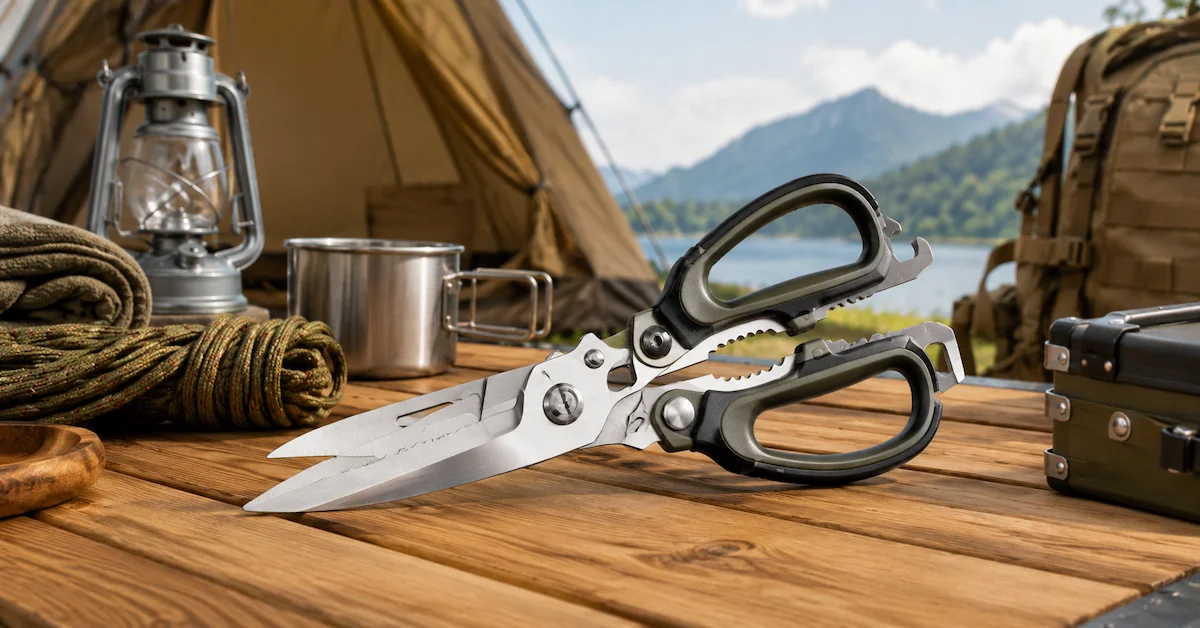
Camping scissors sit between household scissors and heavier utility shears. They should be compact enough for a kit, pack, or retail bundle, but strong enough to feel dependable in outdoor use. Based on the product image, the tool includes metal blades with a silver-toned finish, finger-loop handles, a pivot joint, and a serrated section near the inner cutting area. Those visible details suggest a design intended for grip on tougher or slippery materials, though exact material grades and performance limits must be confirmed by the supplier.
Common use cases include cutting paracord, trimming packaging, opening sealed bags, cutting tape, slicing light fabric, and handling small campsite cleanup tasks. Some buyers may include this type of product in emergency kits, survival assortments, fishing or hiking gear, or general outdoor accessory packs. Each channel has different expectations. A low-cost giveaway item does not need the same construction as a branded utility accessory sold beside knives, multitools, or repair kits.
Supplier Evaluation Checklist
Before discussing volume pricing, buyers should compare suppliers on practical product and service points. The table below can be used during sample review or supplier qualification.
| Check Point | What to Review | Questions to Ask the Supplier |
|---|---|---|
| Blade design | Edge alignment, serrated section, tip shape, cutting feel | What is the blade material and how is the edge finished? |
| Pivot stability | Smooth movement without looseness or excessive stiffness | How is pivot tightness controlled during production? |
| Handle comfort | Finger space, grip texture, molding quality, hand fit | What handle material is used, and can colors be customized? |
| Outdoor suitability | Resistance to moisture, dirt, and rough storage conditions | What finish or treatment is used, if any, and what are its limits? |
| Packaging | Retail card, pouch, kit packaging, labeling, carton protection | Which packaging options are available for wholesale or OEM orders? |
| Consistency | Sample-to-bulk match, blade finish, handle color, cutting action | What inspection steps are used before shipment? |
Blade, Grip, and Pivot Details That Matter
The blade is the main value point in camping scissors, but it should not be judged by appearance alone. A shiny or satin finish does not prove corrosion resistance, and a serrated section does not guarantee clean cutting. Ask the supplier to identify the blade material, production method, edge treatment, and any finishing process. If the product will be sold for damp or humid outdoor environments, ask how the supplier describes corrosion resistance and what care instructions should be given to users.
Grip design is equally important. The pictured scissors show larger finger-loop handles with dark and gray molded sections. That type of handle may provide better control than thin office-style loops, but comfort depends on hand size, surface texture, molding quality, and balance. Sample testing should include repeated cuts, not just one demonstration cut.
The pivot is often where low-quality scissors fail first. If it is too loose, the blades can separate and tear material instead of cutting cleanly. If it is too tight, the user has to apply unnecessary force. During sourcing, open and close each sample several dozen times, cut different materials, and check whether the pivot feel changes.
How to Compare Camping Scissors Suppliers
A general scissors factory may be able to produce a similar-looking item, but outdoor utility buyers should look for a supplier that can discuss use conditions clearly. The best sourcing conversation is specific: what will the scissors cut, where will they be stored, what packaging will protect them, and what type of customer will use them?
When comparing a camping scissors manufacturer with a broader utility tool supplier, consider these points:
- Category experience: Has the supplier worked with outdoor, kit, utility, or private-label accessory programs?
- Material transparency: Can the supplier state blade and handle materials clearly, without vague wording?
- Sample reliability: Do multiple samples perform consistently, or does cutting feel vary from piece to piece?
- Customization scope: Can the supplier explain options for handle color, logo placement, packaging, or carton setup?
- Quality control: What inspections are performed on blade alignment, pivot action, appearance, and packing?
A lower quote may be acceptable for a basic promotional item, but it can create problems for a branded retail line if the product feels inconsistent. For camping scissors wholesale orders, repeatability is often more important than adding extra features.
Common Sourcing Mistakes to Avoid
One common mistake is testing the scissors only on paper. Paper can hide problems that appear when cutting cord, tape, woven straps, or plastic packaging. If your target customer will use the scissors around camp gear, test those materials before approving a sample.
Another mistake is assuming that more features make a better product. Extra hooks, tabs, notches, or decorative elements may look useful in a product photo, but they can add cost or confusion if they are not durable or clearly explained. Ask whether each feature solves a real user problem.
Buyers should also avoid making unsupported marketing claims. Do not describe the scissors as food-safe, marine-grade, heavy-duty, rustproof, or certified unless the supplier provides suitable evidence and your team verifies that the claim fits your sales market. For missing details, turn the claim into a supplier question instead.
Sample Testing Plan for Buyers
A simple testing plan can reveal whether a sample is ready for further negotiation. Use the same materials and scoring method for each supplier so comparisons are fair.
- Cut paracord or similar cord several times and check for slipping or fraying.
- Cut packaging tape and observe whether adhesive buildup affects performance.
- Cut thin plastic packaging, light fabric, and cardboard from typical retail or camping supplies.
- Open and close the scissors repeatedly to check pivot smoothness.
- Inspect blade alignment, handle molding, burrs, finish consistency, and packaging protection.
- Record comments from left- and right-handed users if the product will be sold broadly.
This process does not replace formal compliance or performance testing where required, but it helps sourcing teams identify obvious weaknesses before placing larger orders.
Questions to Ask Before Placing an Order
Before confirming a production run, request a written specification sheet or equivalent product details. Ask the supplier to confirm blade material, handle material, pivot construction, dimensions, weight, finish, packaging type, carton configuration, and available customization options. If your program needs branding, ask about logo methods, artwork requirements, sample approval steps, and whether branding affects lead time or cost.
Commercial details should also be clarified directly. Ask about MOQ, lead time, sample charges, packaging charges, payment terms, quality inspection process, and how defects or shipment issues are handled. If the product is intended for a regulated market or a specific retail channel, ask what documentation is available and verify it independently before making claims.
FAQ for Outdoor Utility Buyers
Are camping scissors different from household scissors?
Usually, yes. Camping scissors are generally selected for more varied utility tasks, while household scissors may be designed mainly for paper, light packaging, or kitchen-drawer use. The exact difference depends on the supplier’s specification.
Can camping scissors be used for food preparation?
Do not assume that. Food-contact suitability depends on materials, finish, intended use, and market requirements. Ask the supplier directly and request supporting documentation if food use will be claimed.
What is the most important quality point?
Blade alignment and pivot stability are critical because they directly affect cutting performance. Handle comfort and material finish also matter for outdoor usability.
Should buyers choose the cheapest supplier?
Not automatically. Low price can work for basic programs, but outdoor retail buyers should compare sample performance, batch consistency, packaging quality, and supplier communication before deciding.
Using This Guide in Your Next Sourcing Project
Start with a clear product role: compact kit scissors, general campsite utility scissors, or a branded private-label accessory. Then compare suppliers on confirmed specifications, sample performance, customization options, and quality control rather than appearance alone. A practical camping scissors supplier should be able to explain what the tool is designed to do, what it is not designed to do, and which details need confirmation before bulk production. That conversation helps buyers reduce risk and build a product that matches real outdoor use.
