




Custom Kitchen Knife Set Manufacturer: What Buyers Should Know
Choosing a custom kitchen knife set manufacturer is different from buying a ready-made knife set from a catalog. For a retail brand, hospitality supplier, promotional buyer, or private-label program, the product has to work as a complete system: knives, handles, block, packaging, user experience, and commercial positioning all need to match.
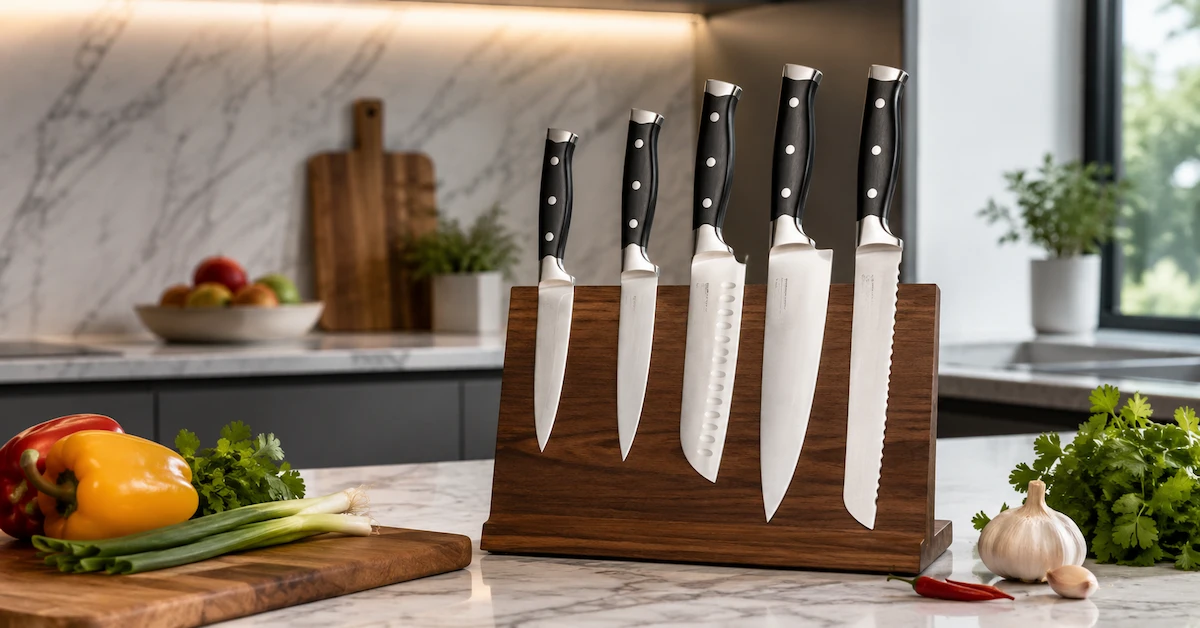
The product style shown here is a five-piece kitchen knife set displayed in a wooden block. The visible assortment appears to cover common kitchen tasks such as chopping, slicing, trimming, carving, and bread cutting. That makes it a practical format for buyers who want a compact set rather than a large, complicated assortment.
Key Takeaways
- A good OEM knife set should be evaluated as a full product, not only by blade appearance.
- The five-piece block format can suit retail, gifting, apartment kitchens, and selected hospitality use.
- Buyers should confirm steel grade, handle structure, block dimensions, packaging, and care instructions with the supplier.
- Sample testing should include real kitchen use, repeated block insertion, and packaging review.
Why Buyers Source Custom Kitchen Knife Sets
Many buyers start looking for a custom kitchen knife set manufacturer when standard wholesale sets do not fit their brand or target price point. A private-label program may need a specific handle color, logo placement, block finish, carton design, or blade mix. A hospitality buyer may care more about practical durability and easy replacement. A gift program may focus on presentation and compact packaging.
The challenge is that the end customer judges the set quickly. If the knives feel unbalanced, the block takes too much counter space, or the assortment includes redundant pieces, the product may disappoint even if each knife looks acceptable in a photo. For that reason, sourcing teams should define the use case before discussing customization.
What the Five-Piece Block Format Offers
The visible set includes five knives held vertically in a slanted wooden block. From the image, the lineup appears to include a chef-style knife, a serrated bread knife, a longer slicing or carving knife, a Santoku or vegetable-style knife with indentations, and a smaller utility or paring-style knife. Buyers should verify the exact knife names and dimensions with the supplier before ordering.
This type of assortment is popular because it covers frequent food preparation tasks without adding too many rarely used pieces. It is also easier to merchandise than a loose knife bundle because the block creates a complete countertop presentation.
Comparison Checklist for Sourcing Teams
When comparing manufacturers, buyers should look beyond the first quotation. The following checklist helps separate visual appeal from practical sourcing quality.
| Evaluation Area | What to Check | Questions to Ask the Supplier |
|---|---|---|
| Knife assortment | Blade types, overlap, and everyday usefulness | Can the knife mix be adjusted for our market? |
| Blade details | Steel grade, edge geometry, finish, and care guidance | What material data and production specifications can you provide? |
| Handle construction | Comfort, alignment, surface finish, and attachment method | Can you provide drawings or a section sample if full-tang structure is claimed? |
| Wooden block | Slot fit, stability, footprint, and surface finish | What are the block dimensions and how are slots matched to blades? |
| Packaging | Retail display, protection in transit, labeling, and instructions | Can packaging be tested with the final block and knives inside? |
Manufacturing Details That Affect Quality
Knife set manufacturing involves many small decisions. Blade forming, polishing, edge finishing, handle assembly, block production, inspection, and packing all affect the final product. A good-looking sample can still fail if the knives rattle inside the block, if handles are unevenly finished, or if the packaging does not protect the set in shipment.
The blades in the image appear to be polished silver-colored metal, and stainless steel is common in kitchen knives. However, buyers should not assume the exact grade, hardness, heat treatment, corrosion behavior, or edge retention unless those details are provided by the manufacturer. The same applies to the black handles with metal rivet-like dots: the appearance suggests a traditional style, but it does not prove a specific internal construction.
For OEM and private-label projects, request written specifications and keep them attached to the approved sample. If performance claims, compliance requirements, or market-specific labeling rules matter to your program, ask the supplier what documentation is available instead of relying on generic product descriptions.
Why the Wooden Block Deserves Attention
The wooden block is not just an accessory. It influences retail presentation, kitchen storage, user convenience, and perceived completeness. A block set is easier for a consumer to understand than five separate knives, especially when the intended market includes home kitchens or gift buyers.
At the same time, the block can create problems if it is treated as an afterthought. Buyers should check whether each slot matches its knife, whether the set remains stable when one or two knives are removed, and whether the angle makes daily use comfortable. A compact footprint is useful, but the base still needs to feel secure on a countertop.
How to Request and Review Samples
Before requesting samples from a custom kitchen knife set manufacturer, prepare a short but clear brief. Include the target user, preferred knife count, block style, handle appearance, packaging needs, logo or labeling expectations, and target retail channel. Avoid asking for too many changes at once without deciding which details are essential.
- Confirm the proposed knife list and intended function of each blade.
- Ask for exact blade, handle, block, and packaging specifications.
- Inspect the sample visually for finish consistency and assembly alignment.
- Use the knives for real tasks such as slicing bread, chopping vegetables, and trimming ingredients.
- Insert and remove each knife repeatedly to test block fit.
- Review carton strength, user instructions, labeling space, and protection during transport.
If the supplier sends a hand-finished showroom sample, ask whether mass production will follow the same process and materials. Production consistency is often more important than one impressive sample.
Common Sourcing Mistakes to Avoid
One common mistake is approving a knife set by image alone. Photos do not reveal edge quality, balance, handle comfort, slot tolerance, or packaging protection. Another mistake is adding more knives simply to make the set look higher value. A larger set may raise cost, increase weight, and confuse end users if the extra pieces are not genuinely useful.
Buyers should also avoid vague customization requests such as “premium handle” or “better steel” without measurable specifications. Instead, ask the manufacturer what options are available and what trade-offs each option creates in cost, lead time, care requirements, and user experience.
Who This Product Style Fits Best
A five-piece wooden block knife set can work well for retail kitchenware brands, private-label assortments, corporate or seasonal gifts, apartment kitchen packages, and selected hospitality programs where a compact set is preferred. It is less suited to buyers looking for highly specialized professional chef tools unless the specifications are developed in more detail.
For most B2B sourcing teams, the best approach is to start with the customer use case, then choose the blade mix, then confirm materials and packaging. This sequence helps prevent a visually attractive set from becoming a poor fit for the sales channel.
Practical FAQ
Can this type of knife set be used for private label?
Yes, the five-piece block format is suitable for private label because it offers clear presentation and practical everyday use. Buyers should confirm available logo, packaging, and finish options with the manufacturer.
Is a five-piece knife set enough for most home users?
For many households, a well-selected five-piece set can cover common preparation tasks. The key is avoiding duplicate blade functions and including knives people actually use.
What details should buyers verify before placing an order?
Ask for steel grade, blade dimensions, handle material, handle construction, block dimensions, packaging details, care instructions, and any available test or inspection documentation.
Should the block be tested during sampling?
Yes. Check slot fit, stability, countertop footprint, surface finish, and ease of removing and returning each knife. Poor block design can damage the user experience.
What is the best next step with a manufacturer?
Send a clear sourcing brief and request samples that reflect the intended production version. Compare suppliers using written specifications, actual kitchen testing, and packaging review rather than quotation price alone.
