




How to Customize Scissors for Private Label
If you are launching a new scissors brand or adding scissors to an existing kitchenware, household, sewing, or stationery product line, private label customization can give you more control over product positioning, appearance, packaging, and customer experience.
But customizing scissors is more than adding a logo to an existing model.
A successful private label project starts with understanding how to customize scissors for private label, then connects product selection, blade performance, handle design, materials, colors, branding, packaging, quality control, and production into one specification.
For B2B buyers, the goal is not simply to find a factory that can print a logo. The better question is:
Can the supplier turn your product concept into a consistent, retail-ready scissors product that can be reproduced across future orders?
BONET HOUSEWARE provides OEM/ODM services for scissors and kitchenware, with customization covering product development, materials, colors, logo applications, surface treatments, packaging, and production support.Its current scissors portfolio includes kitchen, household, tailor, sewing, stationery, school, and other scissors. (BONET HOUSEWARE)
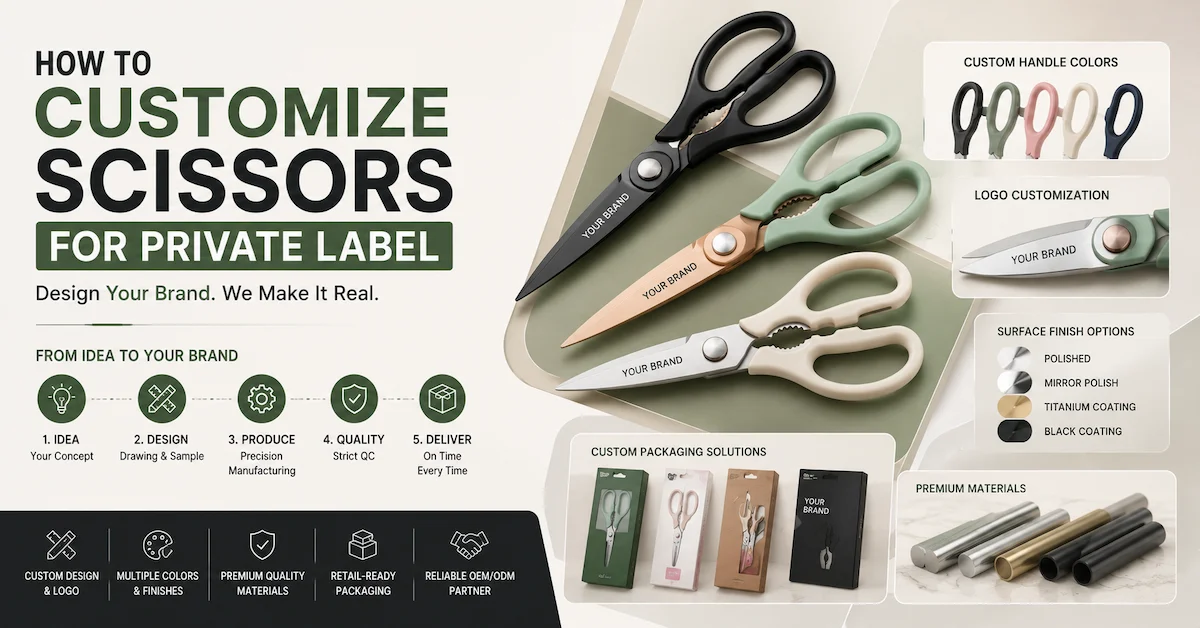
What Can You Customize on Private Label Scissors?
Private label scissors can usually be customized at several levels.
| Customization Area | Typical Options | Commercial Purpose |
|---|---|---|
| Scissors Type | Kitchen, household, sewing, tailor, stationery | Match target market |
| Size | Different lengths and proportions | Match user/application |
| Blade | Profile, finish, cutting configuration | Product performance |
| Handle | Shape, material, color, grip | Ergonomics and branding |
| Surface | Polished, matte, coated or other finishes | Visual differentiation |
| Logo | Printing, laser engraving | Brand recognition |
| Packaging | Retail box, blister, gift packaging | Shelf and e-commerce presentation |
| Labels | Barcode, product information, brand labels | Retail requirements |
| Product Set | Scissors with complementary tools | Increase assortment value |
Not every option is suitable for every scissors model. The final specification should therefore be confirmed during product development and sampling.
Step 1: Choose the Right Scissors Category
Before discussing colors or logos, decide what type of scissors you are actually selling.
This is the foundation of private label customization.
Kitchen Scissors
Kitchen scissors are suitable for food preparation and general kitchen tasks.
Depending on the model, features may include:
- Stainless-steel blades
- Ergonomic handles
- Serrated sections
- Multifunctional features
- Bottle openers
- Nutcrackers
- Detachable construction
- Protective storage
For a kitchenware brand, these features can help create different product tiers.
Household Scissors
Household scissors can serve general cutting, DIY, crafts, packaging, and everyday home applications.
Customization often focuses on:
- Handle comfort
- Size
- Color
- Surface treatment
- Packaging
- Brand presentation
Tailor and Sewing Scissors
For sewing and fabric applications, product performance becomes especially important.
Buyers should consider:
- Fabric type
- Cutting frequency
- Blade configuration
- Handle ergonomics
- Product size
- Professional vs. consumer positioning
BONET's current scissors range includes tailor and sewing scissors in different designs and finishes. (BONET Tailor Scissors)
Stationery and School Scissors
Stationery and school products require a different design strategy.
For children's or school-oriented products, buyers should pay particular attention to intended age group, handle design, tip configuration, packaging, labeling, and applicable destination-market requirements.
Step 2: Define Your Target Customer
The same scissors can be positioned very differently depending on the buyer.
For example:
| Target Customer | Preferred Product Direction |
|---|---|
| Kitchenware Brand | Kitchen scissors and multifunctional designs |
| Supermarket | Retail-ready, easy-to-merchandise products |
| E-commerce Seller | Distinctive design and strong product presentation |
| Sewing Brand | Fabric and tailor scissors |
| Stationery Brand | Household,stationery or school scissors |
| Gift Brand | Decorative designs and premium packaging |
| Distributor | Broad product range and consistent supply |
| Private Label Startup | Existing platform + controlled customization |
This is why product development should begin with the market rather than the factory catalog.
Ask:
Who will buy the scissors?
Then:
What problem does the product solve for that customer?
Then:
Which design, material, function, and packaging decisions support that positioning?
Step 3: Define the Product Specification
A professional private label project should have a written product brief before production.
At minimum, include:
- Product category
- Product dimensions
- Blade configuration
- Handle design
- Handle material
- Product color
- Surface finish
- Logo position
- Logo method
- Packaging type
- Packaging artwork
- Barcode requirements
- Label requirements
- Intended application
- Quality requirements
This document becomes the reference for quotation, sampling, approval, and mass production.
A vague requirement such as:
“We need high-quality black kitchen scissors.”
creates unnecessary room for interpretation.
A better specification explains exactly what the supplier needs to reproduce.
Step 4: Select Blade and Handle Materials
Material selection should follow product positioning and application.
BONET's OEM/ODM information identifies stainless steel, silicone, plastic, wood, bamboo, aluminum alloy, and composite materials among its material capabilities. (BONET OEM/ODM)
Blade Material
For scissors, buyers should confirm:
- Exact material
- Blade construction
- Surface treatment
- Intended application
- Cutting requirements
- Corrosion considerations
Do not choose a steel grade simply because it sounds premium.
The appropriate material depends on the intended product, manufacturing process, cost target, and market requirements.
If a particular steel grade or hardness is commercially important, include it in the product specification and request confirmation from the supplier.
Handle Material
The handle affects both appearance and user experience.
Potential considerations include:
- Grip shape
- Finger-loop size
- Surface texture
- Material
- Color
- Weight balance
- Injection-molded construction
- Soft-touch areas
For frequently used scissors, ergonomic design can become an important selling point.
Step 5: Customize the Handle Design and Color
The handle is often the most visible part of a private label scissors product.
A brand can differentiate the same basic scissors through:
- Handle geometry
- Color combinations
- Surface texture
- Brand placement
- Material selection
- Decorative elements
For retail products, color can also help create a product family.
For example:
Black → Professional
Pastel → Lifestyle / Home
Bright colors → Value / Family
Metallic finishes → Premium
These are positioning examples rather than fixed market rules. The actual color strategy should be based on your target market and existing brand identity.
BONET's OEM/ODM service supports color customization and surface-treatment development for private-label projects.(BONET OEM/ODM)
Step 6: Decide How to Apply Your Logo
Logo placement should be considered during product design, not after manufacturing.
Possible branding methods include:
Laser Engraving
Useful when a durable, understated brand mark is desired.
Printing
Suitable for designs requiring visible colors or specific artwork.
Mold-Based Branding
For certain plastic handles, branding can potentially be integrated into the molded component, depending on the product design and tooling requirements.
Packaging Branding
Even when product branding is minimal, packaging can provide a strong private-label identity.
Before production, confirm:
- Logo dimensions
- Position
- Artwork format
- Printing method
- Color requirements
- Minimum logo size
- Surface compatibility
Always approve a physical sample before mass production.
Step 7: Customize the Surface Finish
Surface treatment can significantly change how the product looks on a retail shelf.
Depending on the product, buyers may consider:
- Polished finish
- Matte finish
- Brushed finish
- Coated finish
- Decorative finishes
The purpose should be clear.
A finish can support:
appearance + differentiation + perceived product positioning.
However, buyers should also confirm whether the selected finish is appropriate for the intended application and cleaning environment.
Step 8: Develop Retail-Ready Packaging
For private-label scissors, packaging is part of the product.
This is particularly important when selling through:
- Supermarkets
- Retail chains
- Home stores
- Gift stores
- E-commerce
- Distributors
Packaging may include:
- Retail boxes
- Blister packaging
- Hang tags
- Gift boxes
- Barcode labels
- Product information
- Instructions
- Export cartons
BONET's OEM/ODM capabilities include customized packaging, labels, barcodes, and retail/export packaging solutions. (BONET OEM/ODM)
For e-commerce, packaging should also protect the product during transportation while maintaining a professional unboxing experience.
Step 9: Request Samples Before Mass Production
Never treat a quotation as the final product.
The sample stage should confirm whether the supplier has correctly understood your specification.
Check:
Product
- Dimensions
- Weight
- Blade alignment
- Cutting performance
- Handle comfort
- Product appearance
Branding
- Logo position
- Logo size
- Color accuracy
- Surface finish
Packaging
- Artwork
- Product protection
- Barcode
- Labels
- Retail presentation
A sample approval process should create a clear reference for future production.
Step 10: Build Quality Control Into the Specification
Quality control should not be an afterthought.
For private-label scissors, define the quality requirements before mass production.
A practical QC framework can include:
Material → Dimensions → Appearance → Assembly → Function → Branding → Packaging → Quantity
BONET's manufacturing process includes stamping, straight adjustment, heat treatment, rough grinding, water grinding, polishing, plastic injection, ultrasonic cleaning, assembly, quality checking, final cleaning/anti-rust treatment, and packing. (BONET Manufacturing)
This production-chain approach is particularly useful for private-label buyers because multiple processes can influence the final product.
How the Private Label Scissors Production Process Works
A typical project can follow this workflow:
1.Requirement Communication
Share:
- Target market
- Product category
- Design references
- Expected quantity
- Material requirements
- Branding
- Packaging requirements
2. Product Selection or Development
Choose an existing model or discuss modifications.
For ODM projects, the supplier can also support concept development, sample development, structural optimization, material recommendations, feasibility assessment, surface treatment, and packaging development.
3. Sampling
Develop and review the physical sample.
4.Quotation and Confirmation
Confirm:
- Product specification
- Customization
- Packaging
- MOQ
- Pricing
- Production schedule
- Commercial terms
5. Mass Production
Manufacturing follows the approved specification and sample.
6. Quality Inspection
Inspect the finished products against agreed requirements.
7. Packaging and Delivery
Complete retail/export packaging and arrange delivery according to the agreed shipping plan.
This six-stage workflow aligns with the OEM/ODM cooperation process presented by BONET. (BONET OEM/ODM)
Private Label Scissors: Existing Model or Custom Design?
One of the biggest decisions is whether to modify an existing product or develop a new design.
| Approach | Existing Model | Custom Development |
|---|---|---|
| Development Speed | Faster | Longer |
| Initial Development Cost | Usually lower | Potentially higher |
| Design Flexibility | Moderate | Higher |
| Product Differentiation | Moderate | Higher |
| Tooling Requirements | May be limited | May be required |
| Suitable For | New brands / testing | Established brands / unique products |
Choose an Existing Model When
You want to:
- Launch quickly
- Test a market
- Control development costs
- Use a proven product platform
- Focus on branding and packaging
Consider Custom Development When
You need:
- A unique handle
- A new functional structure
- A proprietary appearance
- A specific product dimension
- Stronger product differentiation
- A longer-term product platform
The right choice depends on your budget, timeline, sales channel, and business strategy.
How to Choose a Private Label Scissors Manufacturer
A supplier should be evaluated across the complete production chain.
Use this checklist:
Product Capability
- Does the supplier manufacture your scissors category?
- Does it offer multiple product options?
- Can it support product modifications?
Manufacturing Capability
- Can it handle the required production processes?
- Does it have suitable production and QC procedures?
- Can it support repeat orders?
Customization
- Can the handle be customized?
- Can colors be changed?
- Can logos be printed or engraved?
- Can packaging be customized?
Quality
- Can you approve samples?
- Are inspection procedures defined?
- Can specifications be documented?
Commercial
- Is MOQ suitable for your business?
- Are pricing and packaging costs clear?
- Is the production schedule realistic?
Communication
- Does the supplier understand your specification?
- Can it provide clear technical information?
- Is production follow-up organized?
A supplier that checks only the price box may not be the best long-term partner.
Why BONET Is Relevant for Private Label Scissors
BONET combines scissors manufacturing with a broader kitchenware product portfolio.
The company's current OEM/ODM offering covers scissors, kitchen knives, kitchen tools, cutting boards, kitchen gadgets, and multifunctional kitchenware, allowing B2B buyers to develop multiple related product categories through one manufacturing partner. (BONET OEM/ODM)
Its manufacturing operation in Yangjiang covers multiple production stages from metal forming and heat treatment to grinding, polishing, injection molding, assembly, inspection, and packaging. (BONET Manufacturing)
BONET also identifies ISO9001, BSCI, and Sedex among its company credentials and describes the factory as operating under a 6S management system. (BONET About Us)
For private-label buyers, the important point is that customization is connected to manufacturing rather than treated as a separate logo-printing service.
What Information Should You Send When Requesting a Quote?
To receive a useful quotation, provide as much of the following as possible:
Product Type: Kitchen / Household / Sewing / Tailor / Stationery / Other
Target Market: Country or region
Sales Channel: Supermarket / Retail / Amazon / Distributor / Brand Store
Estimated Quantity: Initial and expected repeat orders
Product Reference: Existing model, drawing, photo,or sample
Material: Required material if known
Color: Pantone or other reference where applicable
Logo: Artwork and preferred application method
Packaging: Retail box / blister / gift box / other
Barcode: Required or not
Quality Requirements: Product-specific requirements
Delivery: Required destination and target timing
A clear product brief allows the supplier to evaluate feasibility rather than simply provide a generic price.
Common Mistakes When Customizing Private Label Scissors
Focusing Only on the Logo
A logo does not make a product differentiated.
Better approach: customize the product experience, packaging, and positioning together.
Choosing the Cheapest Product
A low initial price may create downstream problems through inconsistent quality, weak packaging, or high defect rates.
Better approach: compare total sourcing value.
Skipping the Sample
Without a physical sample, you cannot properly evaluate cutting performance, ergonomics, appearance, or packaging.
Better approach: approve a production reference sample.
Giving Vague Requirements
“Premium scissors” is not a technical specification.
Better approach: create a written product brief.
Ignoring the Sales Channel
A product designed for a supermarket shelf may need different packaging from one sold through an e-commerce marketplace.
Better approach: develop the product and packaging around the actual sales channel.
Making Unsupported Compliance Claims
Do not assume that a product is food-contact compliant, dishwasher safe, BPA-free, or suitable for a specific market without the appropriate product documentation.
Better approach: request and verify the relevant documentation for the exact model.
FAQ
How do I customize scissors for private label?
Start by selecting the scissors category and target market, then define the product specification, materials, handle design, colors, logo, surface treatment, and packaging. Request a sample, approve the specification, and then proceed to mass production and quality inspection.
Can I customize the color of private label scissors?
Yes, color customization can be discussed for private-label scissors. The available options depend on the product structure, handle material, finish, production process, and order requirements.
Can I put my own logo on scissors?
Yes. Depending on the product, branding may be applied through printing, laser engraving, molded branding, or packaging.The exact method should be confirmed during product development.
Can I customize the handle design?
Potentially. Existing products can sometimes be modified, while completely new handle structures may require additional development or tooling. A supplier should assess feasibility before production.
Can I customize scissors packaging?
Yes. Private-label scissors can be developed with customized retail packaging, labels, barcodes, gift packaging, and export cartons depending on the project requirements.
Should I use an existing scissors model or develop a new one?
Use an existing model when speed and development cost are priorities. Consider custom development when you need unique functionality, structure, or stronger product differentiation.
What should I check in a scissors sample?
Check dimensions, blade alignment, cutting performance, handle comfort, materials, surface finish, logo quality, packaging, and overall consistency with your approved specification.
What is the difference between OEM and ODM scissors?
OEM generally means manufacturing according to the buyer's design, drawings, samples, or specifications. ODM can involve supplier-supported product development, including concept development, structural optimization, material recommendations, sampling, and packaging development.
How do I choose a private label scissors supplier?
Evaluate product capability, manufacturing processes, customization, sample quality, QC procedures, packaging capability, commercial terms, communication, and long-term supply reliability rather than comparing unit prices alone.
Can BONET customize scissors for my brand?
BONET's current OEM/ODM service supports scissors customization, including product development, materials, colors, logo applications, surface treatments, and packaging. The exact options should be confirmed for the selected scissors model and project. (BONET OEM/ODM)
Conclusion
Learning how to customize scissors for private label starts with understanding that private labeling is a complete product-development process.
The strongest projects connect:
Product Category → Target Customer → Design → Materials → Handle → Branding → Packaging → Sampling → QC → Mass Production
For a simple market test, an existing scissors model with customized colors, branding, and packaging may be the most efficient approach.
For an established brand seeking stronger differentiation, OEM/ODM development can provide more control over product structure, materials, functionality, appearance, and packaging.
BONET's combination of scissors manufacturing, kitchenware production, OEM/ODM development, customization, quality management, and packaging support makes it a potential manufacturing partner for brands, wholesalers, retailers, supermarkets, distributors, and e-commerce businesses developing private-label scissors. (BONET HOUSEWARE)
If you already have a scissors design, sample, reference image, or packaging concept, the next step is to turn those requirements into a clear product specification for sampling and quotation.
Related BONET pages:
