




Cutting Board Manufacturer Guide: How to Choose the Right Supplier
Choosing a cutting board manufacturer is not only about finding a simple kitchen item at a workable cost. For retailers, hospitality buyers, private-label teams, and wholesale sourcing managers, the supplier behind the board affects finish quality, product consistency, packaging decisions, and customer satisfaction after repeated use.
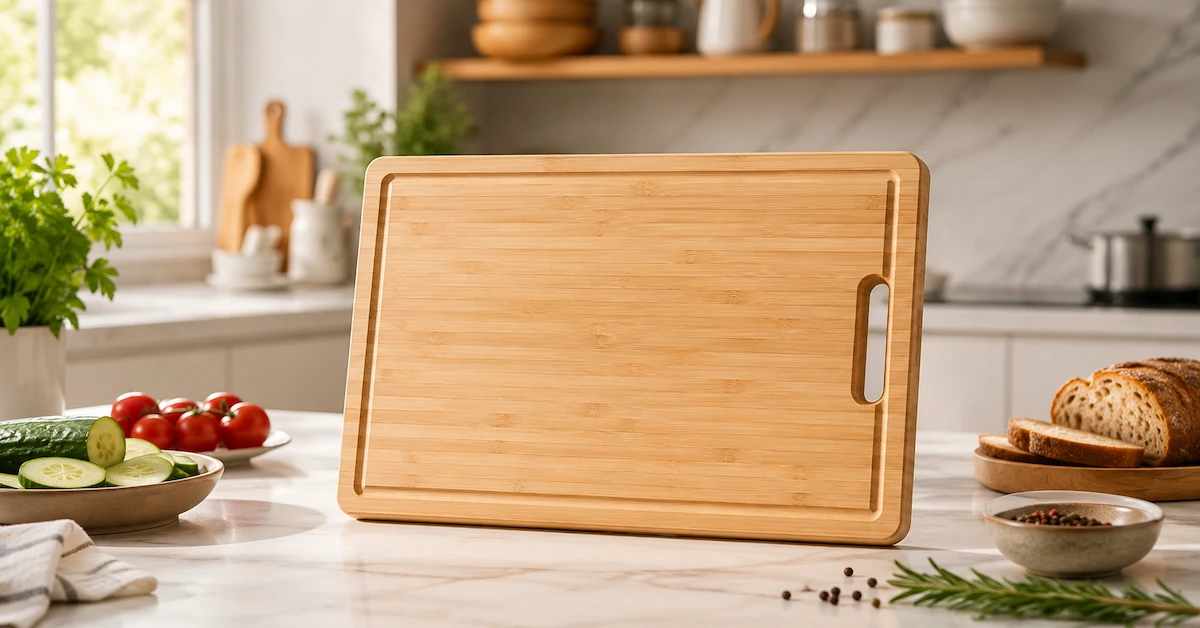
The board shown here is a rectangular kitchen cutting board with a light natural wood appearance, a perimeter groove, rounded corners, and an oval handhold cutout on one side. The visible strip pattern suggests bamboo or a similar laminated wood construction, but buyers should confirm the exact material with the supplier before using that claim in product copy or packaging. These design details make the product suitable for everyday preparation and potentially for serving, but only if the manufacturing and finishing are controlled well.
Key Takeaways
- Confirm material identity before describing a board as bamboo, wood, or engineered wood.
- Evaluate the groove, handhold, corners, and surface finish as functional details, not decoration.
- Ask how the supplier controls sanding, finishing, and batch-to-batch appearance.
- Compare several samples, not just one presentation piece.
- Care instructions and packaging claims should be based on verified supplier information.
Why Supplier Selection Matters for Cutting Boards
A cutting board can look uncomplicated on a sourcing sheet, yet still create problems if the manufacturer does not control the details. Warping, uneven sanding, rough edges, inconsistent color tone, shallow grooves, and unclear material claims can all affect how the product performs in retail or food-service use.
For B2B buyers, the main risk is assuming that a good-looking sample automatically means reliable production. Laminated wood-style boards can vary in tone, grain pattern, machining quality, and finish feel. Some variation is natural and acceptable, but the supplier should be able to explain what level of variation is normal and what is considered a defect.
What This Board Is Designed to Do
The visible design suggests a board intended for everyday kitchen preparation with possible use as a serving piece. The flat working area supports cutting bread, vegetables, fruit, herbs, and other general prep items. The raised groove around the edge is useful when ingredients release light moisture, helping reduce spills onto the counter.
The oval handhold is also practical. It makes the board easier to lift from a counter, carry between prep and serving areas, or hang where suitable. This is especially helpful in smaller kitchens, restaurant stations, or retail displays where easy handling and storage can influence user experience.
Because the board has a clean natural appearance, buyers may position it for home kitchens, hospitality presentation, or giftable kitchenware ranges. That wider use case increases the importance of visual consistency. A board used for serving is judged not only by how it cuts, but also by how it looks on a table or shelf.
Material and Finish Questions to Ask
The source image shows a strip-laminated, light-colored board. It may be bamboo or a similar engineered wood, but appearance alone is not enough for a verified product claim. Buyers should ask the supplier for a plain-language material description and confirm whether the board is solid wood, laminated bamboo, bamboo-like engineered wood, or another construction.
Finish quality is equally important. Ask what finish is applied, how it is applied, and what care instructions the supplier recommends. Do not assume dishwasher suitability, stain resistance, or specific food-contact performance unless the supplier provides documented support for those claims. If you plan to sell the product under a private label, request wording that can be used safely for packaging and product pages.
Design Features Buyers Should Inspect
Small design choices strongly affect everyday use. Rounded corners make the board more comfortable to handle and reduce sharp-feeling edges. A cleanly machined groove can help contain light juices. A well-positioned handhold improves carrying without taking too much usable cutting area away from the board.
When reviewing samples, inspect more than the top surface. Look at the underside, edges, groove walls, and the inside of the handhold. These areas often reveal whether sanding and machining are consistent. A board that feels smooth on the top but rough inside the handle may disappoint customers quickly.
Comparison Checklist for Supplier Evaluation
| Evaluation Area | What to Check | Questions for the Supplier |
|---|---|---|
| Material claim | Confirmed wood, bamboo, or engineered construction | What exact material description should appear on packaging? |
| Surface finish | Smooth feel, even appearance, no rough patches | What finish is used and what care guidance is recommended? |
| Groove design | Clean milling, useful depth, no splintering | Is the groove decorative or designed for liquid containment? |
| Handhold | Comfortable cutout, smooth inner edge | How is the handle cut and finished during production? |
| Batch consistency | Similar color tone, shape, and edge quality across samples | What variation is acceptable in mass production? |
| Packaging and care | Protection from scratches, clear user instructions | Can the supplier provide recommended care wording? |
How to Review Samples Before Ordering
One sample is useful, but it is not enough to judge a cutting board supplier. Request multiple pieces when possible and compare them side by side. Check whether the board sits flat, whether the groove is clean across the full perimeter, and whether the handhold feels comfortable from both sides.
- Inspect the top, underside, edges, corners, groove, and handle cutout.
- Compare color tone and lamination pattern across several samples.
- Run a hand over the surface to detect rough sanding or uneven finish.
- Place the board on a flat surface to check stability.
- Ask for written confirmation of material, finish, care guidance, and packaging options.
If the board is intended for retail, also test how it looks in packaging or on a shelf. If it is intended for hospitality or food-service supply, focus more heavily on handling, storage, and cleaning guidance. Different channels may require the same product to meet different expectations.
Common Sourcing Mistakes to Avoid
A frequent mistake is treating all wooden or bamboo-style boards as interchangeable. Similar-looking boards can perform differently depending on material construction, adhesive system, machining, sanding, and finish. Buyers should not rely only on appearance or price when comparing suppliers.
Another mistake is making claims before verification. Terms such as bamboo, food-safe finish, sustainable material, dishwasher safe, or premium grade should not be used unless the supplier can support them. If details are not confirmed, phrase them as internal questions during sourcing rather than public product claims.
Buyers also sometimes overlook packaging. A smooth board can still arrive scratched or dry-looking if bulk packing is not appropriate. Ask how boards are protected during shipment and whether individual packaging, sleeves, labels, or care cards are available. Avoid assuming any commercial option, MOQ, or price until the supplier confirms it.
Practical FAQ for Sourcing Teams
Can this board be used for both prep and serving?
Yes, the flat work surface, perimeter groove, natural look, and handhold make it suitable for both use cases in principle. Buyers should still confirm finish quality and care instructions before deciding how to position it.
Should it be called a bamboo cutting board?
Only if the supplier confirms that the material is bamboo. The visible pattern suggests a bamboo-like or laminated wood construction, but product descriptions should be based on verified information.
What makes a cutting board manufacturer reliable?
A reliable supplier should provide clear material disclosure, consistent machining, smooth finishing, practical packaging guidance, and realistic answers about production variation. A polished sample is a starting point, not proof of long-term consistency.
What should private-label buyers request first?
Ask for samples, material confirmation, finish details, care instructions, packaging options, and expected appearance variation. If you need custom branding, ask what customization methods are available rather than assuming laser engraving, labels, or packaging changes are included.
Next Step for Product Teams
If this board fits your retail, hospitality, wholesale, or OEM program, the next step is to request supplier confirmation and compare samples against your target use case. Focus on the features that end users will notice: surface feel, stability, groove function, handle comfort, edge smoothness, and appearance consistency. A qualified cutting board manufacturer should be able to answer these questions clearly before you commit to a broader sourcing plan.
