




Egg Beater Manufacturer Guide: What Buyers Should Look For
Choosing an egg beater manufacturer is not only about finding a low-cost kitchen utensil. For importers, wholesalers, private-label brands, and catalog buyers, the real goal is to source a manual tool that turns smoothly, feels stable in the hand, and arrives with consistent build quality from one batch to the next. A manual egg beater is a simple product, but small differences in gear alignment, wire shape, frame stiffness, and finishing can noticeably change the user experience.
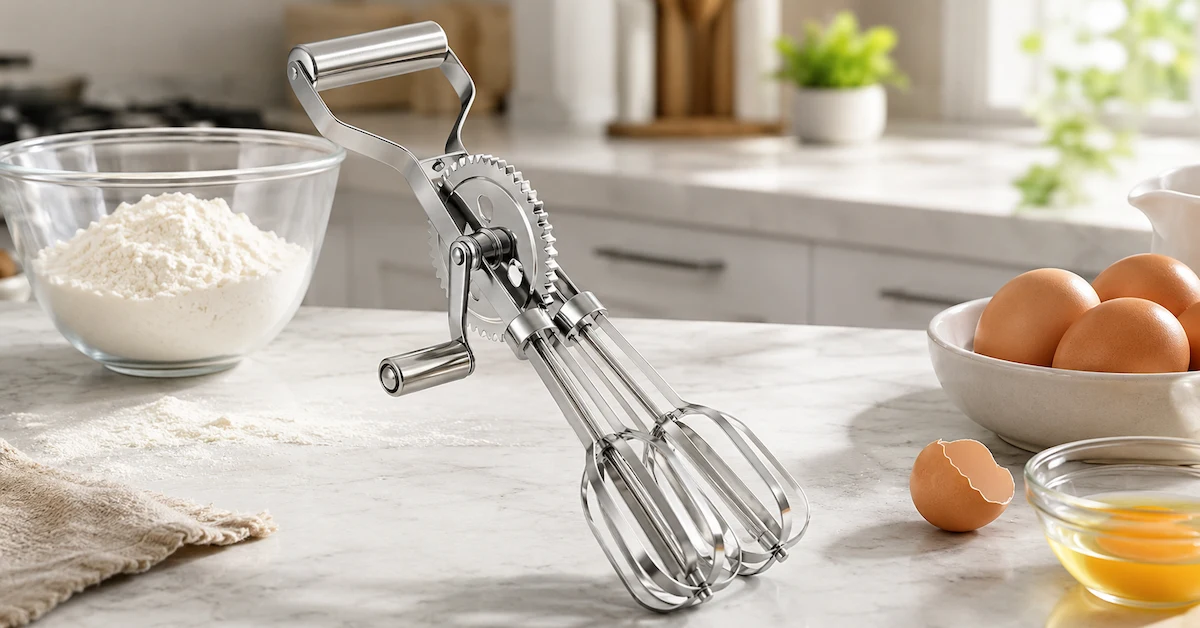
The product shown is a hand-crank egg beater with a metal frame, exposed gear mechanism, top grip, side crank, and twin wire whisk heads. It is intended for light kitchen mixing tasks such as beating eggs, blending thin batters, or mixing sauces. It is not a substitute for an electric mixer, and buyers should position it accordingly.
Key Takeaways
- Prioritize smooth gear action, stable assembly, and consistent whisk alignment over cosmetic appearance alone.
- Ask the supplier to confirm the exact metal, surface finish, joining method, and cleaning guidance.
- Test multiple samples, not just one showroom piece, before approving a production order.
- Match the product to small-batch mixing use cases rather than heavy dough or high-volume preparation.
Why the Mechanism Matters
A manual egg beater works by transferring motion from a side crank through gears to two rotating wire whisk heads. This gear-driven action gives more agitation than a plain hand whisk while keeping the product compact and fully manual. The design is useful where electricity is unnecessary, inconvenient, or excessive for the task.
Because the mechanism is exposed to repeated turning, quality depends on alignment and assembly control. If the gear engagement is rough, the crank may feel sticky or noisy. If the frame flexes, the whisk heads may wobble. If the joints are weak, the beater may work well at first but loosen after regular use. A capable egg beater factory should be able to explain how it controls these points during production and inspection.
Material and Construction Questions to Ask
The visible product appears to use metal construction with wire whisk loops and a polished or chrome-like surface. However, buyers should not assume an exact grade, coating, or finish from an image. Similar-looking egg beaters can be made with different base metals, coatings, and joining methods, which may affect corrosion resistance, cleaning performance, and long-term appearance.
Before placing an order, ask the supplier for clear answers to these questions:
- What metal is used for the frame, gear, crank, handle parts, and whisk wires?
- Is the surface polished, plated, coated, or finished by another process?
- How are the wire whisk heads formed and secured?
- What method is used for the pivot points, rivets, or joints?
- What cleaning and storage instructions should be provided to end users?
These questions do not require exaggerated claims. They help buyers understand whether the supplier knows the product in practical manufacturing terms.
Supplier Evaluation Checklist
When comparing an egg beater supplier, use hands-on testing as well as document review. A catalog image can show the silhouette, but it cannot show crank resistance, gear feel, or sample-to-sample consistency.
| Evaluation area | What to check | Why it matters |
|---|---|---|
| Gear action | Turn the crank slowly and quickly; listen for scraping or binding. | Smooth movement is central to user satisfaction. |
| Frame stiffness | Apply light pressure to the handle and frame. | Flex can reduce efficiency and cause wobble. |
| Whisk alignment | Compare both wire cages from several angles. | Uneven loops may rotate poorly or feel unbalanced. |
| Finish quality | Inspect edges, surface marks, and coating consistency. | Kitchen tools must tolerate frequent handling and washing. |
| Batch consistency | Test several samples, not one selected unit. | Variation is often the real sourcing risk. |
Common Sourcing Mistakes
One frequent mistake is treating every manual egg beater as interchangeable. Two models may look nearly identical but perform very differently once the crank is turned. A shiny finish may photograph well, but it does not prove that the gear system is well aligned or that the joints will remain tight.
Another mistake is focusing too narrowly on unit price. For wholesale and retail programs, returns, complaints, bent wires, and inconsistent motion can cost more than a slightly better-built product. Buyers should also avoid over-promising the product’s capability. A hand-crank egg beater is best for eggs, thin mixtures, and light batters. It should not be marketed as a heavy-duty mixer unless the supplier can substantiate that claim with appropriate evidence.
Trial Order and Quality Review Tips
Before moving to a larger purchase, request samples from the same production route intended for your order. If possible, compare several units side by side. Look for differences in crank feel, wire shape, gear noise, surface marks, and packaging protection. A practical trial order should answer whether the supplier can repeat the same quality, not just produce one acceptable sample.
For B2B buyers, it is also useful to ask how the factory handles inspection before packing. Questions may include: Are units turned by hand during inspection? Are bent whisk wires rejected? Are sharp edges checked? How is the surface protected during transit? Do cartons prevent the crank or wire heads from being crushed? These are basic process questions, but they reveal whether the supplier treats the utensil as a finished product rather than a generic metal item.
Where Manual Egg Beaters Fit in the Market
Manual egg beaters remain relevant for home kitchens, compact baking kits, camping assortments, and simple food-preparation tasks where electricity is not needed. They also work as practical add-on items in kitchenware ranges. Their value is portability, simplicity, and predictable light mixing performance.
For brands and distributors, the category can be useful when expectations are clear. The product does not need complicated feature claims. It needs reliable movement, safe handling, reasonable cleaning guidance, and consistent presentation. In this category, disciplined manufacturing is more important than novelty.
Practical FAQ
Is a manual egg beater still worth sourcing?
Yes, if your market needs a simple hand-powered tool for eggs, sauces, and light batters. It is most suitable for small-batch household or compact kitchen use.
What should buyers check first?
Start with the crank and gear action. If the mechanism feels rough, loose, or misaligned, the product is unlikely to satisfy end users even if the finish looks attractive.
Can buyers judge quality from photos?
Only partially. Photos can show the design, but they cannot confirm metal grade, gear smoothness, joining strength, or production consistency.
What commercial details should be confirmed with the supplier?
Ask about material specifications, sample availability, order quantities, packaging options, inspection methods, lead time, and any compliance documents required for your market.
Final Sourcing Advice
A good egg beater manufacturer should be able to discuss materials, assembly, finishing, and inspection in clear practical language. Buyers should avoid relying on appearance alone and instead test how the product performs in the hand. For a simple utensil, the best sourcing decision often comes from a simple process: compare multiple samples, ask specific manufacturing questions, document the accepted standard, and approve production only when the supplier can repeat it.
