








What a good egg beater manufacturer really has to deliver
When buyers search for an egg beater manufacturer, they are usually not shopping for novelty. They are trying to solve a simple production problem: how to source a manual whisking tool that feels solid in the hand, turns smoothly under load, and survives ordinary kitchen use without the mechanism loosening or the finish looking tired after a short run. For sourcing managers, the decision is less about the concept of a hand-crank whisk and more about consistency, materials, assembly quality, and whether the supplier can build a product that behaves the same way from batch to batch.
The manual egg beater still has a place in modern kitchens. It is useful where electricity is unnecessary, inconvenient, or simply overkill for small tasks like beating eggs, whipping a light batter, or mixing a sauce. That makes the category small, but not trivial. A buyer who treats it as a commodity item often ends up with noisy gears, loose rivets, or wire beaters that deform too easily. A better approach is to understand how the product is built and what separates a capable egg beater supplier from a seller of generic utensils.
What this product is, and why the mechanism matters
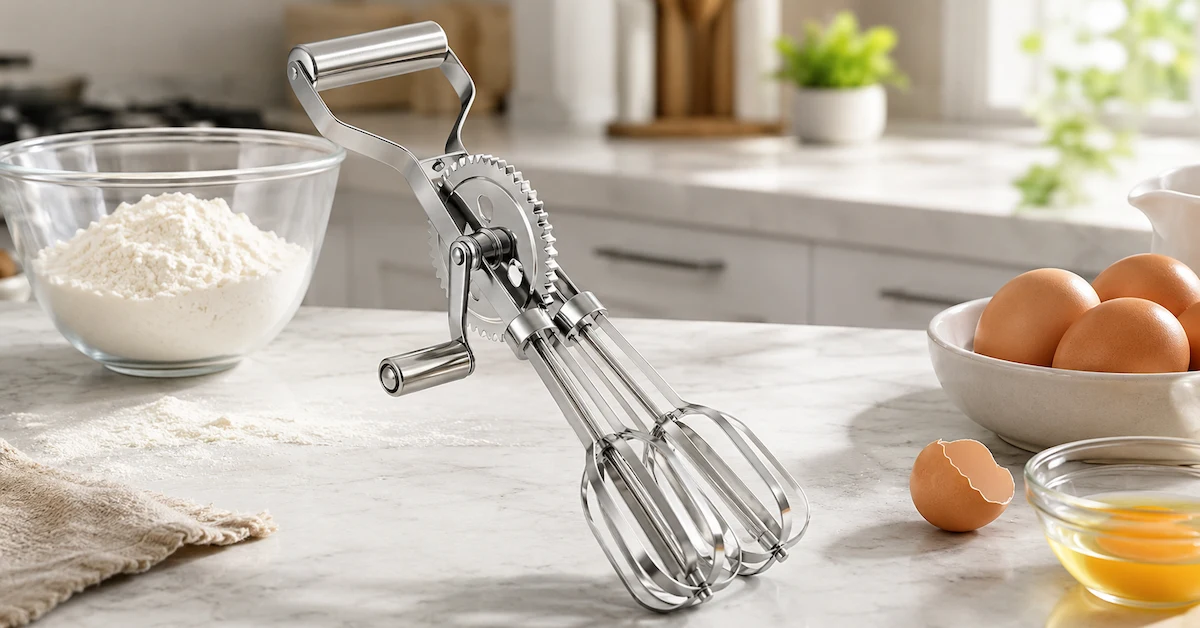
The visible product category here is a manual egg beater, sometimes described as a hand-crank whisk. The working principle is straightforward: a side crank drives a gear mechanism that rotates twin wire whisk heads inside a narrow frame. That gear-driven action gives the user more agitation than a plain whisk for a given effort, while keeping the tool compact and fully manual. In practice, that means the beater is most useful for light-to-moderate mixing jobs rather than heavy dough or dense batters.
That sounds simple, but the mechanism is where quality lives or dies. If the gear engagement is rough, the crank feels sticky. If the frame flexes, the whisk heads wobble and the motion becomes inefficient. If the joints are weak, the tool may work fine on day one and then begin to rattle after repeated use. A buyer evaluating an egg beater factory should pay close attention to how the drive system is assembled, not just how the product looks in a photo.
Quick buyer takeaways
Before getting into details, a short practical view helps.
Look for a manual whisk that balances three things: smooth turning, sturdy construction, and a finish that is appropriate for kitchen contact and cleaning. The product visible here appears to be an all-metal design with a polished or chrome-like surface, a top grip, an exposed spur gear, and twin rotating whisk cages made from wire loops. Those features are common in this category because they support durability and keep the tool compact.
What is not visible matters just as much. You still need to confirm the exact metal grade, whether the surface treatment holds up in washing, how the joints are secured, and whether the motion remains aligned under repeated use. Those are the details that separate a promising sample from a reliable production item.
Material and construction: where suppliers often differ
From the product information available, the body and wire whisk heads appear to be stainless steel or chrome-plated metal, though the exact alloy cannot be verified here. That uncertainty is common in early sourcing discussions, and it is worth handling carefully. Many manual kitchen tools can look similar on a page while being made from noticeably different base metals or coatings underneath.
For buyers, the practical issue is not only appearance. Stainless steel and plated metal can behave differently in corrosion resistance, hand feel, and long-term finish retention. If the product is intended for repeated kitchen use, the supplier should be able to explain what parts are formed from sheet metal, what parts are wire-bent, and how the assembly is joined. A clean-looking frame is not enough if the crank housing or riveted joints are weak points.
Likely manufacturing steps
Based on the visible geometry, the product likely involves metal forming, stamping or cutting, wire bending, and mechanical assembly of gears and joints. That is a fairly classic utensil manufacturing route. It is also the kind of route where small process changes can affect the final feel of the tool. For example, slightly inconsistent wire loops may still rotate, but they may not track evenly. Likewise, a gear set with uneven finishing can create a gritty cranking feel that customers notice immediately.
A practical aside: buyers sometimes focus on the whisk heads and ignore the handle geometry. That is a mistake. In a manual tool, comfort and leverage affect usability as much as the mixing action itself. If the top grip and side crank do not sit naturally in the hand, the product becomes a shelf item rather than a working utensil.
How to evaluate an egg beater supplier
The best supplier conversations are specific. If you are sourcing from an egg beater supplier, ask how they control assembly alignment, what finishing steps are used on the metal surface, and how they inspect the gear-driven motion before packing. Even simple kitchen utensils benefit from process discipline. A supplier that cannot describe those steps clearly may still be able to ship product, but the risk profile is higher than many buyers want.
It also helps to ask for sample variation across multiple units, not just one display sample. Manual tools can be deceptive in a single specimen. One sample may feel smooth because it was assembled unusually well, while the next dozen show more drag or a looser crank. For a product like this, consistency matters more than dramatic specifications.
Questions buyers should not skip
Ask what metal is used for the frame and whisk loops, how surface finish is achieved, and whether the mechanism is intended for light batter work or more general kitchen mixing. If a supplier makes performance claims, request the basis for those claims rather than accepting them at face value. Also confirm whether the product has any care instructions that affect use in a commercial or home setting. Even without exact certification data, those answers reveal how seriously the manufacturer treats the utensil as a finished product.
Common sourcing mistakes with manual egg beaters
One common mistake is treating the whole category as interchangeable. It is not. Two products can have a similar silhouette and very different user experience. Another mistake is judging only by the polished finish. Reflective metal looks good in photos, but a shiny surface does not guarantee a durable gear assembly or a comfortable crank.
Buyers also sometimes overfocus on price and underweight repairability or replacement risk. That may be acceptable for a low-value household item, but if you are building a retail assortment or supplying hospitality customers, failures create returns and noise in the supply chain. A low-cost manual beater that rattles, binds, or arrives with bent wire heads will cost more in the end than a better-built unit.
There is another subtle issue: fit for use case. A manual egg beater is not meant to replace an electric mixer. If your buyer brief calls for whipping thick creams or high-volume bakery prep, this is the wrong tool. The right conversation is about small-batch, low-power, countertop mixing tasks. Matching the product to the application avoids disappointment later.
Selection criteria for B2B buyers
If you are narrowing supplier options, keep the evaluation grounded in practical features rather than marketing language.
First, examine the mechanical feel. The crank should rotate with manageable resistance and without obvious scraping. Second, inspect the structural stiffness of the frame; any flex in the housing can undermine whisking performance. Third, review the consistency of the wire whisk heads. Their shape, symmetry, and spacing affect how the tool moves through eggs or light batter. Fourth, ask about finish quality, since a kitchen tool must tolerate frequent handling and cleaning without quickly looking worn.
For importers and private-label teams, packaging and presentation matter too, but they should come after mechanical quality. A well-presented utensil with a poor mechanism will not hold up with end users. On the other hand, a plain-looking tool with good geometry and stable assembly can perform well in value channels.
Where this type of product fits in the market
Manual egg beaters are often purchased for home kitchens, compact baking setups, camping kits, or environments where a powered mixer is unnecessary. They also fit smaller food-prep tasks in settings where simplicity is valued over speed. In those cases, the product’s appeal is low dependence on power, portability, and predictable function.
That makes the category attractive for catalog sellers and kitchenware brands looking for practical add-ons. It is not a headline product, but it can be a useful line item if the construction is dependable and the supply is stable. For that reason, the manufacturer’s ability to repeat the same build quality matters more than elaborate feature claims.
FAQ for sourcing teams
Is a manual egg beater still relevant?
Yes, for small-batch mixing and everyday kitchen use where a powered mixer is unnecessary. Its value is simplicity, not speed.
What should buyers verify first?
Verify the mechanism, the metal construction, the finish, and the consistency across samples. Those four areas usually determine user satisfaction.
Can appearance be trusted as a quality indicator?
Only partly. A polished surface is helpful, but hidden assembly quality and gear alignment are more important.
What to ask before placing a trial order
If you are moving from sample to purchase, request a small production lot and compare units side by side. Check the crank feel, inspect the joints, and look for any variation in wire shape or finish. It is also sensible to confirm basic care expectations, because kitchen tools live or die on how easily they can be cleaned and stored.
For a product as simple as a manual egg beater, the sourcing decision often comes down to whether the factory treats simplicity with discipline. The best manufacturers understand that a small utensil must still feel engineered. If you are vetting an egg beater factory, that is the standard to keep in view.
Next step for buyers
Shortlist suppliers that can explain their materials, assembly method, and inspection approach in plain language. Ask for samples, compare motion and finish, and do not let a clean catalog image substitute for real handling. In this category, a few minutes of mechanical testing can save a great deal of after-sale trouble.
