




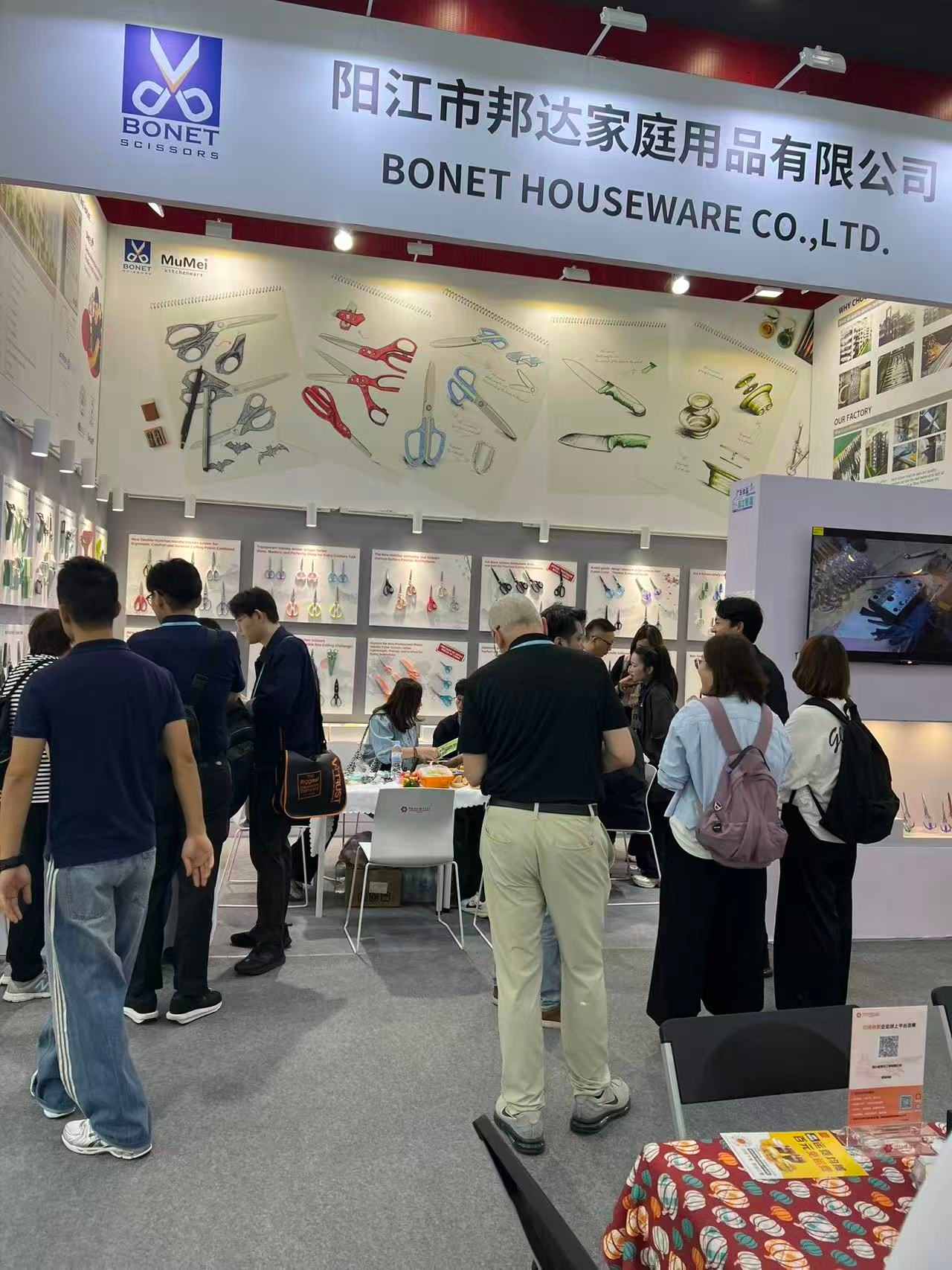
Experience Canton Fair 2025: Innovation in Trade
Canton Fair 2025 remains one of the most useful meeting points for global buyers who want to compare products, speak directly with suppliers, and understand where everyday houseware and tool categories are moving. For companies sourcing precision cutlery, scissors, and multifunctional tools, the fair is not only a product showcase. It is also a place to test assumptions, verify supplier communication, and collect the details needed for responsible purchasing decisions.
The original Bonet Houseware update described a busy fair atmosphere, international customer flow, and a display of precision cutlery and multifunctional tools. This expanded guide keeps that focus while adding practical sourcing advice for importers, wholesalers, distributors, and brand owners preparing for trade discussions.

Why Canton Fair 2025 Matters for Tool Buyers
Large trade fairs help buyers evaluate more than a catalog photo can show. When viewing scissors, kitchen tools, or multifunctional products in person, buyers can inspect weight, balance, grip shape, blade alignment, packaging presentation, and the consistency of samples across a display. These details often determine whether a product is suitable for retail shelves, promotional channels, e-commerce bundles, or professional use.
Canton Fair also creates a concentrated environment for comparing supplier responses. A capable supplier should be able to explain available product ranges, customization options, sample procedures, packaging choices, and quality control checkpoints. If some commercial details are not published, buyers should treat the meeting as an opportunity to ask clear questions rather than make assumptions.
What to Look for in Scissors, Cutlery, and Multifunctional Tools
The original article highlighted ergonomic scissors, stainless steel blades, and a focus on comfort, control, sharpness, and corrosion resistance. Buyers should still verify these points with samples, documents, and direct discussion. Words such as ergonomic, durable, or corrosion resistant can mean different things across markets, so they should be translated into measurable requirements whenever possible.
- Check whether the handle shape suits the intended user group, such as household, school, office, craft, or kitchen users.
- Open and close scissors repeatedly to assess smoothness, blade contact, and hand comfort.
- Ask what blade material is used and whether the supplier can provide material information for the exact model ordered.
- Review edge finishing, tip alignment, pivot stability, and surface finish on multiple samples.
- Discuss packaging structure, carton strength, labeling needs, and barcode or language requirements.
For multifunctional tools, buyers should also test each function individually. A tool with several features is only useful if each function performs reliably and safely for the target application.
Supplier Questions to Ask at the Booth
A trade fair meeting is most productive when buyers arrive with a prepared question list. Instead of asking only for a price, focus on the conditions that affect long-term supply, repeat orders, and market suitability. Bonet Houseware’s fair presence can be used as a starting point for a practical sourcing conversation about product fit and cooperation process.
- Which product models are standard items, and which require customization?
- What sample options are available, and how long does sample preparation usually take?
- What materials are used for the blades, handles, and accessories in the specific models being discussed?
- What packaging formats can be supported for wholesale, retail, or e-commerce channels?
- What quality checks are normally performed before shipment?
- Can the supplier support buyer-specific labeling, instructions, or outer carton marks?
- What information is needed to quote accurately, such as quantity, packaging, destination, and customization details?
If certifications, compliance reports, or test results are required for your market, ask the supplier which documents are available for the exact product and production batch. Do not assume that one document applies to every model.
Comparison Checklist for Fair Evaluation
Buyers often visit many booths in one day. A simple checklist helps prevent decisions from being based only on booth design or first impressions.
| Evaluation Area | What to Check | Buyer Note |
|---|---|---|
| Product handling | Grip comfort, balance, opening and closing movement | Test several samples, not only one display piece. |
| Blade and finish | Alignment, edge consistency, surface treatment, visible defects | Ask what material and finishing process apply to the quoted model. |
| Packaging | Retail appeal, protection, carton strength, labeling space | Confirm whether packaging shown is standard or customized. |
| Communication | Clarity of answers, follow-up speed, technical understanding | Strong communication reduces order risk. |
| Commercial terms | MOQ, lead time, payment terms, sample cost, shipment options | Request written confirmation after the meeting. |
How Innovation Should Be Evaluated
Innovation at a trade fair can include new materials, improved handles, updated color palettes, better packaging, or more efficient multifunctional designs. However, buyers should evaluate innovation through market needs. A bright color or unusual shape may attract attention, but the product still needs to solve a real user problem, fit the target price range, and meet channel requirements.
For scissors and cutlery categories, practical innovation often appears in small details: a more comfortable grip, smoother cutting action, safer packaging, clearer usage instructions, or a product range that supports multiple retail segments. These improvements may be more valuable than novelty alone.
Turning Fair Meetings into Reliable Sourcing Decisions
After Canton Fair 2025, the most important work happens in follow-up. Buyers should organize booth notes, photos, sample references, and quotation requests as soon as possible. When requesting a quote, include product model, quantity range, packaging requirements, destination market, and any customization needs. This helps the supplier provide a more accurate response and reduces back-and-forth communication.
Before confirming an order, review pre-production samples when appropriate and make sure written specifications match the product you approved at the fair. If you require market-specific compliance, request supporting documentation and confirm whether it relates to the exact product. A disciplined follow-up process turns the energy of the fair into a practical sourcing plan.
Key Takeaways
- Canton Fair 2025 is valuable for comparing products, suppliers, and communication quality in person.
- For scissors, cutlery, and multifunctional tools, test handling, finish, packaging, and consistency across samples.
- Ask suppliers direct questions about materials, customization, samples, quality checks, and commercial terms.
- Do not assume certifications, MOQ, lead times, or specifications; request written confirmation for your exact order.
FAQ: Sourcing Tools at Canton Fair 2025
What should I bring to a supplier meeting?
Bring your target product list, expected order quantity range, packaging requirements, destination market, and any branding or labeling needs. Photos of current products or competitor references can also make discussions clearer.
How can I judge scissors quality at the fair?
Test the cutting movement, grip comfort, blade alignment, pivot stability, and finish. If possible, compare several samples from the same supplier and ask whether the displayed sample matches normal production.
Should I discuss price first?
Price matters, but it should be discussed with specifications. A quote is only useful when material, size, packaging, quantity, customization, and delivery expectations are clear.
Can I confirm an order directly at the fair?
You can start negotiations at the fair, but it is usually safer to confirm details in writing afterward. Request samples, specifications, packaging details, and commercial terms before final approval.
What if required compliance documents are not available at the booth?
Ask the supplier to follow up with documents for the exact product model. If compliance is essential for your market, verify the documents before placing an order.
