








What a food prep board supplier needs to solve for buyers
Choosing a food prep board supplier is rarely about the board alone. Buyers are usually trying to fix a practical problem: keep prep areas organized, reduce cross-contamination risk, make ingredient handling faster, and get a product that holds up under repeated kitchen use without looking tired after a few weeks. If you source for retail, food service, or private label, the board is one of those low-drama items that can create high frustration when it is poorly specified.
A food prep board looks simple on the surface. Yet the details matter: the material, edge profile, handle opening, board size, surface finish, and even the color system can affect how the product performs in real kitchens. For sourcing teams, that means the right supplier is not just a vendor. It is a partner that can keep the design consistent, support the intended use case, and avoid the kind of vague claims that cause trouble later.
This article breaks down what buyers should look for in a food preparation board supplier, how board design affects use, and where sourcing mistakes usually begin.
Why the board design matters more than it first appears
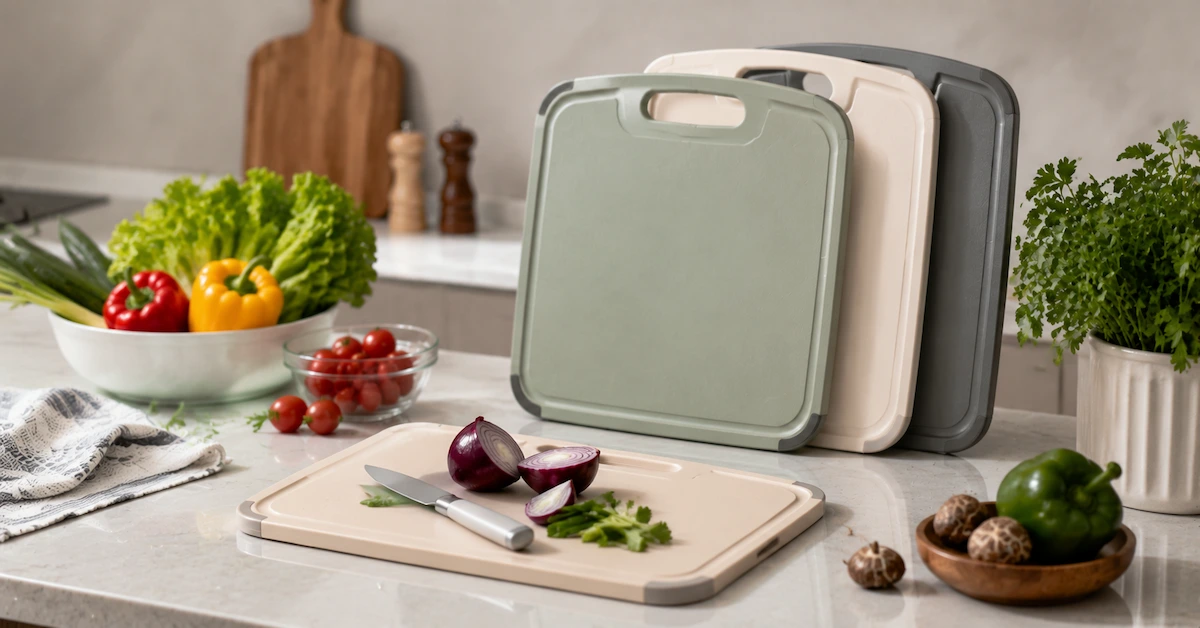
The boards described here are rectangular, with rounded corners, a matte smooth surface, and an integrated handhold near one end. A shallow perimeter edge is visible as well. Those are not decorative choices. They are the kinds of features that make a prep board easier to live with in an actual kitchen.
The rectangular format gives usable surface area for slicing, chopping, and staging ingredients. Rounded corners are a small but sensible detail because they reduce sharp edges and make the board feel less awkward when lifted or stored. The handle slot improves portability, especially when a cook needs to move prepped produce from counter to stove or sink area. The shallow lip or raised edge is useful for containing juices or keeping items from sliding, though it should never be oversold as a full spill barrier.
Color variation is another clue. Boards in muted tones such as sage green, beige, and dark gray suggest a set or a color-coded offering. For many buyers, that is a useful operational feature. Different colors can help separate prep tasks, organize ingredients, or support simple workflow distinctions in busy kitchens. In commercial settings, color coding can be especially helpful when teams need a visual system that is easy to follow at a glance.
What buyers should ask a food preparation board supplier
A serious buyer should not stop at “What material is it?” The answer may be incomplete or generic. Ask for the things that determine whether the board will work in your market.
Material and surface behavior
The boards in the supplied product information appear to be made from a matte, smooth, solid-board material that looks non-porous and easy to wipe clean. Exact material is not confirmed, and that matters. A supplier should be able to identify whether the board is plastic, composite, or another engineered material, and describe how that material behaves under repeated cutting, washing, and daily handling.
Buyers should also ask whether the board is intended to be gentle on knife edges, resistant to visible scoring, and suitable for repeated cleaning. Those are not minor points. A board can look attractive on day one and still disappoint if it develops deep cut marks too quickly or holds staining.
Construction and molding method
The visible geometry suggests a molded kitchenware product, possibly produced through injection molding or compression molding, though that cannot be confirmed from the image alone. For procurement, the important issue is consistency. A food prep board supplier should be able to produce boards that stay uniform in shape, surface quality, and edge detail across batches.
If the board includes a raised lip, buyers should confirm that the lip is functional enough to matter but not so tall that it interferes with scraping ingredients off the board. That balance is easy to miss in sample approval.
Handling, storage, and set presentation
The integrated handhold is a small feature with outsized value. It makes the board easier to lift, carry, and hang if the design supports that. For retail packaging, it also helps the product photograph well. Stackable or nestable boards can reduce shelf space and improve warehouse efficiency, but only if the supplier has designed the edges and thickness with storage in mind.
Quick comparison: what sourcing teams usually care about
When evaluating a cutting board supplier, buyers tend to compare a few practical variables rather than abstract promises.
Board format matters because a rectangular prep board gives more predictable working area than odd shapes. Surface finish matters because a matte, smooth board is usually easier to wipe down than a heavily textured one, though the exact cleanability depends on the material. Handle design matters because a slot or grip makes the board easier to move and less likely to be dropped. Color options matter because they support merchandising and workflow separation. A raised edge matters because it can contain light juices or keep chopped ingredients from wandering across the counter.
That is the basic trade-off: functionality, durability, and presentation. The best suppliers know how to keep those three in balance instead of overloading the product with features that look good in a catalog but feel awkward in use.
Common mistakes when sourcing prep boards
One frequent mistake is assuming all boards are interchangeable. They are not. A board intended for home kitchens may be perfectly acceptable for retail, but not durable enough for heavier prep routines. A board intended for light food service may be too plain for consumer packaging, where shelf appeal matters more.
Another mistake is specifying only dimensions and color. That is rarely enough. Buyers should also define the finish, edge profile, handle design, expected use environment, and whether the board is meant for individual use or as part of a multi-board set.
A third mistake is making hygiene assumptions without evidence. The product information suggests a non-porous, easy-to-wipe surface, but that is not the same as proven performance in a real kitchen. If hygiene is central to the buying decision, ask for material documentation and clear care guidance. Do not assume that a smooth-looking surface automatically solves sanitation issues.
Finally, do not ignore buyer perception. A board can be technically fine and still fail commercially if it feels flimsy, scratches too easily, or looks too generic next to competing products. In consumer channels, appearance often influences conversion more than sourcing teams like to admit.
How to evaluate samples without overcomplicating the process
A practical sample review does not need a lab to begin with. Start by handling the board as a user would. Does the handhold fit comfortably? Does the board feel balanced when lifted? Does the raised edge help in a real way, or does it just look like a feature? Are the corners and edges smooth enough to feel finished?
Then look at the surface under ordinary kitchen light. A matte finish can hide fingerprints better than a glossy one, but it may also show scuffs differently. Check whether the board sits flat and whether it feels stable during light cutting motions. If the set includes multiple colors, compare the consistency of the finish across each board. Mixed quality in a color set is a common sign that a supplier is better at making samples than production.
If possible, ask how the board is expected to be cleaned and stored. Even without exact dishwasher data or heat resistance claims, the supplier should be able to state the intended care method. If they cannot, that is usually a warning sign.
Selection criteria for different buyer types
For retail buyers, visual appeal and easy product explanation matter. Color-coded boards with a handle slot and clean rectangular shape are easy to merchandise and easy to photograph. The product should also communicate function without much education.
For food service or institutional buyers, the priority shifts. Cleanability, batch consistency, and workflow logic matter more than decorative detail. Multiple board colors can support task separation, but only if the supplier can keep shades consistent and the board format stable over time.
For private-label programs, the main question is how much customization the supplier can support. That may include color, packaging, logo placement, or size variants. Just be careful not to ask for too many cosmetic changes if the base product is still unproven.
What the product details suggest about use
Based on the supplied information, this looks like a kitchen prep board aimed at cutting, slicing, chopping, and ingredient organization. The visible features point to everyday food prep rather than heavy-duty butcher work. The board is likely meant for vegetables, fruit, and general countertop prep, with enough visual polish to serve in consumer kitchens and possibly light food service settings.
That is useful for sourcing because it sets expectations. A supplier offering this type of board should be able to speak clearly about daily handling, compact storage, and the needs of routine prep work. If they start describing it like a high-spec industrial surface, they may be overselling the product.
FAQ for sourcing teams
Is a color-coded board set worth considering?
Usually yes, if your market values organization or visual separation of tasks. It is also attractive for retail packaging because it looks like a complete set, even when the buyer starts with a single kitchen need.
Should we specify a handle slot?
If portability matters, yes. The handle slot makes the board easier to move and may improve perceived usability. If the board is meant for fixed countertop use only, it becomes less important.
What should we avoid claiming without proof?
Avoid exact material claims, dishwasher safety, heat resistance, antimicrobial properties, or certifications unless the supplier has provided them in writing. Those are the details that create trouble if they are implied but not verified.
Next step for buyers
If you are evaluating a food prep board supplier, focus on the basics that affect real kitchen use: material clarity, surface quality, handle design, edge behavior, and consistency across the set. The best supplier is not the one with the flashiest language. It is the one that can explain how the board is made, what it is meant to do, and where its limits are.
Start with a sample, ask for material specifics, and check whether the supplier can support the product as a real prep tool rather than just a nice-looking board. That usually tells you enough to decide whether the relationship is worth building.
