




Fruit Scooping Tool Supplier Guide for Buyers
Sourcing a fruit scooping tool supplier may look simple at first. The product is small, familiar, and easy to describe: a handheld utensil used to form round portions from melon, fruit, butter, or other soft foods. Yet for foodservice buyers, wholesalers, and private-label teams, small differences in design can affect prep speed, presentation, waste, and repeat customer satisfaction.
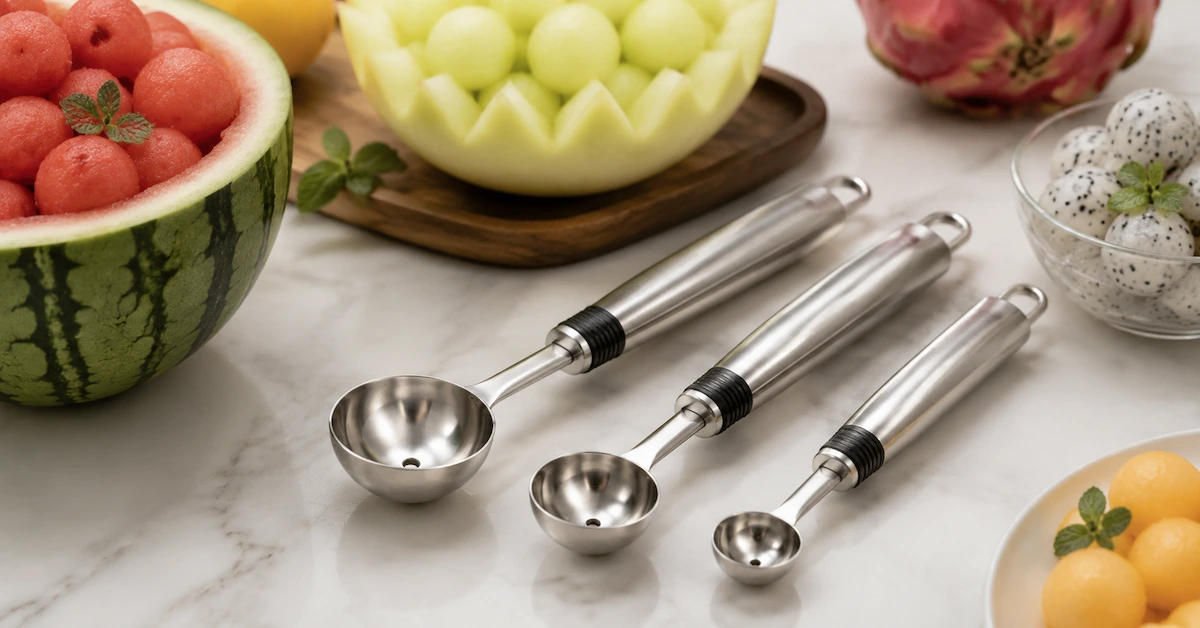
The visible product is a three-piece fruit scooping tool set with long straight handles, hemispherical scoop bowls, black ribbed grip areas near the head, hanging loops, and small holes in the bowls that appear intended to help release the scooped portion. These details make the set more than a basic kitchen gadget. For a catering team, dessert station, hotel buffet, or retail kitchenware assortment, the question is whether the supplier can provide a consistent, practical tool that matches the buyer’s channel and end use.
Key Takeaways
- Compare the actual scoop size range, not only the number of pieces in the set.
- Inspect the bowl edge, release hole, handle joint, grip texture, and hanging loop before committing to volume orders.
- Do not assume dishwasher safety, material grade, packaging, or compliance details unless the supplier confirms them in writing.
- For B2B sourcing, request samples and ask channel-specific questions for foodservice, retail, OEM, or wholesale use.
What the Fruit Scooping Tool Is Designed to Do
A fruit scooping tool is mainly used to create rounded portions from soft fruits such as melon. In professional settings, that can mean buffet trays, dessert cups, plated garnish, fruit salads, catering displays, or prep for beverage garnish. A neat fruit ball is not only decorative; it can help kitchens control portion appearance and serving consistency.
The three sizes shown in the set are useful because one bowl size rarely fits every application. A larger scoop may suit watermelon or cantaloupe portions. A medium scoop can work for fruit salads and dessert service. A smaller scoop is useful when the goal is fine garnish or tighter presentation. Buyers should confirm whether the supplier sells the three sizes as a set, as separate tools, or both.
Comparison Checklist for Supplier Evaluation
Before comparing price sheets, sourcing teams should compare the features that affect daily use. The table below provides a practical checklist for sample review and supplier discussion.
| What to Check | Why It Matters | Question to Ask the Supplier |
|---|---|---|
| Scoop size range | Determines portion variation and usefulness of the set | Are the three bowl sizes clearly different, and can dimensions be provided? |
| Release hole | May help fruit release more cleanly from the bowl | Is the hole included on all sizes, and is it finished smoothly? |
| Grip area | Affects control during wet or repetitive prep | What material is used for the black ribbed grip section? |
| Handle and joint | Weak joints can loosen during repeated use | Can close-up sample photos show the neck and handle connection? |
| Finish quality | Impacts appearance, cleanability, and retail presentation | Are edges, holes, and handle ends smooth on production samples? |
| Packaging format | Important for retail, wholesale, and storage | What packaging options are available, and what information can be printed? |
Material and Construction Questions to Clarify
The tools appear to be metallic and are described visually as having a stainless steel look, but buyers should not treat appearance as a complete specification. Ask the fruit scoop supplier to state the material details plainly, including whether the bowl, handle, grip area, and hanging loop use different materials. If a material grade, surface finish, or cleaning method is important to your market, request written confirmation rather than relying on a catalog image.
Construction is equally important. In simple utensils, the weak point is often the joint between the scoop head, neck, and handle. During sample inspection, check whether the head feels secure, whether the bowl edge is even, and whether the release hole is smooth. A small burr or rough edge can affect both handling and user perception.
Why Three Sizes Can Improve Commercial Use
A three-piece set gives kitchens and retail customers more flexibility than a single melon baller. The value is strongest when the sizes are meaningfully different. If the bowls are too similar, the set may look complete but offer limited practical benefit.
For foodservice, size variation can reduce improvisation. Staff can choose a larger scoop for high-volume fruit trays, a medium scoop for composed desserts, and a smaller scoop for garnish work. For retailers, a three-size set is easier to explain to consumers because it supports multiple uses in one package. For wholesalers, it can fit seasonal promotions, catering supply assortments, or kitchen tool bundles.
B2B Selection Criteria for Wholesale, Retail, and OEM Buyers
Different buying channels should evaluate the same tool differently. A restaurant supply buyer may care most about grip, repeat use, and easy storage. A retail buyer may focus on appearance, packaging clarity, and whether the set’s uses are easy for shoppers to understand. An OEM or private-label buyer may need artwork support, packaging structure, barcoding, master carton information, and documentation suitable for the target market.
Before placing a bulk order, define the end user and use environment. A hotel kitchen using the tools daily has different expectations from a giftable kitchenware set sold for occasional home use. Ask the supplier what information can be provided for samples, packaging, materials, cleaning guidance, and production consistency. If certifications, testing, or compliance documents are required for your sales channel, ask what is available instead of assuming.
Sample Review: A Practical Process
- Request samples of all three sizes, not only one representative tool.
- Check each scoop bowl for smooth edges, roundness, and a clean release hole.
- Hold the handle with wet hands to assess grip control and comfort.
- Inspect the joint between the head and handle for looseness or rough finishing.
- Test the tools on real fruit that matches the intended use, such as melon.
- Confirm packaging, labeling, and storage requirements before moving to purchase terms.
This process is faster than a long negotiation based only on price. It helps buyers separate a visually acceptable product from one that performs reliably in prep work or satisfies retail customers after purchase.
Common Buyer Mistakes to Avoid
One common mistake is assuming every fruit scooper behaves the same. Bowl profile, edge finish, handle length, and release hole design all influence the result. Another mistake is overvaluing the catalog photo. A shiny finish can look good online, but usability depends on how the tool feels during repeated motion.
Buyers also sometimes overlook storage. The hanging loop visible at the handle end can be useful in busy kitchens or on retail display hooks, but the buyer should confirm whether the loop is strong, smooth, and consistent across production. Finally, do not assume cleaning performance, corrosion resistance, or dishwasher suitability unless those details are supplied by the manufacturer or distributor.
FAQ
Is a three-piece fruit scooping tool set better than a single scoop?
For commercial and retail assortments, often yes. Three sizes can support different fruits, portions, and presentation styles. The key is confirming that the sizes are genuinely distinct.
Does the release hole in the scoop bowl matter?
It can. A small hole may help release soft fruit more cleanly, especially when forming melon balls. Buyers should inspect whether the hole is smooth and consistent.
What should I ask a fruit scooping tool supplier first?
Ask for material details, size information, sample availability, packaging options, cleaning guidance, and close-up photos of the bowl edge, release hole, and handle joint.
Can I assume the tool is dishwasher safe?
No. Dishwasher suitability should be confirmed by the supplier. Do not make cleaning or durability claims in retail materials unless they are supported by supplier documentation.
What matters most for wholesale sourcing?
Consistency matters most: consistent size, finish, grip feel, packaging, and supply communication. Price is important, but sample quality and clear specifications reduce purchasing risk.
Next Step for Sourcing Teams
If you are comparing fruit scooping tool suppliers, begin with a focused sample review and a short list of technical questions. Confirm the three sizes, inspect the grip and bowl geometry, and test the tools in the setting where they will actually be used. A good supplier should be able to answer practical questions without exaggerating unsupported claims. In this category, careful comparison turns a simple utensil into a more reliable sourcing decision.
