




Hollow Handle Knife Set Manufacturer: What Buyers Should Know
When buyers search for a hollow handle knife set manufacturer, they are usually looking for more than loose kitchen knives. They need a coordinated set that looks consistent, handles everyday cutting tasks, fits neatly into a storage block, and can be supplied with enough repeatability for retail, foodservice, wholesale, or private-label programs.
A knife set is harder to source than a single chef knife because every component affects the final impression. Blade shapes, handle balance, surface finish, block slot fit, packaging protection, and the visual alignment of the full set all need to work together. The hollow handle design adds another layer because its open or metal-look handle profile must be formed, finished, and attached cleanly.
Key Takeaways
- Evaluate the knife set as a complete product system, not only as individual blades.
- Ask the supplier to explain how the hollow handle is formed, attached, finished, and inspected.
- Confirm the included knife types, block material, packaging method, and sample approval process before ordering.
- Do not assume steel grade, certifications, MOQ, capacity, or performance claims unless the supplier provides written specifications.
What a Hollow Handle Knife Set Usually Includes
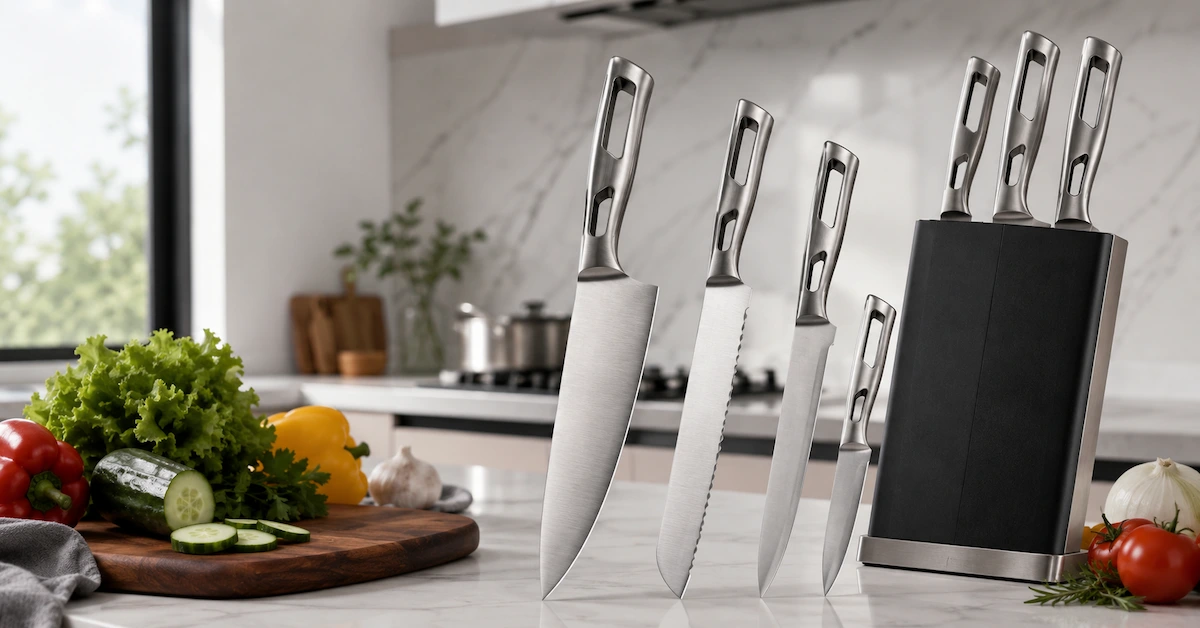
The product shown in the source appears to be a kitchen knife set with multiple stainless-looking blades, hollow or open metal-look handles, and a black countertop storage block. Visible pieces include at least five knives, such as a larger chef-style knife, a serrated utility or bread-style knife, a smaller paring-style knife, and other general-purpose cutting tools.
Because the exact knife count and material specifications are not fully confirmed in the original information, buyers should request a formal component list. For a retail or private-label listing, small uncertainties can become expensive later. A product page, carton label, and purchase order must all describe the same set configuration.
Why Hollow Handle Construction Matters
Hollow handle knives are often selected for their clean, modern appearance and lighter visual profile compared with traditional riveted or molded handles. For merchandising, this can help a set stand apart on a shelf or in online product photography. For end users, the handle shape may influence balance, grip comfort, cleaning, and perceived quality.
From a manufacturing perspective, hollow handle construction is less forgiving than it may appear. The handle shell, blade-to-handle transition, edges around the open space, and final surface finish are all visible to the buyer. Uneven seams, rough edges, inconsistent brushing, or poor alignment can make the whole set feel low quality even if the blades are acceptable.
A capable manufacturer should be able to discuss these points clearly. Buyers should ask whether the handle is fully metal, metal-look, or made with additional inserts. They should also ask how the supplier checks handle uniformity, blade alignment, and finishing consistency across different knife sizes.
Comparison Checklist for Supplier Evaluation
Use the following checklist when comparing a hollow handle knife set factory or supplier. The goal is not to accept marketing claims, but to identify which suppliers can give specific, verifiable answers.
| Evaluation Area | What to Check | Questions to Ask |
|---|---|---|
| Set configuration | Knife count, blade types, block included | Can you provide a complete component list with dimensions? |
| Handle construction | Formation method, attachment, edge finish | How is the hollow handle made and inspected? |
| Blade finish | Surface consistency, edge grinding, visible scratches | What material specification and finish options can you document? |
| Block fit | Slot alignment, retention, ease of removal | Is the block designed for this exact set or adapted from another model? |
| Packaging | Scuff protection, retail display, carton strength | How are blades and handles protected during shipping? |
| OEM readiness | Artwork, labeling, sample approval, change control | What customization details require written confirmation? |
Manufacturing Questions Buyers Should Ask
For OEM, wholesale, or private-label programs, the most useful supplier conversations are specific. Avoid asking only whether the supplier can make the product. Instead, ask how they control the details that affect repeat orders.
- What knife types are included in the standard set, and can the lineup be adjusted?
- What is the confirmed blade material specification?
- How is the hollow handle formed, attached, and finished?
- Are there any inserts, welds, seams, or bonding methods buyers should know about?
- How is each knife checked for alignment, edge condition, and appearance?
- What is the block material, and how is slot fit controlled?
- Can packaging be adapted for retail, e-commerce, or foodservice distribution?
- What information is needed for branding, labeling, or carton artwork?
If the supplier cannot answer these questions directly, that does not automatically mean they are unsuitable. However, it does mean the buyer should slow down and request samples, drawings, or written specifications before committing.
Sample Review: What to Inspect Before an Order
A sample should be treated as a working document, not just a visual approval. Inspect every knife in the set individually, then review the set as a complete unit in the block. Look for finish consistency between blades, smooth transitions where the handle meets the blade, and comfortable grip edges around the hollow section.
Also test the block fit. Each knife should enter and exit its slot without forcing, rattling excessively, or scraping the finish. If the block is too loose, the set may feel cheap. If it is too tight, users may damage blades or handles during normal use.
For retail programs, photograph the sample from multiple angles and compare it with the intended product imagery. For foodservice or catering use, focus more on handling comfort, storage convenience, cleaning access, and whether the included blade types match actual prep tasks.
Common Sourcing Mistakes
One common mistake is assuming all stainless-looking knives share the same construction. They do not. The original product image suggests stainless-looking blades and metal-look hollow handles, but buyers still need documented material and finish information.
Another mistake is treating the storage block as an accessory rather than a core part of the product. The block affects presentation, shipping durability, countertop safety, and user satisfaction. If a supplier uses a generic block not designed for the knife lineup, the final set can feel poorly engineered.
A third mistake is approving a single attractive photo instead of checking samples. Hollow handle designs can hide important details in images, including rough inner edges, uneven polish, or weak visual alignment between pieces.
Practical FAQ
Is a hollow handle knife set suitable for foodservice use?
It can be, but buyers should verify handling comfort, cleaning suitability, durability expectations, and replacement logic. A set designed mainly for retail presentation may not automatically match high-volume prep use.
Does a hollow handle always make the knife lighter?
Not necessarily. Weight depends on the exact handle construction, blade size, and materials. Buyers should compare physical samples rather than relying on the term hollow handle alone.
What should be confirmed before private-label production?
Confirm the set composition, material specification, handle construction, logo method, packaging artwork, inspection criteria, carton labeling, and sample approval process in writing.
Can the block be customized?
Possibly, but buyers should ask the supplier directly. Important questions include available materials, color options, slot layout, branding placement, packaging impact, and whether customization changes cost or lead time.
Final Sourcing Guidance
A hollow handle knife set can be a strong product when the blades, handles, block, and packaging are developed as one coordinated set. For buyers, the safest approach is to request clear specifications, inspect samples carefully, and ask direct questions about manufacturing and quality control.
Price matters, but it should not be the first filter. A cheaper set that has inconsistent handles, poor block fit, or vague material information can create returns, complaints, or catalog problems. Start with the product architecture, confirm the details, and then compare commercial terms once the supplier has proven they can make the set consistently.
