




Choosing a household scissors manufacturer is a product validation decision, not just a factory-price comparison. Retail buyers need a range that fits real cutting tasks, clear written specifications, a repeatable method for checking blade and pivot performance, and packaging that protects both customers and products. The same requirements should still hold when the next shipment arrives.
This guide shows importers, distributors, homeware chains and OEM brands how to evaluate household scissors by size, use case, steel and handle construction, sample performance, inspection records and replenishment control. BONET HOUSEWARE's published household models provide practical examples; any test limits, commercial quantities and custom options must still be agreed for the actual project.
Quick answer: For a reliable household-scissors retail program, define the material each SKU must cut; shortlist appropriate sizes and handles; document blade material, pivot design and packaging; test approved samples at the heel, middle and tip on representative media; agree on visual and functional inspection limits; and retain revision-controlled references for repeat production. A manufacturer that can support those steps is more useful than one offering an attractive unit price without verifiable consistency.
1. Why This Buying Decision Is Different from Sourcing Kitchen Shears
A household scissor is often bought for a utility drawer, home office, craft cabinet or general-merchandise aisle. It may open envelopes in the morning, cut a length of string after lunch and trim thin packaging in the evening. The customer does not expect it to behave like poultry shears, heavy-duty industrial cutters or professional dressmaking scissors. This difference matters when the purchase team writes its performance requirements.
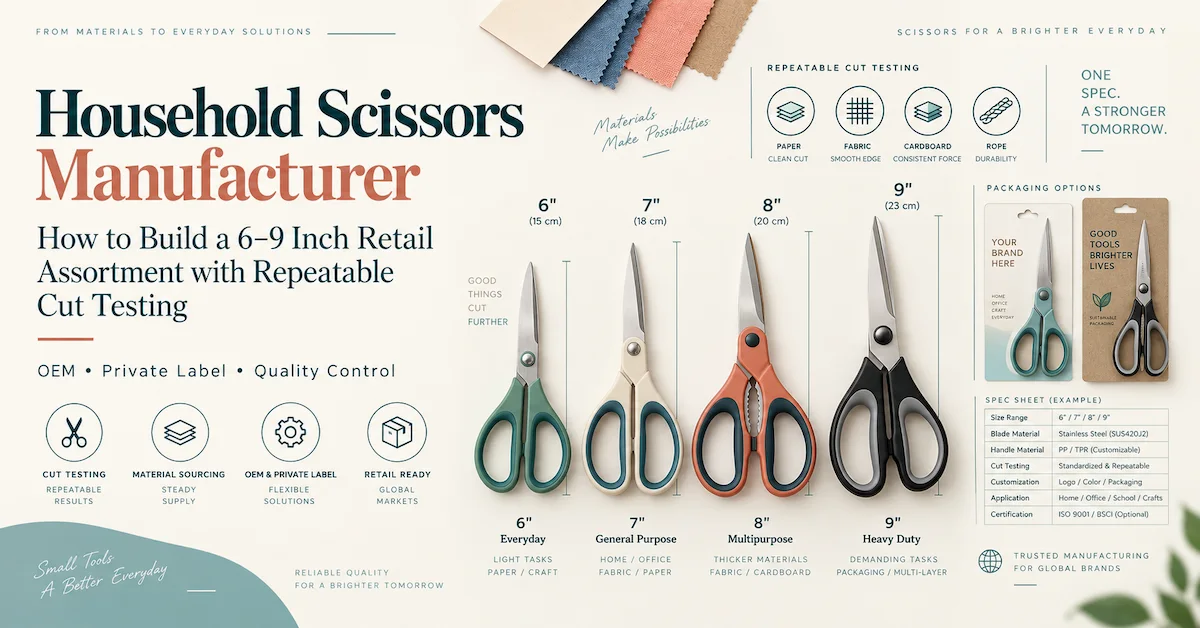
Marketing a product for every imaginable task creates avoidable risks. A blade that cleanly cuts writing paper does not automatically cut thick cardboard, electrical cable, metal wire or multiple fabric layers. Similarly, a product described as left- and right-hand friendly has not necessarily been validated for equivalent cutting visibility and comfort in either hand. A sensible supplier evaluation starts by narrowing the claimed applications.
For BONET's range, the most direct browsing point is its household scissors product category. The broader scissors collection helps buyers distinguish household, kitchen, tailor, stationery and school-use directions. The category names are useful for discovery, but the commercial specification should be written around a particular model and intended use.
This article intentionally concentrates on assortment architecture and reproducible testing. Supplier discovery, logo customization and kitchen shear features have their place in related sourcing content, but a retail purchaser also needs to know what a pass looks like when receiving 10,000 visually identical pairs. The framework below is designed to make that conversation more objective.
2. Build a Retail Assortment Before Choosing the Lowest Quote
Start with where a pair of scissors will live and which customer is expected to buy it. A stationery chain may need compact products for desk drawers. A supermarket general-merchandise buyer may prioritize a familiar full-size household shape. A craft-oriented brand may prefer an easy-to-control handle and a clear performance claim for paper, card or light fabric. An online seller may need one hero SKU and one upgraded alternative rather than several nearly identical lengths.
Separate the assortment into core, compact and optional specialty tiers. The core product should satisfy the most common household functions without excessive design complexity. The compact product should solve a real storage or control need. A specialty item needs enough differentiated value to justify additional tooling, packaging and inventory. A larger product is not automatically better or more capable; blade geometry, hand fit and leverage matter as much as length.
| Proposed tier | Buyer-facing job | What to test | Merchandising risk |
|---|---|---|---|
| Compact home/desk | Paper, tags, strings and tidy storage | Fine-tip control, handle clearance, light-media cuts | Overselling heavy-duty performance |
| Everyday household | Mail, ordinary packaging, labels and domestic tasks | Full-stroke consistency, grip comfort, repeat opening | Nearly identical versions confusing shoppers |
| Large general-use | Longer cutting strokes and selected craft tasks | Balance, handle fit, controlled cutting toward the tip | Length mistaken for professional-grade capability |
| Decorative or coated | Color-led or gift-oriented assortment | Coating appearance, handling, agreed cutting media | Unproven durability or material claims |
For a first range, prioritize a few deliberately different SKUs. If three pairs use similar blade geometry and the same handle, a minor difference in nominal length may not generate meaningful incremental sales. Ask retailers for shelf dimensions and real shopper questions before creating more versions. If multiple colors are necessary, request MOQ and cost separately by color instead of assuming a blended quantity.
Buyers can also plan product information as a system: one short intended-use statement, a consistent safety warning, a clear size descriptor and transparent material information. This improves comparison across the shelf and reduces the need for customer service to explain basic differences after the product is bought.
3. What BONET's Published Household Scissors Models Actually Show
BONET HOUSEWARE CO., LTD. operates from Yangjiang, China, and publishes household scissors alongside other cutting-tool categories. A valuable distinction for buyers is between data shown in a specific product listing and capabilities described at company level. The former helps establish a sample shortlist; the latter indicates what can be discussed in a custom project. Neither should replace a signed order specification.
The following catalog references are traceable to individual BONET product pages. The measurements are advertised product sizes, not guaranteed blade lengths. "420 stainless steel" is a listed material description, not a published hardness value. Request confirmation of the exact standard, heat treatment and component identity when your contract requires that information.
| Model / product link | Listed size | Listed metal / plastic materials | Practical evaluation focus |
|---|---|---|---|
| SHO207-6 | 6 inches | 420 stainless steel / PP | Compact grip, fine cutting control, storage |
| SHO207-7 | 7 inches | 420 stainless steel / PP | Everyday paper and light-craft evaluation |
| SHO207-8 | 8 inches | 420 stainless steel / PP | General household reach, full-stroke function |
| SHO063-9 | 9¼ inches | 420 stainless steel / PP + TPR | Larger handle comfort and heavier-use screening |
Important distinction: This table documents published listings only. It does not assert that all four models are in stock, that their edges pass a particular cutting test, that a fixed MOQ is available, or that they are appropriate for children, food contact or professional tailoring. Such claims need model-specific evidence and approval.
The 6-, 7- and 8-inch SHO207 entries allow a buyer to compare different sizes within a named product family. The SHO063-9 introduces a different handle-material listing and a larger nominal size. Ordering all four without trial may be unnecessary. The right shortlist depends on demand, hand fit and how the samples perform on the media your customers genuinely expect to cut.
For a brand considering a higher-visibility product, BONET also lists SHO065R-9 rainbow-finish household scissors at 9¼ inches with 420 stainless steel and PP+TPR in the product fields. Decorative coatings and their commercial claims should be checked separately from base-steel performance. Do not infer a quantified edge-life or corrosion benefit from a color treatment alone.
4. The Four Mechanical Characteristics Buyers Need to Understand
Blade geometry and closing contact
Scissors cut by bringing two edges past one another under controlled contact, not by behaving like two separate knives. The blade shapes, alignment and pivot setting influence how reliably the edges meet during a stroke. A sample can feel sharp near the pivot yet fold thin material as the cut approaches the tips. Inspect more than one location along the blade.
Pivot tension and free movement
The joint must hold the blades in an appropriate relationship while allowing comfortable opening and closing. Too little effective contact may let thin media escape between the blades; excessive friction may make cutting tiring. Ask whether the design uses a screw, rivet or another pivot construction, and how the supplier controls the assembly setting in production. Do not assume that end customers can adjust or repair a permanent joint.
Handle geometry and the user's hand
Ring opening, handle offset, contact edges and the position of the thumb relative to the blade path affect grip. Testing one person is inadequate for products sold to a broad household market. Review selected samples with adults who have different hand sizes, and document pressure points or slippage. If a product is promoted as ambidextrous, verify that claim with a structured left- and right-hand evaluation.
Tip configuration and exposed edges
Tips deserve attention in handling, storage and retail display. A pointed tip can assist accurate control for some tasks but also requires appropriate warnings and packaging protection. Smoothly finished handles do not compensate for exposed blade hazards. Decide the intended customer and channel before locking the tip style or claiming suitability for school environments.
The best way to turn these observations into a repeatable supplier conversation is a critical-to-quality list that distinguishes pass/fail safety or functional problems from acceptable cosmetic variation. The initial list should accompany every sample request, not appear only after a shipment has disappointed the buyer.
5. Create a Repeatable Household Scissors Cut-Test Matrix
A good cut-test protocol is short enough that a supplier can repeat it on the production floor but specific enough to distinguish a good sample from an inconsistent pair. It should describe the cutting media, dimensions where relevant, condition of the media, number of strokes, portions of the blade used, observation method and pass criteria. The values must be agreed for the product. The example below is a suggested test design, not a statement that BONET has performed or passed these tests.
| Suggested test medium | Buying question | What the inspector observes | Required agreement |
|---|---|---|---|
| Standard writing paper | Can the pair cut a common home-office medium cleanly? | Snagging, torn edges, paper folding, incomplete cut | Paper specification, number of cuts, allowable defects |
| Thin card or retail tag stock | Does a selected SKU support its packaging-task claim? | Stalling, edge deflection, excessive user effort | Card basis weight/thickness and full-stroke procedure |
| Light cotton fabric | Is the product suitable for an advertised occasional craft use? | Material slipping, fraying, pinching at the tip | Fabric specification and whether this use is claimed |
| Soft ribbon or string | Can it cut narrow, flexible media without forcing them aside? | Material escaping, inconsistent completion | Material type, diameter or width and cut count |
| Repeated opening/closing | Does the joint feel consistent after cycling? | Loose pivot, abnormal binding, contact change, damage | Cycle count and objective acceptance method |
Use the same approved supplies in successive trials. "Ordinary paper" from two offices may differ in thickness, coating and moisture condition; uncontrolled test material makes comparison unreliable. When the commercial claim does not include fabric or heavier packaging, those media can remain exploratory screening tasks rather than guaranteed specifications.
For each sample, cut near the heel, through the middle and toward the tip. Note whether the blades complete the cut and whether material folds between them. Where feasible, retain a failed media example with the sample ID and photograph the defect. A simple record of the test location frequently explains more than a broad judgment that the scissors are "not sharp enough."
Do not publish cutting-force figures, edge-retention cycles or pass rates unless tested under a stated method. Comparing force measurements is useful only when the fixture, medium, blade position and test procedure are consistent. A sample that feels easy in one evaluator's hand may owe part of that impression to grip rather than blade edge quality.
6. How to Test a Sample Without Mistaking Anecdotes for Evidence
Begin by identifying the sample: model number, revision, date received, packaging version and the party that supplied it. Verify the visible dimensions and inspect for burrs, handle damage, uneven finish, assembly defects and unprotected tips. If samples have different model or lot origins, do not combine their results into a single conclusion about factory consistency.
Then perform the chosen cutting tasks under the agreed conditions. One person can perform an initial screen, but a product destined for a broad retail audience benefits from additional reviewers. Ask each evaluator to record cutting behavior separately from comfort. For example, a pair may cut very cleanly but place uncomfortable pressure on the thumb during repeated strokes; the corrective action may be handle geometry rather than grinding.
Compare against an approved reference or a clearly documented benchmark. Competitor products can help establish shopper expectations, but copying an unidentified product's geometry without checking intellectual property, size and construction creates other risks. A good manufacturer can translate the desired use into an agreed specification rather than offering to reproduce an entire reference unquestioningly.
If a sample fails, describe the symptom precisely: "Paper folds at the last 15 mm of closing travel" is more actionable than "poor sharpness." The supplier may need to check blade contact, edge finish, pivot setting or geometry. Request a revised sample and repeat the same procedure. Keep the earlier failed sample identified; it establishes what changed.
7. Inspect Blade Alignment, Pivot Control and Handle Integrity
Incoming and pre-shipment inspection should include both visual and functional characteristics. For general household scissors, blade alignment and pivot operation often determine whether a retail customer perceives the product as dependable. The evaluation does not need extravagant instruments, but it does need a consistent procedure and trained judgment.
Blade alignment: With the scissors carefully operated, check whether the edges meet in the intended progression. Look for unintended gaps, rubbing, crossing anomalies or contact that changes abruptly. Examine both a closed and an opened condition without touching a sharpened edge. The supplier should identify which observations are acceptable for the specific construction.
Pivot condition: Check for side play, unexpectedly loose action, binding and visible damage. If the pivot is mechanically adjustable, the permitted adjustment method should be documented for production or service. If it is riveted, the supplier should explain how assembly consistency is achieved before packaging.
Handles: Inspect molded surfaces, seams, embedded blade attachment, grip texture and color consistency. Check that the handle does not rotate or move unexpectedly relative to the metal component. A PP handle and a PP+TPR handle can feel different, but one material label is not a guarantee of ergonomic superiority.
Finish and corrosion expectations: Ask for the exact steel and surface finishing specification where it affects claims. The BONET models listed here state 420 stainless steel, but the label alone does not publish heat-treatment hardness, blade thickness or results after corrosion exposure. Require product-level evidence before promising a particular test performance or rust resistance.
When unexpected cutting failures appear, BONET's separate article on blade misalignment signs offers additional background. In a commercial order, however, a failure should be investigated through the approved specification and nonconformity process, not treated as a normal condition the end user must repair.
8. How a Household Scissors Manufacturer Should Explain the Production Process
A useful factory discussion follows the product from incoming materials to the finished retail pack. The exact process sequence depends on blade blank production, selected heat treatment, grinding approach, pivot design and handle construction. Ask the manufacturer which steps it performs directly and which are supplied or subcontracted. A broad company manufacturing page can indicate capabilities, but the applicable route should be mapped to the model being quoted.
BONET publishes information about its manufacturing capabilities, while its OEM/ODM service page describes production from drawings or samples, material customization, logo marking, packaging and inspection support. The buyer should request a process description for the chosen scissors rather than assuming all equipment and quality controls described for other kitchenware are applied identically to household scissors.
Incoming material and component identification
Ask how the material, handle components, pivots and surface finishes are identified when received. If 420 stainless steel and PP are stated in a specification, the receiving process should support traceability to the supplied material or component and provide a way to identify unauthorized substitutions. The amount of documentation needed depends on the market and risk profile; requiring impossible paperwork does not improve product reliability.
Blade shaping, treatment and edge finishing
Blade geometry, heat treatment and final edge finishing need consistent process settings. Cutting performance can suffer when blades are ground differently across batches even if they have the same nominal steel grade. Ask which process characteristics the factory monitors and how it checks critical blade features before assembly. A manufacturer's answer should describe actual controls, not simply state that the product is "high quality."
Handle production and assembly
Plastic handles must fit the intended metal components and resist separation during normal use. If a soft-grip material is included, check appearance, bonding or assembly and durability under the defined use conditions. The pivot assembly also merits its own checkpoint because some failures cannot be identified by a final cosmetic inspection alone.
Final testing and packing
After assembly, the relevant cutting media and visual inspection should be available on the production floor or at a documented final-inspection stage. Link lot records to the packaging configuration to prevent one approved pair from being placed in the wrong color card or barcode pack. Buyers should ask what happens when an item fails: segregation, investigation, rework limits and repeat inspection after correction.
9. Set Critical-to-Quality Characteristics Before the Purchase Order
Not every measurable characteristic deserves the same attention. Critical-to-quality (CTQ) characteristics are the features whose failure would materially affect safety, the intended cutting function or a customer promise. For a household scissor, typical candidates include correct blade orientation, specified handle construction, acceptable pivot operation, the agreed cutting result and accurate labeling.
Keep CTQs separate from routine cosmetic requirements. A small shade difference inside an approved range is not the same failure as a loose blade assembly or a burr that could injure the user. Create defect categories suited to the actual product, with examples and disposition rules. Do not copy generic numerical limits from another supplier's inspection sheet without understanding their applicability.
| Characteristic | Typical risk if uncontrolled | Suggested evidence | Acceptance to define |
|---|---|---|---|
| Correct blade and tip configuration | Wrong performance or handling hazards | Approved drawing and reference sample | Geometry and prohibited defects |
| Cutting ability on claimed media | Tearing, folding, customer returns | Documented medium and cut procedure | Pass/fail results by blade location |
| Pivot and closing action | Binding, loose fit, inconsistent cuts | Functional inspection record | Play, friction and movement criteria |
| Handle attachment and finish | Discomfort, cracking, component movement | Assembly and visual inspection | Structural and cosmetic limits |
| Retail package and barcode | Mislabeling, damage or retailer rejection | Approved dieline and packed golden sample | Artwork, contents and protection |
Some buyers use statistical acceptance sampling based on a selected edition of ISO 2859-1 or another agreed scheme. Such a reference can organize inspection, but it is not an automatic guarantee of shipment quality. Determine the inspection level, defect classification, sample size and acceptance conditions with your quality team before production. Any critical hazard should have an explicit response plan rather than being dismissed through an average defect percentage.
Record which tests the supplier will perform during production and which checks an independent inspector may repeat before shipment. Confirm access to the approved sample and test media. The supplier, inspector and buyer should all be able to reach the same decision using the same acceptance document.

10. Use Three Sample Gates to Prevent Uncontrolled Changes
Gate A — Product concept: Choose the size, intended task, finish and general handle design. Early samples may be commercial catalog products or development prototypes. Identify any details that do not represent final production, including material or pivot type. This gate decides direction, not whether an entire order is production-ready.
Gate B — Functional approval: Review the actual component materials and carry out the agreed cut-test matrix. Check geometry, pivot action, ergonomics, packaging fit and model-specific product claims. When the result is accepted, record a specification revision and retain physical samples under controlled identification. A photograph alone is not enough to settle future disagreements about blade feel or handle finish.
Gate C — Pre-production and packed unit: Approve a sample reflecting the proposed production process, logo application and retail pack. Compare it with the accepted Gate B record. Confirm that any agreed changes have not altered the cutting performance, safety guidance or supplied components. Keep a final packed reference in addition to an unpacked product sample.
Make the approval authority explicit. A marketing team may sign off the color and logo but should not automatically approve blade contact or cutting performance. Conversely, an engineer may validate a scissor's function without checking the retailer's barcode placement and shelf-hanging strength. Assign owners for technical, commercial and artwork approvals so an unresolved decision does not silently become a production assumption.
If something changes between the sample and production run, define whether a new test or new sample is required. A handle resin substitution, new blade supplier, finish alteration or pivot component revision may be more consequential than a logo color change. The contract should give the buyer visibility before such changes are implemented.
Need a Model-Level Sample Plan?
Share your target application and compare BONET's published 6-, 7-, 8- and 9¼-inch references. Ask which product options are currently available, which construction details can be customized and what test evidence can be supplied for your order.
11. Plan OEM and Private Label Customization Without Losing Performance
Once the functional specification is stable, customization can add brand value. Discuss handle colors, logo application, blade finish and retail packaging within the limits of the selected model. BONET's published OEM/ODM offering includes production from customer drawings or samples, logo printing or laser marking, material and color options and packaging support. These are categories of services, not a guarantee that every modification is feasible for every scissor.
A common mistake is approving a catalog scissor and then requesting a new handle color, plastic compound or grip layer without asking whether the change affects fit, durability or assembly. Another is moving the logo to a different surface without reviewing abrasion, visibility and manufacturing implications. Any material or structural revision needs technical review and, if necessary, targeted revalidation.
For a private-label program, define where the logo will appear, the artwork dimensions, the permitted color variation and how the mark should survive normal handling. Avoid automatically claiming permanent engraving or fade-proof printing. Select the marking method through sample evaluation on the actual production surface.
If a custom handle or blade profile requires tooling, clarify who pays for it, who owns it, whether the tooling can be moved, who maintains it and whether an exclusivity agreement is intended. A custom logo is not equivalent to exclusive ownership of an existing product design. For protected design elements, obtain appropriate contractual guidance before sharing confidential files.
A practical development route is to launch a standard or lightly customized core SKU, learn from actual sales and then invest in distinct geometry where customer feedback justifies it. This keeps early complexity manageable and provides data to support the next product decision.
12. Design Household Scissors Packaging for Real Retail Handling
Household scissors are cutting tools, so the retail pack must protect the edges and tips during handling while allowing the product to be displayed and identified. A hanging card, protective blister, sleeve or boxed configuration presents different merchandising and freight trade-offs. Choose the format after understanding the target retailer's fixture, shelf dimensions and handling process.
Start with the finished packed sample, not just a graphic mockup. Verify that the product cannot easily puncture or tear its intended protective packaging under expected distribution conditions. Check that the card or box presents the correct size, model, barcode, intended use and applicable cautionary statements. A visually attractive package that misstates the product's function creates commercial and potential safety risks.
For online retail, consider movement within a parcel and whether loose components can damage adjacent items. For supermarkets, hanging strength and barcode scan position may matter more than a premium gift-box finish. Different channels can use different packs for the same scissor, but each pack becomes a separate controlled SKU configuration.
Do not label ordinary household scissors as children's safety scissors without appropriate design, age-use assessment and destination-market compliance review. Claims such as "professional tailor scissors," "heavy-duty wire cutters" or "safe for food preparation" similarly require evidence specific to the product. The retailer's listing, carton and printed card should agree on the intended use and limitations.
Before printing at scale, have the buyer approve a production artwork file and a final physical pack. Request a carton plan with units per inner and master carton, gross weight, dimensions and handling marks. These shipping data should be quoted for the selected configuration rather than assumed from a sample pair.
13. Compare Cost Per Saleable Unit, Not Only Unit Price
A low ex-factory price is useful only when the product and service scope are comparable. One quotation may include color printing, a protective blister and final cutting inspection; another may describe an unbranded scissor in a simple sleeve. Insist on a common comparison sheet before selecting a preferred vendor.
Request the product price by model, color and order quantity. Separate nonrecurring tooling, sample charges, custom artwork, inspection fees, test fees and freight. Ask for the trade term and clarify whether the quote includes inland transport, export charges, packaging or third-party verification. Confirm the currency and validity period, as these can make nominally similar offers different.
Illustrative calculation only: Imagine one shipment costs $8,800 delivered and yields 9,700 saleable units after an agreed acceptance process. Its delivered cost per saleable unit is approximately $0.91. Another shipment costs $8,550 but yields 9,200 saleable units; the corresponding figure is about $0.93. These are hypothetical values to demonstrate why quality and completeness matter. They are not BONET prices or observed defect rates.
For a household scissors range, even modest packaging and barcode errors can affect replenishment. If cartons mix 6- and 8-inch products under the wrong labels, a retailer may require sorting, relabeling or return. Agreeing on a model-level packing list and SKU identification is often less costly than resolving confusion after delivery.
MOQ should be requested by model and variation. A combined purchase quantity may not satisfy separate minimums for colors, packaging prints or tooling. BONET does not publish a universal model-specific MOQ in the product listings used here, so request a written project quotation. Avoid using a guessed MOQ to build cash-flow forecasts.
14. Design a Reorder Control System from the First Shipment
The first successful order is not the finish line for a private-label brand. A retail program needs repeatability, especially when a company intends to sell the same scissor for several seasons. Preserve the engineering drawing, bill of materials, performance test media, physical sample, packaging artwork and approved carton specification together under a revision identifier.
On each reorder, ask the supplier to confirm whether the blade material, handle materials, pivot design, major equipment or subcontracted processes have changed. Not every administrative adjustment requires a full new validation. Changes that affect function, claims or safety should trigger a documented technical review and appropriate additional tests before approval.
Keep records of customer returns and their actual causes. A complaint that a pair "does not cut" could originate from blade geometry, pivot setting, an inappropriate claimed use or damage during distribution. Categorizing complaints prevents the team from ordering another batch of the same unresolved design. Feed those findings into future test media and acceptance criteria.
For seasonal products, confirm the reordering window well before a promotional date. The supplier should distinguish sample revision time, production scheduling, packaging preparation and shipment milestones. Dates and batch capacity are project-specific; they should appear in a purchase confirmation rather than in evergreen claims about universal factory lead times.
15. What a Manufacturer Should Prove During Due Diligence
Supplier evaluation should be an evidence-gathering exercise. Look for a clear explanation of which factory processes apply to the selected model, an organized sample response, an understanding of the specified cutting media and a practical process for handling defects. A company presentation is useful background but does not replace sample-level evidence.
For BONET, the official company information, manufacturing information and OEM/ODM workflow provide a starting point. The website describes development, sample review, quotations, production, inspection and packing. For any particular household scissors order, ask which steps, material controls, sampling arrangements and documentation are actually included.
Buyer teams should request evidence of supplier identity, clear trade documents, specification agreement, realistic order milestones and the right to verify goods against the accepted sample. If certificates are mentioned, check their issuing body, scope, named legal entity and validity period. A quality management certificate does not in itself certify every scissor's cutting ability or suitability for a regulated use.
Evaluating several candidate samples side by side can make the discussion concrete. Give all suppliers the same media and testing instructions and keep the decision sheet. If a competitor offers a different blade profile or handle, document which requirement that difference helps satisfy rather than declaring a winner based on appearance alone.
16. Copy This Household Scissors RFQ Brief
An effective RFQ lets the supplier propose actual options and identify gaps before calculating cost. The template below can be pasted into an inquiry and edited to suit the buyer. It deliberately asks for confirmation instead of inventing specification values.
Project: Household scissors retail assortment / private-label procurement
Target sales market and channel: [Country or region] / [supermarket, homeware distributor, stationery retail, e-commerce or other]
Product references: [SHO207-6, SHO207-7, SHO207-8, SHO063-9 or alternative proposed models]
Intended cutting media: [Writing paper / agreed card / ribbon / specified light fabric / other] with any excluded uses stated clearly
Material and construction requirements: [Confirm metal grade, handle materials, pivot construction, nominal size, drawing, finish]
Proposed variations: [Colors, brand artwork, marking locations, retail package type, barcode and instructions]
Planned quantity: [Opening units by model and color] plus [estimated reorder volume, if known]
Quality plan requested: [Approved sample, cut-test method, blade alignment checks, pivot checks, defect classification, inspection rights and reporting]
Commercial information: [MOQ by SKU, sample costs, tooling if needed, packaging costs, production milestones, payment, trade term, carton details and freight basis]
Requested supplier response: Please identify any alternative construction, limits, test documents, cost assumptions or changes required to produce this specification.
Attach photographs or sketches for shape and color intent, but use written notes for the desired functional outcome. If a reference sample is sent, establish whether it is intended for evaluation, inspiration or replication under an appropriate design-rights arrangement.
17. Frequently Asked Questions About Household Scissors Manufacturing
What should I check first when choosing a household scissors manufacturer?
Start with the intended cutting tasks and shortlist models that fit the sales channel. Request documented materials, approved samples, a functional cut-test plan, inspection criteria and a packing specification. This produces a meaningful basis for supplier comparison before negotiation over the final price.
Does BONET offer 6-, 7- and 8-inch household scissors?
Its website lists SHO207-6, SHO207-7 and SHO207-8 at those respective nominal lengths. Each page names 420 stainless steel as the metal material and PP as the plastic material. Ask BONET to confirm current availability, configuration and commercial terms when requesting a quotation.
What is the difference between household scissors and kitchen scissors?
General household scissors are usually positioned for tasks such as paper, labels, string and light crafts. Kitchen shears may be intended for food preparation and may include specialized functions, depending on the model. Do not substitute one category for the other without checking design, cleaning requirements, product claims and applicable evidence.
Are 420 stainless steel blades always harder or sharper than other blades?
No conclusion about an individual scissor's hardness, cutting feel or edge life follows from the material name alone. Geometry, treatment, finishing and assembly also matter. Request appropriate specification details or testing evidence when hardness or long-term cutting performance is a purchasing requirement.
Which scissors length is best for a general retailer?
There is no universally best length. Compact options may suit desk storage and detailed household tasks, while longer products may suit customers preferring a larger grip and longer stroke. Compare the intended use and actual handling of samples rather than treating nominal size as a performance ranking.
What media should a factory use for a cutting test?
Choose media connected to the product's intended and advertised applications, such as specified writing paper, card, string or light fabric. Record the media properties, test location along the blade, cut procedure and acceptance result. Do not apply a demanding test for an unadvertised heavy-duty use without first agreeing its relevance.
How can a buyer check pivot quality without a sophisticated laboratory?
Define a controlled visual and functional inspection for blade play, binding, opening and closing consistency, and completion of the agreed cut. Use approved samples and trained inspectors. For quantitative or durability claims, agree on more formal fixtures, conditions and measurement methods.
Can household scissors be customized with a private-label logo?
BONET describes logo marking, color changes, material options and packaging services in its OEM/ODM offering. The practical availability depends on the model, marking surface and project. Confirm the final technique on an approved sample before committing to artwork or packaging quantities.
What is the MOQ for wholesale household scissors from BONET?
A universal MOQ is not established by the product pages cited in this guide. Request a quotation by model, color, branding process and packaging type. Clarify whether minimums apply separately to each variation rather than assuming that several SKUs can always be combined into one threshold.
Can I sell ordinary household scissors as children's school scissors?
Do not make that positioning change without reviewing tip design, age suitability, packaging warnings and relevant destination-market requirements. Product category and marketing claims should reflect the actual design and applicable evidence rather than a retailer's preferred label.
How should defective scissors be handled during bulk inspection?
Classify defects according to the agreed plan, segregate affected goods, document the failure and request investigation and corrective action. Decide whether repair, rework, replacement or rejection is allowed under the purchasing agreement. Recheck corrected units before final shipment release.
How do I avoid quality drift on repeat orders?
Maintain revision-controlled drawings, approved samples, test media, inspection procedures and packaging artwork. Require review of material, blade, pivot or handle changes that may affect function or claims. Compare results between lots and include actual customer complaint data in future improvements.
Conclusion
A capable household scissors manufacturer should help the buyer build a clear connection between retail use, product construction and measurable quality. The right assortment is not necessarily the one with the most colors or sizes. It is the one whose intended functions are defined, whose samples can pass an agreed evaluation and whose production can be checked against the same references when the next order arrives.
BONET HOUSEWARE publishes a household scissors lineup including 6-, 7- and 8-inch SHO207 models and larger options, together with OEM/ODM customization support. Use its household scissors product category to select candidate designs, then request confirmation of materials, sample performance, available customization, MOQ, inspection and delivery terms for your specific program. Clear requirements and transparent evidence are more valuable than unsupported performance claims.
Develop Your Next Household Scissors Retail Range
Share your market, intended cutting tasks, target models, branding preferences and expected order plan. Ask BONET for a model-specific quotation and a practical sample approval route.
