








Buying kitchen cutting board wholesale: what actually matters
When buyers search for kitchen cutting board wholesale, they are usually not just looking for a low unit price. They are trying to solve a practical supply problem: how to source prep boards that hold up in daily use, fit the look of the kitchen or retail line, and can be ordered in enough volume without creating headaches later. That sounds straightforward, but anyone who has handled foodservice supply knows the details can get messy fast.
A cutting board is one of those modest items that can quietly make or break a kitchen workflow. If the board slides, stains too quickly, stores badly, or feels flimsy in hand, the complaint arrives from the line cook or the customer, not the purchasing desk. For wholesalers, that means the right buying decision is not only about style or price. It is about consistency, material behavior, and whether the product family makes sense across different end uses.
Why wholesale buyers care about board construction
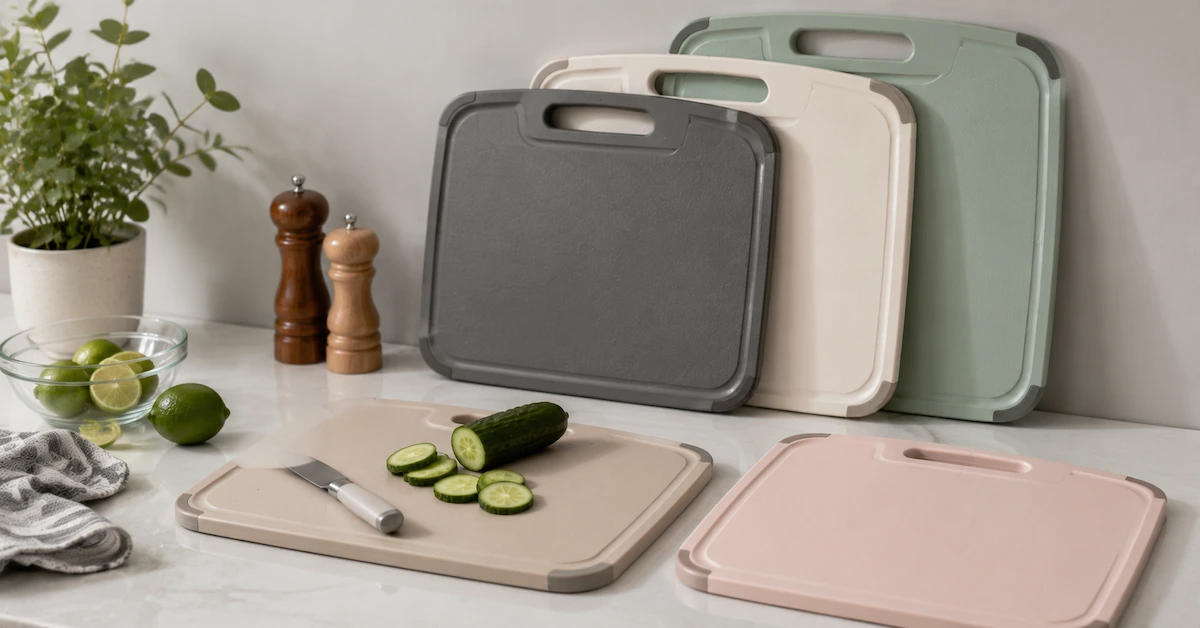
The boards in this product family appear to be flat prep boards with a molded handle opening, rounded corners, and a raised outer rim or lip. Visually, they look suited to efficient prep rather than decorative display. The smooth matte surface and integrated edge framing suggest a molded plastic or plastic-composite product, though the exact material cannot be confirmed from appearance alone.
That matters because board construction affects how the product is used in the real world. A buyer supplying kitchens, hospitality operations, or retail accounts needs to think about three things at once: handling, storage, and repeatability. A handle cutout helps with carrying and hanging. A flat rectangular form stacks well in cartons and on shelves. Multiple colorways can support merchandising or task separation in the kitchen, even if the product is sold as a general prep item.
For wholesale programs, those are not minor features. They are what make the SKU manageable.
Quick comparison: what wholesalers usually evaluate
1. Material feel and finish
The visible finish here is smooth and wipe-clean, which is useful for food prep and for buyers who want easy maintenance. A matte surface can look more premium than glossy plastic, but that depends on the final mold quality and surface texture. Do not assume every board in a similar-looking range will behave the same way. Two products can look nearly identical and still differ in rigidity, odor retention, or wear.
2. Shape and handling
The rectangular shape with rounded corners is the safe commercial choice. It wastes little space and is easy to pack. The integrated handle opening is a practical detail that helps with carrying, hanging, and moving the board from storage to prep station. In a wholesale context, features that sound small can reduce complaints later.
3. Color assortment
The shown palette includes gray, cream or beige, pale green, and light pink. That kind of assortment can serve several market positions. It can be presented as a coordinated retail set, a mixed bulk kitchenware line, or a color-coded prep solution for different ingredient types. Still, color is not a substitute for performance. A pretty board that warps or marks too easily is still a problem.
What these boards are suited for
These kitchen cutting boards are a sensible fit for home kitchens, meal prep stations, hospitality operations, and general wholesale kitchenware supply. That breadth is useful, but only if the buyer matches the product to the right environment.
For home use, buyers often want a board that looks neat on the counter and stores easily. In meal prep settings, a flat, stable board that is easy to carry is often more important than a decorative edge. In hospitality, especially where multiple prep surfaces are in play, color variety can support organization. For wholesalers, that gives the product more than one sales angle, which is helpful when account needs change by season or channel.
A practical caution: if a customer expects heavy butcher-block performance, a molded board in this category may not satisfy them. It is better suited to slicing, chopping, and general ingredient prep than to misuse as a heavy-duty cleaver surface.
Selection criteria that save buyers trouble
Confirm the material story
Because the exact material is not confirmed here, buyers should ask for a clear specification before ordering at scale. The visible product suggests plastic or composite construction, but the difference between blends, grades, and surface finishes can affect rigidity and durability. If the supplier cannot explain the material cleanly, that is worth a pause.
Check stackability and carton efficiency
Wholesale buying is rarely just about the board itself. Carton size, nesting behavior, and storage footprint affect landed handling costs. A flat board family usually helps, but only if the thickness and edge profile are consistent across sizes. Slight differences can create awkward packing and extra breakage in transit.
Think about account type before choosing the color range
A retail account may want the full assortment shown in coordinated tones. A foodservice buyer may care more about board count, size mix, and whether the set supports task separation. A distributor selling into both channels may need different pack configurations. That is often where wholesale programs succeed or fail: not in the product concept, but in the packaging logic.
Common mistakes in kitchen cutting board wholesale sourcing
One common mistake is treating all cutting boards as interchangeable. They are not. Even within a simple-looking range, the edge thickness, finish, and handle detail can change how the board feels in hand and how it moves through a prep workflow.
Another mistake is overpromising properties you have not verified. If you have not confirmed dishwasher safety, knife-friendliness, heat resistance, or any antibacterial claim, do not build your sales pitch around those features. In wholesale, that kind of assumption can become an awkward return issue.
A third error is ignoring the end user’s storage reality. Boards with handle openings are useful, but only if the destination customer has a place to hang or stack them. A good-looking set still needs to fit the kitchen, pantry, or display fixture it is headed for.
How buyers should talk to suppliers
When sourcing wholesale cutting boards, the most useful questions are practical ones:
Ask what material family the boards are made from and whether the finish is consistent across colors.
Ask whether the same mold or tooling is used across the sizes in the range.
Ask how the boards are packaged for bulk shipping and whether mixed-color cartons are possible.
Ask for photos of the edge detail, the handle opening, and the board underside if the product is being positioned for foodservice.
Ask what use cases the supplier sees as the primary market. If the answer changes depending on who you speak with, that is useful information in itself.
These questions help separate a dependable supply item from a one-off catalog image. That distinction matters more than many first-time buyers expect.
What a sensible wholesale program looks like
A workable kitchen cutting board wholesale program usually balances three variables: variety, consistency, and reorder simplicity. The multi-color presentation shown here gives buyers some flexibility, but the range should still feel organized. Too many size/color combinations can make inventory harder to manage. Too few, and you lose the ability to serve different account types.
The strongest wholesale programs tend to offer a clear structure: perhaps one core board shape, a few practical sizes, and a limited color assortment. That keeps purchasing easier and helps the customer understand what they are buying. It also reduces the chance that a retailer or distributor ends up with a shelf full of nearly identical SKUs that are difficult to explain.
FAQ for sourcing teams and product managers
Are these boards more for retail or foodservice?
They can work for both, but the multi-color presentation suggests strong retail potential. At the same time, the carry handle and flat form also fit prep-focused users.
Can I assume they are dishwasher safe?
No. That needs to be confirmed by the supplier. It should never be guessed from appearance.
Are the boards reversible?
That is not clear from the available product details. Buyers should verify before specifying them for a particular account.
Do the colors matter functionally?
They can, especially if a customer wants visual organization in the kitchen. But they also serve merchandising purposes in retail or mixed wholesale assortments.
The practical takeaway for buyers
If you are evaluating kitchen cutting board wholesale options, this product type makes sense when you need a clean, stackable prep board with a simple handling feature and a presentation that can work across channels. The visible design is straightforward, which is a strength. It avoids unnecessary flourishes and focuses on utility.
What you should not do is fill in missing details with assumptions. Confirm the material, the dimensions, the care instructions, and the carton format before you commit. A board that looks right in a catalog can still miss the mark once it reaches a busy prep area.
If you are building a wholesale kitchenware range, use this kind of board as a practical base item and then shape the offer around the customer: retail display, bulk supply, or operational prep use. That is usually where a simple product turns into a reliable program.
