




Kitchen Cutting Board Wholesale: What Buyers Should Know
Buying kitchen cutting board wholesale is rarely just a search for the lowest unit cost. For distributors, retailers, hospitality buyers, and kitchenware sourcing teams, the real question is whether a board can be supplied consistently, packed efficiently, presented clearly, and used without creating avoidable complaints.
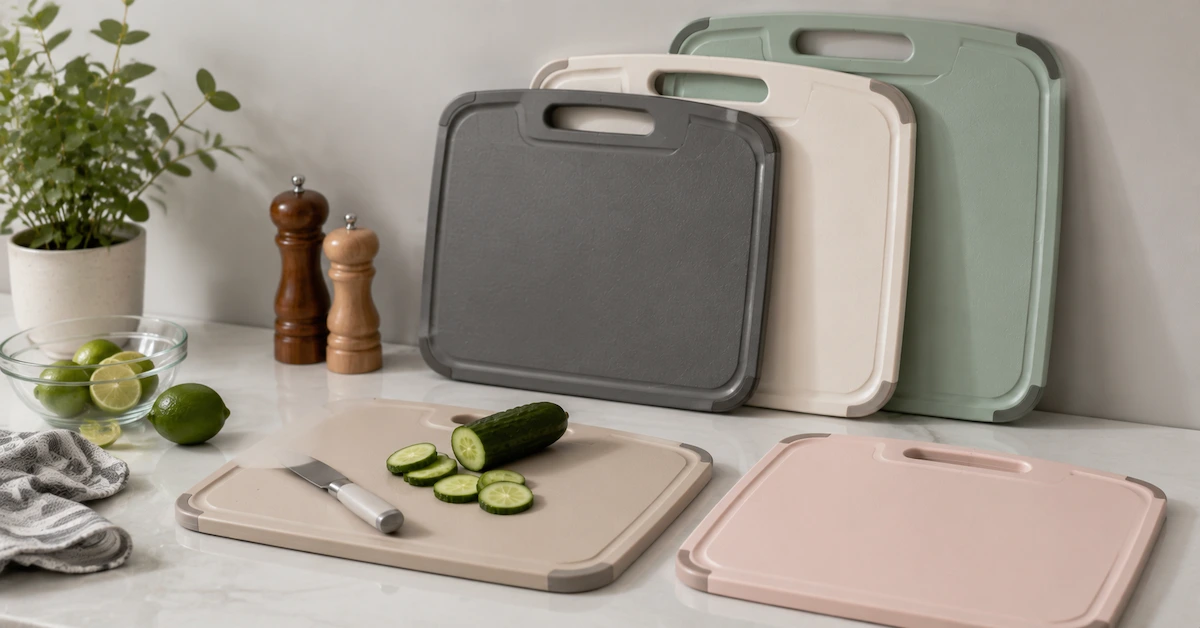
The cutting boards shown in the product image appear to be flat rectangular prep boards with rounded corners, an integrated handle opening, a raised outer edge or rim, and several soft color options including gray, cream or beige, pale green, and light pink. The exact material is not confirmed from the available information, so buyers should avoid assuming a specific plastic grade, dishwasher rating, heat resistance level, or compliance status without supplier confirmation.
That caution is important. A cutting board may look simple, but small differences in rigidity, surface texture, edge thickness, packaging, and color consistency can affect how well it performs in retail and food preparation channels.
Key Takeaways
- Evaluate wholesale cutting boards by construction, handling, packaging, and reorder consistency, not price alone.
- Confirm material, dimensions, care instructions, carton details, and available colors before bulk purchasing.
- Do not market unverified claims such as dishwasher safety, antibacterial performance, or heat resistance.
- Match the assortment to the end channel: retail display, hospitality supply, meal prep, or general kitchenware distribution.
What Buyers Can Tell From the Visible Design
The visible design suggests a practical prep board rather than a decorative serving piece. The rectangular shape helps with stacking, packing, and shelf placement. Rounded corners reduce sharp edges during handling. The molded handle opening may help users carry, hang, or remove the board from storage.
The raised outer rim or framed edge may also be relevant for buyers because it changes the feel of the board and may help define the working surface. However, buyers should inspect samples before assuming how the rim behaves during chopping, cleaning, or stacking. A visual feature is not the same as a verified performance feature.
The muted color palette gives the range broader merchandising potential than a single-color commodity board. Retailers may prefer a coordinated display, while foodservice-oriented buyers may use colors for visual organization. Still, color should support the product program, not distract from core sourcing checks.
Wholesale Evaluation Checklist
Before selecting a kitchen cutting board wholesale supplier, buyers should compare the product and the commercial program side by side. The table below highlights practical checks that reduce sourcing risk.
| Evaluation Area | What to Check | Why It Matters |
|---|---|---|
| Material | Ask the supplier to identify the material family and finish. | Appearance alone cannot confirm durability, care limits, or suitable use. |
| Dimensions | Confirm size, thickness, weight, and tolerance expectations. | Small differences affect packing, shelf fit, and user perception. |
| Color Range | Request actual color samples or production photos. | Online images may not reflect batch-to-batch color consistency. |
| Packaging | Check inner pack, master carton, mixed-color options, and labeling. | Packaging affects warehouse handling, retail presentation, and damages. |
| Care Instructions | Ask what cleaning and storage guidance the supplier recommends. | Unclear care instructions can lead to customer complaints or returns. |
How to Match the Board to the Sales Channel
For retail, presentation matters. A soft multi-color assortment can help a cutting board line look organized on a shelf or in an online listing. Retail buyers should ask whether boards can be supplied in single colors, mixed assortments, or display-ready packaging. They should also confirm whether the handle opening and edge design are visible in packaging, because those details may influence shopper understanding.
For hospitality and foodservice supply, the priorities are different. Buyers usually care about repeat availability, cleaning guidance, storage footprint, and whether the board is appropriate for the intended level of preparation. If the end user needs heavy-duty butcher-block performance, this style of board should be evaluated carefully with samples before being positioned for that use.
For distributors serving multiple account types, a simple program often works best: a core shape, a controlled color selection, and clear carton logic. Too many near-identical variations can make inventory harder to explain and harder to reorder.
Supplier Questions Before Placing a Bulk Order
A reliable sourcing process depends on direct, practical supplier communication. Buyers should request clear answers instead of relying on catalog assumptions.
- What material family is used for the cutting board, and is it the same across all colors?
- What are the confirmed dimensions, thickness, and product weight?
- Are the handle opening, edge profile, and underside consistent across production batches?
- What care instructions should be printed or supplied with the product?
- Can the supplier provide individual samples before volume purchasing?
- What are the available carton configurations for single-color and mixed-color orders?
- How are products protected during bulk shipping to reduce scratching or deformation?
- What commercial details should be confirmed, including MOQ, lead time, packing, labeling, and reorder process?
These questions do not require the supplier to overpromise. Instead, they help buyers understand whether the product is a good fit for the intended account.
Common Mistakes in Kitchen Cutting Board Wholesale Sourcing
One common mistake is treating all flat cutting boards as interchangeable. Two boards may look similar in a photo but differ in stiffness, surface feel, edge finish, odor retention, or how they sit on a counter. Sample review is especially important when the board is intended for repeated daily use.
Another mistake is promoting unverified claims. Unless the supplier provides clear documentation, buyers should not describe the board as dishwasher safe, antibacterial, heat resistant, non-slip, or made from a specific material grade. Unsupported claims can create problems for retailers, distributors, and end users.
A third mistake is ignoring packaging and logistics. Wholesale success depends on more than the board itself. Carton strength, scratch protection, barcode or label requirements, color mix, and case quantity all affect whether a product is easy to receive, store, and resell.
What a Sensible Wholesale Program Looks Like
A good cutting board wholesale program is easy to understand and easy to repeat. Buyers should define the role of the item before negotiating volume. Is it a budget-friendly kitchen basic, a coordinated retail assortment, a hospitality prep board, or a general-purpose kitchenware SKU?
Once the role is clear, the assortment should be controlled. The color options shown can be useful, but not every account needs every color. Retailers may want an attractive mixed pack, while commercial buyers may prefer fewer colors and simpler replenishment. The best decision depends on how the product will be sold and used.
Buyers should also build a basic approval process: inspect samples, confirm product details in writing, review packaging, test stacking and storage, and clarify reorder terms. This is not complicated, but it prevents many problems that appear only after the first shipment arrives.
Practical FAQ
Are these boards suitable for retail or foodservice?
They may be suitable for both, depending on confirmed specifications and intended use. The color assortment supports retail presentation, while the flat shape and handle opening may also suit prep-focused environments.
Can buyers assume the boards are dishwasher safe?
No. Dishwasher suitability must be confirmed by the supplier. It should not be inferred from the product image or from the fact that the board appears easy to wipe clean.
Do the colors have a functional purpose?
They can support visual organization, assortment planning, or merchandising. However, buyers should not claim a formal color-coding system unless that is part of the supplier’s confirmed product information.
What should buyers request before ordering wholesale quantities?
Request samples, confirmed specifications, material information, care guidance, packaging details, carton configuration, available colors, and commercial terms such as MOQ and lead time.
The Bottom Line for Wholesale Buyers
Kitchen cutting board wholesale sourcing works best when buyers balance product appearance with practical verification. The boards shown offer a clean rectangular form, handle opening, raised edge detail, and several soft colors, making them relevant for retail and general kitchenware supply. But the commercial decision should depend on confirmed material, dimensions, packaging, care instructions, and supplier reliability.
Before committing to a bulk order, ask precise questions, review samples, and match the product to the correct sales channel. A simple cutting board can be a dependable wholesale item when the sourcing process is clear, documented, and realistic.
