








Choosing a kitchen knife set manufacturer is usually less about glossy presentation than about whether the set will hold up in daily prep. Buyers in retail, hospitality, and private label programs are trying to solve a practical problem: how to source a coordinated knife set that cuts cleanly, stores safely, and looks coherent on the counter without creating avoidable complaints later.
That sounds simple until you start comparing options. A set can look complete on paper and still disappoint in use if the blades dull too quickly, the handles feel awkward, or the block wastes counter space. For engineers and sourcing managers, the real decision is not just “who can make knives,” but “who can make a usable system” — blades, handles, storage, and maintenance tools that feel like one product rather than a bundle of unrelated parts.
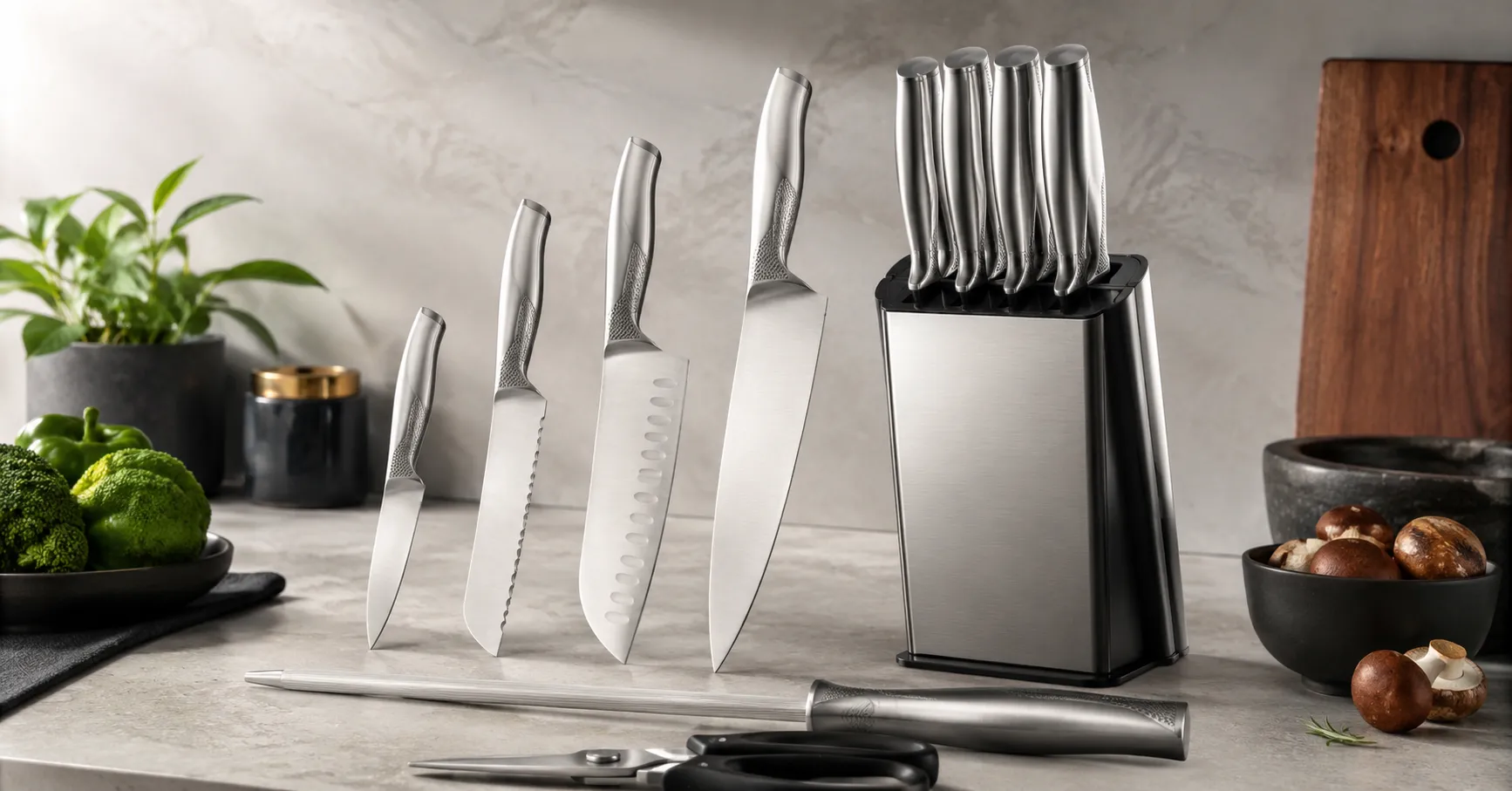
The set described here is a good example of the category as buyers typically encounter it: multiple stainless-steel knives, a matching countertop block, and a honing rod laid in front. That mix tells you something important. A serious kitchen knife set manufacturer is not only producing cutting edges; it is also thinking about presentation, storage, and the day-to-day maintenance users will actually perform.
Quick takeaways for buyers
If you are shortlisting a kitchen knives manufacturer or comparing knife set manufacturer capabilities, focus on four things first: blade consistency, handle ergonomics, finish quality, and block integration. Those four details drive most of the user experience, and they are where low-cost sourcing often shows its seams.
The visible set suggests a practical home-or-commercial-prep assortment: a chef’s knife, a serrated utility or bread-style knife, a santoku-like blade, smaller paring or utility knives, and a honing rod. That is a sensible mix for general food preparation, but only if the manufacturer maintains decent geometry from knife to knife. A mismatched set can be worse than having fewer knives.
Why the storage block matters more than it gets credit for
Many buyers treat the block as packaging. In reality, it is part of the product. A countertop storage block influences how often the knives are used, how safely they are stored, and how the set is perceived in a kitchen. The block in the supplied product data has a rectangular form, a brushed silver front panel, black top and base sections, and vertical slots. That is the kind of design that signals order and makes the set feel finished on a counter.
From a sourcing standpoint, the block also affects manufacturing complexity. A block may be molded, sheet-metal-clad, or built from a combination of materials. The exact internal construction is not visible here, so it should not be assumed. Still, a buyer should ask how the slots are aligned, how easily they can be cleaned around the opening, and whether the material resists moisture and wear. Knife blocks get overlooked until they collect debris or start looking tired after a few months of use.
That is especially relevant in commercial kitchens or high-turnover environments. Even if the knife blades themselves perform well, a poor storage block can lead to loose fit, damaged edges, or awkward handling. A good manufacturer understands that the block is not an accessory; it is part of the user interface.
What the visible knife mix tells you about the maker
The apparent set contents suggest a general-purpose assortment rather than a highly specialized culinary package. The visible blades include at least one chef’s knife, one serrated knife, a santoku or santoku-like blade with granton scallops, and smaller prep knives. A honing rod is also included, which is a useful sign that the manufacturer expects the user to maintain the edge rather than treat the knives as disposable tools.
That detail matters. A kitchen knife set manufacturer that includes a honing rod is usually thinking beyond the initial sale. Honing does not sharpen a dull edge in the full sense, but it helps realign and preserve cutting performance between sharpenings. Buyers should not confuse the two, but they should appreciate the intent. It is a small addition that can improve the long-term experience of a set.
The products appear to use stainless-steel blades and matching metallic handles, or possibly stainless-steel-clad handles. Exact steel grade is not visible, and it would be a mistake to guess. Still, a coordinated metal finish tends to communicate durability and makes the set look consistent. The tradeoff, of course, is that polished metallic finishes can show fingerprints and wear more readily than textured or coated alternatives. That is not necessarily a problem, but it should be acknowledged early in the spec conversation.
Manufacturing approaches that usually sit behind this kind of set
For sets like this, the two most common knife production paths are stamped and forged stainless-steel construction. Either can work well when executed properly. Stamped knives are often lighter and more cost-efficient; forged knives usually bring more mass and a different hand feel. The image alone does not confirm which process was used, so buyers should request manufacturing details instead of assuming based on appearance.
What matters more than the label is repeatability. Blade profile, edge alignment, handle attachment, and polish quality should be stable from knife to knife. A kitchen knives manufacturer should be able to explain how the knives are formed, finished, and inspected. If they cannot, that is a warning sign, especially for private label or chain-store programs where returns become expensive fast.
The block likely uses molded or sheet-metal-clad storage construction. Again, that is an inference, not a confirmed specification. For buyers, the useful question is whether the block design protects the blade edge and keeps the set stable on the counter. A polished exterior does not matter much if the set rocks when a user pulls out the chef’s knife.
Selection criteria that actually separate one supplier from another
When evaluating a knife set manufacturer, it helps to think in terms of failure modes. Ask where the set is most likely to disappoint after a few weeks of use. Often the answer is edge retention, handle comfort, slot fit, or finish durability rather than dramatic structural failure.
Blade performance
Buyers should request clarity on blade material, manufacturing route, and finishing method. If the steel grade is not yet fixed, do not let the conversation drift into marketing language. You need enough information to judge corrosion resistance, sharpening behavior, and likely service life. A beautiful knife that chips too easily is a procurement headache, not a premium product.
Handle and balance
The visible matching-metal handle style suggests a modern, unified look. That can be attractive, but it also raises ergonomic questions. Metal-feeling handles can be slick if the surface geometry is too smooth. A good supplier will consider grip security, balance point, and user fatigue, particularly if the set is meant for broad household use or repetitive prep work.
Block fit and slot design
Knife blocks need to fit the actual blades, not just the concept of them. If the slots are too narrow, users damage edges. If they are too loose, the set feels cheap and unstable. The brushed silver-and-black block style in the supplied data suggests a contemporary countertop product, but buyers should still verify slot depth, slot count, and ease of cleaning. It is surprising how often that last point is missed during sourcing.
Included maintenance tools
The honing rod is not a throw-in; it is part of the maintenance story. If the manufacturer includes one, ask about the intended use and how it is positioned in the block or set layout. Some buyers also want guidance materials for end users. That can reduce complaints about “dull” knives that simply need proper honing.
Common sourcing mistakes with knife sets
One common mistake is comparing sets only by piece count. Six knives in a block may be more useful than ten pieces with overlapping blade types and weak construction. Another mistake is ignoring finish durability. Metallic-looking handles and brushed block panels can look premium in a showroom and still show wear quickly if the coating or polish is thin.
Another practical problem is assuming every kitchen knife set manufacturer can support the same use case. A set designed for home kitchens may not suit a foodservice buyer who needs heavier handling and more frequent maintenance. The visual format may be identical, but the duty cycle is not. That distinction should shape your procurement questions.
Buyers also tend to under-spec the block. A stylish block that is hard to wipe down or doesn’t sit securely on the counter creates avoidable friction. If a product is meant for retail shelves, the block appearance matters. If it is meant for actual kitchen use, cleaning and stability matter more.
Practical advice for private label and OEM programs
If you are sourcing for your own brand, start with the assortment rather than the logo placement. Decide which knives your end user actually needs, and resist the temptation to make every set look fuller than it needs to be. The visible assortment here is sensible because it covers everyday prep: slicing vegetables, trimming meat, chopping herbs, cutting bread or soft items, and maintaining the edge with the honing rod.
Then review what can be customized safely. Handle finish, block color, packaging graphics, and set composition are usually easier to tailor than blade architecture. If the supplier offers multiple manufacturing routes, ask how those choices affect consistency across production runs. A private label program lives or dies on repeatability, not just the prototype sample.
Also, keep an eye on terminology. Some suppliers will call a set “stainless steel” when only certain components are stainless, or use “forged” loosely. Ask for plain-language descriptions of the blade, handle, and storage materials. Clear specs prevent awkward surprises later, especially when the product moves from sample stage into bulk production.
FAQ buyers tend to ask too late
Is a complete block set always better than buying knives individually?
Not always. A well-matched block set is convenient and visually tidy, but only if the included knives align with the user’s actual workload.
Does a honing rod mean the knives are difficult to maintain?
No. It usually means the manufacturer expects routine care. Honing is part of normal maintenance, not a red flag.
Should I assume the handles are solid metal?
No. The supplied information only suggests a metallic appearance. The actual handle construction is not confirmed and should be verified.
Can this kind of set work in a commercial kitchen?
Potentially, yes, for lighter prep or secondary stations. For heavier use, the supplier’s materials and process details matter much more than the appearance of the set.
What to ask before you place the order
Before committing to a kitchen knife set manufacturer, ask for the exact blade material, the construction method, the handle build, the block material and slot design, and whether the honing rod is part of the standard set. Request visual confirmation of the final assortment as well, since piece counts can drift between sample and production. If you need dishwasher-safe claims or specific hardness data, get those in writing from the supplier rather than assuming they apply.
A decent supplier will not just say yes to every request. They will explain tradeoffs, especially where appearance, cost, and durability pull in different directions. That kind of answer is usually more valuable than a polished sales pitch.
Next step
If you are comparing a kitchen knife set manufacturer for retail, private label, or foodservice procurement, build your shortlist around the things that affect daily use: blade consistency, handle feel, block stability, and maintainability. The set should be judged as a working system, not as a photo on a product page. Ask for the missing specifications, verify the parts that matter, and avoid overbuying features that do not improve the cut.
That approach saves time later, and in this category, it usually saves margin too.
