




Choosing a kitchen scissors private label supplier should begin with manufacturing control, product-market fit, and repeatability—not with logo placement.
For a kitchenware brand, importer, supermarket buyer, distributor, or e-commerce seller, the real commercial risk is whether the scissors cut consistently, whether the approved sample can be reproduced in mass production, whether the handle and accessory design work in actual use, whether the packaging survives the intended sales channel, and whether the same specification can be supplied again six or twelve months later.
A low quotation has limited value if the blades lose alignment, the pivot feels different between batches, the handle color shifts, the magnetic sheath no longer fits properly, or the retail packaging changes without approval.
A capable private-label supplier should therefore be able to discuss the entire product system: blade material, blade geometry, alignment, heat treatment, grinding, pivot assembly, handle construction, logo method, surface finish, packaging, quality inspection, and reorder control.
For buyers starting a sourcing project, the goal is not simply to find “a factory that can make scissors.” The better question is:
Can this supplier turn a kitchen-scissors specification into a repeatable retail product that remains consistent from sample approval through future reorders?
That is the standard this guide uses.
What Should a Kitchen Scissors Private Label Supplier Actually Provide?
Private label does not mean putting a brand name on a generic product and shipping it.
A professional kitchen scissors private label program normally involves several layers of decision-making.
The first layer is the product platform. Buyers need to decide whether the program requires general kitchen scissors, detachable scissors, magnetic kitchen scissors, poultry shears, multi-functional kitchen shears, or another structure.
The second layer is functional specification. Blade shape, serration, opening angle, pivot resistance, handle geometry, additional functions, and cleaning requirements all influence how the product performs.
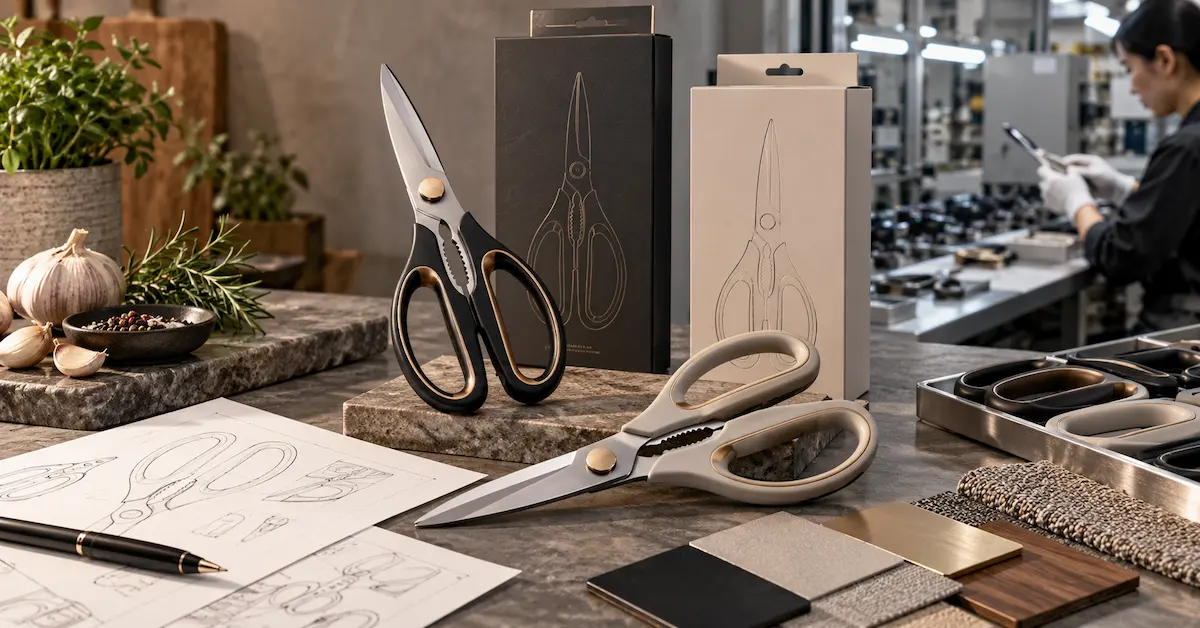
The third layer is brand differentiation. Color, logo, surface finish, accessories, sheath design, packaging structure, insert cards, color boxes, gift boxes, labels, and export cartons can all affect how the final product is perceived.
The fourth layer is manufacturing repeatability. A visually attractive sample is not enough. The factory must be able to reproduce the approved cutting feel, blade alignment, handle fit, finish, and packaging in production quantities.
The fifth layer is commercial execution. The supplier must understand quotation variables, sample approval, mass-production confirmation, inspection, packaging requirements, export preparation, and repeat-order documentation.
BONET's OEM and ODM service process is structured around requirement communication, design and sampling, quotation and confirmation, mass production, quality inspection, packaging, and delivery. For a B2B buyer, that sequence is useful because it separates decisions that should be made before production from checks that must happen during and after production.
Who Actually Needs Private Label Kitchen Scissors?
The buying requirements vary significantly by sales channel. A kitchen scissors program designed for an Amazon seller should not automatically be treated the same way as a supermarket program or a professional food-service project.
Kitchenware Brands
Established kitchenware brands usually need more than a logo.
They may require a coordinated color system, specific handle geometry, packaging that matches an existing product family, defined materials, controlled surface finishes, and reliable repeat orders.
Their biggest concern is often brand consistency across production runs.
Importers and Sourcing Companies
Importers tend to focus heavily on specifications, documentation, price structure, quality consistency, export packaging, production communication, and supply risk.
A strong importer usually wants the product definition to be detailed enough that another production batch can be compared against the same approved standard.
Supermarkets and Chain Stores
Supermarket buyers look at the product differently.
They care about:
- clear consumer benefits;
- shelf presentation;
- packaging dimensions;
- barcode and label requirements;
- retail price positioning;
- carton efficiency;
- consistency across stores;
- repeat replenishment.
For this channel, packaging is not an afterthought. It is part of the product.
E-commerce Sellers
Online sellers need products that can be explained quickly in photographs and product listings.
A detachable blade, magnetic storage feature, integrated nutcracker, bottle opener, herb stripper, or safety sheath can create visible differentiation.
However, more functions also mean more points that need to be tested.
E-commerce packaging must also account for parcel handling. A package that looks good on a supermarket hook may not provide enough protection for individual courier shipments.
Distributors and Wholesalers
Distributors are often less concerned with one highly customized model and more concerned with a dependable assortment.
They may value:
- multiple price levels;
- different scissor sizes;
- several handle styles;
- stable replenishment;
- standardized cartons;
- mixed product programs.
Buyers building a broader kitchenware assortment can review BONET's product portfolio alongside its dedicated scissors range.
Restaurant, Catering, and Food-Service Buyers
Professional users tend to place greater emphasis on cutting performance, comfort during repeated use, grip, cleaning, durability, and functional simplicity.
A consumer product may sell because of attractive packaging and multiple functions. A food-service buyer may prefer fewer functions and more predictable daily performance.
That distinction matters when defining the private-label specification.
Start With the Sales Channel, Not the Scissor Model
One of the most common sourcing mistakes is choosing a product first and deciding the target market later.
A better private-label project works in the opposite direction.
Define the buyer, price segment, sales environment, main use case, and packaging format before locking the scissors.
| Target Channel | Main Buyer Concern | Product Direction | Packaging Priority |
|---|---|---|---|
| Supermarket | Fast consumer understanding, shelf value | Familiar functions, clear differentiation | Retail display, barcode, shelf durability |
| Kitchenware brand | Brand consistency, design control | Customized colors, features, finishes | Branded retail packaging |
| E-commerce | Visual differentiation, parcel protection | Magnetic, detachable, multifunctional options | Compact, protective, listing-friendly |
| Distributor | Range depth, repeat supply | Multiple sizes and price points | Standardized carton efficiency |
| Food service | Durability, grip, cutting performance | Practical heavy-duty designs | Functional bulk or channel-specific packaging |
| Outdoor/camping | Portability, multifunctionality | Compact multipurpose scissors | Lightweight and space-efficient |
This decision should happen before detailed quotation.
Otherwise buyers often compare quotations for products that look similar but are not built around the same commercial requirement.
Which Kitchen Scissors Type Is Right for a Private Label Program?
There is no single “best” kitchen scissors design.
The right platform depends on the selling proposition.
Standard Kitchen Scissors
A straightforward kitchen-scissor design can be a strong private-label product when the target buyer values reliable cutting and a familiar form factor.
This type is often suitable for:
- everyday household food preparation;
- vegetables and herbs;
- packaging;
- light meat preparation;
- general kitchen tasks.
Its advantage is simplicity. Fewer secondary functions can make the buying proposition clearer and reduce unnecessary complexity.
Multi-Functional Kitchen Scissors
Multi-function designs may integrate features such as:
- bottle opening;
- nut cracking;
- herb stripping;
- fish-scale removal;
- serrated gripping areas;
- additional food-preparation functions.
These products can be attractive for retail and e-commerce because buyers can communicate several benefits in one SKU.
The trade-off is that each added function should have a defined acceptance criterion.
A bottle opener that looks useful but performs inconsistently is not a value-added feature. It becomes a complaint risk.
Magnetic Kitchen Scissors
A magnetic sheath or magnetic storage solution creates an obvious consumer-facing advantage: easier storage and access.
It can also help differentiate a private-label program without completely redesigning the scissors.
But buyers should check more than magnetic strength.
They should also consider:
- sheath fit;
- blade protection;
- insertion and removal feel;
- cleaning access;
- material durability;
- attachment stability;
- packaging orientation.
Detachable Kitchen Scissors
Detachable blades can make cleaning easier because the two halves can be separated.
That is a meaningful benefit in food preparation, particularly when the scissors are used around meat, poultry, herbs, or sticky ingredients.
However, the joint geometry becomes more important.
The design should be easy to separate intentionally without separating unexpectedly during normal cutting.
Poultry and Heavy-Duty Kitchen Shears
These products may use stronger handle structures, different blade geometry, serrations, or heavier construction.
Buyers targeting poultry preparation should define what the product is expected to cut.
“Suitable for poultry” is too broad for a serious RFQ.
Chicken skin, cartilage, joints, thin bones, packaging, and general food preparation create different loads.
A more precise application description results in a more meaningful sample evaluation.
Blade Material Matters, but Material Grade Alone Does Not Define Quality
Material is one of the first questions buyers ask, but it is often discussed too simply.
BONET product specifications show 420 stainless steel across a number of kitchen and household scissor models. Depending on the model, handle materials shown on the site include PP and PP+TPR.
Those specifications are useful starting points, but professional sourcing should go further.
A buyer should ask:
- What material is used for each blade?
- Is the same grade used across the entire quoted model?
- What heat-treatment process is applied?
- What edge geometry is used?
- Is one blade serrated?
- How is blade straightness controlled?
- How is pivot tension set?
- What handle polymer is used?
- Are TPR soft-grip sections molded or assembled separately?
- Are surface finishes functional, decorative, or both?
A common mistake is treating “420 stainless steel” as a complete performance specification.
It is not.
Cutting performance depends on the interaction between material, heat treatment, grinding, geometry, blade alignment, assembly, and intended use.
Two scissors can be made from the same general steel family and still feel very different in actual cutting.
For that reason, your RFQ should describe the required outcome as well as the material.
Instead of writing only:
Blade: 420 stainless steel
a stronger specification might also define:
Intended application: household food preparation; smooth closing action; controlled blade contact; comfortable grip; approved reference sample to be retained for mass-production comparison.
The exact technical criteria can then be agreed during development.
Why Manufacturing Process Matters to Cutting Performance
A serious kitchen scissors private label supplier should be able to explain how production steps influence the finished product.
BONET's published manufacturing workflow includes stamping, straight adjustment, heat treatment, rough grinding, water grinding, polishing, injection molding, ultrasonic cleaning, setting and assembly, quality checking, final clearing, and packing.
For buyers, these steps are more valuable than a generic claim such as “high quality.”
They show where variation can enter the product and where it should be controlled.
Stamping
Stamping creates the basic metal form from the selected raw material.
At this stage, consistency in blank shape matters because downstream grinding and assembly depend on that geometry.
If the basic blade form varies excessively, later processes have more work to correct it.
Straight Adjustment
Blade straightness is fundamental to scissors.
Unlike a single knife blade, scissors require two cutting elements to interact along a moving contact path.
If one blade is distorted, the scissors may cut well in one area and poorly in another.
That is why straight adjustment should be considered a functional process, not simply a cosmetic one.
Heat Treatment
Heat treatment affects how the blade material performs after forming.
For B2B sourcing, buyers should avoid assuming that the steel name alone tells the whole story.
Ask the supplier how heat treatment is managed for the chosen product and what production controls apply.
If your project requires a specific hardness or testing method, put that requirement into the project specification rather than assuming a standard number.
Rough Grinding
Rough grinding establishes the basic edge and removes material.
Variation at this stage can influence later finishing and blade interaction.
Water Grinding
Water grinding is particularly relevant to edge finishing because water helps manage friction and heat during the grinding process.
For a buyer, the practical concern is not whether a supplier can use the phrase “water grinding.” The concern is whether the final edge and blade contact are repeatable.
Polishing
Polishing affects appearance and surface condition.
For retail private label products, surface consistency matters because consumers compare the two blades visually and because finish quality strongly affects perceived value.
If the project uses decorative treatments, the buyer should approve the finish under realistic lighting rather than relying only on digital color references.
Injection Molding
Plastic and soft-grip handles are a major part of the user experience.
Handle molding affects:
- grip shape;
- comfort;
- appearance;
- fit around the metal structure;
- color consistency;
- flash and molding marks.
If a private-label design uses PP+TPR, the soft-touch region should be evaluated for feel, fit, appearance, and adhesion.
Ultrasonic Cleaning
Cleaning removes processing residues before later stages.
This is especially relevant for a kitchen product because visible residue, polishing compound, dust, or oil can create a poor first impression when the package is opened.
Setting and Assembly
Assembly is where two individually acceptable blades must become one functional pair of scissors.
Pivot assembly and alignment influence opening resistance, closing feel, blade contact, and cutting behavior.
For this reason, sample approval should include functional feel rather than appearance alone.
Quality Check
A private-label buyer should ask what is actually checked.
“QC before shipment” is too vague.
A useful discussion should cover appearance, function, assembly, packaging, and consistency.
Final Clearing and Packing
BONET's manufacturing process also lists drying, anti-rust treatment, final cleaning, and packaging stages.
These final steps matter because a product can be manufactured correctly and still arrive in poor condition if cleaning, moisture control, protection, or packaging are inadequate.
Private Label Customization: What Can Actually Be Changed?
Customization works best when buyers divide requests into levels.
Level 1: Branding
This is the lowest-complexity route.
Typical items may include:
- logo printing;
- laser engraving;
- packaging artwork;
- label customization;
- barcode placement.
It can be suitable for buyers who want a faster route to market using an existing product platform.
Level 2: Color and Finish
This may include:
- handle color;
- soft-grip color;
- matte or brushed appearance;
- coating or surface treatment;
- packaging color system.
Color development should use approved physical references whenever possible.
Screen colors are not reliable production standards.
Level 3: Functional Configuration
The project may change:
- serration;
- sheath;
- magnetic storage;
- auxiliary functions;
- handle texture;
- product combination;
- accessory set.
Changes at this level need more testing because they can affect user experience.
Level 4: Structural Development
A buyer may need significant geometry changes, new components, new tooling, or a new product concept.
At that point the project moves closer to ODM rather than simple private label.
BONET's OEM/ODM capabilities cover concept development, structural optimization, sample development, material recommendations, surface-treatment options, packaging development, and mass-production support.
The important procurement lesson is to tell the supplier how much of the product is already defined.
A finished drawing, a reference sample, a rough concept, and a target-market brief are four different starting points. They should not receive the same development plan.
Logo Application Should Be Chosen for the Product, Not Just the Artwork
Private-label buyers often send a logo and ask the supplier to “put it on the scissors.”
That leaves too many variables undefined.
The buyer should confirm:
- logo location;
- logo dimensions;
- orientation;
- color;
- method;
- visual contrast;
- durability expectations;
- whether the logo is placed on metal, plastic, packaging, or multiple surfaces.
Laser engraving and printing create different visual effects.
A subtle metal marking may suit a premium minimalist line. A printed handle logo may offer stronger shelf visibility. In some programs, the most commercially effective branding is not on the scissors at all but on a distinctive handle color, magnetic sheath, and well-designed package.
Brand recognition should be designed as a complete system.
Sample Approval Is the Most Important Control Point Before Mass Production
The sample is not merely a sales sample.
It should become a reference standard.
A good sample approval process evaluates the same elements that will later be checked during mass production.
| Sample Check | What the Buyer Should Evaluate | Why It Matters |
|---|---|---|
| Overall appearance | Finish, color, scratches, molding quality | Defines acceptable visual standard |
| Blade alignment | Contact through opening and closing | Directly affects cutting |
| Cutting performance | Test on intended materials | Confirms application fit |
| Pivot action | Resistance, looseness, smoothness | Affects perceived quality |
| Serration | Grip and cut behavior | Important for meat or slippery materials |
| Handle comfort | Grip shape, pressure points | Critical for repeated use |
| PP/TPR fit | Molding quality and soft-grip feel | Affects comfort and durability perception |
| Auxiliary functions | Bottle opener, nutcracker, etc. | Prevents decorative but unusable features |
| Detachable mechanism | Separation and reassembly | Relevant to cleaning and safety |
| Magnetic sheath | Fit, holding force, removal | Key for storage-focused models |
| Logo | Size, position, clarity | Controls brand presentation |
| Packaging | Fit, protection, opening experience | Protects product and supports retail |
| Carton configuration | Quantity, orientation, protection | Important for transport and warehousing |
Buyers should record sample approval decisions rather than relying on memory.
Photos, specification sheets, artwork versions, color references, dimensions, packaging files, and approved physical samples all help reduce ambiguity.
A sentence such as “same as sample” is useful only when both parties know exactly which sample version is being referenced.
Test Kitchen Scissors on the Materials They Are Supposed to Cut
A generic sharpness demonstration is not enough.
If the product is intended for herbs, vegetables, thin packaging, and food bags, those materials should be included in evaluation.
If it is intended for poultry preparation, the test should reflect realistic poultry tasks.
If it is sold as a multi-functional product, each advertised function should be tested.
This prevents a common sourcing problem: a product passes one impressive demonstration but performs poorly in the consumer's real use case.
Private-label product claims should grow out of the approved application, not the other way around.
Quality Control Should Protect the Approved Product Definition
Quality inspection becomes more effective when the supplier and buyer agree on what “good” means before mass production.
A practical kitchen-scissors inspection framework can be divided into five areas.
Appearance
Check:
- scratches;
- staining;
- finish consistency;
- polishing;
- handle molding;
- color;
- logo position;
- sheath appearance;
- packaging presentation.
Function
Check:
- opening and closing;
- blade contact;
- cutting;
- serrated grip;
- detachable mechanism;
- magnetic storage;
- additional functions.
Assembly
Check:
- pivot condition;
- alignment;
- component fit;
- handle fit;
- accessory fit.
Packaging
Check:
- correct artwork;
- labels;
- barcode;
- product orientation;
- accessories;
- carton marks;
- protection.
Consistency
This is the part many projects underestimate.
A buyer does not need one excellent pair of scissors and 5,000 slightly different ones. The commercial requirement is repeatable performance within the agreed acceptance standard.
BONET's website lists ISO9001, BSCI, and Sedex information on its company profile. Buyers should still match any required certifications, product tests, compliance documents, or market-specific standards to the actual destination market and project rather than assuming that a general factory certification automatically covers every product requirement.
Repeat-Order Control Is as Important as First-Order Quality
The strongest private-label programs are built for the second and third purchase order from the beginning.
Repeat orders create new risks:
- raw-material variation;
- color variation;
- artwork version confusion;
- packaging supplier changes;
- component substitutions;
- revised molds;
- production-line adjustments;
- personnel changes;
- undocumented sample changes.
A reliable reorder system should retain the approved specification.
That may include:
- item number;
- material specification;
- dimensions;
- approved color reference;
- logo file;
- logo size and position;
- packaging artwork version;
- carton configuration;
- approved sample;
- agreed inspection criteria;
- approved change history.
Before a reorder, buyers should ask one simple but important question:
Has anything changed since the previous approved production batch?
If the answer is yes, determine whether a new sample or approval is required.
This discipline matters more than repeatedly negotiating a few cents from unit price.
Packaging Should Be Designed Around the Sales Channel
Packaging is one of the easiest places for a private-label product to gain—or lose—commercial value.
Supermarket Packaging
A supermarket package should communicate the main benefit quickly.
Consumers may only look at the product for a few seconds.
The package should help them understand:
- what the product is;
- what makes it different;
- what it can cut;
- whether it has special features;
- how it should be stored.
It must also work physically with the store's merchandising system.
E-commerce Packaging
E-commerce packaging needs a different balance.
The package still represents the brand, but it also needs to survive individual distribution.
Buyers should consider:
- movement inside the package;
- blade protection;
- sheath security;
- crushing;
- moisture exposure during logistics;
- package dimensions;
- parcel efficiency.
Gift and Premium Packaging
A premium kitchenware program may use a gift box or more structured presentation.
In this segment, opening experience and finish become part of perceived product value.
Wholesale Packaging
For distributor programs, carton efficiency and handling can matter more than elaborate individual packaging.
BONET states that its customization program can support retail packaging, color boxes, gift boxes, barcode labels, and export cartons through its private-label and OEM/ODM service.
The key is not choosing the most expensive package. It is choosing the right package for the selling environment.
What Really Affects MOQ?
Buyers frequently ask for MOQ before fully defining the project.
That is understandable, but MOQ is usually connected to the structure of the order.
Factors that can influence minimum quantities include:
- whether an existing model is used;
- custom handle colors;
- material requirements;
- new molds or tooling;
- custom surface treatments;
- logo method;
- printed packaging;
- accessory combinations;
- carton configuration;
- production setup;
- component supplier requirements.
A standard existing scissors model with simple branding is commercially different from a new structural design with custom molded handles and exclusive packaging.
That is why a useful quotation request should provide enough detail for the supplier to calculate the project rather than asking only:
What is your MOQ for kitchen scissors?
A better question is:
What is the MOQ for this model with our specified handle color, logo application, individual retail box, barcode label, and export carton configuration?
The second question produces an answer that is much more useful.
What Affects Private Label Kitchen Scissors Cost?
Cost should be analyzed as a system.
The main drivers may include:
Product Structure
A basic household scissor normally has a different cost structure from detachable, magnetic, heavy-duty, or multi-functional models.
Blade Material and Processing
Material choice, geometry, heat treatment, grinding, polishing, coatings, and special finishes all affect manufacturing complexity.
Handle Construction
Single-material handles, PP+TPR structures, custom colors, and new mold requirements create different costs.
Accessories
Magnetic sheaths, protective covers, storage systems, inserts, and bundled tools add both product and assembly cost.
Branding
Logo printing, engraving, special finishes, and multicolor branding vary in setup and processing requirements.
Packaging
A simple retail card, blister-style structure, printed color box, premium gift box, or e-commerce-protective package can materially change total landed product cost.
Order Volume
Production efficiency, material purchasing, packaging runs, and setup allocation can change at different quantities.
Quality and Testing Requirements
If a buyer requires specific inspection levels, third-party tests, compliance documents, or additional testing, those requirements should be defined before quotation.
The correct sourcing question is therefore not:
“Which supplier has the lowest kitchen scissors price?”
It is:
“Which supplier gives us the best controlled cost for the specification, quality level, packaging, and repeat-order requirements we actually need?”
How to Compare Kitchen Scissors Private Label Suppliers
A structured supplier scorecard helps buyers avoid being influenced by one good sample or one attractive quotation.
| Evaluation Area | Questions to Ask | Warning Sign |
|---|---|---|
| Product range | Does the supplier understand several scissor structures? | Only discusses one generic model |
| Materials | Can material by component be confirmed? | Uses vague descriptions only |
| Manufacturing | Can key processes be explained? | Cannot connect process to performance |
| Sampling | Is sample approval documented? | Sample revisions are informal |
| Customization | Can logo, color, finish, packaging be controlled? | Everything is described as “no problem” without detail |
| QC | What is checked before shipment? | QC is only a general promise |
| Packaging | Can channel-specific packaging be developed? | Packaging treated as final-minute task |
| OEM/ODM | Can the supplier support different development levels? | Cannot distinguish OEM from product development |
| Reorders | How are approved specifications retained? | Reorder depends on verbal memory |
| Communication | Are changes documented clearly? | Important decisions remain only in chat messages |
| Commercial fit | Can MOQ and cost be explained by specification? | Price changes without clear reasons |
| Risk control | How are deviations and changes handled? | No change-control process |
The strongest supplier is not necessarily the one that says “yes” to every request.
Sometimes a supplier that identifies a design risk, packaging issue, unrealistic feature combination, or potential production constraint is showing more useful manufacturing judgment than one that immediately agrees to everything.
What Information Should Be Included in an RFQ?
If you want a meaningful quotation from a kitchen scissors private label supplier, send a structured RFQ.
At minimum, include the following.
| RFQ Item | Example Information |
|---|---|
| Product type | Standard, magnetic, detachable, multifunctional, poultry shears |
| Target market | US retail, European importer, online channel, food service |
| Intended use | Herbs, poultry, packaging, general kitchen preparation |
| Reference model | Existing item, photo, physical sample, drawing |
| Blade material | Required grade or request supplier recommendation |
| Handle | PP, PP+TPR, custom requirement |
| Color | Standard color or physical color reference |
| Size | Required dimensions or reference product |
| Functions | Serration, bottle opener, nutcracker, magnetic sheath, etc. |
| Logo | Method, location, dimensions, file |
| Packaging | Retail card, color box, gift box, e-commerce format |
| Barcode/labels | Required format and placement |
| Quantity | Trial order and expected repeat volume |
| Quality | Inspection requirements and key functional tests |
| Compliance | Destination-market requirements |
| Delivery | Target timing and destination |
| Files | Artwork, drawings, photos, packaging dielines |
This allows the supplier to identify missing information before quoting.
It also makes quotations easier to compare because suppliers are responding to the same specification.
OEM or ODM: Which Approach Fits Your Project?
These terms are often used loosely, but buyers can simplify the choice.
Choose a More OEM-Oriented Route When:
You already have:
- a reference product;
- technical drawings;
- defined materials;
- confirmed functions;
- packaging requirements;
- a clear brand specification.
The supplier's role is mainly to manufacture and customize according to your defined requirements.
Choose a More ODM-Oriented Route When:
You have:
- a target customer;
- a product concept;
- a list of desired functions;
- a price segment;
- packaging objectives;
but the structure is not yet fully defined.
In that case, the project may require product selection, structural adjustment, material recommendations, sampling, feasibility review, and packaging development.
BONET describes both approaches within its OEM/ODM program, which is useful for buyers who want to start from either an existing product platform or a less-developed concept.
Seven Common Private Label Kitchen Scissors Sourcing Mistakes
1. Approving Appearance but Not Function
A sample can look excellent and still have poor blade interaction.
Always test opening, closing, cutting, and the intended application.
2. Using “Same as Sample” Without Controlling the Sample Version
Projects often go through Sample A, Sample B, revised handle color, revised logo, and updated packaging.
The approved reference must be identified clearly.
3. Choosing Too Many Functions
More functions can improve marketing, but only if consumers actually use them and the functions perform reliably.
Do not turn a focused kitchen tool into a feature list simply to make the packaging look impressive.
4. Ignoring the Handle
Buyers naturally focus on blade material, but the handle strongly influences perceived quality.
A sharp scissor with an uncomfortable grip still creates a poor user experience.
5. Finalizing Packaging Too Late
Packaging can affect product orientation, sheath retention, shipping protection, carton count, artwork timing, barcode placement, and cost.
It should be developed in parallel with the product.
6. Comparing Prices Before Aligning Specifications
Two quotations cannot be compared fairly if one includes custom packaging, TPR grip, magnetic storage, and additional QC while the other quotes a standard product in basic packing.
Align the specification first.
7. Treating the First Order as an Isolated Purchase
Private label works best as a product program.
Plan for repeat orders, artwork control, sample retention, possible line extensions, new colors, and related SKUs from the beginning.
How to Improve Conversion Without Over-Customizing the Product
Private-label success does not always require a new mold.
For many buyers, the strongest commercial differentiation comes from combining several lower-risk elements:
- selecting the right existing product structure;
- using a distinctive handle color;
- choosing a practical feature such as magnetic storage;
- adding a controlled brand mark;
- improving packaging;
- writing clearer consumer benefits;
- building a coordinated assortment.
For example, an e-commerce brand might choose a proven detachable kitchen-scissors platform, a recognizable handle color, branded packaging, clear cleaning instructions, and strong visual explanation.
A supermarket buyer might prefer a simpler standard model with a highly visible feature hierarchy on the package and reliable reorder availability.
The decision should come from channel strategy, not from a belief that “more customization is always better.”
Build a Product Family Instead of a Single SKU
Once the first private-label scissors program works, buyers can expand more efficiently.
A product family might include:
- standard kitchen scissors;
- detachable kitchen scissors;
- magnetic kitchen scissors;
- heavy-duty poultry shears;
- compact household scissors;
- related knives or kitchen gadgets.
Shared design language can include:
- handle colors;
- logo position;
- package layout;
- typography;
- finish;
- naming structure.
This gives the brand a recognizable shelf or online identity while reducing the need to reinvent every product.
BONET's broader kitchenware product categories can also support buyers who want to extend a scissors program into knives, utensils, multifunctional kitchen tools, cutting boards, or kitchen gadgets.
When Is BONET a Relevant Supplier to Evaluate?
BONET is particularly relevant to buyers looking for a supplier that combines scissors manufacturing with a broader kitchenware program.
Its website presents capabilities across scissors, kitchen knives, utensils, multifunctional tools, cutting boards, and kitchen gadgets, along with OEM/ODM customization.
For private-label scissors projects, the published manufacturing process is also useful because buyers can connect sourcing requirements to specific production stages rather than relying only on finished-product photographs.
A potential buyer should still treat each new project individually.
The correct material, functions, sample requirements, packaging, MOQ, lead time, and compliance needs depend on the exact specification.
The most productive starting point is therefore not simply:
“Send me your best kitchen scissors price.”
It is to provide the target market, product type, intended use, customization level, packaging format, quantity, and quality requirements.
Buyers can use BONET's contact page to submit those project details for a project-specific discussion.
What Should You Send a Supplier Before Asking for a Final Quotation?
A strong enquiry can often fit on one page.
Include:
- Target market: where the scissors will be sold.
- Buyer channel: supermarket, e-commerce, distributor, kitchenware brand, food service, or another channel.
- Product type: standard, magnetic, detachable, poultry, or multifunctional.
- Reference: photo, sample, drawing, or product link.
- Required material: if already determined.
- Required functions: define what each advertised function should do.
- Branding: logo method and placement.
- Color: required handle and accessory colors.
- Packaging: retail or e-commerce format.
- Quantity: initial order and expected reorder pattern.
- Quality expectations: critical dimensions and functional requirements.
- Destination: country or region.
- Required timing: target sample and shipment schedule.
- Compliance requirements: any market-specific requirements that must be confirmed.
This one step significantly improves quotation quality.
It also helps identify technical questions before money is spent on tooling, artwork, or samples.
FAQ
What is a kitchen scissors private label supplier?
A kitchen scissors private label supplier manufactures scissors that are sold under the buyer's brand. Depending on the project, customization may include logo marking, handle color, material, surface finish, functions, accessories, retail packaging, barcodes, export cartons, and sometimes structural development.
The supplier should also support sampling, production, quality inspection, packaging control, and repeat orders rather than treating private label as logo printing only.
Can I private-label an existing kitchen scissors model without developing new tooling?
Often, yes.
Using an existing product platform with customized branding, color, and packaging can be a practical route for buyers who want differentiation without a complete structural redesign.
However, feasibility, MOQ, color requirements, packaging quantities, and branding methods need to be confirmed for the selected model.
If you need significant structural changes, the project may move from straightforward private labeling toward ODM development.
Is 420 stainless steel suitable for kitchen scissors?
420 stainless steel appears in multiple kitchen-scissor specifications within BONET's product range.
However, buyers should not evaluate scissors based on steel grade alone.
Heat treatment, blade geometry, grinding, straightness, blade interaction, pivot assembly, and intended application all affect finished performance.
The correct approach is to define the material together with functional expectations and approve performance using a physical sample.
What should I test before approving a kitchen scissors sample?
At minimum, review appearance, blade alignment, opening and closing feel, cutting performance on intended materials, handle comfort, serration if applicable, pivot condition, logo, auxiliary functions, accessories, and packaging.
For detachable or magnetic designs, specifically test the detachable joint or sheath system.
The approved sample should then become a reference for production.
Are detachable kitchen scissors better than standard kitchen scissors?
Not automatically.
Detachable scissors offer easier access for cleaning, which can be attractive for food preparation.
Standard scissors may offer a simpler user experience and fewer moving interfaces.
The better choice depends on the target customer, intended use, retail price, cleaning expectations, and product positioning.
What affects the MOQ for private label kitchen scissors?
MOQ can be influenced by the selected scissors model, custom color, handle material, logo process, surface finish, packaging print quantity, accessories, new tooling, and overall production setup.
Because of these variables, buyers should request MOQ against a defined specification rather than asking for one universal MOQ.
How should an e-commerce seller package kitchen scissors?
E-commerce packaging should protect the blades and handle while limiting unnecessary package volume.
The product should not move excessively inside the package, and detachable components or magnetic sheaths should remain secure during parcel handling.
The packaging should also support clear online product presentation and a good unboxing experience.
How can buyers prevent quality changes on repeat orders?
Maintain a controlled product specification that includes material, dimensions, colors, logo files, packaging artwork version, carton configuration, approved samples, and critical inspection criteria.
Before placing a repeat order, confirm whether any material, component, production, packaging, or supplier-side process has changed.
If a relevant change has occurred, consider re-approving a sample.
What is the difference between OEM and ODM for kitchen scissors?
OEM is generally more appropriate when the buyer already has a defined product or reference specification and needs a manufacturer to produce it with the required branding and customization.
ODM is more relevant when the buyer has a market need or product concept but still requires support with structure, material selection, feasibility, sampling, or packaging development.
The boundary can overlap, so it is more useful to explain your project's current development stage than to focus only on the label “OEM” or “ODM.”
How do I get a more accurate quotation from a kitchen scissors supplier?
Provide the product type, target market, intended use, material preference, reference sample or drawing, functions, handle requirements, color, logo, packaging, quantity, destination, quality expectations, and compliance requirements.
A detailed RFQ gives the supplier enough information to identify cost drivers and technical questions before quoting.
If you are planning a new private-label program, you can submit those project details through BONET's contact page.
Conclusion
Selecting a kitchen scissors private label supplier is ultimately a risk-control decision as much as a purchasing decision.
The strongest project does not begin with a logo or the lowest unit price. It begins with a clear target market, a defined use case, an appropriate scissors platform, controlled material and manufacturing requirements, a meaningful sample-approval process, channel-specific packaging, and a repeat-order specification that can be reproduced.
For brands, importers, supermarkets, distributors, and e-commerce sellers, the most important supplier questions are therefore practical ones: How are the blades formed and aligned? How are heat treatment and grinding controlled? What does the factory inspect? Which elements can be customized without unnecessary development risk? How will the approved sample be translated into mass production? How will the same product be maintained on future orders?
A supplier that can answer those questions clearly is more valuable than one that simply offers the lowest initial quotation.
BONET combines a scissors product range, a documented manufacturing process, and OEM/ODM customization support for buyers developing private-label kitchenware programs. If your project already has a target market, reference model, required functions, branding direction, packaging concept, and expected quantity, the next useful step is to turn those requirements into a structured RFQ and evaluate the project against an approved sample and repeatable production standard.
