




Why Kitchenware Supplier Certifications Matter for Global Buyers
When global brands, retailers, and importers source kitchen products, supplier evaluation goes beyond product design and pricing. Understanding kitchenware supplier certifications helps buyers identify suppliers with stronger quality management, compliance awareness, and manufacturing reliability.
Kitchenware products are closely related to food preparation and daily household use. Products such as kitchen knives, scissors, utensils, chopping boards, and cooking tools need to meet customer expectations for:
- Product safety
- Material reliability
- Consistent quality
- Manufacturing control
- Market compliance
For B2B buyers, certifications can provide important information about a supplier's production management and quality awareness. However, certifications should be considered together with manufacturing capability, product experience, quality control processes, and communication efficiency.
BONET provides kitchenware manufacturing solutions for global brands, retailers, wholesalers, and private-label companies, including kitchen knives, kitchen scissors, utensils, chopping boards, multifunctional kitchen tools, and customized kitchenware solutions. BONET Products
What Are Kitchenware Supplier Certifications?
Kitchenware supplier certifications refer to certifications, compliance documents, and quality-related standards that help buyers evaluate whether a supplier can meet specific product, safety, and manufacturing requirements.
These certifications may cover different areas:
| Certification Area | Purpose |
|---|---|
| Quality management | Evaluate production control systems |
| Food safety compliance | Support food-contact product safety |
| Material compliance | Verify material requirements |
| Social responsibility | Evaluate responsible manufacturing |
| Market regulations | Support different country requirements |
The specific certifications required depend on:
- Product category
- Material type
- Target market
- Customer requirements
- Retail channel expectations
A professional kitchenware supplier should understand the compliance expectations of different markets and provide appropriate documentation when required.
What Certifications Should Kitchenware Buyers Consider?
There is no single certification that applies to every kitchen product. Buyers should evaluate certifications based on their sourcing requirements.
Common areas include:
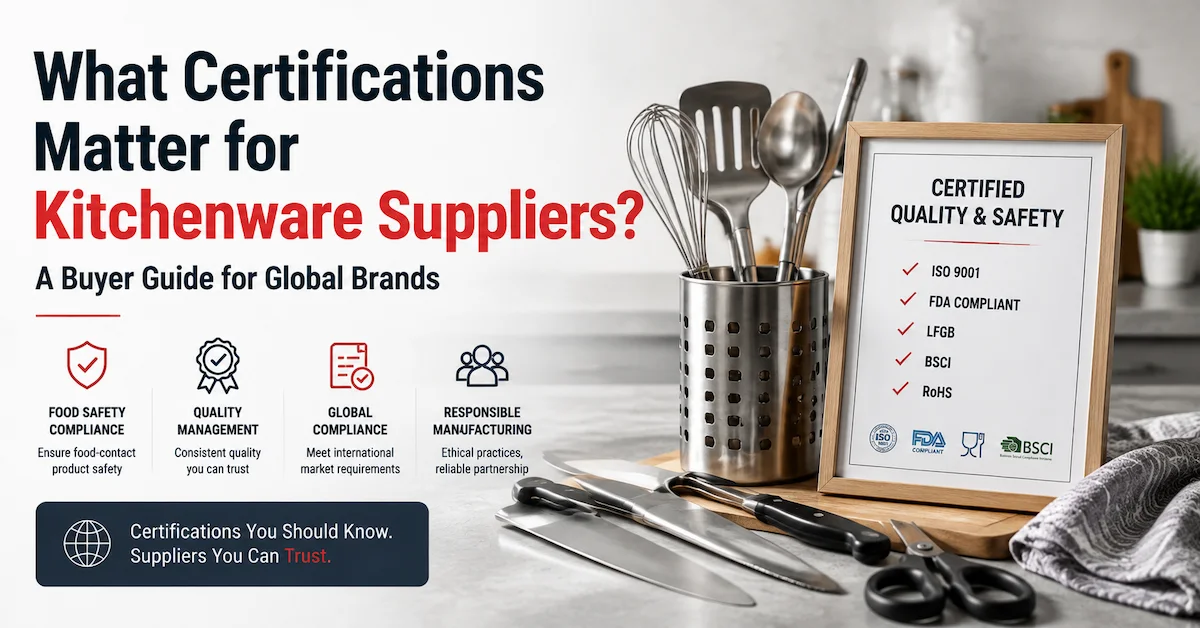
| Certification / Standard | Main Focus | Why Buyers Care |
|---|---|---|
| ISO 9001 | Quality management system | Production consistency |
| Food Contact Compliance | Product safety | Consumer protection |
| FDA Related Requirements | US market requirements | Food safety expectations |
| LFGB Related Requirements | European food contact requirements | Market compliance |
| BSCI / Social Compliance | Responsible sourcing | Supplier responsibility |
| RoHS | Material restrictions | Product compliance |
The right certification combination depends on the product and destination market.
For example:
- Kitchen knives may focus on material quality and manufacturing consistency.
- Silicone utensils may require food-contact safety considerations.
- Plastic kitchen products may require material compliance evaluation.
Food Safety Compliance for Kitchenware Products
Food safety is one of the most important considerations when selecting kitchenware suppliers.
Because many kitchen products are used during food preparation, buyers should understand how suppliers manage:
- Material selection
- Product safety requirements
- Testing procedures
- Manufacturing controls
Stainless Steel Kitchenware
Common products:
- Kitchen knives
- Kitchen scissors
- Metal utensils
Buyers usually evaluate:
- Material specifications
- Surface treatment
- Corrosion resistance
- Product consistency
Silicone Kitchen Tools
Common products:
- Cooking utensils
- Heat-resistant kitchen accessories
Important considerations:
- Food contact suitability
- Material safety
- Heat resistance
- Product durability
Plastic Kitchen Products
Common concerns:
- Material composition
- Chemical restrictions
- Application requirements
A reliable supplier should be able to explain material selection and provide relevant documentation when required.
Why Quality Management Certifications Matter
Quality management certifications help buyers understand how suppliers organize their production processes.
ISO 9001 Quality Management System
ISO 9001 focuses on:
- Process control
- Quality consistency
- Documentation management
- Continuous improvement
For kitchenware buyers, a structured quality management system can indicate that a supplier has established procedures for managing production quality.
However, buyers should not evaluate suppliers based only on certificates. They should also review:
- Manufacturing experience
- Product inspection procedures
- Production capability
- Customer support
Social Compliance Certifications for Kitchenware Suppliers
Global brands increasingly pay attention to responsible supply chains.
Social compliance standards may evaluate:
- Workplace conditions
- Employee management
- Ethical manufacturing practices
- Factory responsibility
Common examples include:
BSCI
Often used by international buyers to evaluate social responsibility practices in supply chains.
Sedex / SMETA
Focuses on ethical business practices and responsible sourcing assessments.
For retailers and global brands, responsible manufacturing can support:
- Brand reputation
- Customer trust
- Long-term supplier relationships
Certifications and Requirements by Kitchenware Material
Different materials may require different evaluation approaches.
Stainless Steel Kitchen Tools
Typical products:
- Knives
- Scissors
- Metal kitchen accessories
Buyer concerns:
- Material quality
- Manufacturing precision
- Surface finish
- Durability
Silicone Kitchen Utensils
Typical products:
- Spatulas
- Cooking tools
- Kitchen accessories
Buyer concerns:
- Food safety
- Material stability
- Product performance
Plastic Kitchen Tools
Typical products:
- Kitchen gadgets
- Tool handles
- Functional components
Buyer concerns:
- Material compliance
- Product safety
- Market requirements
Material selection should match the intended application and target market.
Kitchenware Supplier Certification Checklist for Buyers
Before choosing a supplier, buyers should review more than certificates alone.
A practical evaluation checklist includes:
| Buyer Question | Why It Matters |
|---|---|
| Can the supplier provide valid documents? | Verify compliance |
| Do certifications match the products? | Avoid incorrect assumptions |
| Can the supplier provide test reports? | Support product approval |
| Does the factory control production? | Improve consistency |
| Are quality inspections performed? | Reduce defects |
| Can the supplier support customization? | Develop branded products |
A professional supplier should be able to clearly explain its quality system and compliance capabilities.
Certifications vs Manufacturing Capability: Which Matters More?
Certifications are valuable, but they are only one part of supplier evaluation.
A reliable kitchenware partner should combine:
| Evaluation Factor | Business Value |
|---|---|
| Certifications | Compliance support |
| Manufacturing capability | Production reliability |
| Quality control | Product consistency |
| OEM capability | Custom development |
| Experience | Better problem solving |
| Communication | Project efficiency |
For global brands, the ideal supplier is one that combines compliance awareness with strong manufacturing expertise.
How BONET Supports Quality-Focused Kitchenware Sourcing
For kitchenware buyers, product quality depends on the entire manufacturing process.
Important factors include:
- Material control
- Production management
- Process inspection
- Product consistency
- Packaging quality
BONET supports OEM/ODM kitchenware projects with services including product development, material selection, color customization, logo customization, packaging solutions, and manufacturing support. BONET OEM ODM Service
BONET's manufacturing process includes multiple production stages such as stamping, heat treatment, grinding, polishing, injection molding, assembly, quality inspection, cleaning, protection, and packing for related cutting-tool products. BONET Manufacturing Process
How Global Brands Should Choose a Certified Kitchenware Supplier
Before starting cooperation, buyers should consider several questions.
Does the Supplier Understand Your Market?
Different regions may have different expectations for:
- Product compliance
- Packaging
- Documentation
- Customer requirements
Can the Supplier Provide Supporting Documents?
Professional suppliers should be able to explain:
- Available certifications
- Product testing information
- Quality procedures
Does the Supplier Have Manufacturing Experience?
Manufacturing experience affects:
- Product consistency
- Problem solving
- Customization ability
Can the Supplier Support Long-Term Development?
Strong suppliers can support:
- New product development
- Repeat orders
- Market expansion
- Product improvement
FAQ
What are the most important kitchenware supplier certifications?
The most important certifications depend on product type and target market. Common areas include food safety compliance, quality management systems, and social responsibility standards.
Are certifications required for all kitchenware products?
Requirements vary based on materials, applications, and destination markets. Buyers should confirm specific compliance requirements before purchasing.
What certifications are important for food-contact kitchenware?
Food-contact products often require evaluation of material safety, testing requirements, and applicable food-contact standards.
Does ISO 9001 guarantee kitchenware quality?
ISO 9001 shows a structured quality management system, but buyers should also evaluate manufacturing capability and actual quality control practices.
How can buyers verify supplier certifications?
Buyers should check certificate validity, applicable product scope, issuing organization, and whether documentation matches the products being purchased.
Are certifications enough when selecting kitchenware suppliers?
No. Buyers should also evaluate factory capability, production processes, quality inspection, customization ability, and communication.
Do private-label kitchenware brands need certified suppliers?
Private-label brands benefit from working with suppliers that understand compliance requirements and can provide supporting documentation.
What should buyers check besides certifications?
Important factors include product quality, manufacturing experience, materials, quality control, packaging, and supplier reliability.
Can BONET support OEM kitchenware projects?
Yes. BONET provides OEM/ODM kitchenware solutions including product customization, packaging support, and manufacturing services for global business buyers. BONET OEM ODM Solutions
How can buyers contact BONET for kitchenware sourcing?
Global brands and retailers can contact BONET to discuss kitchenware sourcing, OEM projects, and customized product requirements. BONET Contact Us
Conclusion
Understanding kitchenware supplier certifications helps global brands, retailers, and importers make more informed sourcing decisions.
Certifications provide valuable information about compliance, safety awareness, and quality management. However, the best supplier evaluation combines certification review with manufacturing capability, quality control, product experience, and customization support.
BONET helps global buyers develop reliable kitchenware products through professional manufacturing, OEM/ODM solutions, quality-focused production processes, and customized product support.
Brands and retailers looking for reliable kitchenware manufacturing partners can explore BONET products, OEM/ODM services, or contact the team to discuss sourcing requirements. BONET Products BONET Contact Us
