




What Should Buyers Expect From a Multi-Purpose Scissors Manufacturer?
A professional multi-purpose scissors manufacturer should do more than produce a pair of scissors with several added features. The manufacturer needs to balance cutting performance, functional integration, material selection, ergonomic handling, production consistency, and customization requirements.
For B2B buyers, this matters because multi-purpose scissors are often positioned as differentiated kitchen tools rather than basic cutting products. A model may combine food cutting with additional functions such as gripping, opening, or preparation assistance, but every added feature also introduces new manufacturing and quality-control requirements.
A reliable manufacturing partner should therefore be able to support:
- Product and function development
- Blade and handle material selection
- Stable component manufacturing
- Assembly and functional testing
- OEM/ODM customization
- Retail packaging requirements
- Repeat-order consistency
BONET offers kitchen scissors and related kitchenware products for brands, retailers, distributors, and other business buyers. Explore BONET Products
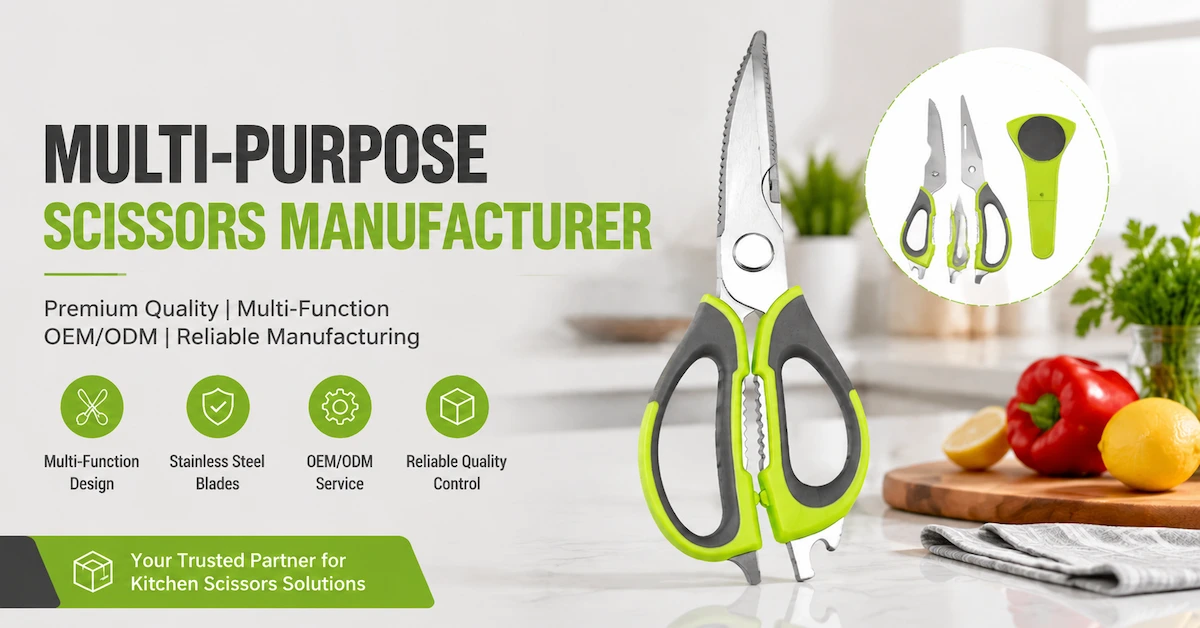
What Are Multi-Purpose Scissors?
Multi-purpose scissors are cutting tools designed to perform more than one practical task.
Depending on the product structure, additional functions may include:
- Food preparation
- Herb cutting
- Packaging opening
- Bottle-opening features
- Gripping or crushing functions
- General household cutting
The commercial value of a multi-purpose design is not simply the number of functions it contains. The more important question is whether those functions are genuinely useful, easy to operate, and compatible with the target customer.
For retailers and private-label brands, a well-designed multifunctional model can create stronger differentiation than a standard pair of kitchen scissors.
Multi-Purpose Scissors vs Standard Scissors
B2B buyers should understand the commercial difference between the two product types before building a collection.
| Factor | Multi-Purpose Scissors | Standard Scissors |
|---|---|---|
| Primary value | Multiple functions in one tool | Simple cutting |
| Product positioning | Mid-range or differentiated | Basic or entry-level |
| Design complexity | Higher | Lower |
| Manufacturing control | More functional checks required | Mainly cutting and assembly |
| Retail storytelling | Stronger feature-based messaging | Straightforward |
| OEM potential | High | Moderate |
| Best suited for | Brands, gifts, e-commerce, functional ranges | General retail and basic ranges |
A multi-purpose product is not automatically better. Standard scissors may remain more appropriate where simplicity, familiarity, and low manufacturing complexity are priorities.
What Product Features Should Buyers Evaluate?
A multi-purpose scissors manufacturer should be able to explain how each feature affects product performance and manufacturing.
Blade Performance
The blade remains the core functional component.
Buyers should evaluate:
- Cutting smoothness
- Blade alignment
- Edge consistency
- Resistance to routine kitchen moisture
- Surface finish
- Stability after repeated opening and closing
For kitchen applications, stainless steel is commonly used because it can provide a practical balance of durability, corrosion resistance, appearance, and maintenance.
Functional Integration
Additional features should improve usability rather than make the product complicated.
For example, a multifunctional model may integrate:
- Serrated gripping areas
- Opening functions
- Crushing areas
- Specialized blade profiles
Buyers should ask whether each feature has been tested in its intended application.
Handle Design
Handle geometry influences both comfort and safety.
Important considerations include:
- Grip size
- Finger opening dimensions
- Left/right-hand usability where relevant
- Surface texture
- Handle rigidity
- Comfort during repeated cutting
An attractive handle is not enough if the user cannot maintain stable control.
Why Material Selection Matters
Material choice directly affects product durability, appearance, positioning, and cost.
Blade Materials
For many kitchen scissors, stainless steel is a practical option because it supports:
- Corrosion resistance
- Stable appearance
- Routine cleaning
- Reliable cutting applications
However, buyers should avoid assuming that every stainless steel blade performs the same way. Material specification, processing, grinding, heat treatment where applicable, and assembly all influence the finished product.
Handle Materials
Handles may use plastics, elastomeric components, or composite structures depending on the design.
Buyers should consider:
- Strength
- Grip comfort
- Color stability
- Surface feel
- Intended application
For OEM programs, handle material and color are also important elements of brand differentiation.
How Manufacturing Affects Multi-Purpose Scissors Quality
Multifunctional scissors place greater demands on manufacturing because several features need to work together.
A typical production workflow may involve:
- Material preparation
- Blade forming
- Grinding and edge processing
- Surface finishing
- Handle/component production
- Assembly
- Functional testing
- Appearance inspection
- Packaging
BONET presents manufacturing information covering cutting-tool production and inspection processes for its kitchenware business. View BONET Manufacturing
Blade Alignment
Poor alignment can lead to:
- Uneven cutting
- Excessive resistance
- Poor user experience
- Faster wear at contact points
Pivot and Joint Control
The pivot affects how smoothly the scissors open and close.
Buyers should check:
- Appropriate tension
- Stable connection
- Smooth operation
- No excessive looseness
Function-to-Function Compatibility
Added functions should not interfere with normal cutting.
For example, a bottle-opening or gripping feature should not make the handle uncomfortable or weaken the structure.
Quality Control Checklist for Multi-Purpose Scissors
A useful supplier evaluation should focus on measurable product behavior rather than general statements such as “high quality.”
| Inspection Area | What Buyers Should Check |
|---|---|
| Blade alignment | Smooth, consistent cutting |
| Cutting test | Performance on intended materials |
| Pivot | Stable but smooth movement |
| Handle | Comfort, strength,secure assembly |
| Additional functions | Each function works as intended |
| Surface | Consistent finish and appearance |
| Branding | Correct logo and placement |
| Packaging | Matches approved specification |
For custom projects, the approved sample should become an important reference for later production inspection.
How to Evaluate a Multi-Purpose Scissors Manufacturer
Supplier selection should combine product evaluation with manufacturing and commercial capability.
1.Check Whether the Manufacturer Understands the Application
A manufacturer should ask questions about:
- Target users
- Sales channel
- Intended functions
- Product positioning
- Packaging format
- Target market
A supplier that immediately quotes without understanding the product requirement may not be the strongest development partner.
2. Review Relevant Product Experience
Ask to review models related to:
- Kitchen scissors
- Multifunctional scissors
- Detachable scissors
- Food-preparation tools
Relevant experience reduces development uncertainty.
3.Evaluate Sample Quality
A physical sample can reveal issues that drawings cannot.
Check:
- Cutting feel
- Handle comfort
- Function usability
- Weight and balance
- Surface quality
4. Understand Quality-Control Procedures
Ask which inspections are performed during:
- Incoming material control
- Production
- Assembly
- Final inspection
5.Confirm Commercial Requirements
Before committing to a project, confirm:
- MOQ
- Sample requirements
- Customization scope
- Production lead time
- Packaging
- Shipping preparation
These figures can vary by model and customization level, so they should be confirmed for the specific project rather than assumed from generic supplier claims.
OEM and Private Label Multi-Purpose Scissors
OEM capability is particularly valuable for multifunctional products because buyers often need differentiation.
Common customization directions include:
Product Appearance
- Handle colors
- Surface finishes
- Product combinations
Branding
- Logo printing
- Laser marking where suitable
- Private-label packaging
Functional Development
Depending on feasibility,manufacturers may help buyers adjust:
- Blade configuration
- Handle structure
- Integrated functions
- Product combinations
Retail Packaging
Packaging may need to support:
- Supermarket shelves
- E-commerce fulfillment
- Gift positioning
- Private-label branding
BONET's OEM/ODM offering includes customization based on drawings or samples, material and color options, logo solutions, packaging customization, and product-development support.BONET OEM ODM Services
Which Buyers Are Multi-Purpose Scissors Suitable For?
Kitchenware Brands
These buyers typically need:
- Product differentiation
- Consistent brand design
- OEM development
- Stable repeat production
Retail Chains
Retail buyers may prioritize:
- Clear consumer value
- Packaging
- Reliable supply
- Competitive product positioning
Wholesalers and Distributors
They often focus on:
- Broad customer appeal
- Repeat availability
- Quality consistency
- Multiple models
E-Commerce and Private-Label Brands
Online sellers may value:
- Distinct functions
- Visual differentiation
- Bundling potential
- Custom packaging
The ideal product configuration should therefore be determined by channel rather than simply copying an existing model.
Manufacturer vs Supplier: Which Should Buyers Choose?
A manufacturer and a general supplier may both be able to provide finished products, but they offer different advantages.
| Requirement | Direct Manufacturer | General Supplier |
|---|---|---|
| Production control | Usually stronger | Depends on sourcing network |
| Custom development | Often stronger | Varies |
| Product variety | Focused on production scope | May be broader |
| Technical communication | More direct | May involve intermediaries |
| OEM projects | Often suitable | Depends on partner factories |
| Multi-category sourcing | More limited | Can be advantageous |
For a custom multifunctional scissors project, direct manufacturing communication can be especially useful because product structure and function may require repeated development adjustments.
Cost: Why the Lowest Quote Is Not Always the Best
Multi-purpose scissors should be evaluated through total sourcing value rather than unit price alone.
A lower quotation may become expensive if it leads to:
- Rework
- Returns
- Poor reviews
- Packaging problems
- Inconsistent repeat orders
Buyers should compare quotations together with:
- Materials
- Product specifications
- Customization scope
- QC requirements
- Packaging
- Supply reliability
This approach provides a more realistic supplier comparison.
Questions to Ask Before Ordering
Before selecting a multi-purpose scissors manufacturer, buyers can ask:
- Which functions are already proven in existing products?
- What blade and handle materials are available?
- Can you produce from our drawing or sample?
- Which parts can be customized?
- What quality checks are performed?
- Can we approve samples before production?
- What packaging options are available?
- What are the MOQ and lead time for this specific configuration?
- How are repeat orders controlled against the approved specification?
Clear answers make supplier comparison more objective.
FAQ
What is a multi-purpose scissors manufacturer?
A multi-purpose scissors manufacturer produces scissors designed for more than basic cutting and may support product development, manufacturing, testing, OEM customization, and packaging for business buyers.
What functions can multi-purpose kitchen scissors include?
Depending on the model, they may support food cutting, herb preparation, package opening, gripping, crushing, or bottle-opening functions.
What materials are commonly used for multi-purpose scissors?
Stainless steel is commonly used for kitchen-scissor blades, while handles may use suitable plastic, elastomeric, or composite materials depending on the design.
How should buyers test multi-purpose scissors?
Buyers should test cutting performance, pivot movement, handle comfort, assembly stability, and every additional advertised function.
Can multi-purpose scissors be customized?
Yes. Customization may include colors, logos, packaging, product structure, and function combinations depending on manufacturing feasibility.
Are multi-purpose scissors suitable for private-label brands?
Yes. Their differentiated features and customization potential can make them suitable for private-label kitchenware collections.
What should buyers confirm before mass production?
Confirm the approved sample, specifications, materials, branding, packaging, inspection requirements, MOQ, and production schedule.
Does BONET support custom kitchen scissors projects?
BONET provides OEM/ODM kitchenware support including customization, branding, packaging, and product-development services for business buyers. Contact BONET
Conclusion
Choosing a reliable multi-purpose scissors manufacturer requires evaluating more than product appearance or price.
Global buyers should focus on:
- Useful functional design
- Appropriate materials
- Blade and pivot performance
- Manufacturing consistency
- Quality-control procedures
- OEM/ODM capability
- Commercial reliability
For brands, retailers, distributors, and private-label businesses, the right manufacturing partner can turn a multifunctional scissors concept into a consistent and market-ready product rather than simply adding more features to a basic tool.
BONET supports kitchen scissors and customized kitchenware development for global B2B buyers, with product, manufacturing, OEM/ODM, and sourcing support available through its website. Explore BONET Products
