




Non Stick Cookware Supplier: How to Source the Right Utensil Line
Choosing a non stick cookware supplier is rarely just about buying pans or adding a few utensils to a catalog. For retail buyers, OEM teams, and wholesale distributors, the real task is building a kitchenware line that protects coated cookware, feels coherent on the shelf, and performs as expected in everyday use.
Non-stick compatibility depends on more than a product label. A utensil can look suitable in photos but still create complaints if the edge is too hard, the handle joint is weak, or the assortment lacks the tools people actually use. A strong supplier conversation should cover materials, construction, intended use, finish consistency, packaging, and after-sampling evaluation.
Key Takeaways
- Source non-stick utensils as a system, not as disconnected single items.
- Inspect working edges, seams, handle joins, and color consistency before approving samples.
- Ask suppliers to confirm materials, use limits, care instructions, packaging options, and compliance documents where required.
- Match the line to the selling channel: home retail, gift sets, cookware bundles, or food-service support.
What Buyers Mean by a Non Stick Cookware Supplier
When buyers search for a non stick cookware supplier, they may be looking for several different things: coated pans, non-scratching utensils, cookware accessory sets, or a supplier that can support private-label packaging. The first sourcing step is to define the scope clearly.
If the project is a utensil line for non-stick cookware, the priority is surface protection. Tools should have smooth working ends and shapes that slide under, stir, lift, or serve food without gouging a coated surface. If the project is a cookware bundle, the utensils must also match the cookware’s market positioning and user expectations.
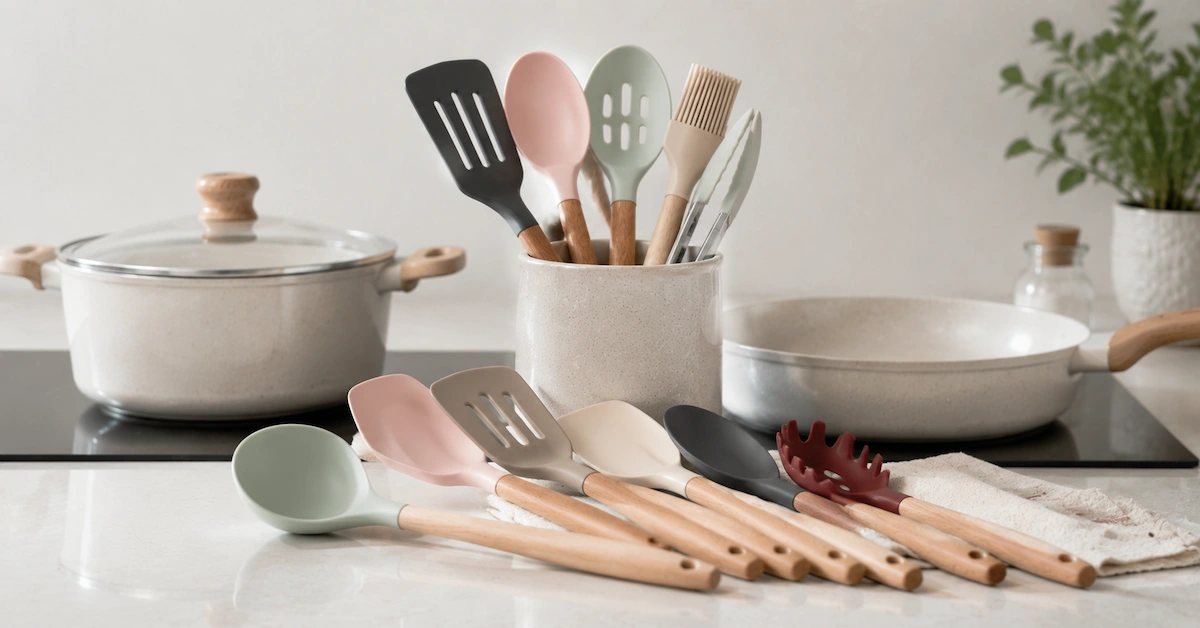
The product image shows a coordinated utensil assortment with items such as spatulas, spoons, a pasta or serving tool, a pastry brush, and tongs or clips. This type of set is useful for everyday cooking because it covers common tasks without relying on metal contact. For sourcing teams, the question is whether the supplier can maintain the same quality across every piece in the set.
Why Non-Stick Compatibility Is a Sourcing Issue
Non-stick cookware has limited tolerance for sharp tools, stiff edges, rough seams, and poor user habits. A supplier’s catalog may describe items as suitable for non-stick cookware, but buyers should still verify how the product behaves in real kitchen use.
Compatibility involves several factors. The working end should appear smooth and forgiving. The tool geometry should help users lift or stir food without scraping aggressively. The handle should feel stable enough for the intended duty level. If the utensil includes more than one material, the joint between the handle and head should be neat and easy to clean.
Because the original information does not confirm exact material grade, dishwasher safety, temperature limits, or food-contact certification, buyers should not assume these details. They should request written confirmation from the supplier and review the documents against the market where the products will be sold.
What a Practical Utensil Line Should Include
A useful non stick utensils supplier should offer more than one shape. Different cooking tasks require different edges and bowl depths. A basic retail or bundle assortment usually benefits from a balanced mix rather than many near-duplicate pieces.
- Slotted spatula or turner: useful for eggs, pancakes, fish, and draining oil or liquid.
- Solid spoon: suitable for stirring sauces, mixing, and serving.
- Slotted spoon: helpful for lifting food while leaving liquid behind.
- Ladle-style spoon: practical for soups, stews, and sauces.
- Pasta or serving tool: adds utility for noodles and larger serving tasks.
- Pastry brush: extends the set into baking and glazing use.
- Tongs or clips: support handling tasks that spatulas and spoons cannot perform well.
For B2B buyers, the assortment should also make sense commercially. A set with too many pieces can raise cost and packaging complexity without improving customer value. A set with too few pieces may not feel complete enough for a cookware bundle or retail display.
Supplier Evaluation Checklist
Before placing a wholesale or OEM order, compare suppliers using practical sourcing criteria. The table below can be used during sample review and supplier discussions.
| Check Area | What to Review | Questions to Ask |
|---|---|---|
| Working end | Smoothness, flexibility, edge shape, visible seams | Is the tool designed for coated cookware surfaces? |
| Handle and joint | Grip comfort, join quality, residue traps, finish uniformity | How is the head attached to the handle? |
| Material clarity | Declared handle and head materials | Can the supplier provide written material details? |
| Assortment | Usefulness of each SKU in the set | Are there duplicate tools that add cost but little value? |
| Packaging | Retail display, hanging holes, set presentation, private label needs | What packaging formats and artwork support are available? |
| Documentation | Care instructions, compliance documents, test reports if applicable | Which documents are available for the target market? |
OEM and Wholesale Sourcing Questions
For private-label and wholesale programs, the right supplier is not only the one with attractive samples. It is the one that can answer commercial and technical questions clearly. Buyers should ask about available colors, finish consistency across production, carton packing options, barcode or label support, and whether custom packaging is possible.
Commercial terms should be confirmed directly. Do not assume minimum order quantity, lead time, price tiers, payment terms, or exclusivity from a product photo or brief listing. Ask the supplier what options apply to your order size and market.
It is also sensible to ask how the supplier handles pre-production samples, approved reference samples, color matching, and inspection criteria. For multi-piece utensil sets, small variations can become obvious when products are displayed together. A controlled approval sample helps reduce disputes later.
Common Buyer Mistakes to Avoid
One frequent mistake is sourcing by appearance alone. Muted colors, wooden-looking handles, and soft finishes can create a cohesive look, but performance depends on construction and use suitability. Inspect the tool, not just the presentation.
Another mistake is treating “non-stick safe” as a complete specification. Buyers should define what the term means for their program. Does it refer to the working end material, the edge finish, the absence of metal contact, or the intended use with coated cookware? Clear specifications help suppliers quote accurately and help buyers compare offers fairly.
A third mistake is ignoring the end user. A utensil set for home cooking may not be suitable for a high-throughput food-service environment. If the product will be used in heavier conditions, ask the supplier whether the line is intended for that duty level and what evidence supports the recommendation.
Sampling and Inspection Before Order Approval
Samples should be tested as a set. Check whether the utensils feel balanced, whether the edges are smooth, and whether each piece has a distinct purpose. Review the handle finish, hanging holes, color consistency, and any visible joints. If the product includes a brush or tongs, inspect those items separately because their construction differs from spoons and spatulas.
Buyers should also review cleaning and care information. If dishwasher safety, heat resistance, or food-contact compliance is important for the sales market, request supplier confirmation and supporting documentation. Missing information should be treated as an open question, not as an assumed feature.
FAQ
Is a non stick utensils supplier the same as a cookware supplier?
Not always. Some suppliers focus on pans and pots, while others specialize in utensils and cookware accessories. A buyer sourcing a bundle may need both capabilities or one supplier that can coordinate the full line.
What makes a utensil suitable for non-stick cookware?
A suitable utensil usually has a smooth working end, non-abrasive edge profile, and a shape that moves food without digging into the coating. Buyers should confirm the actual material and intended use with the supplier.
Should buyers ask for compliance documents?
Yes, if the products will be sold in markets where food-contact, labeling, or safety documentation is required. The exact documents depend on the target market and product materials.
Can one supplier support retail, OEM, and wholesale orders?
Some suppliers can, but buyers should verify packaging support, order terms, sampling process, and production consistency. These details should be discussed before committing to a program.
Next Step for Sourcing Teams
Shortlist suppliers that can present a coherent utensil assortment, answer material questions clearly, and support the packaging format your channel requires. Then request samples, inspect every working edge and handle joint, and compare the set against your intended use case. A good non stick cookware supplier should help you reduce product risk, not create uncertainty after the order is placed.
