








Why buyers start looking for an ODM kitchenware supplier
When sourcing kitchen tools and countertop accessories, many product teams are not looking for a blank-sheet design project. They want a practical route to market: a coordinated set, a cleaner shelf presentation, and fewer unknowns in development. That is where an ODM kitchenware supplier becomes relevant. Instead of commissioning every item from scratch, buyers can work from existing product platforms and adjust the details that matter most, such as materials, colorways, packaging, and branding.
This matters because kitchenware sits in a crowded middle ground. It is not as technically complex as cookware with precise heat-transfer requirements, but it is not a simple throwaway category either. Small details shape consumer perception fast. A utensil holder that feels steady, a cutting board that looks finished, or a chopper that seems easy to handle can make the difference between a set that moves and one that lingers on the shelf. For sourcing managers, the decision is often less about finding the fanciest product and more about finding the right balance of design control, manufacturability, and commercial speed.
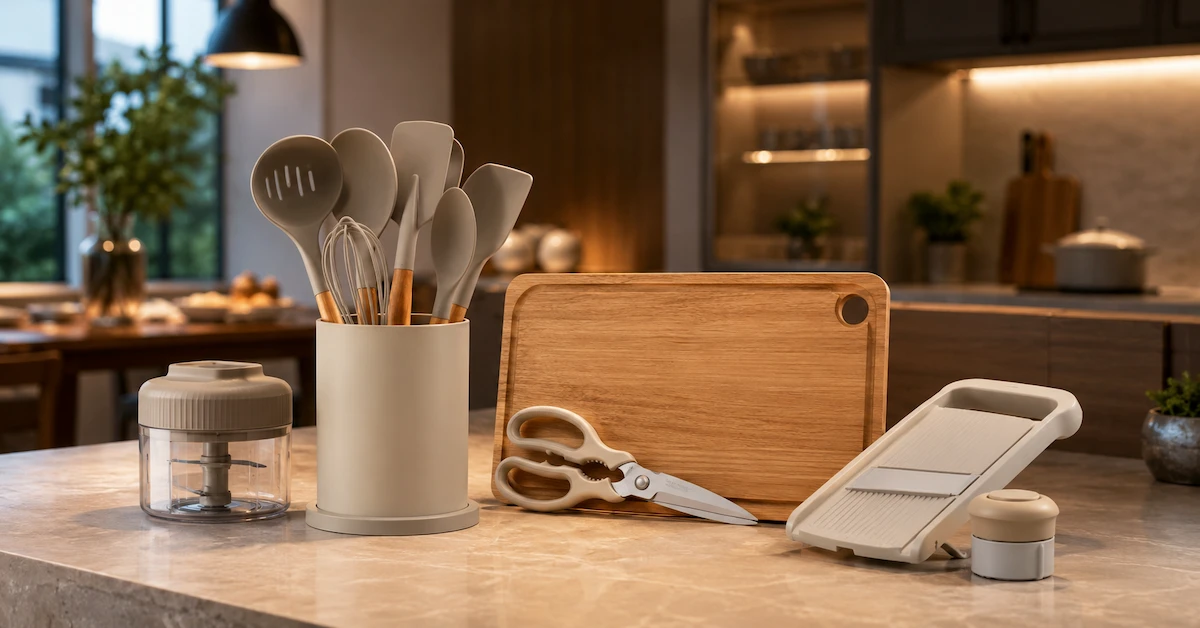
The coordinated countertop set described here is a good example of what private label kitchenware often looks like in practice: a utensil holder with cooking tools, a whisk, kitchen scissors, a wooden cutting board, a compact manual food chopper or mini processor, a handheld slicer or grater-style tool, and a small lidded container. The palette is neutral and domestic, with light beige, off-white, and natural wood finishes. That kind of visual consistency is deliberate. It helps a product line feel like a family rather than a collection of unrelated parts.
What an ODM kitchenware supplier usually brings to the table
An ODM kitchenware supplier typically offers more than manufacturing capacity. The real value is pre-developed product knowledge. In a kitchenware factory, that may mean existing mold families, established component combinations, and practical experience with how plastic housings, stainless-steel parts, and wood elements fit together in a consumer-ready set.
For buyers, this can shorten development time and reduce the risk of starting from zero. It also means the supplier may already understand common weak points: handles that flex too much, cutting boards that warp visually in a retail display, tool holders that tip when loaded unevenly, or slicer frames that look sharp but feel awkward in the hand. Those are not glamorous issues, but they are the ones that show up in returns and product reviews.
That said, ODM is not the same as “off the shelf and done.” Good programs still need careful definition. Private label kitchenware may need custom branding, packaging language, surface finish changes, or a revised set composition to fit a retailer’s price ladder. The supplier’s role is to provide a workable base and then adapt it without compromising the product’s day-to-day usability.
A quick read on the product mix
The photographed assortment suggests a coordinated prep-and-serve set rather than one standalone hero item. That is useful commercially because multi-item kitchen sets can satisfy more than one shopper motive at once. Some customers want organization. Others want a giftable bundle. Others simply want to replace mismatched tools with a tidier, more cohesive setup.
The visible items point to several different manufacturing approaches:
• The wooden cutting board likely relies on wood processing, shaping, sanding, and finishing.
• The whisk and scissor blades suggest stainless-steel forming and assembly.
• The utensil holder, chopper body, and slicer frame appear to be molded plastic components.
• Some handles may use plastic or silicone-coated finishes, with wood or wood-look accents to soften the overall look.
From a sourcing standpoint, that mix is common and sensible. It allows the set to stay lightweight and visually warm while keeping the functional parts durable enough for kitchen use. But it also raises the coordination burden. Different materials age differently, pack differently, and can create mismatched quality impressions if one part looks premium and another looks too thin or glossy.
How to evaluate a kitchenware set before you commit
Buyers often focus on the headline item and miss the supporting pieces. In kitchenware, the supporting pieces are usually what determine sell-through. A counter set should feel stable and coherent. A hand chopper should not look like a toy. A slicer should read clearly as a food-prep tool rather than an awkward plastic object with a blade.
1. Check the use case, not just the SKU count
A larger item count does not automatically make a stronger product. The better question is whether each item earns its place. In this set, the utensil holder, whisk, scissors, cutting board, chopper, slicer, and small container create a broad prep workflow. That gives the retail story more structure than a random assortment of utensils. It also helps buyers position the line for home kitchens, starter apartments, or gift purchases.
2. Study the material mix
Material pairing is where many kitchen products succeed or fail visually. Wood can add warmth, but it should not look unfinished. Plastic can lower weight and cost, but the mold quality has to be clean enough to avoid a cheap impression. Stainless-steel elements should look intentional, not merely inserted. If a set mixes all three, as this one appears to do, alignment in color and finish becomes especially important.
3. Think about countertop footprint
The image suggests a compact footprint, which is a real selling point. Many home buyers want tools that can live on the counter without cluttering the space. A straight-sided utensil holder and small coordinated accessories make sense in that context. For retailers, compact sets also photograph well and fit better into giftable packaging formats.
4. Don’t overpromise on performance
This is a small but important caution. From an image alone, no one can confirm heat resistance, dishwasher safety, blade grades, or long-term durability. A kitchenware factory can probably offer those details later in the project, but they should be verified during sampling and testing, not assumed from appearance. Buyers who lock claims too early usually create packaging headaches later.
Common sourcing mistakes with private label kitchenware
One frequent mistake is treating all kitchen tools as interchangeable. They are not. A whisk, a slicer, and a mini chopper each carry different user expectations. The whisk must feel balanced. The chopper must appear safe and easy to clean. The slicer must communicate control. If the design language is too generic, the entire set loses credibility.
Another issue is ignoring how a set will be merchandised. A countertop cluster like this works because it tells a story at a glance. But if the packaging splits the items poorly, or if the color palette varies too much between components, the retail effect weakens. Private label kitchenware often wins on presentation as much as on function.
There is also a temptation to let suppliers decide too much. An ODM kitchenware supplier can guide structure and manufacturability, but the buyer still needs to define the market position. Is this a value set, a gift set, or a design-led home organization item? Those choices affect materials, finish, and accessory count. A product can be technically sound and still miss the shelf if the commercial brief is vague.
What to ask a kitchenware factory during RFQ and sampling
Keep the early conversations practical. Ask which parts are standard and which need new tooling or revised components. Ask what can be changed without affecting the core design logic. Ask how the pieces will be packed so they arrive without scuffing or deformation. Those are the questions that save time later.
For this kind of set, buyers should also ask about assembly sequence and quality checks. Multi-material products often fail at the seams: loose blade retention, unstable holders, rough board finishing, or awkward fit between lid and body on small containers. A factory that knows the category will usually have a sensible response, but you still want that response on record before you approve samples.
If you are evaluating private label kitchenware for retail, ask how the supplier handles branding placement across different materials. A logo on wood, a mark on molded plastic, and a label on a metal tool will not behave the same way. Inconsistent branding can make an otherwise attractive line feel stitched together.
Buyer-facing checklist for this product type
If the goal is a coordinated kitchen set, the most useful buying checklist is the one that stays close to actual use:
• Does the set solve a real kitchen workflow, or does it just look full?
• Do the materials feel visually consistent across the whole assortment?
• Is the holder stable enough when the tools are inserted and removed repeatedly?
• Does the cutting board present as a finished consumer product, not a rough utility item?
• Are the small devices easy to explain on a package front panel?
• Can the supplier support the branding and packaging style your market expects?
Those questions sound basic, but they catch problems early. And in kitchenware, early is the only time problems are inexpensive.
FAQ: practical questions buyers usually ask
Is ODM better than fully custom development?
Not always, but it is often faster and less risky for commodity-adjacent categories like kitchen tools. If the market needs speed, ODM is usually the smarter starting point.
Can a single kitchenware factory produce all these items?
Sometimes yes, sometimes no. Sets like this may involve different production lines or partner processes for wood, plastic, and metal components. That is normal, but it should be clarified early.
What makes this kind of set attractive to retailers?
The combination of utility and presentation. A coordinated neutral set looks giftable, photographs well, and can fit into home organization, starter home, or seasonal merchandising themes.
What should buyers verify before launch?
Usability, packaging durability, material consistency, and any product claims that will appear on the carton or product page. Do not assume performance details from appearance alone.
Next step for sourcing teams
If you are comparing an ODM kitchenware supplier against a fully custom route, start with a clear brief: target customer, desired set composition, acceptable material palette, and branding requirements. From there, ask for sample options and build a shortlist based on how well the supplier handles coordination across the whole set, not just one hero item.
In this category, the best partner is usually the one that understands how a countertop set needs to look in a real kitchen, not just in a catalog. That is where product quality, commercial logic, and practical manufacturing experience have to meet.
