




ODM Kitchenware Supplier Guide for Private Label Countertop Sets
For many retail buyers and sourcing teams, a countertop kitchenware set is not a pure invention project. The goal is usually to launch a coordinated, practical product line with manageable development risk. That is where an ODM kitchenware supplier can be useful. Instead of designing every tool from the ground up, buyers can start with existing product platforms and then adjust the set composition, color direction, branding, and packaging.
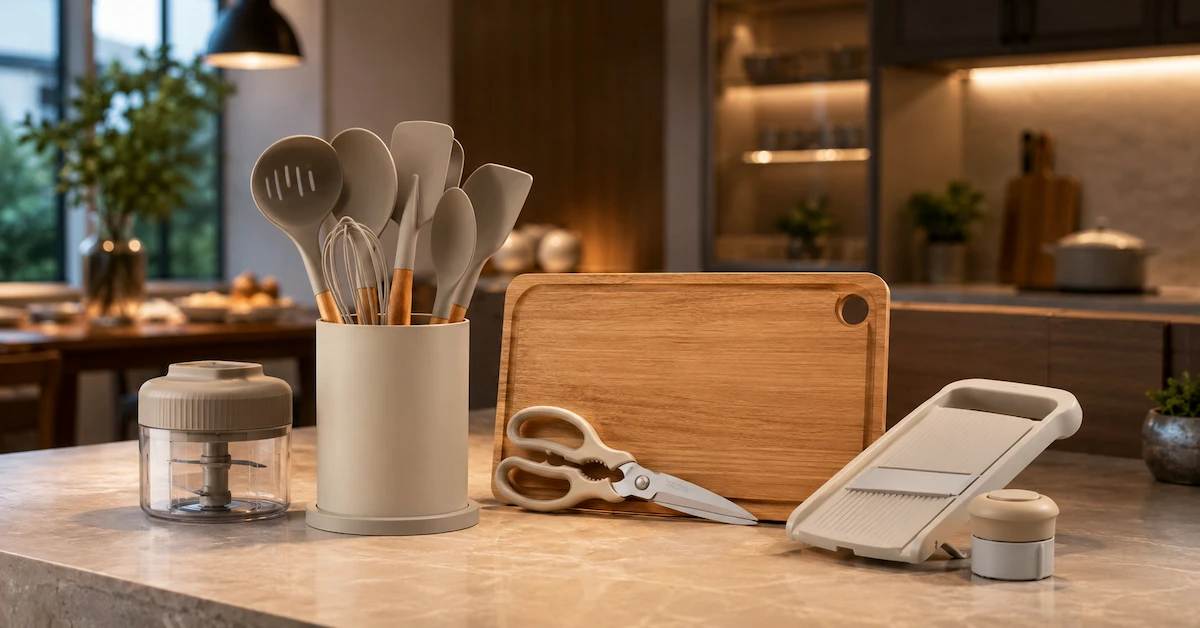
The product shown here reflects a common private label kitchenware approach: a coordinated group of prep and storage items, including a utensil holder with cooking tools, a whisk, kitchen scissors, a wooden cutting board, a compact manual food chopper or mini processor, a handheld slicer or grater-style item, and a small lidded container. The visible palette is neutral, using light beige, off-white, and natural wood tones to create a consistent countertop look.
Key Takeaways
- ODM sourcing can reduce development time, but buyers still need a clear brief and approval process.
- Countertop kitchenware sets should be evaluated as a complete workflow, not just as a list of items.
- Mixed materials such as wood, plastic, and metal require careful checks for finish, fit, packaging, and branding consistency.
- Do not make claims about heat resistance, dishwasher safety, blade grade, or durability unless the supplier provides evidence and samples confirm it.
Why Buyers Choose an ODM Kitchenware Supplier
An ODM kitchenware supplier usually offers pre-developed product concepts that can be adapted for private label programs. This route is attractive when a retailer, importer, or brand owner needs a coordinated kitchenware line without the cost and timeline of full custom development.
The value is not only the physical product. A capable supplier may understand common design and production issues, such as utensil holders tipping when loaded unevenly, plastic parts looking too glossy or thin, wooden boards feeling unfinished, or small choppers appearing difficult to clean. These details influence consumer perception quickly, especially in kitchen tools that are handled often.
However, ODM should not be treated as automatic approval. Buyers still need to define the market position. Is the set intended as an entry-level starter kit, a giftable countertop bundle, a home organization product, or a coordinated private label range? That decision affects item count, finish, packaging structure, and acceptable cost targets.
Understanding the Product Mix
This type of countertop set works because it combines several kitchen tasks in one visual family. The utensil holder organizes tools. The whisk and scissors support everyday prep. The cutting board adds a natural visual element. The small chopper and slicer suggest convenience, while the lidded container supports storage or serving.
From a sourcing viewpoint, the set also brings complexity because it appears to include multiple material and process categories. Wood elements may require shaping, sanding, and finishing. Metal parts may involve forming and assembly. Molded plastic parts may be used for housings, holders, lids, or frames. Each material can create different quality risks, so the set should be reviewed as a combined retail product rather than as isolated components.
ODM vs OEM vs Off-the-Shelf Buying
Before contacting factories, buyers should be clear about the sourcing model. The terms are sometimes used loosely, but they lead to different project expectations.
| Sourcing route | Best use case | Buyer should clarify |
|---|---|---|
| ODM | Adapting an existing supplier design for private label use | Which parts are standard, what can be customized, and whether changes require new tooling |
| OEM | Producing to the buyer's own design or technical brief | Drawings, materials, tolerances, ownership of tooling, and sample approval stages |
| Off-the-shelf | Fast purchasing with minimal customization | Available packaging, branding limits, stock stability, and product consistency between batches |
For a countertop kitchenware set, ODM often sits in the practical middle. It gives buyers more control than a generic stock item but is usually less demanding than a fully custom program.
How to Evaluate a Private Label Kitchenware Set
A strong set should make sense in real kitchen use. Item count alone is not enough. A larger bundle can look attractive in a listing or catalog, but weak pieces can lower the perceived quality of the whole range.
During sample review, focus on practical handling. Does the utensil holder stay stable when tools are removed? Do the scissors open and close smoothly? Does the cutting board feel finished at the edges? Does the small chopper feel safe and understandable? Does the slicer communicate control and caution clearly? These checks are simple, but they often reveal whether the product is ready for retail refinement.
Visual consistency also matters. Neutral colors and wood accents can help a set look coordinated, but only if the tones are controlled across production. Ask the supplier how color matching is handled between plastic, coated surfaces, and natural wood. Natural materials can vary, so expectations should be agreed before mass production.
RFQ and Sampling Questions for the Factory
A useful RFQ should be specific enough to avoid vague answers. Instead of asking only for a price, sourcing teams should ask how the supplier would build, customize, pack, and inspect the set.
- Which items in the set are existing designs, and which would require modified or new tooling?
- What branding methods are possible on wood, plastic, metal, labels, and packaging?
- How are the items protected from scuffing, blade contact, deformation, or movement during shipping?
- What product claims can be supported with documentation, and which claims need additional testing?
- How does the factory control color consistency across multiple materials?
- What quality checks are performed for assembly, fit, surface finish, and packaging?
- Can the supplier provide pre-production samples that match the intended retail packaging?
These questions do not assume any specific certification, capacity, MOQ, or test result. Instead, they help buyers confirm what the supplier can actually support.
Common Sourcing Mistakes to Avoid
One common mistake is allowing the supplier to define the entire product strategy. An ODM supplier can provide valuable structure, but the buyer should still own the commercial brief. Without a clear target customer and shelf position, the final set may become a collection of available items rather than a focused product.
Another mistake is approving appearance before checking use. A countertop set can photograph well but fail in small interactions: a lid that fits poorly, a holder that rocks, a handle that feels weak, or packaging that allows items to rub against each other. These problems are easier to correct at sampling than after purchase orders are placed.
Buyers should also avoid making early marketing claims that have not been verified. Heat resistance, dishwasher safety, food-contact suitability, blade material, and durability claims should be confirmed through supplier documentation and appropriate review for the destination market. If details are not yet available, keep packaging language conservative until the evidence is in place.
Checklist Before Committing to Production
| Review area | What to check | Why it matters |
|---|---|---|
| Set logic | Each item supports a clear kitchen workflow | Prevents a random bundle that feels inflated |
| Material finish | Wood, plastic, and metal look consistent and clean | Protects perceived value on shelf and online |
| Handling | Tools feel stable, safe, and easy to understand | Reduces disappointment after purchase |
| Branding | Logo placement works across different surfaces | Keeps the private label presentation coherent |
| Packaging | Items are separated and protected during transit | Limits scuffs, movement, and retail damage |
| Claims | All product statements are supported before printing | Avoids compliance and relabeling problems |
FAQ for Private Label Buyers
Is ODM the best option for every kitchenware project?
No. ODM is useful when speed, existing product platforms, and moderate customization are priorities. If the buyer needs a unique mechanism, special dimensions, or a proprietary design, OEM or full custom development may be more suitable.
Can one kitchenware factory make every item in a set?
Sometimes, but not always. A set that includes wood, metal, and molded plastic may involve different production lines or partner processes. Buyers should ask who controls final assembly, inspection, and packaging.
What should be checked first in samples?
Start with the user-facing details: stability, fit, finish, sharp edges, loose parts, packaging protection, and whether each item feels consistent with the intended retail position.
How much customization should a buyer request?
Request changes that support the market brief, such as color, packaging, logo placement, or set composition. Avoid unnecessary changes that add tooling cost or production risk without improving customer value.
What information should not be assumed from a product photo?
Do not assume material grade, heat resistance, dishwasher safety, compliance status, blade performance, or long-term durability from images. Ask the supplier for documentation and confirm through sampling.
Next Step for Sourcing Teams
When comparing ODM kitchenware suppliers, prepare a concise brief before requesting pricing. Include the target market, set composition, preferred color direction, branding needs, packaging format, claim requirements, and any retail constraints. Then judge suppliers not only on unit cost, but on how well they explain customization limits, quality controls, sample development, and packaging protection.
For private label countertop sets, the best sourcing decision is usually the one that balances visual coordination, everyday usability, and manufacturing practicality. A good ODM program should help buyers reach that balance without pretending that important details can be skipped.
