




Plastic Handle Knife Set Supplier: What Buyers Should Check
Sourcing a plastic handle knife set is not only about finding a low unit price. For retailers, wholesalers, private-label teams, and kitchenware importers, the real issue is whether the supplier can deliver a set that is consistent, practical, and easy to present to end users. A knife set with a countertop block is bought as a complete kitchen solution, so the blades, handles, block, packaging, and carton protection all need to work together.
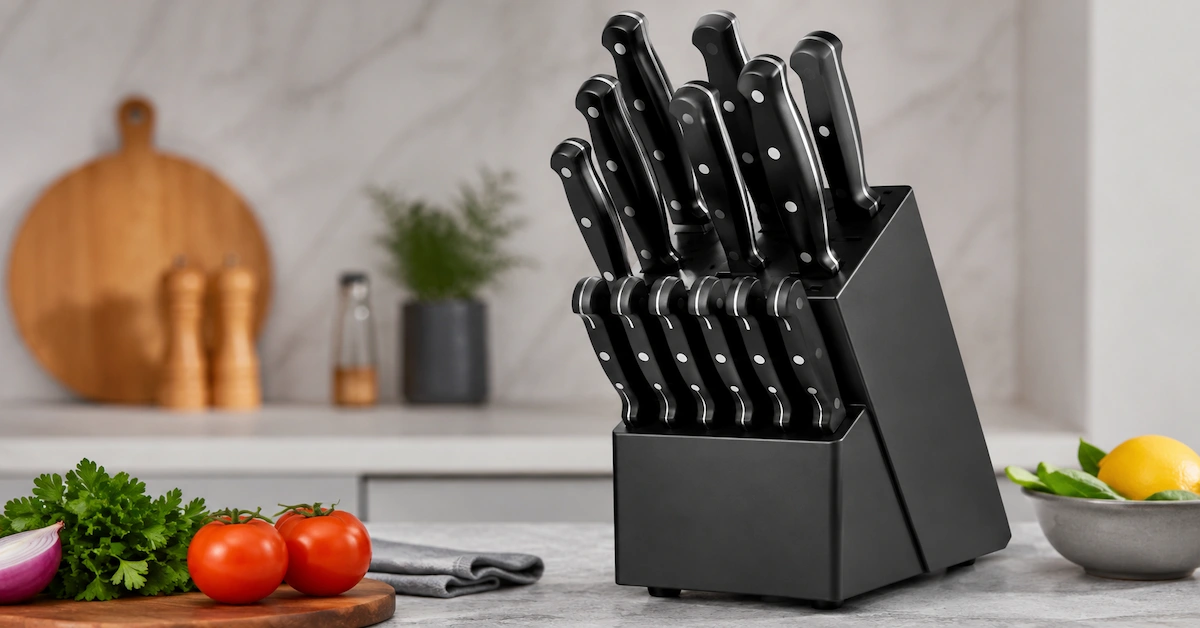
The product shown in the original article uses black handles and a black countertop block. That gives the set a coordinated appearance and makes it suitable for broad household kitchen positioning, but buyers should not infer technical details from the image alone. Material, blade construction, edge treatment, packaging method, and durability expectations should all be confirmed directly with the supplier before an order is placed.
Key Takeaways
- Treat the knife set as a full system: knives, handles, block, packaging, and shipping protection.
- Do not rely on product photos to confirm blade material, handle composition, or finish durability.
- Ask whether the supplier manufactures, assembles, or sources the set through partners.
- Review multiple samples when possible to check repeatability across handles, slots, and packaging.
- Match the set design to the sales channel, such as retail, e-commerce, promotional bundles, or hospitality supply.
Why Buyers Choose Plastic Handle Knife Sets
Plastic or plastic-composite handles are common in everyday kitchen knife sets because they can be molded into repeatable shapes and colors. For buyers managing a product range, this can support consistent visual presentation across cartons, shelves, and online listings. A coordinated black set can also reduce visual mismatch between individual knives, which is useful when the product is sold as a bundle rather than as separate pieces.
The countertop block adds another layer of value. It organizes the knives, reduces loose blade storage, and gives the set a clear display format. For retail shelves and online product photography, the block helps customers understand the assortment quickly. For household users, it can make the knives easier to access during daily meal preparation.
However, plastic handle sets are not automatically suitable for every channel. If the set is intended for demanding foodservice environments, buyers should ask more detailed questions about cleaning expectations, handle attachment, blade performance, and replacement policies. A set that works well for general home cooking may not be the right fit for heavy commercial prep.
Supplier Comparison Checklist
Before shortlisting a plastic handle knife set supplier, compare the details that affect quality, returns, and customer satisfaction. The table below can be used during sample review or supplier qualification.
| Check Point | What to Review | Questions to Ask the Supplier |
|---|---|---|
| Set composition | Number of knives, blade shapes, and whether the assortment fits the target user | Can the set composition be adjusted for retail, wholesale, or promotional programs? |
| Handle material | Actual plastic type, surface finish, color consistency, and grip feel | What material is used for the handles, and can it be documented in the product specification? |
| Handle assembly | Fit around the tang, visible fasteners or decorative rivet-like details, alignment, and gaps | Are the visible rivet-like points functional, decorative, or part of the molding design? |
| Block design | Stability, slot fit, footprint, surface finish, and ease of inserting or removing knives | What material and finish are used for the block, and how is it protected during shipment? |
| Packaging | Blade protection, movement inside the box, carton strength, and scuff prevention | How are the knives and block separated or fixed to prevent damage in transit? |
| Repeatability | Consistency between samples and expected production units | Can multiple samples from the same run be reviewed before confirming volume orders? |
Material and Construction Questions to Confirm
The word “plastic” is too general for purchasing decisions. Different molded materials can vary in rigidity, surface texture, impact behavior, color stability, and perceived quality. Buyers should ask the supplier to identify the handle material clearly and include it in the specification sheet. If the supplier cannot explain the material, the sample should be treated cautiously.
Handle construction also deserves attention. Ask how the handle is formed or attached, whether the tang is full, partial, or another construction type, and whether any visible metal points are functional or decorative. Do not assume a construction method from photographs. A sample may look acceptable from the side while still having gaps, rough transitions, or inconsistent alignment.
Blade information should also be confirmed in writing. Ask what blade material is used, how the edge is finished, whether there is any coating, and what maintenance guidance should be provided to end users. If a supplier makes claims about corrosion resistance, dishwasher suitability, or food-contact compliance, buyers should request supporting documentation rather than treating those statements as automatic.
Block Design and Packaging Matter More Than They Appear
Many buyers focus on the knives and treat the block as secondary. That is a mistake. The block affects the way the product looks on a counter, how safely the knives are stored, and how the set feels when used every day. During sampling, check whether the block sits flat, whether it feels stable when a knife is removed, and whether the slots guide the blades smoothly.
The finish on a black block should also be reviewed carefully. A matte or dark surface can look clean in photography, but scratches, chips, dust, or fingerprints may become visible during handling. Ask how the block surface is produced and how it is protected during packing. If the product will be shipped through e-commerce channels, extra internal protection may be needed to reduce movement inside the box.
Packaging is especially important for knife block sets because several hard components sit close together. Poor internal packaging can cause scuffed handles, blade contact, chipped block edges, or loose presentation when the consumer opens the box. Ask the supplier to explain the inner tray, blade sleeves, block wrapping, and carton arrangement before approving the packaging plan.
How to Evaluate Samples Without Overcomplicating It
A practical sample review should include both appearance and use. Remove each knife from the block and reinsert it several times. Check whether the slots feel too tight, too loose, or poorly aligned. Hold each handle and look for seams, sharp edges, inconsistent finish, or visible defects. Place the full block on a flat counter and test whether it rocks.
Then compare multiple samples if possible. One polished sample does not prove repeatable production. Look for variations in handle color, blade alignment, block finish, and packaging fit. Small differences can be normal, but random variation may create customer complaints when the set is sold at scale.
For private-label or wholesale programs, the sample review should also include branding and carton presentation. Ask where logos, labels, inserts, barcodes, and care instructions would be placed. If the supplier offers customization, confirm the limits instead of assuming that every color, mark, or package format is available.
Common Sourcing Mistakes to Avoid
- Choosing by price alone. A lower quote may not include the same packaging, block finish, blade specification, or inspection level.
- Assuming photos confirm quality. Images can show appearance, but they cannot verify blade material, handle composition, edge consistency, or packaging strength.
- Ignoring the block. A weak or unstable block can make the whole set feel poorly designed.
- Under-specifying private-label needs. Branding, carton artwork, inserts, and labeling should be discussed before sampling is finalized.
- Skipping transit protection checks. Knife sets can arrive damaged if the knives and block are not fixed securely inside the package.
Practical FAQ
Is a plastic handle knife set suitable for household kitchens?
Yes, this type of set can be suitable for everyday home cooking when the blades, handles, and block are properly specified. Buyers should still confirm material details and care instructions before listing the product.
Can this type of set be used for hospitality or foodservice supply?
Possibly, but buyers should verify cleaning requirements, handle durability, blade performance, and replacement expectations. Foodservice use can be more demanding than ordinary household use.
What should buyers ask a plastic handle knife set supplier first?
Start with material, construction, set composition, block design, packaging method, and whether the supplier manufactures, assembles, or sources the product through partners.
Should buyers request more than one sample?
Yes. Multiple samples help reveal consistency issues in handle finish, blade fit, block stability, and packaging. Repeatability is often more important than one attractive sample.
Can private-label details be customized?
They may be, but buyers should ask the supplier directly about available options, limitations, lead times, artwork requirements, and any commercial conditions such as MOQ or tooling needs.
Next Step for Sourcing Teams
When comparing plastic handle knife set suppliers, build the specification around real use: blade assortment, handle material, block stability, packaging protection, and channel requirements. Ask clear questions before discussing volume, and document any agreed details in the quotation and sample approval process. A reliable supplier should be able to explain what the product is made from, how it is assembled, and how it will arrive at the customer without relying only on catalog photos.
