




Plastic Houseware Supplier China: What Buyers Should Know
Sourcing plastic houseware from China can look straightforward at first: containers, bowls, colanders, measuring cups, cutting boards, and organizers are familiar products with everyday uses. In practice, this category requires careful supplier evaluation because small details affect retail performance, user satisfaction, shipping efficiency, and repeat orders.
A plastic houseware supplier China buyers consider should be judged on more than catalog variety. The better question is whether the supplier can produce a coordinated kitchen range with consistent molding, reliable part fit, practical nesting, and finishes that match the target market. For importers, wholesalers, private-label teams, and retail buyers, the goal is not only to buy plastic items, but to reduce sourcing risk across a full household product program.
Key Takeaways
- Plastic houseware sourcing should focus on daily-use performance, not only product photos or unit cost.
- Fit, stacking, lid alignment, drainage, color consistency, and surface finish are practical inspection points.
- Do not assume resin type, food-contact status, heat resistance, or compliance documentation unless the supplier confirms them in writing.
- Ask for samples, packing details, and clear specifications before approving private-label or wholesale orders.
What Plastic Houseware Products Usually Include
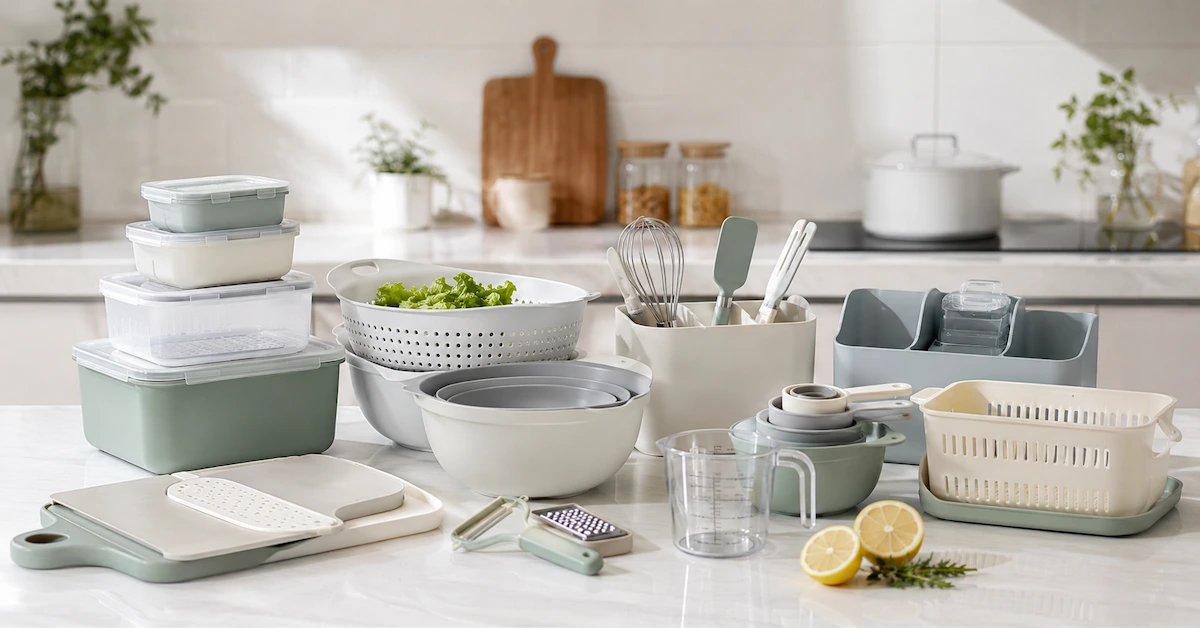
The visible product category covers a broad kitchen houseware set rather than one isolated tool. Typical items include food storage containers with lids, nested bowls, colanders or strain bowls, measuring cups, utensil holders, cutting boards, and small prep accessories. These products support common kitchen tasks such as washing produce, measuring ingredients, storing food, organizing utensils, and saving counter space.
Many modern assortments use square or rectangular shapes, soft neutral colors, translucent pieces, and stackable profiles. These design choices are popular because they work in retail displays and help consumers organize cabinets more easily. However, buyers should treat the assortment as a product system. If one lid fits poorly, one bowl nests awkwardly, or one color varies from the rest, the perceived quality of the whole line can suffer.
How to Evaluate a China Plastic Houseware Supplier
When comparing a China plastic houseware manufacturer or trading supplier, begin with evidence. A long product list is useful, but samples and process details are more important. Ask whether the supplier produces the items directly, sources part of the assortment from partner factories, or combines both models. Each approach can work, but buyers need transparency before planning forecasts, packaging, and quality control.
Important supplier evaluation points include:
- Can the supplier provide samples in the intended colors and product combinations?
- How are lids, containers, and nested parts checked for fit during production?
- Which parts are injection molded, and do any require secondary assembly?
- What packaging method prevents scuffing, deformation, or missing components in transit?
- Can the supplier provide material confirmation and market-specific documents when required?
These questions are especially important for OEM, private-label, wholesale, and retail programs because the buyer is responsible for how the final product performs in the target market.
Product Quality Checklist for Buyers
Plastic household goods are handled frequently, so defects become visible quickly. A container may look acceptable in a photo but fail in practical use if the lid is difficult to align, the surface scratches too easily, or the parts wobble when stacked. The table below gives buyers a simple review framework before placing an order.
| Checkpoint | What to Inspect | Why It Matters |
|---|---|---|
| Nesting and stacking | Test how bowls, containers, and lids sit together | Affects shipping volume, shelf display, storage, and scuffing risk |
| Lid fit | Check alignment, closing force, and consistency across samples | Poor fit often leads to customer complaints and returns |
| Drainage function | Pour water through colanders or strain bowls | Hole placement and bowl shape determine whether water drains properly |
| Measurement markings | Review legibility and position on measuring cups | Users need markings that are easy to read during food preparation |
| Color consistency | Compare lids, bodies, bowls, and accessories under normal light | Mismatched colors make a coordinated set look low quality |
| Packing method | Confirm separators, carton layout, and component count | Good packing reduces scratches, deformation, and missing pieces |
Material and Manufacturing Questions to Ask
The source product group appears to be molded plastic houseware, and injection molding is a common process for this type of kitchen storage and prep assortment. Still, buyers should not assume the exact plastic type, heat resistance, dishwasher suitability, food-contact status, or regulatory compliance unless these details are specified by the supplier and supported by appropriate documentation.
For food-related products, material discussion should happen early. Ask the supplier what resin is intended for each item, whether different components use different materials, and what documents are available for the destination market. If packaging will include claims such as food contact, BPA-free, freezer use, microwave use, or dishwasher use, those claims should be verified before artwork approval. Avoid adding claims simply because competing products use similar language.
Surface finish also matters. Matte and semi-matte finishes can look clean and may hide fingerprints better than glossy surfaces, but texture can influence cleaning, scratch visibility, and mold release. Buyers should review physical samples instead of relying only on renderings or online images.
Common Sourcing Mistakes in Houseware Programs
One common mistake is selecting a supplier based mainly on a low quotation. In plastic houseware, the lowest price can become expensive if the buyer later faces inconsistent color, lid problems, unstable stacking, or retail complaints. A second mistake is approving only one item from a coordinated set. If the program includes containers, bowls, measuring tools, and organizers, the entire assortment should be reviewed together.
Another frequent issue is unclear packaging planning. Retail multipacks, supermarket value sets, e-commerce cartons, and private-label gift packs all require different decisions about part count, carton strength, component protection, and labeling. Ask whether the supplier has packed similar product combinations before, but avoid assuming they can meet your preferred format without a packing trial.
Finally, buyers sometimes leave compliance questions too late. If the item may touch food, the destination market may require specific documentation or testing. The supplier should be asked what they can provide; the buyer should also confirm what is required for import, retail sale, and packaging claims.
Practical Sourcing Process for OEM and Wholesale Buyers
A structured sourcing process reduces surprises. Start with the product use case: kitchen storage, produce washing, dry food organization, prep measurement, or a complete household set. Then define the target retail channel and price position. A supermarket value line may need different colors, packing density, and part counts than a private-label kitchen organization range.
Next, request samples and test them like an end user. Fill containers, close lids repeatedly, stack parts, hold wet colanders, read measuring marks, and place organizers on a counter with real utensils. Share feedback with the supplier in measurable language, such as lid alignment, color tolerance, carton configuration, or sample revision needs.
Before order confirmation, ask for a written specification sheet covering item names, dimensions if available, colors, materials, packing method, artwork responsibility, and inspection criteria. If the supplier does not list a detail, treat it as unconfirmed and ask before production.
FAQ: Plastic Houseware Supplier China
Is one supplier enough for a full plastic houseware line?
Sometimes. One supplier can simplify communication if they can manage multiple product types consistently. For larger programs, buyers should confirm whether all items are made in-house or sourced from partner factories.
What should I check first in samples?
Start with fit, stacking, lid alignment, color consistency, surface finish, and basic usability. These points usually reveal more than a catalog or quotation alone.
Can I assume plastic kitchenware is food safe?
No. Ask the supplier to confirm the material, intended use, and any documents required for your market. Do not print food-contact or usage claims unless they are supported.
Are stackable designs always better?
They are often useful for shipping, storage, and retail display, but they must be tested. Poor nesting can cause scuffing, instability, or difficulty separating parts.
Choosing the Right Supplier for the Next Program
The right plastic household products supplier is not simply the one with the largest catalog. For B2B buyers, the stronger partner is the one that can explain materials, provide realistic samples, control fit and color across components, and answer practical packing and documentation questions clearly.
If you are comparing options for a kitchen storage or prep program, begin with a clear product brief and sample review. Then confirm materials, intended use, packaging, inspection points, and any market-specific requirements before committing to production. That approach helps buyers build a more reliable houseware line and reduces the risk of problems after the goods reach the shelf.
