








What Buyers Should Know Before Ordering Silicone Kitchen Utensils Wholesale
For sourcing teams comparing silicone kitchen utensils wholesale offers, the real question is not just who can supply a colorful set, but who can supply a tool that will hold up in daily cooking, look consistent on the shelf, and behave properly around nonstick cookware. That sounds simple until you start comparing mixed-material sets, because the details that matter in a store or commercial kitchen are often the details that are hardest to verify from a catalog photo.
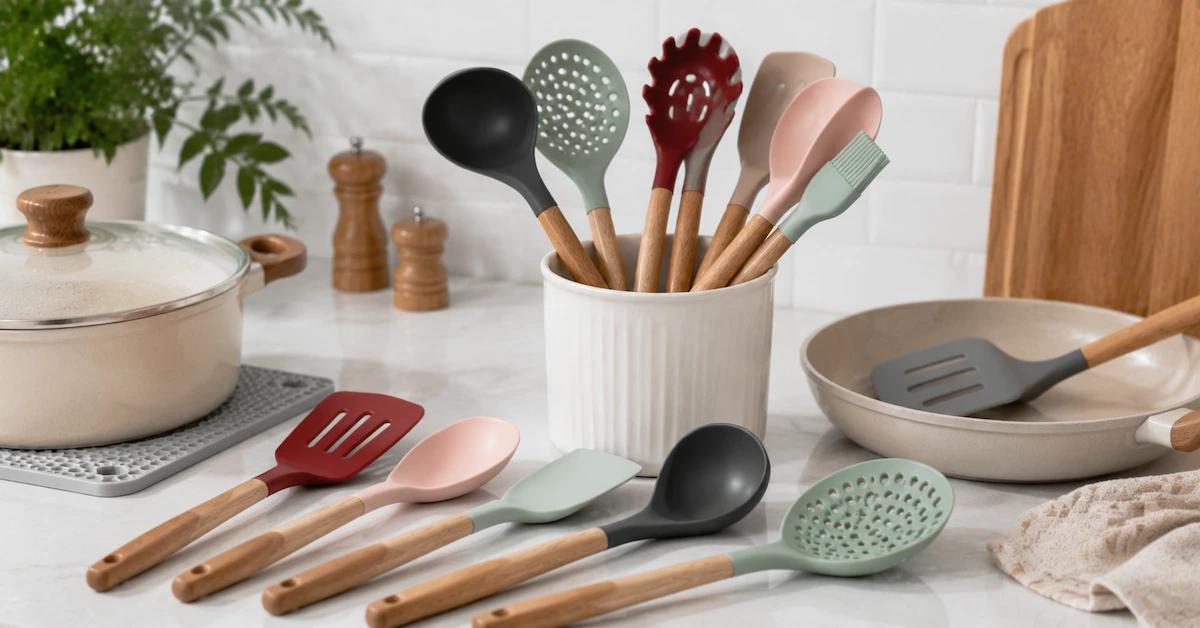
The set described here follows a common market pattern: silicone working ends paired with natural wood handles, arranged as a coordinated multi-piece assortment. It appears to include spoons, ladles, a slotted spoon or skimmer, a slotted turner, a solid spatula, and pasta/server-style pieces. That combination matters because buyers rarely want a single utensil; they want a family of tools that covers stirring, serving, scooping, flipping, draining, and scraping without looking mismatched.
Why This Category Sells
Kitchen buyers usually choose silicone for one practical reason: it is a safer choice for coated pans and everyday hot-food handling than hard metal tools. The silicone working end can move across a nonstick surface without the same risk of scratching, while the shape can be molded into broad spatulas, flexible edges, or slotted heads for draining. In a retail setting, that gives you a simple story to tell. In a food-service setting, it gives the cook a tool that is easier to use across a range of tasks.
The wood handle changes the product story in a useful way. It gives the utensil a warmer touch in the hand, reduces the all-plastic look that some buyers want to avoid, and adds a natural visual cue that works well in consumer kitchenware lines. The tradeoff is that mixed-material construction usually asks more of the buyer: if the silicone is easy to clean, the wood section still needs sensible care expectations, and the attachment between the two parts has to feel secure.
Quick Read on the Product Format
This style of utensil set is built for breadth rather than specialization. Instead of selling one premium ladle or one chef-specific spatula, the assortment covers the day-to-day range of kitchen motions. That makes it attractive to retailers, private-label kitchen brands, and suppliers building starter sets or giftable bundles.
From the image cues alone, a few features are clear: multiple utensil types in one coordinated line, several color options including black, sage green, red, beige, pink or peach, and gray, and hanging holes on some handles for storage. Those are small details, but they matter on the sales floor. A set that looks unified usually photographs better, merchandises better, and is easier for a buyer to position as a collection rather than a loose mix of utensils.
Construction Details That Matter in Sourcing
Silicone head performance
The working end is the part buyers should inspect first. Silicone heads are expected to tolerate heat, flex enough for scraping and mixing, and keep their shape after repeated use. But sourcing teams should not assume every molded silicone part performs the same way. Grade, wall thickness, design geometry, and the way the head is joined to the handle all influence real-world durability. A broad spatula with a thin edge behaves differently from a deep ladle or a slotted skimmer, even if the outer finish looks similar.
If a supplier is positioning itself as a heat resistant silicone utensils supplier, ask what that claim means in practice. Is the statement based on the silicone compound, the handle assembly, or the full utensil? If the answer is vague, that is a warning sign. The buyer does not need a marketing phrase; the buyer needs a defined product specification and a consistent production standard.
Wood handle considerations
Natural wood handles bring aesthetic value and a more traditional feel, but they also introduce variability. Wood species, surface finish, moisture behavior, and dimensional stability all influence how a utensil will age. You do not need to overcomplicate this, but you do need to check for fit, smoothness, and seam quality where the handle meets the silicone head. If the transition is rough or loose, the product may look fine in a photo and feel cheap in hand.
Because the handle is wood, buyers should also be careful about claims they have not verified. Dishwasher safety, stain resistance, and long-term exposure to steam or oily residues should not be assumed unless the supplier has documented them. For retail lines, that matters because consumer expectations are often shaped by the appearance of the product, not by the engineering behind it.
How the Set Fits Typical Kitchen Use
A coordinated set like this is not built for one task; it is built to cover the most common motions in cooking and serving. Solid spoons and ladles handle soups, sauces, and portioning. A slotted spoon or skimmer helps lift vegetables or drain liquid. A slotted turner works for flipping and serving items that benefit from drainage. Solid spatulas are useful for mixing, folding, and scraping bowls or pans. Pasta-server-style utensils add another useful niche for noodles and similar foods.
That kind of coverage is exactly why high temperature silicone cooking tools are popular with both home cooks and light commercial users. The tools reduce crossovers between cookware types, and they make a display look complete without requiring a huge part count. For private label brands, that can mean a simpler assortment strategy. For distributors, it can mean easier bundling with cookware sets or kitchen starter packages.
Selection Criteria for Wholesale Buyers
Buyers should compare more than color and count. A good wholesale decision usually comes down to the following practical checks:
First, confirm the geometry of each utensil type. A spoon that is too shallow will not serve well, and a turner that is too flexible may fail during flipping. Second, inspect the handle-to-head connection. This is where many mixed-material products either feel solid or feel disposable. Third, review finish consistency across the set; when colors are mixed, inconsistencies can look like quality drift even if the product is technically acceptable.
Fourth, ask for clear information on the intended use case. Some utensil sets are designed mainly for home cooking and display appeal. Others are better suited to everyday food-service handling. That distinction affects not just durability expectations but also how you market the product. A retailer selling to design-conscious consumers may care more about the wood-and-silicone look, while a commercial buyer may focus more on wear, cleanup, and repeat handling.
Common Mistakes in Procurement
One common mistake is treating all silicone utensils as interchangeable. They are not. Small differences in thickness, edge shape, and assembly quality can change how a tool performs with a heavy sauce or a crowded skillet. Another mistake is asking only for a sample photograph and a price. That approach works poorly in categories where tactile quality matters. If the item looks elegant but the handle feels flimsy, the selling story collapses quickly.
A second recurring issue is overpromising on performance before the product specification is locked down. If the supplier has not confirmed exact heat resistance, food-contact compliance, handle material details, or packaging format, those claims should stay out of the catalog copy. It is better to be slightly restrained at launch than to revise customer-facing materials later.
There is also a merchandising trap. Multi-color sets photograph well, but not every market wants bright variety. Some buyers prefer a restrained palette that fits modern kitchens. Others want color coding for assortment appeal. The right choice depends on the channel, not on personal taste in the sample room.
What This Product Type Does Well
At its best, this style of utensil set gives the buyer a clean combination of utility and presentation. The silicone heads support everyday cooking tasks, the wood handles create a more natural look, and the coordinated colors make the assortment easier to merchandise. For brands trying to build a kitchen line quickly, that combination is valuable because it gives the line enough visual identity without requiring custom engineering for every SKU.
It also works well for retailers that want a practical giftable item. Consumers understand what the tools do immediately. They do not need a technical explanation to see the use case. That makes it easier to sell than niche cookware accessories that require more product education.
Buyer Questions Worth Asking
Before placing a wholesale order, ask the supplier how the silicone parts are made, how the wood handles are finished, and how the two materials are joined. Ask whether each utensil type is sold as a set or can be mixed into a custom assortment. Ask for dimensions, packaging details, and care guidance. If the supplier is responsive on those basics, that is usually a better sign than a polished brochure with thin technical content.
It is also fair to ask for clarification on the product’s best-fit channel. Some versions of this category are aimed at household retail. Others may be better for kitchenware distributors, promotional programs, or bundled cookware sales. The same physical product can be positioned differently depending on packaging and assortment strategy.
Practical Next Step
If you are sourcing silicone kitchen utensils wholesale, start by comparing the utensil mix, handle quality, and the consistency of the silicone finish rather than only the unit price. For this type of kitchenware, the first sample review often tells you more than a long spec sheet. A good supplier will be able to explain the product structure clearly, show the range of available colors, and discuss what can be customized without making unsupported claims.
For the right buyer, this is a straightforward category with solid commercial potential. The challenge is not finding a silicone utensil set. The challenge is finding one that feels finished, sells cleanly, and holds up after the first round of real use.
