








Why buyers look for a silicone non slip mat supplier
When a kitchen mat slips, the problem is usually not dramatic at first. A bowl skids a few centimeters, a cutting board drifts during prep, or a hot pan lands on a surface that was supposed to protect it. In a home kitchen that is annoying; in a commercial setting it can be a real nuisance. That is why sourcing teams often start with a silicone non slip mat supplier rather than treating the item as a simple commodity. The difference is not just price. It is consistency in surface grip, material feel, finish, and the way the mat behaves after repeated use.
For buyers evaluating silicone non slip mat products for kitchens, tabletops, or private-label houseware lines, the key decision is usually this: which supplier can deliver a mat that stays put, looks clean on the shelf, and fits the use case without overpromising? That matters more than it sounds. A mat that is too soft may bunch up. A mat with a weak texture may slide on polished countertops. A mat that looks nice in photos but does not stack or store easily creates complaints later.
What these mats are actually doing
The product category here is straightforward on the surface: a flat silicone or silicone-like rubber mat with a textured face, rounded corners, and a flexible body. In practice, it can do several jobs at once. It can serve as a grippy base for cookware, dishes, utensils, or small appliances. It can protect counters from scratches. Depending on the material and final specification, it may also work as a trivet or pot rest for warm items. Some buyers will use the same format as a prep mat or drying mat as well.
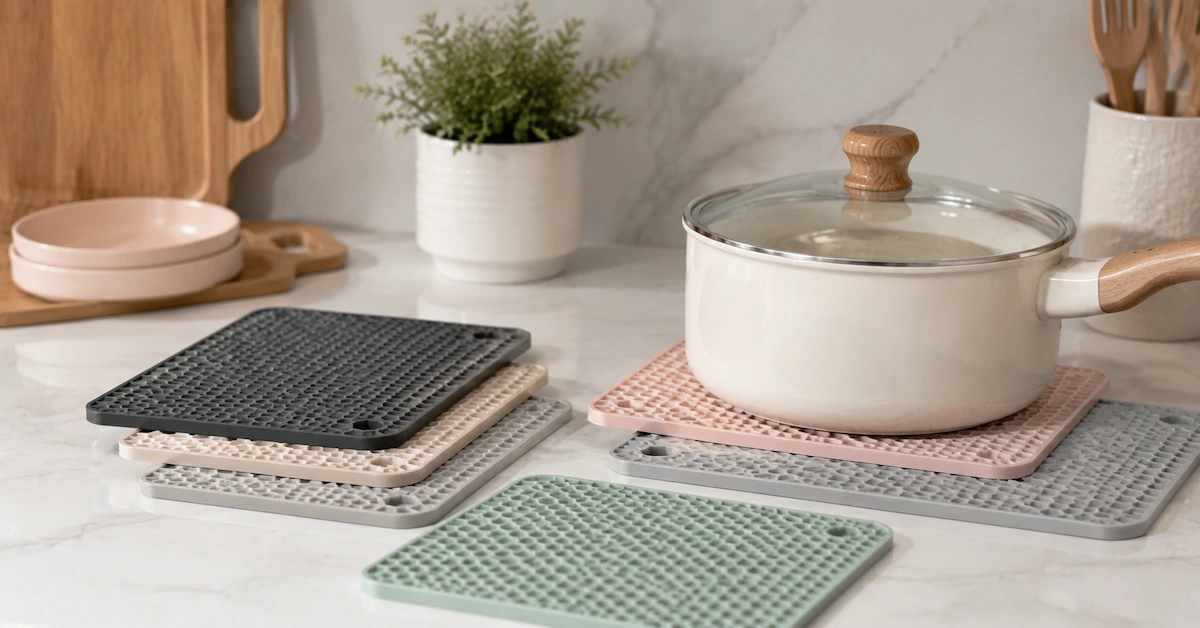
The visible structure matters. A rectangular format is practical because it fits shelves, counters, and appliance footprints more easily than decorative shapes. Rounded corners help reduce curling and make the mat feel more finished. The raised honeycomb or dimple-like texture is not just styling; it is the feature that gives the surface its grip. The available colors in the product imagery, including black, beige, gray, pink, and mint, also suggest this product is being treated as both a utility item and a consumer-facing kitchen accessory.
Quick buyer checklist before you compare suppliers
If you are sourcing from a silicone anti slip mat supplier or a non slip silicone mat supplier, the first comparison should not be the photo. It should be the specification set. Even when exact data is not yet fixed, buyers should ask for clarity on the following points:
Surface texture: Is the grip created by a molded honeycomb pattern, dimples, ribs, or another texture? The pattern affects both appearance and performance.
Form factor: Is the mat thin and flexible, or slightly stiffer? Thin mats are easier to store; stiffer mats may lay flatter.
Edge design: Rounded corners and clean edges usually indicate better finishing and fewer storage snags.
Storage feature: A hanging hole or corner hole can matter more than expected for retail and kitchen organization.
Color control: Multiple colors are useful for merchandising, but they also reveal whether the supplier can keep appearance consistent across batches.
Intended use: Trivet, countertop protector, drying mat, liner, or general anti-slip surface. One mat can do several jobs, but only if the material spec supports that claim.
Materials and molding: what to ask, even if the catalog is vague
Based on the product style, these mats are likely produced from molded silicone or a silicone-like elastomer. The exact process is not confirmed from the available data, so it is better to treat any process claim carefully. Still, in this category, compression molding and injection molding are both common routes. The important thing for the buyer is not the molding label itself, but whether the process delivers a clean surface, uniform texture, and repeatable thickness.
Silicone is popular here because it usually combines flexibility, heat tolerance potential, and a naturally grippy feel. That said, not every soft mat is equal. Some suppliers use a material blend that looks similar but behaves differently under heat, weight, or cleaning. If the product will sit near stovetops, dishwashers, or frequent wiping, ask the supplier how the material holds up over time. Also ask whether the matte surface stays presentable after repeated use, because glossy wear can make a product look tired very quickly.
Why finish matters as much as function
In kitchenware sourcing, buyers sometimes focus only on anti-slip claims. That is a mistake. A mat with good grip but a cheap-looking finish may still be rejected by retailers or end users. The matte appearance seen in the product style is useful because it reads as practical and modern. It also tends to hide light smudging better than highly polished surfaces. For private-label programs, this can be a quiet advantage.
How to judge supplier quality without overcomplicating it
The best way to compare suppliers is to separate what can be seen from what must be verified. Visibly, this product line offers rectangular mats with rounded corners, textured surfaces, multiple colors, and at least one storage hole. Those are easy to confirm in samples and photographs. Less visible items, such as food-contact compliance, dishwasher safety, temperature resistance, and hardness, should be requested in writing rather than assumed. A buyer who skips that step may discover the gap too late, especially if the mat is going into a retail channel or being bundled with cookware.
Ask for sample consistency across colorways. A supplier who does a nice black mat but struggles to match beige or mint may still be developing process control. Also check whether the mat lays flat after unpacking. Curling corners are a common complaint in this category, especially when the material is thin. The practical test is simple: place the mat on a smooth counter and see whether it stays put under light sideways pressure.
Common mistakes buyers make with anti-slip kitchen mats
One mistake is buying a mat that looks like a trivet but never confirming heat expectations. Another is assuming all silicone surfaces grip equally well on wet countertops. They do not. A textured surface can help, but water, oil, and fine dust all reduce real-world performance. If the mat will be used under jars, bowls, or cutting boards, the supplier should understand the specific substrate it must grip.
Another frequent issue is underestimating storage needs. The visible hanging hole is not a decorative extra. For retail packaging or home storage, that small detail can make the product feel thought through. On the other hand, a hole placed poorly can weaken the corner or interfere with stacking. It is the sort of detail that only shows up when someone has actually handled the product.
Finally, do not let color options distract from dimensional control. A nice palette helps merchandising, but it does not fix poor texture or weak molding. Buyers sometimes discover that the “pretty” SKU sells first, then the functional complaints arrive afterward. That is an expensive lesson.
What sourcing teams should request from a supplier
Even when the supplier is not yet giving full technical documentation, a serious sourcing conversation should include sample confirmation, material description, intended application, and the exact visual features that matter to your channel. For this product type, that means asking for the surface pattern, the edge profile, the storage hole placement, and whether the mat is meant for countertop protection, anti-slip use, or general kitchen support.
If the mat is going into OEM or private-label supply, ask how logo placement or packaging could be handled without compromising the flat surface. In this category, branding should usually stay away from the active grip area. A print that looks harmless on a screen can become a weak point on the mat itself.
Practical buying advice for kitchenware and tabletop programs
For restaurant buyers, simplicity is usually best. A dark color such as black or gray tends to hide wear and blends into service environments. For retail, lighter tones or pastel shades can work well, especially if the packaging explains the use clearly. For home goods brands, a narrow set of colors often performs better than a wide one, because the product is utility-driven and too many options can muddy the line.
Also think about how the customer will understand the product. If you need it to function as a non-slip mat, a counter protector, and a pot rest, the listing and packaging should not bury that. Buyers want a single clear use first, then any secondary uses as a bonus. That is often what separates sell-through from confusion.
FAQ for sourcing teams
Is a silicone non slip mat the same as a trivet?
Not always. Some mats can do both jobs, but not every product is designed or tested for direct hot cookware contact. Confirm the intended use before assuming heat resistance.
Can it be used on smooth countertops?
Usually that is the point of the product, but real grip depends on texture, surface cleanliness, and the weight of the item being held.
Why do suppliers emphasize the texture pattern?
Because it is one of the few visible features that directly affects performance. In this category, the texture is not decoration.
What should be checked in a sample?
Flatness, grip, corner finishing, hole placement, flexibility, and whether the mat feels consistent across the entire surface.
A sensible next step
If you are shortlisting a silicone non slip mat supplier, start with one sample round and one clear use case. Do not ask the first sample to be everything at once. Decide whether the mat is primarily for anti-slip support, countertop protection, or warm-item handling, then judge the supplier on how well the product matches that job. A good supplier in this category will understand that the details are small only on paper. In use, they decide whether the mat earns a repeat order.
