




Stainless Steel Houseware Manufacturer: What Buyers Should Know
For retail, hospitality, private-label, and promotional buyers, choosing a stainless steel houseware manufacturer is not only about finding attractive products. The category must look clean, organize well on the counter, withstand frequent handling, and arrive with finishes protected through shipping. A knife block set, utensil stand, serving tools, scissors, and loose kitchen knives may appear simple, but each item raises sourcing questions about material confirmation, edge treatment, balance, assembly, packaging, and after-sales consistency.
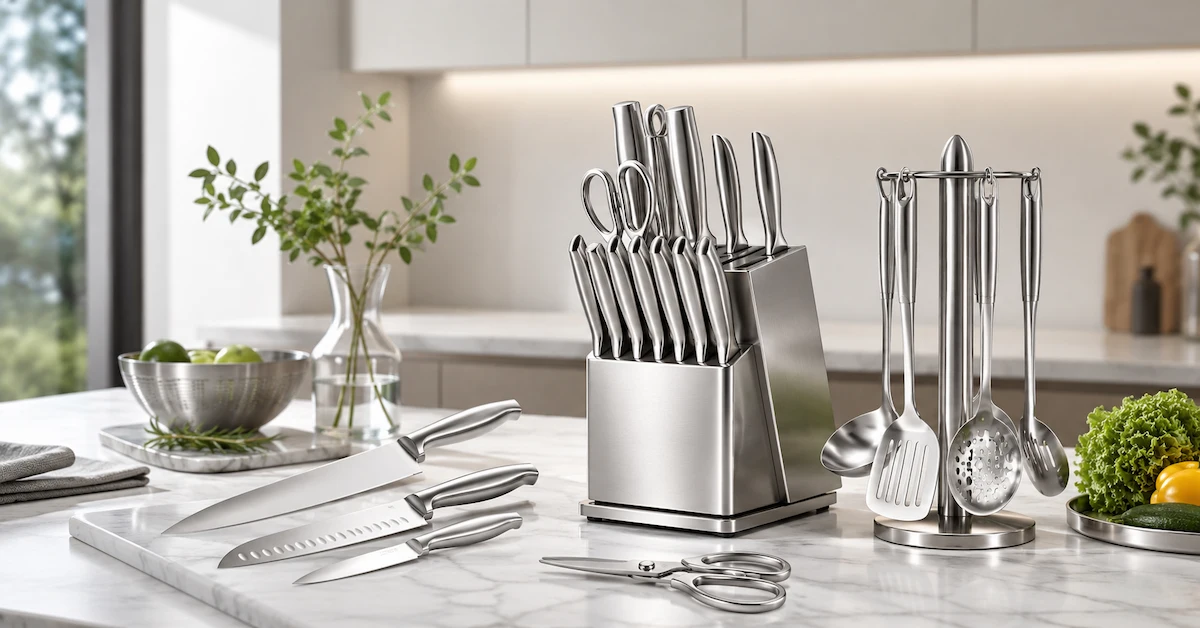
The product image below shows a coordinated countertop assortment rather than a single utensil. That matters because buyers are often comparing full houseware programs: knife storage, hanging or upright tool organization, and a consistent metallic finish across multiple pieces. The goal is to judge whether a supplier can support a practical range, not just produce one good-looking sample.
Key Takeaways
- Do not assume steel grade, dishwasher safety, or corrosion performance from photos; ask the supplier to confirm.
- Sample review should focus on finish consistency, edge smoothness, handle comfort, stability, and packaging protection.
- For OEM or private-label programs, clarify which elements can be customized before discussing cost or launch timing.
- The best supplier fit depends on the sales channel: home retail, hospitality, catering, or institutional use may require different priorities.
What the Product Mix Tells a Buyer
The visible assortment includes a knife block, upright utensil storage, long-handled tools, scissors, and knives. This suggests a kitchenware program designed around access and organization. A knife block is not simply an accessory; it affects counter footprint, stability, cleaning, and perceived value. A utensil holder or stand must keep tools accessible without tipping or crowding the work surface.
The surface appears to have a brushed or satin metallic look, a common choice for stainless steel household products because it can look clean and may be less visually harsh than a mirror polish. However, buyers should not treat appearance as proof of finish quality. Two products can look similar in a catalog but differ in scratch visibility, burr removal, weld quality, and how the surface looks after repeated washing and handling.
How Stainless Steel Houseware Is Commonly Produced
Manufacturing routes vary by product type and positioning. Stainless steel utensils are often formed from sheet metal through stamping and shaping, then finished through grinding, polishing, or brushing. Handles may be integrated, attached, welded, or assembled depending on the design. Knives may be stamped or forged depending on the supplier’s process and the intended market level, but buyers should ask directly rather than infer construction from a photo.
For sourcing teams, the important question is not whether one production method is always better. It is whether the process produces consistent edges, stable handles, balanced weight, and a finish that suits the target customer. A value retail program, a hotel kitchen, and a gift-oriented set may all require different compromises.
Buyer Checklist Before Requesting a Quote
Before comparing prices, buyers should collect enough information to compare suppliers on the same basis. The following checklist helps avoid unclear assumptions.
| Area to Check | What to Ask the Supplier | Why It Matters |
|---|---|---|
| Material | What stainless steel specification is used for each component? | Material affects cost, appearance, corrosion expectations, and buyer claims. |
| Finish | Is the surface brushed, polished, satin, or another finish? | Finish influences visual consistency, scratch visibility, and retail presentation. |
| Edges and joints | How are burrs, seams, and handle transitions controlled? | Rough edges create usability complaints and return risk. |
| Storage pieces | How stable are the knife block and utensil stand when loaded? | Countertop organization fails if the storage item wobbles or tips. |
| Packaging | How are surfaces separated and protected in transit? | Rubbing and scratches can damage sellable inventory before arrival. |
| OEM options | Which parts can be branded or customized? | Customization may affect tooling, artwork, packaging, and lead-time planning. |
Selection Criteria That Matter More Than Catalog Claims
A stainless steel kitchenware supplier should be evaluated through physical samples, not only digital images. Handle each piece and check for balance. A ladle that feels too top-heavy, a turner that flexes excessively, or scissors with a loose pivot will create customer dissatisfaction even if the set photographs well.
Look closely at the working ends of utensils. The edge of a spoon, turner, or ladle should feel smooth enough for repeated handling. Check the transition between handle and head, especially where parts are joined. For knives, ask how blade construction, handle attachment, and sharpening are controlled, but avoid making performance claims unless the supplier provides verified details.
Packaging deserves equal attention. Knife blocks and utensil stands can rub against metal tools during transport if inner packing is weak. Buyers should ask for packing photos, carton drop-test information if available, and a sample shipped through a realistic route when order value justifies it.
OEM and Private-Label Sourcing Questions
For OEM or private-label buyers, customization should be discussed in practical terms. Branding may be possible on handles, blocks, inserts, hang tags, color boxes, or outer cartons, but the available options depend on the product structure and supplier capabilities. Do not assume every metal part can be modified without tooling impact.
- Ask which components are existing designs and which require new tooling.
- Confirm whether logos can be applied to metal, wood-like storage pieces, packaging, or labels.
- Request the supplier’s artwork requirements and approval process.
- Clarify minimum order quantity, sample cost, lead time, and packing method directly with the supplier.
- Ask what quality checks are performed before shipment and what records can be shared.
Common Mistakes When Comparing Manufacturers
One common mistake is treating all stainless steel products as interchangeable. The term “stainless steel” is broad, and this article does not confirm a specific material grade for the pictured assortment. Buyers should request written material details for each item, especially when making durability, cleaning, or compliance-related decisions.
Another mistake is buying mainly on appearance. A set may look coordinated but still be awkward to use if the handles are slippery, the holder is unstable, or the knife block is difficult to clean. For hospitality and foodservice buyers, these details become operational problems. For retail buyers, they become reviews, returns, and weak repeat orders.
A third mistake is ignoring assortment fit. The best mix for home retail may differ from the best mix for a catering supplier. Some buyers need a full countertop set for visual merchandising; others need open-stock utensils for replenishment. The supplier conversation should start with channel, user, and packaging format.
How to Review Samples Efficiently
A simple sample review can reveal most early risks. Inspect the surface under normal room light, not only bright studio light. Run a finger carefully along edges and handle transitions. Place the knife block and utensil stand on a flat counter and test whether they feel stable when items are inserted and removed. Wash and dry samples according to the supplier’s stated care guidance, then check for marks, looseness, or finish changes.
Keep notes by SKU rather than relying on general impressions. If multiple suppliers are being compared, use the same review form for each sample set. This makes discussions about improvement more specific and reduces the chance of choosing a supplier based only on the lowest quoted price.
Practical FAQ
Can buyers assume the products are dishwasher safe?
No. Dishwasher suitability should be confirmed by the supplier for the exact product construction, including handles, blocks, coatings, labels, and any mixed materials.
Is brushed stainless steel better than polished stainless steel?
Neither is always better. Brushed finishes may hide light handling marks more easily, while polished finishes may suit certain retail presentations. The right option depends on use case and brand positioning.
What should be checked first in a knife block set?
Check block stability, knife fit, handle comfort, edge finish, packaging protection, and whether the set layout is easy for the intended user to understand and maintain.
What information should an OEM buyer request early?
Ask for material confirmation, available customization areas, artwork requirements, packaging options, sample timeline, MOQ, lead time, and quality-control documentation the supplier can provide.
Next Step for Buyers
When shortlisting a stainless steel houseware manufacturer, move from appearance to evidence. Use the product mix as a starting point, then verify material details, finish standards, storage stability, packaging protection, and customization limits. A strong sourcing decision comes from comparing samples against the exact sales channel and user environment, not from catalog images alone.
