




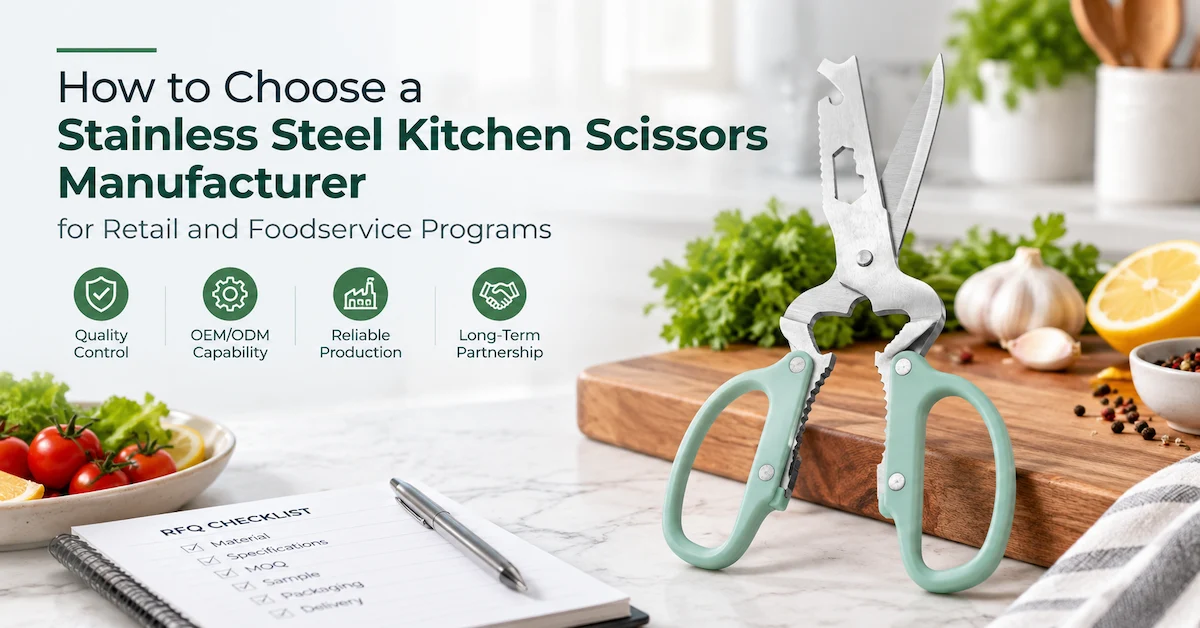
Quick Answer:
A stainless steel kitchen scissors manufacturer should be compared on the exact blade material declaration, heat-treatment route, grinding and blade-pairing controls, pivot construction, handle assembly, cleaning, corrosion plan, packaging and repeat-order records. Buyers should not accept the words “stainless steel” as a complete specification. Request evidence for the selected SKU, approve a physical sample against defined cutting and appearance checks, and keep the released material, artwork and carton files together.
Introduction: Stainless Steel Is a Starting Point, Not a Complete Buying Specification
An importer can receive five quotations that all say “stainless steel kitchen scissors” and still be looking at five different products. The blades may differ in thickness, edge geometry, surface treatment and contact along the cutting path. One pair may use a simple fixed joint; another may be detachable. Handles may differ in resin, texture, opening size and assembly method. The retail packs may protect the tips in different ways. A price comparison becomes meaningful only when those differences are written down.
This guide is for kitchenware brands, distributors, supermarket buyers, foodservice suppliers, promotional companies and e-commerce importers. Its primary intent is commercial investigation and supplier comparison. The practical question is not “Who sells scissors?” It is “Which manufacturer can explain and reproduce the blade, pivot, handle, test and package that my market requires?” That question leads to better samples, clearer quotations and fewer surprises after shipment.
BONET HOUSEWARE is the entity used for the evidence examples in this guide. Its public range includes all-purpose scissors and related kitchenware, while its OEM/ODM page describes work from a drawing or sample, material and color choices, logo methods, packaging customization, sampling, quotation, production and inspection. The supplied ISO certificate covers production and sale of scissors. Those facts support a manufacturer discussion; they do not establish the grade, hardness, test result or commercial terms of an unspecified model.
What Is a Stainless Steel Kitchen Scissors Manufacturer?
A stainless steel kitchen scissors manufacturer is a production entity that converts a defined blade material and other components into an assembled pair of kitchen scissors, then controls the result through operations such as forming, heat treatment where applicable, grinding, finishing, cleaning, handle production or fitting, pivot setting, inspection and packing. The word manufacturer should refer to actual process responsibility, not merely to a trader that can forward a catalog. A buyer should therefore ask which work happens at the named site and who controls any external operation.
The product is also more than two metal blades. A complete buying specification can include the blade pair, edge type, serrated zone, tip, pivot or fastener, washers, spring or lock if present, molded or overmolded handles, added tools, logo, retail pack, insert, labels and master carton. The intended application might be household preparation, opening food packs, herbs, poultry work, restaurant supply, a gift set or a branded promotional program. Each use changes the evidence that matters.
| Entity question | What a useful answer contains | What remains project-specific |
|---|---|---|
| Who sells and signs? | Brand, legal entity, sales contact and quotation entity | Contract party and payment details |
| Where is production controlled? | Site address and internal versus external processes | Selected-model production route |
| What is manufactured? | Scissors category, relevant equipment and process ownership | Blade, handle, pivot and package for the SKU |
| Which material is proposed? | Material family plus available declaration or certificate | Exact grade, source, finish and acceptance rule |
| Who uses the product? | Household, retail, foodservice, gift or promotional context | Destination requirements and claim language |
The Real Procurement Risk Behind the Word Stainless
“Stainless” names a family of steels. It does not promise that a finished pair will resist every stain, keep its edge under every task or tolerate careless storage. In practice, the result changes with the steel selected for that model, the factory route, the final surface, the edge and pivot, how the scissors are washed, and whether moisture is trapped in the pack. Two products bearing the same grade description may therefore feel and age quite differently. An uneven grind, a loose joint or residue left before packing can matter as much to the buyer as the grade printed on a sheet. That is why the useful discussion covers the complete product and its production history.
The opposite mistake is choosing a familiar grade before anyone has described the work. A specification can look impressive and still spend money in the wrong place. Start instead with the cuts the user makes on an ordinary day. Note the likely frequency, the cleaning routine, the finish the retailer will accept and any claim planned for the pack. The factory can answer that practical brief with a proposed material and process. The buyer then has something concrete to sample, question and either approve or reject.
Step 1: Define the Cutting Work, User and Cleaning Route
Begin with an ordinary sentence that a sample technician can understand. For example: “This pair will be sold through supermarkets for opening food packaging, trimming herbs and light household preparation.” A restaurant distributor may write a different sentence, including repeated handling, frequent washing and storage in a busy preparation area. Poultry shears, general-purpose scissors and a compact gift-set pair should not share one vague description.
List representative materials the sample must cut and materials it is not expected to cut. The list might contain herbs, thin food pouches, cooking twine or a buyer-provided reference material. If bone, shell or heavy packaging is expected, state it plainly and let the supplier respond before testing. Add the hand size, left- or right-handed expectations, opening-force concern, detachable-blade preference and any lock or guard. These details determine geometry and safety boundaries.
Cleaning deserves its own line. Hand washing, occasional rinsing, detergent exposure, a dishwasher route and prolonged wet storage are not equivalent. Do not claim dishwasher safety or food-contact compliance unless the project has the evidence required for that claim. Instead, describe the intended cleaning environment and ask what material, joint and surface route the supplier proposes. The final care instruction should match what was actually reviewed.
| Application input | Buyer should state | Supplier should return |
|---|---|---|
| Cutting work | Reference materials, frequency and excluded tasks | Proposed model, edge and limitations |
| User | Household, foodservice, store staff or gift recipient | Handle size, grip and opening recommendation |
| Cleaning | Hand wash, detergent, rinse, drying and storage reality | Material and care proposal plus test options |
| Channel | Retail shelf, distributor case, e-commerce parcel or set | Pack, retention and carton proposal |
| Market | Destination country or region and planned claims | Documents and open compliance questions |
Step 2: Turn “Stainless Steel” into a Traceable Material Request
Ask the supplier to write the exact material proposed for the blade rather than copying a generic catalog phrase. If the grade is important, request the grade or applicable material designation and identify the evidence that will accompany the approved sample or order. If the buyer is open to a supplier proposal, say so and describe the performance target. Either route is better than leaving the word “stainless” undefined.
Material evidence can take several forms: a supplier declaration, incoming material record, mill certificate, test report or another document agreed by the quality teams. The right document depends on the risk and commercial arrangement. The critical discipline is linkage. The record should connect to the material batch or SKU under review rather than sit in a folder as an unrelated example. Ask how receiving personnel identify and separate material before it reaches stamping or another forming step.
Surface finish must be named separately from material identity. A polished, brushed, coated or otherwise treated surface changes appearance and may change how scratches, marks or residues are seen. Establish a visual reference under agreed lighting. Define whether minor grind lines, water marks, polishing variation or fingerprints are acceptable. A material certificate will not answer an appearance dispute, and a beautiful sample photograph will not prove material identity.
Step 3: Review Stamping, Heat Treatment and Blade Formation
The supplied BONET manufacturing information lists stamping, straight adjustment, heat treatment, rough grinding, water grinding and polishing among its scissors processes. A buyer can use that published sequence to ask product-level questions. Which blank belongs to the selected model? When is flatness checked? Does the model require a heat-treatment operation, and what evidence is retained? Which dimensions are controlled before grinding begins? The answers should refer to the proposed scissors, not only to factory capability in general.
Heat treatment can affect hardness, toughness, distortion and grinding behavior, but a useful inquiry does not invent a target number. Ask the supplier to propose the parameter or hardness range appropriate to the chosen material and task, then agree how it will be verified if the project requires verification. A single hardness value without location, method, sample plan or tolerance is difficult to interpret. The buyer should also ask what happens when a result is outside the approved range.
Flatness and straightness matter because two blades must meet in a controlled way as the handles close. A blank that is distorted can create a gap, heavy friction or uneven contact. Ask where straight adjustment occurs and how personnel decide that the blade can proceed. If a fixture or gauge is used, request a description. For a development model, compare the first pieces with the drawing and retained sample before committing to a larger batch.
Step 4: Inspect Grinding, Edge Geometry and Blade Pairing
Kitchen scissors cut through the relationship between two blades. Sharpness on one blade is not enough. The edges must be prepared for the intended material, and the blades must contact correctly from heel toward tip. Ask how rough grinding and water grinding are separated, how burrs are handled and how edge consistency is judged. If one blade is serrated, specify the serrated location and purpose instead of using “serrated” as a decorative feature name.
A sample review should include slow opening and closing. Listen and feel for rough spots. Look at the contact path, tip alignment and any visible gap. Then cut the agreed reference materials at more than one location along the blade. Record whether the sample folds, pushes, snags or cuts cleanly. The buyer does not need to pretend that this simple check is a laboratory test; it is a practical comparison that can be repeated across supplier samples.
For formal performance claims, write the method before requesting a number. State the material being cut, its condition, the cut length, number of cycles, observation and failure rule. A result from an unknown medium or an undisclosed method cannot be compared with another result. If an external laboratory is needed, name the standard or protocol and confirm the sample identity. Test data becomes procurement evidence only when the model and method are visible.
| Blade control | Sample question | Possible evidence |
|---|---|---|
| Blank identity | Is this the approved material and model revision? | Batch or incoming record linked to SKU |
| Straightness | Do the blades sit and travel as intended? | Fixture check, first-piece record or sample comparison |
| Edge preparation | Which surfaces are ground and how is burr controlled? | Process description and visual reference |
| Blade pairing | How is contact checked from heel to tip? | Assembly check and retained sample |
| Cut result | What material, motion and pass rule apply? | Buyer-approved method and recorded result |
Step 5: Evaluate the Pivot, Handle and Added Functions
The pivot controls opening feel, blade contact and play. Too loose can create separation; too tight can make the tool tiring or hide roughness during a brief inspection. Ask whether the joint uses a rivet, screw, bolt or detachable construction and how its setting is controlled. A buyer-approved sample should capture the acceptable feel. If a numeric torque or force is required, define the instrument, location and range rather than asking for “good tension.”
Handle material and geometry affect comfort, cleaning and appearance. Request the intended resin or other handle material for the selected model and the actual color reference. Check the opening size, finger contact, texture, flash, gate mark, parting line, cracks and the place where the molded part meets the metal. A handle shown in a rendering can look correct while feeling entirely different in use, so approve a physical sample.
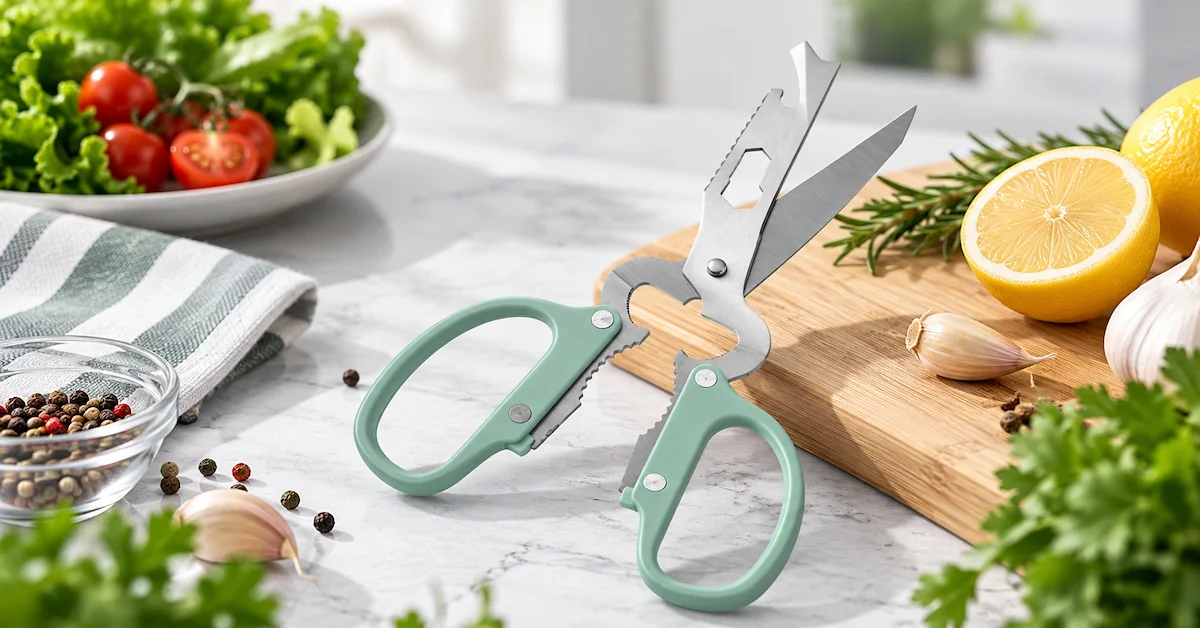
Added functions create added inspection points. A bottle opener, nut-cracking section, herb stripper, bone notch, fish-scaling feature, magnet, sheath, lock or detachable joint should each have a stated purpose and sample check. Decide whether the feature is required, optional or merely a styling element. Claims on the package must stay within the work that was actually evaluated. A multifunction silhouette is not evidence that every function suits every food or commercial environment.
Step 6: Build a Corrosion, Cleaning and Residue Plan
Corrosion review starts by describing exposure. Is the concern normal household hand washing, detergent, salt-containing food, wet storage, humid shipping or another condition? Ask the supplier what material and finish are proposed for that route. Then agree the test or observation method, sample preparation, duration, evaluation area and acceptance rule. A statement such as “salt-spray tested” is incomplete without the method, exposure, result and model identity.
Cleaning before packing also matters. Grinding and polishing compounds, metal particles, water marks or detergent residue can affect appearance and customer confidence. Ask what cleaning stages occur, how pieces are dried and how clean product is kept separate before packing. The supplied process context mentions ultrasonic cleaning and final cleaning; the selected model still needs its own confirmed route and inspection points.
Packaging can create a false corrosion problem. Moist board, trapped humidity, an incompatible film or contact with another metal component may mark a blade after it has passed factory inspection. Discuss the retail insert, blade cover, bag, desiccant if proposed, master carton and storage assumptions as one system. Any chemical or food-contact claim for the packaging must be supported separately; do not infer it from a clean appearance.
| Evidence request | Minimum information to record | Why it matters |
|---|---|---|
| Material statement | SKU, component, grade or material description, issuer and date | Connects the claim to the actual blade |
| Hardness or treatment result | Method, location, units, range, sample and date | Makes a number interpretable |
| Corrosion observation | Exposure, duration, preparation, acceptance and photos | Prevents incomparable “rust proof” claims |
| Cleaning record | Process stage, chemistry where relevant, rinse/dry and check | Reduces residue and water-mark disputes |
| Pack condition check | Material, retention, moisture assumptions and carton route | Links product finish to shipment reality |
Step 7: Compare MOQ, Cost and Lead Time by Their Real Drivers
MOQ is not one universal number. The metal part may have an efficient batch, the handle color another, and the printed card or color box a separate print minimum. A custom mold, insert or special fastener can add a tooling or component threshold. Ask for minimums by model, blade route, handle color, logo version and packaging version. This makes it possible to reduce launch complexity without pretending that every layer can share one minimum.
Request price at quantities the business can actually buy. Separate the base scissors, logo, retail pack, insert, assembly, testing, inspection, carton, pallet and freight basis. Record one-time charges apart from recurring cost. If a material or test choice is still open, show it as an assumption rather than burying uncertainty in a single price. A transparent quote is easier to update and easier to compare.
Lead time also needs an anatomy. Ask for sample timing, artwork approval, packaging proof, material preparation, production, inspection, packing and logistics handoff. Seasonal programs should work backward from the required arrival, not forward from a factory-ready estimate. Because no current SKU-specific timing is supplied in the evidence base, this article does not publish a generic promise. The project calendar belongs in the signed quotation or order plan.
| Commercial layer | Question for the manufacturer | Decision it supports |
|---|---|---|
| Product MOQ | Minimum per model and blade construction? | Pilot size and inventory exposure |
| Color MOQ | Minimum per handle color or resin batch? | Range width and replenishment plan |
| Packaging MOQ | Minimum per printed artwork and structure? | Private-label economics |
| Setup/tooling | Which costs occur once and which repeat? | Lifetime cost comparison |
| Schedule | What starts after sample and artwork approval? | Launch plan and risk buffer |
| Logistics | What trade term, carton dimensions and gross weight apply? | Landed-cost comparison |
Step 8: Approve the Sample, Packaging and Production Release
Give every sample a model, revision and date. A first appearance sample may not use production-intent material or tooling, so label its purpose. A later functional sample should prove the blade pair, pivot, handle and added functions. A branded sample checks logo position and appearance. A production-intent packed sample connects the tool to the retail unit and carton. One word, “approved,” should never silently cover all four stages.
Write an approval sheet while the sample is on the table. Photograph the closed, open, side and packed views. Record dimensions, color reference, surface, pivot feel, agreed cuts, appearance limits, logo, pack retention, label and barcode. Note any temporary difference and its owner. If the final material or print is unavailable, do not treat a substitute as full production approval. The file should tell a colleague what still needs to close.
Production release happens only when the quotation, product specification, approved sample, artwork, packaging file, inspection plan and shipping marks agree. Check the revision on each document. A late barcode or color change may affect both sample approval and schedule. Ask the manufacturer to acknowledge the released file set in writing and to raise any proposed change before using it. Silence is not a change-control system.
Step 9: Protect Reorders with a Golden Sample and Change Record
The second order is where supplier discipline becomes visible. Keep a retained sample or clearly identified golden sample, the blade and handle specification, material record, artwork, packaging dieline, barcode, carton plan, inspection method and test references together. When purchasing writes “same as last order,” the supplier should be able to identify the exact revision rather than rely on a sales photograph.
Ask the factory to declare changes in material source, heat-treatment route, blade finish, pivot hardware, handle resin, mold, logo method, packaging supplier or carton count. Not every change requires a full restart, but every meaningful change needs an impact review. The buyer can request a sample, limited test or documented deviation based on risk. The important thing is that the decision occurs before shipment.
Use complaints to improve the master record. If a blade stains, document the location, cleaning history, pack condition and lot. If the pair pushes material instead of cutting, compare contact and edge with the retained sample. If a handle cracks, record the mold area and use conditions. A useful corrective-action response contains containment, investigation, cause, correction and evidence that the correction worked.
How BONET Manufacturing Evidence Fits the Buyer Checklist
BONET publicly describes a scissors-related process that includes stamping, straight adjustment, heat treatment, rough grinding, water grinding, polishing, injection, ultrasonic cleaning, setting, quality checking, final cleaning and packing. The supplied ISO certificate scope is production and sale of scissors. Together, those items provide a credible starting point for a factory conversation. They do not remove the need to confirm which steps, material and controls apply to the chosen SKU.
The useful buyer move is to convert each public capability into a model-specific question. Where is the selected blank identified? What record follows heat treatment? How is the blade pair checked after grinding? What controls handle color and assembly? Which cleaning stage occurs immediately before packing? Who approves an exception? A supplier that can answer in the language of the actual model gives procurement more value than one that sends another general brochure.
| Public evidence | Supported statement | Do not infer without confirmation |
|---|---|---|
| ISO 9001:2015 certificate | Certified scope includes production and sale of scissors | Specific grade, hardness, corrosion result or market approval |
| Manufacturing page | Lists relevant forming, grinding, cleaning and inspection operations | Every operation applies identically to every model |
| OEM/ODM page | Describes sampling, customization, quotation, production and packaging | Any particular MOQ, lead time or tooling price |
| All-purpose scissors page | Shows a relevant product and commercial category | Final dimensions, steel grade or test performance |
| BSCI record | Provides audit-date site and process context | Current commercial capacity or confidential findings |
Supplier Comparison Scorecard for Stainless Steel Kitchen Scissors
Score only after all candidates receive the same brief. Give more weight to evidence than to fluent claims. A supplier that asks about the cutting material, washing route and package may be more useful than one that immediately promises the best steel. Keep commercial terms separate from technical confidence so a low price does not erase a missing sample record. The final award can then balance risk, margin and launch timing transparently.
| Score area | Suggested weight | Evidence to compare |
|---|---|---|
| Product fit | 20% | Task, geometry, handle and limitations match the brief |
| Material and process evidence | 20% | Traceable proposal and model-specific process answers |
| Sample performance | 20% | Cutting, pivot, appearance, cleaning and pack results |
| Quality and change control | 15% | Inspection route, records, containment and revision handling |
| Commercial structure | 15% | MOQ layers, transparent price, setup and logistics basis |
| Communication and schedule | 10% | Clear owners, assumptions, approvals and timing logic |
Incoming Material and Lot Traceability Questions
Sample approval answers one question, but the purchasing team still has to connect later production with what it approved. Ask the factory to walk through an incoming delivery of blade stock. Where is the supplier or batch reference written down? How do operators avoid drawing from the wrong stack? Who stops the material when the receiving record disagrees with the purchase requirement? A small order does not need an elaborate speech. It does need a traceable answer that lets the team retrieve the relevant record after a complaint.
Traceability does not always mean printing a metal batch number on every pair. It can mean linking the finished lot, production traveler, incoming record and purchase document through a controlled internal reference. Ask where that link begins and where it can be lost. If several models use similar blanks, find out how workers separate them. If a material source changes, require review before the change reaches the production line.
The buyer also needs a sensible retention plan. Decide which records are required with the shipment, which stay at the factory and how long they remain available. A private-label program may retain a declaration and approved sample, while a higher-risk claim can require more. The record list should be agreed before the order, because reconstructing material evidence after a complaint is slower and less reliable.
Receiving Inspection at the Buyer Warehouse
Factory inspection is not the last opportunity to protect the program. When cartons arrive, receiving staff should confirm the purchase order, SKU, color, carton count, labels and visible shipping condition before product is mixed into inventory. Open representative cartons using the buyer sampling plan. Compare the pair, logo, package and carton marks with the released file and retained reference. Record the lot so any finding can be traced.
A receiving check should separate transport damage from manufacturing defects. A crushed card, shifted insert or wet carton can affect a sound pair of scissors. A loose pivot, mismatched blade, molding crack or incorrect logo points elsewhere. Photograph both the product and the pack before moving components. This distinction helps the supplier contain the right material and prevents a packaging complaint from being counted as a blade failure without investigation.
Do not improvise a destructive test on saleable stock unless the plan allows it. If cutting, corrosion or cycle checks are required at receiving, define the sample quantity, method and disposition in advance. Keep the result with the lot. When a failure occurs, quarantine the affected inventory, describe the defect in observable language and send the supplier enough evidence to begin containment rather than only stating that quality is bad.
Illustrative Buying Scenario: Comparing Two Stainless Scissors Offers
Consider an illustrative supermarket buyer seeking a general-purpose pair with a branded card. Supplier A quotes a lower unit price but does not identify the blade material, includes one mixed MOQ and shows a catalog photograph. Supplier B proposes a material direction, separates product and printed-card minimums, explains its sample stages and identifies the carton assumptions. This is not a BONET customer case; it is a procurement example showing why headline price can hide scope.
The buyer sends both suppliers the same cutting tasks, dimensions, color reference, artwork status and order split. Supplier A revises its quote after learning that each color has separate packaging. Supplier B offers a standard handle color for the pilot and a custom color at the reorder volume. Once the quotes share the same basis, the apparent price gap becomes smaller, and the buyer can measure the inventory cost of customization rather than guessing.
Samples then reveal a second difference. One pair looks polished but pushes the buyer reference pouch near the tip. The other has plainer packaging, yet it cuts the agreed materials repeatedly and carries an unmistakable revision label. The buyer can correct the second supplier's pack without abandoning the sounder scissors. Price alone did not settle that decision. The sample record showed which shortcoming was inexpensive to correct and which one created the larger supply risk.
When the warehouse reports a problem, send a compact evidence pack rather than a chain of impressions. Include purchase order, SKU, lot or carton reference, received quantity, affected quantity, clear photographs, the exact location of the issue, care or handling information and the immediate containment taken. Ask the manufacturer to acknowledge the scope, check retained material and propose the next evidence. A disciplined report shortens the path from complaint to cause and also shows whether the released specification or inspection plan needs improvement.
Frequently Asked Questions
Which stainless steel grade is best for kitchen scissors?
No single steel grade wins every kitchen-scissors project. A buyer trimming retail packaging has a different duty cycle from a seafood counter, and each program brings its own edge, cleaning, corrosion, cost and labeling constraints. Ask which material the factory proposes for the actual model under review and what document or check supports that answer. Where the range must use a named grade, put both the designation and the agreed verification route into the RFQ before the sample is signed.
Should buyers ask for a hardness value?
Ask for hardness only when the value supports a defined engineering or quality decision. Record the method, unit, location, sample plan and acceptable range. A number copied from a catalog is less useful than a result linked to the approved material and model. Balance edge behavior with toughness and actual cutting results rather than selecting on one number alone.
Does stainless steel mean the scissors cannot rust?
No. The word stainless does not make a pair immune to every kitchen environment. Salt, food residue, washing chemistry, a damp pivot, the finish and storage conditions can all change what the user sees. Describe the expected use and cleaning routine in the brief, agree any relevant check with the factory, and avoid an absolute rust-proof claim unless the evidence for that exact product supports it.
What MOQ should a buyer expect?
MOQ must be quoted for the project. Separate product, handle color, logo, printed pack, insert and special component minimums. Ask for a pilot scenario and a normal reorder scenario. BONET materials available for this article do not provide one verified MOQ that can be stated for every stainless steel kitchen scissors model.
Can the manufacturer add a logo and private-label packaging?
BONET publicly describes logo printing or laser engraving and packaging customization within its OEM/ODM service. Feasibility depends on the selected surface, logo size, artwork, quantity and package. Request a marked sample and packaging proof, then keep the approved files and color references in the release record.
What should be checked before mass production?
Confirm the model and revision, blade material, finish, edge and contact, pivot, handle, functions, appearance limits, logo, packaging, labels, carton, test plan, inspection points, MOQ, price and timing. Approve the production-intent sample and require written review of any deviation. Do not release production from a catalog image alone.
Relevant BONET Product and Sourcing Links
Buyers comparing a stainless steel kitchen scissors supplier can begin with the relevant scissors product route. A stainless steel kitchen scissors factory review should then connect the model to manufacturing steps. Brand programs can brief OEM stainless steel kitchen scissors, custom stainless steel kitchen scissors and private label stainless steel kitchen scissors through the OEM/ODM workflow. Distributors sourcing wholesale stainless steel kitchen scissors should request case and carton data. Buyers evaluating a stainless steel kitchen scissors manufacturer China should confirm the legal entity and production route. Foodservice projects can contact a commercial stainless steel kitchen shears supplier with the actual cleaning and use case.
Conclusion: Buy a Controlled Product, Not a Material Buzzword
A reliable stainless steel kitchen scissors program joins product use, material identity, manufacturing control, sample evidence, packaging and reorder discipline. Define the work before asking for steel. Connect any material or hardness claim to a method and SKU. Watch the two blades work together, not only the shine of one blade. Approve the joint and handle in the hand, then verify cleaning and packing in the real sales route.
The final inquiry should give the manufacturer enough information to respond honestly: reference product or drawing, destination, buyer type, cutting tasks, cleaning route, material requirement or performance target, dimensions, functions, color, logo, packaging, quantities, test questions and required date. Ask the supplier to return assumptions and open points. That exchange creates the foundation for a usable quotation and a repeatable second order.
